
On this page
Start here
Quick answer
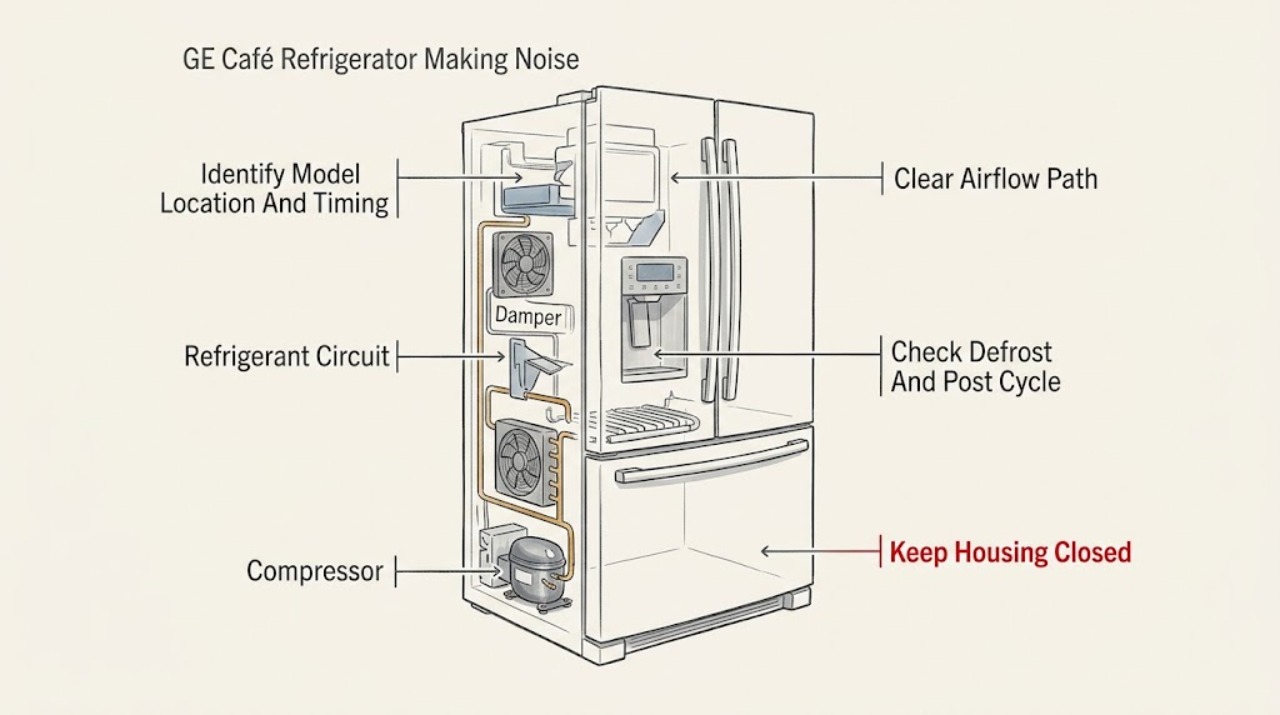
Start by recording where the sound comes from and when it occurs: after a door closes, during cooling, during defrost, during an icemaker fill or harvest, or when a dispenser is used. GE identifies many hums, fan-speed changes, clicks, refrigerant gurgles, defrost sizzling, and short icemaker or dispenser sounds as normal operating sounds on applicable refrigerators. A new persistent tap, scraping that follows a fan, or a fan blade striking something is not a normal pattern. On a model equipped with an icemaker, repeated buzzing when its water supply is off is a reason to switch the icemaker off using the model's normal control; do not reach into the mechanism. Check only visible installation vibration and loose items. Stop for smoke, a burning or electrical odor, sparks, a hot or damaged cord or outlet, water near electrical parts, repeated breaker trips, or a sound that requires removing a cover. Do not live-test, open panels, disturb the sealed refrigeration system, or order a part from noise alone.
Before you begin
Safety first
- Do not remove panels or grilles, reach into a powered fan or icemaker, touch a heater or valve, open the sealed refrigeration system, loosen water fittings, bypass protection, or perform live electrical tests. Stop for smoke, burning or electrical odor, sparks, abnormal heat, a hot or damaged cord or outlet, water near electrical parts, repeated breaker trips, or uncontrolled vibration.
Work through in order
Diagnostic checks
Use only checks that match the exact appliance or system and its official guide.
-
Check 1
Record the exact Café model from its rating label or model support page, then listen from a safe position without removing panels. Note whether the sound is in the fresh-food section, freezer, rear, underside, door, or dispenser area; whether it is constant or intermittent; and what operation immediately preceded it.
Expected result: The sound is a steady hum, a short click, a gurgle, a brief hiss or sizzle, a fan-like rush, a repeated buzz, a tap, a scrape, or a blade-contact sound, and it either follows a known cycle or has no clear trigger.
Next step: Continue with the branch matching the sound pattern and equipment. If the model label can only be reached by moving a built-in or wet appliance, stop and arrange model-specific help.
Stop if: Stop immediately for smoke, sparks, electrical odor, abnormal heat, a hot or damaged cord or outlet, water near electrical parts, or repeated breaker trips.
Why this matters
Why: Location and timing separate normal cooling, airflow, refrigerant, defrost, and water-system sounds from a changed mechanical pattern. The exact Café model determines whether an icemaker, dispenser, filter valve, or particular fan path exists; do not diagnose an accessory that is not installed.
-
Check 2
With the refrigerator closed and operating normally, compare the sound before and after one door opening. Listen from outside the cabinet for a compressor hum, fan-speed change, damper chirp or click, refrigerant gurgle, or a short change in airflow. Do not place a hand or tool into a vent or fan opening.
Expected result: The sound changes briefly after a door opening or temperature change and then settles; it is a water-like gurgle or brief click; or it is a continuous tap, scrape, or fan-blade strike that does not settle.
Next step: Monitor a sound that matches a documented cycle once. Escalate a persistent blade-contact, scraping, or unexplained tapping sound for qualified service without removing a fan cover.
Stop if: Do not reach into vents, remove an evaporator or condenser cover, or perform a live test to locate the sound.
Why this matters
Why: GE describes fan-speed changes, damper sounds, control clicks, and refrigerant boiling or gurgling as possible normal refrigerator operation. A persistent sound that tracks a fan or resembles a blade hitting an object is the unusual-noise branch, not a reason to wait for it to worsen.
-
Check 3
Record whether the noise appears only around a defrost period or after a power interruption. Observe from outside for a brief click, sizzling or hissing, cracking or popping, or a compressor restart sound; do not attempt to trigger defrost and do not touch the heater or rear components.
Expected result: The sound is brief and occurs during or just after defrost, a short gurgle follows a door close, or a compressor clicks for several minutes after power returns; alternatively, tapping continues between cycles or becomes louder.
Next step: Document a brief cycle-linked sound and monitor once. Arrange service if tapping continues outside defrost, the sound is accompanied by loss of cooling, or the pattern is not resolved without internal access.
Stop if: Do not remove panels, pour liquid into vents, touch a heater, or restart the appliance repeatedly after a power or breaker event.
Why this matters
Why: GE lists defrost dripping, sizzling or hissing, cracking or popping, door-related gurgling, and a limited post-outage compressor click as possible normal events. A changed sound that persists outside those conditions, especially a new tap, is not explained by the normal-cycle branch.
-
Check 4
Only if the exact Café model has an installed automatic icemaker, check its normal control or feeler-arm position from the user-accessible area. If the refrigerator is connected to water, note whether the buzz coincides with a fill cycle. If it is not connected to water or the supply is intentionally off, turn the icemaker off using the model's documented control; do not handle the ejector, mold, heater, or valve.
Expected result: The icemaker is absent; a short buzz occurs at a fill interval with water connected; a repeated buzz occurs while water is off; or the sound remains after the icemaker is disabled.
Next step: Leave an unconnected or repeatedly buzzing icemaker off and arrange model-specific service if the noise continues, water leaks, or the control cannot be safely identified. Do not assume every Café refrigerator includes this system.
Stop if: Never reach into a powered icemaker, force a feeler arm, disconnect water tubing, or live-test a valve.
Why this matters
Why: GE explains that an equipped icemaker or water valve can buzz or vibrate during filling, while an icemaker left on without water can repeat the sound. If the sound remains with the icemaker disabled, the icemaker branch becomes less likely and another fan, installation, or internal fault needs assessment.
-
Check 5
If the exact configuration has a water dispenser or a water filter system, note whether the sound occurs only while dispensing or near a filter-related fill event. Confirm that the filter and water connection match the model instructions from the support page, but do not loosen fittings or remove a housing while the unit is powered or wet.
Expected result: The sound lasts only during a normal dispense; a short valve-like buzz occurs at a water event; the dispenser or filter is not fitted; or a hum or vibration continues with no water operation.
Next step: Skip this branch on a non-dispenser configuration. For persistent or leak-associated water-system noise, stop using the affected function and arrange qualified service with the exact model and filter configuration.
Stop if: Do not disconnect a pressurized water line, open the dispenser or filter housing beyond the model instructions, or continue when water can reach electrical parts.
Why this matters
Why: GE lists a brief dispenser buzz and water-valve or filter-related vibration as possible operation sounds on applicable configurations. A sound with no water event, or one accompanied by leaks, abnormal heat, or persistent rattling, is not established as a normal dispenser sound.
-
Check 6
From a dry, safe position, check only visible causes of vibration: bottles or pans touching the cabinet, items on top, a cabinet or nearby panel resonating, and an unstable or obstructed installation. Do not pull the refrigerator, remove a rear grille, or access a fan. After one visible correction, listen once and record the result.
Expected result: The noise stops when a loose item is moved; it changes when a nearby surface is no longer touching; it remains unchanged; or it is accompanied by cooling loss, water, smoke, heat, sparks, or breaker trips.
Next step: Keep any simple visible correction and monitor once. Arrange qualified GE appliance service for a persistent, worsening, internal, or cooling-related noise and provide the model, location, timing, and recording. Use a qualified electrician for a confirmed house electrical hazard.
Stop if: Stop operation for smoke, burning or electrical odor, sparks, abnormal heat, damaged power parts, water near electrical parts, repeated breaker trips, or uncontrolled vibration. Do not restart merely to reproduce a dangerous symptom.
Why this matters
Why: A noise that changes with a visible item or adjacent surface is more consistent with vibration than a failed part, but recurrence should still be documented. An unchanged sound, fan-blade contact, or hazard symptom needs professional assessment; noise alone cannot identify a compatible replacement part.
Use your observations
Decision map
Find the observation that best matches what you see, then follow the next safe action.
-
PATH 01Safety boundary
What you see
The sound is a steady hum, brief click, airflow change, refrigerant gurgle, or short door/temperature-related sound that matches a cooling or control cycle and is not worsening.
Do this next
Record the cycle and monitor once. Escalate if the sound becomes constant, changes character, accompanies loss of cooling, or cannot be separated from a fan-blade strike.
Why this path and its safety boundary
Why it matters: GE describes these patterns as possible normal operation. The exact model still determines which fan, damper, dispenser, and water features apply, so a normal-sound label should not be extended to a different persistent noise.
Safety stop: Do not remove covers or perform live tests to prove a normal sound.
-
PATH 02Safety boundary
What you see
The sound is a brief sizzle, hiss, crack, pop, drip, or limited compressor click associated with defrost or power returning, then it stops.
Do this next
Monitor the next normal cycle without touching internal parts. Arrange service if the sound persists, the refrigerator does not resume cooling, or repeated power events are involved.
Why this path and its safety boundary
Why it matters: GE lists these as possible defrost or post-outage operating events. A tap or scrape continuing between cycles is less consistent with that explanation and should be serviced.
Safety stop: Do not touch the defrost heater, rear components, or energized wiring.
-
PATH 03Safety boundary
What you see
An icemaker or water system is actually installed, and the buzz occurs at an expected fill or dispenser event, or repeats while the icemaker's water supply is off.
Do this next
Turn the installed icemaker off through its documented user control when water is unavailable, then arrange service if buzzing remains, water leaks, or the exact control is uncertain.
Why this path and its safety boundary
Why it matters: On applicable GE configurations, the water valve or icemaker can make a short buzz or vibration. Repetition with water off points to an icemaker left enabled without a water path rather than proving a failed motor or valve.
Safety stop: Do not reach into the icemaker, force its arm, disconnect tubing, or live-test a valve.
-
PATH 04Safety boundary
What you see
The freezer or under-unit sound resembles a fan blade striking something, a continuous scrape, a new repetitive tap, or a rattle that remains after visible loose items are ruled out.
Do this next
Stop at external observation and arrange qualified GE appliance service, especially if cooling or airflow has changed. Provide a recording, location, timing, and exact model.
Why this path and its safety boundary
Why it matters: GE identifies fan-blade contact as an unusual refrigerator sound and says some tapping patterns may require service. The cause could be an obstruction or internal fan or mounting issue, but the sound does not justify removing a cover or selecting a part.
Safety stop: Do not remove evaporator or condenser covers, reach through a grille, or run a powered appliance with a suspected blade obstruction.
-
PATH 05Safety boundary
What you see
The noise is accompanied by smoke, burning or electrical odor, sparks, abnormal heat, a hot or damaged cord or outlet, water near electrical parts, repeated breaker trips, or an inability to stop the sound without internal access.
Do this next
Stop using the refrigerator from a dry, safe position and obtain qualified appliance or electrical service as appropriate. Do not attempt to reproduce the sound.
Why this path and its safety boundary
Why it matters: These are safety symptoms rather than a normal-sound diagnosis. Continuing to operate or repeatedly resetting protection can increase shock, fire, water, or equipment risk.
Safety stop: Do not touch wet electrical parts, pull a hot plug, bypass protection, open panels, or perform live measurements.
Helpful context
Understand the symptom
The timing is more useful than the volume
A Café refrigerator may change sound as its compressor, fans, damper, defrost system, water valve, or icemaker operates. Note whether the noise is inside the freezer, behind the refrigerator, under the cabinet, at a door, or at a dispenser, and whether it follows a door opening, cooling cycle, defrost period, or ice-making event. GE's Café support page confirms the brand and gives a model-specific manual for an example Café refrigerator, but it does not establish that every Café configuration has the same accessories or controls.
Normal operating patterns versus a changed pattern
A steady hum, a fan that changes speed after a door opening, a brief control click, refrigerant gurgling, or a defrost sizzle can fit GE's normal sound descriptions. Short buzzing, humming, rattling, or vibration can also be tied to an equipped icemaker or water-filter arrangement. A new repetitive tap, scraping that tracks a fan, or a freezer sound like a blade striking an object is a different result and should not be normalized just because the refrigerator still cools.
Keep the diagnosis external and de-energized
Do not reach through a grille toward a fan, icemaker, heater, or moving mechanism. If an owner-authorized external inspection or cleaning is needed, unplug from a dry, safe position first and follow the exact model manual. Never remove a cover, probe a live circuit, bypass a switch, or open the refrigerant system. Stop using the refrigerator for smoke, sparks, an electrical odor, abnormal heat, a damaged cord or outlet, repeated breaker trips, or water near electrical parts.
When checks do not resolve it
Need a professional?
Call qualified GE appliance service for a persistent or worsening tap, scrape, fan-blade contact, unexplained rattle, noise with cooling loss, or any sound that requires internal access. Service is also appropriate when an equipped icemaker or water-system buzz remains after its documented user control is turned off. Stop immediately for smoke, burning or electrical odor, sparks, abnormal heat, damaged power parts, water near electrical parts, or repeated breaker trips.
Safety scope: Do not remove panels or grilles, reach into a powered fan or icemaker, touch a heater or valve, open the sealed refrigeration system, loosen water fittings, bypass protection, or perform live electrical tests. Stop for smoke, burning or electrical odor, sparks, abnormal heat, a hot or damaged cord or outlet, water near electrical parts, repeated breaker trips, or uncontrolled vibration.
Have this ready
- Exact GE Café model, sound location, whether an icemaker, dispenser, filter, and water connection are installed, the timing relative to doors, defrost, dispensing, and power recovery, whether a visible item correction changed it, cooling or water symptoms, and a short recording if safe.
Common questions
FAQ
Is a humming or gurgling GE Café refrigerator always failing?
No. GE describes compressor and fan hum, fan-speed changes, damper and control sounds, and refrigerant gurgling as possible normal operation. Judge the sound by its location, timing, and change from the refrigerator's prior pattern; persistent scraping or blade contact is different.
Why does my GE Café refrigerator buzz every few minutes when the water is off?
If the exact model has an automatic icemaker and its water path is unavailable, GE says an enabled icemaker can buzz repeatedly while trying to fill. Turn that icemaker off using the model's documented control or feeler-arm arrangement, without reaching into the mechanism, and arrange service if the sound continues.
Can I remove the rear cover to see which fan is making the noise?
Do not remove a rear or evaporator cover for a live noise test. A suspected fan-blade strike, internal obstruction, compressor, control, or sealed-system issue needs qualified service; provide the exact Café model and a safe recording instead.
Read the exact guide
Official sources
- User Manual & Care for CFE26KP2NS1 | GE AppliancesGE Appliances · Exact opened Café model example; use the reader's exact Café model for controls, accessories, and manual procedures
- Refrigerator - Unusual NoisesGE Appliances · GE refrigerator unusual sound patterns; exact Café model controls and internal access remain model-specific
- Refrigerator - Normal Sounds and Noises MadeGE Appliances · GE refrigerator sound guidance; apply accessory-specific examples only when the Café model has that equipment
- Refrigerator - Buzzing NoiseGE Appliances · GE refrigerator buzzing guidance, including applicable XWF or XWFE filter configurations; verify the Café model
- Refrigerator - Intermittent Buzzing or Vibrating NoiseGE Appliances · GE refrigerator configurations with an automatic icemaker or applicable water-filter valve; verify equipment on the exact Café model
Community feedback
Share a repair observation
Share a plain-text repair observation. Accepted observations are published automatically; this page may take a moment to update.