
On this page
Start here
Quick answer
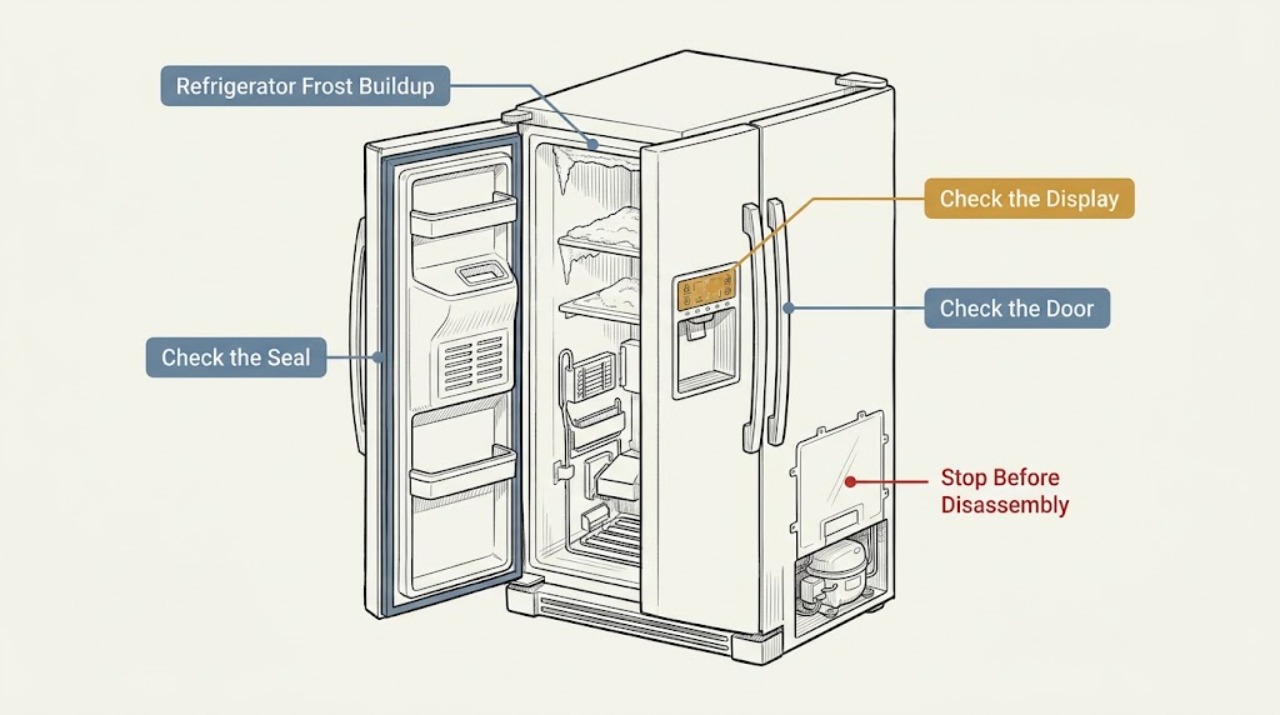
For frost buildup on a GE Eterna refrigerator, first identify whether the frost is a light layer on packages, a thick layer on the freezer walls, or an unusual concentration on one wall. Eterna is a discontinued legacy GE line, so the exact model manual matters more than the badge. Check that doors close fully, no package blocks the gasket or air duct, the refrigerator is level, and the temperature and room conditions match the manual. If the model is manual-defrost, follow its unplugged defrost procedure; if it is frost-free, do not manually dismantle the evaporator or defrost system. Frost that returns after sealing and external checks, remains heavily concentrated on one wall, or affects cooling needs qualified service.
Work through in order
Diagnostic checks
Use only checks that match the exact appliance or system and its official guide.
-
Check 1
Find the Eterna model and serial label and identify the frost location without removing panels. Inspect the freezer shelves, packages, walls, door opening, and visible air ducts; take note of whether the pattern is light and scattered, thick across a surface, or concentrated on one wall.
Expected result: Record whether the freezer still holds temperature, whether the fresh-food section is also affected, and whether the refrigerator is labeled frost-free or manual-defrost in the exact owner guide.
Next step: Use the exact model instructions for the next check. If the pattern is unusual, the cabinet is warming, or frost blocks a cover or door, stop before dismantling anything and arrange service.
Why this matters
Why: Light frost tied to a package or door opening has a different cause from heavy one-sided frost or frost that blocks airflow. The defrost method cannot be inferred from the Eterna name alone.
-
Check 2
Check the freezer and refrigerator doors externally: remove only packages that hold a door or gasket open, make sure bins and shelves are not overfilled, inspect the gasket for cuts or gaps, and verify the refrigerator is level enough for the door to close on its own as the installation instructions describe.
Expected result: Look for a door left slightly ajar, a torn or loose gasket, an uneven door, a package against the air duct, or frost that is worst near the opening rather than evenly distributed.
Next step: Reposition accessible items and clean or seat the gasket only as the model manual permits. Do not remove a door or hinge or force a gasket into shape; escalate persistent gaps, misalignment, or damaged seals.
Why this matters
Why: Warm humid room air entering through a gap is a likely frost source. A door or gasket that cannot seal normally can continue creating frost even after a previous defrost.
-
Check 3
Check the temperature controls and installation conditions against the Eterna model guide. Limit unnecessary door openings, cover high-moisture foods, and confirm that the room is not outside GE's recommended installation range unless the manual explicitly permits that environment.
Expected result: Record the control positions, whether the frost began after a setting change or move, whether the freezer is in a humid garage or unheated space, and whether the refrigerator has had about 24 hours to stabilize after startup or adjustment.
Next step: Set controls only as the exact manual recommends and allow the documented stabilization interval. Do not add aftermarket heater or garage kits; move or service the appliance if the environment is unsuitable.
Why this matters
Why: Excess moisture, a control set too cold, an extreme ambient temperature, or initial stabilization can affect frost and condensation. A stable setting with recurring heavy frost makes a sealing or defrost issue more likely.
-
Check 4
If and only if the exact owner guide identifies the refrigerator as manual-defrost, follow its unplugged defrost procedure with food safely stored and a plastic scraper only where permitted. If it is frost-free, wait through a normal automatic-defrost pause and do not remove the evaporator cover or use a sharp tool or powered heat source.
Expected result: For a manual-defrost unit, note whether frost melts normally and whether the drain or drip path handles water. For a frost-free unit, note whether the compressor and fans resume after the model's normal cycle without touching the interior system.
Next step: Restore the exact manual setting only after defrosting is complete. Never chip frost with a sharp or metallic object, pierce a cooling surface, use an electrical heating device, or expose wiring to water; arrange service for an abnormal pattern or inaccessible ice.
Why this matters
Why: Manual-defrost frost can be a maintenance condition when it reaches the manual's threshold. Heavy frost on a frost-free unit, an abnormal one-sided pattern, or a failure to clear after the proper procedure points toward a service issue.
-
Check 5
After external sealing, loading, setting, and model-approved defrost checks, observe whether frost returns and whether cooling is affected. Record the model, frost location and pattern, door/gasket result, ambient conditions, control setting, and time to recurrence for the technician.
Expected result: A thin layer that does not return, persistent heavy frost, frost concentrated on one wall, blocked airflow, rising food temperature, or water leaking during defrost are distinct outcomes.
Next step: Stop user troubleshooting and arrange qualified GE service for recurring or unusual frost, impaired cooling, or any internal diagnosis. Keep the symptom documented and do not remove internal covers or test live circuits.
Why this matters
Why: No recurrence supports a moisture or door-use cause. Rapid recurrence or affected cooling suggests a defrost, airflow, gasket, control, or sealed-system diagnosis that cannot be confirmed safely from the frost pattern alone.
Use your observations
Decision map
Find the observation that best matches what you see, then follow the next safe action.
-
PATH 01Next step
What you see
Frost is light, localized near a package or door opening, and the door or gasket is not sealing consistently.
Do this next
Correct the accessible loading or sealing issue and monitor after the model-approved defrost or stabilization period.
Why this path and its safety boundary
Why it matters: Warm humid air entry is more likely than a failed defrost component.
-
PATH 02Next step
What you see
The unit is labeled frost-free but heavy frost returns or blocks airflow.
Do this next
Stop before removing covers and arrange qualified service with the exact Eterna model and frost pattern.
Why this path and its safety boundary
Why it matters: An automatic-defrost, airflow, sensor, or control issue is more likely; a frost-free unit should not need routine manual scraping.
-
PATH 03Next step
What you see
The refrigerator is manual-defrost and frost has reached the manual's service threshold.
Do this next
Complete the exact manual procedure and monitor recurrence. If the frost pattern is unusual or returns quickly, arrange service.
Why this path and its safety boundary
Why it matters: Accumulated maintenance frost is more likely than an automatic-defrost fault, because this architecture is not designed to clear frost automatically.
-
PATH 04Next step
What you see
Frost is concentrated on one wall, the door will not seal, or cooling is impaired after external checks.
Do this next
Stop troubleshooting and arrange qualified GE service. Do not pierce ice, remove evaporator covers, or test energized components.
Why this path and its safety boundary
Why it matters: A hidden defrost, airflow, gasket, control, or refrigeration-system problem is more likely; the Eterna badge does not justify naming a part.
Helpful context
Understand the symptom
Treat Eterna as a model-specific legacy refrigerator
GE says Eterna models were a special dealer line produced beginning in 2000 and are no longer manufactured. The badge does not identify one universal freezer layout or defrost method. Record the model and serial label and locate the matching owner information before deciding whether the unit is frost-free, manual-defrost, garage-ready, or equipped with a particular air duct.
Read the frost pattern as evidence
A small amount of frost on frozen packages can be normal, while a thick layer on walls or an unusual one-sided pattern changes the decision. Frequently opened or slightly ajar doors admit warm humid air; blocked ducts and poor leveling can keep a door from sealing. Frost that persists on an automatic-defrost model is not fixed by repeatedly scraping the visible surface.
Do not mix manual and automatic defrost instructions
GE describes automatic-defrost refrigerators as melting evaporator frost during a timed or adaptive cycle, with the compressor and fans paused during that cycle. A manual-defrost refrigerator has a different owner procedure. Do not remove a cover or reach for the hidden evaporator simply because an older Eterna model has frost; use the exact manual or stop for service.
When checks do not resolve it
Need a professional?
Arrange qualified GE service if heavy frost returns on a frost-free Eterna refrigerator, frost is concentrated on one wall or blocks an internal cover, the freezer or fresh-food section is warming, a door or gasket cannot seal, or the model requires defrost-system, fan, sensor, control, or sealed-system diagnosis. Stop immediately for damaged wiring, smoke, a burning odor, water near electrical parts, or repeated breaker trips. Unplug before any model-authorized cleaning or manual defrost and never use sharp tools, powered heat, internal-panel removal, or live testing.
Common questions
FAQ
Is a GE Eterna refrigerator supposed to be frost-free?
The Eterna name alone does not establish the defrost design. GE says Eterna was a discontinued special line with different feature mixes, so check the exact model's owner guide for frost-free or manual-defrost instructions. Do not use a different model's defrost procedure.
Why does frost keep building up in my GE Eterna freezer?
Start with warm humid air entering through a door gap, gasket damage, poor leveling, frequent openings, or a package blocking closure or an air duct. If those checks are normal and frost returns heavily, especially on one wall or with poor cooling, a defrost or internal system issue needs service.
Can I scrape the frost off a GE Eterna refrigerator?
Only a manual-defrost model whose exact manual authorizes a plastic scraper during an unplugged defrost. Never use a sharp or metallic tool, powered heating device, or force against an internal cover. For frost-free models, recurring heavy frost should be diagnosed by a technician rather than repeatedly scraped.
Read the exact guide
Official sources
- Refrigerator and Freezer Troubleshooting and SupportGE Appliances · GE model-specific refrigerator support and troubleshooting scope
- Refrigerator - Temperature Stabilization PeriodGE Appliances · GE refrigerator startup and temperature-control stabilization guidance
- Refrigerator - Moisture Inside the Fresh Food SectionGE Appliances · GE refrigerator moisture, door, startup, defrost-cycle, and food-related frost context
- Refrigerator - Installation Location and TemperatureGE Appliances · GE refrigerator installation ambient-temperature guidance
- 49-60090-1 Refrigerator Use and Care GuideGE Appliances · Older GE refrigerator owner safety and frost/defrost context
- Refrigerator - Frost in FreezerGE Appliances · GE refrigerator freezer-frost checks for doors, gaskets, alignment, leveling, and settings
- Refrigerator - Automatic Defrost SystemGE Appliances · GE refrigerator automatic-defrost operation and heavy-frost service boundary
- GE Appliances - Eterna BrandGE Appliances · GE Eterna brand identity, legacy status, and feature-mix context
- Refrigerator - Manual DefrostingGE Appliances · GE manual-defrost refrigerator safe defrost procedure
Community feedback
Share a repair observation
Share a plain-text repair observation. Accepted observations are published automatically; this page may take a moment to update.