
On this page
Start here
Quick answer
Do not judge a GE Eterna refrigerator by volume alone; first match the sound to its timing and location. GE lists many normal sounds, including compressor or refrigerant hum and gurgle, defrost clicks and dripping, hissing or sizzling as defrost water reaches the heater, cracking or popping as coils change temperature, and short icemaker or water-valve sounds. A buzz every 10 to 15 minutes can mean the icemaker is on while its water supply is off; if that model has an icemaker and the water is not connected, turn the icemaker off using the exact manual's control. A freezer sound like a fan blade striking something, a new tapping or scraping sound on an older refrigerator, a persistent harsh vibration, or a noise accompanied by poor cooling, smoke, electrical odor, water, or heat is not a normal-sound diagnosis. GE says Eterna appliances are no longer manufactured, so identify the model and serial number and use the correct legacy manual rather than assuming a current GE procedure applies. Do not remove rear or bottom covers, reach into a fan, move the refrigerator across a floor, or perform live electrical or sealed-system tests. Arrange qualified appliance service for a persistent or newly worsening abnormal sound, and stop using the appliance for any electrical, refrigerant, cabinet, or water hazard.
Before you begin
Safety first
- The owner may listen externally, record timing and location, move only ordinary loose items, use the exact icemaker control, and identify the model. Qualified personnel must handle rear or bottom covers, fans, compressor, controls, defrost components, water valves, wiring, live tests, refrigerant, sealed-system work, and hazard conditions.
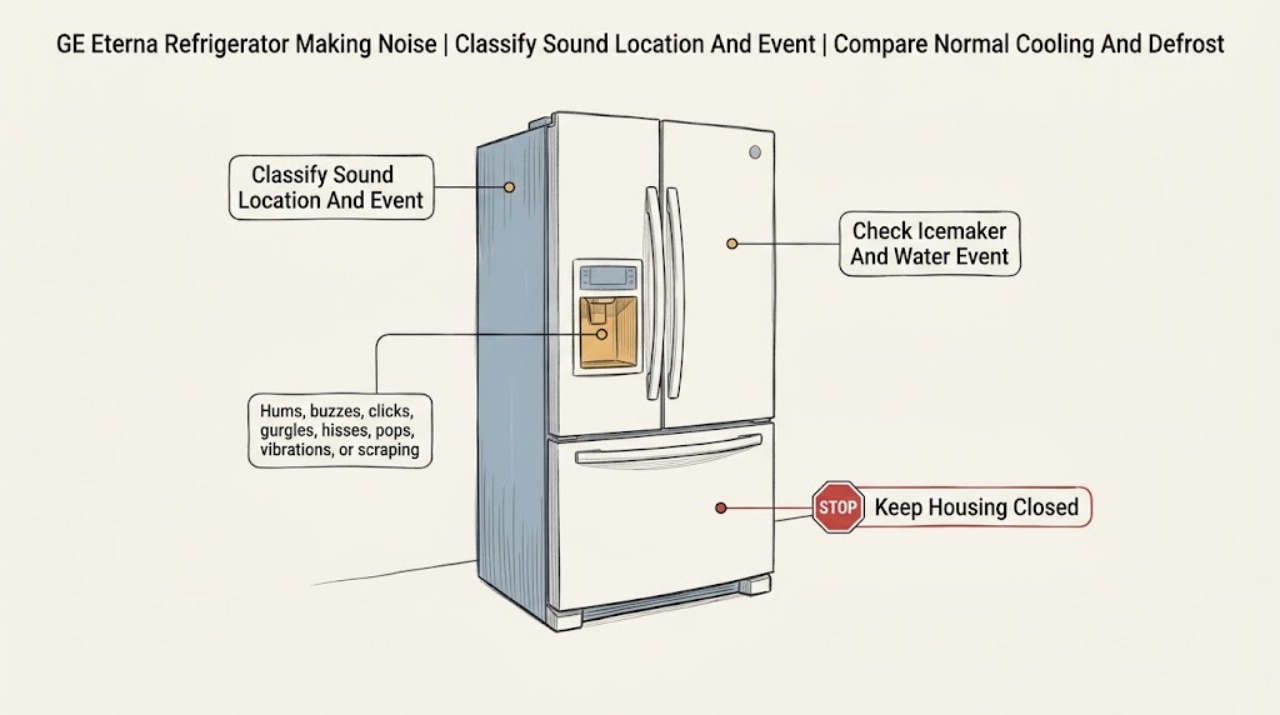
Work through in order
Diagnostic checks
Use only checks that match the exact appliance or system and its official guide.
-
Check 1
From outside the cabinet, record the sound in plain language and note where it is loudest: inside the freezer, fresh-food section, behind or underneath the cabinet, at the icemaker, or at a dispenser. Note whether it occurs during cooling, door closure, defrost, water dispensing, icemaker filling, compressor startup, or after an outage.
Expected result: The sound is a hum or gurgle while cooling; click or drip during defrost; buzz linked to water or ice; rattle or vibration; fan-like scraping; or a new sound with poor cooling or another hazard.
Next step: Follow the matching branch below and record the exact model and serial number. Stop immediately for smoke, electrical odor, heat, water near electricity, or visible damage.
Why this matters
Why: Timing and location separate likely normal refrigerant, defrost, compressor, fan, and icemaker sounds from a mechanical or electrical fault. A freezer impact sound or a new sound on an older unit is more concerning than a brief event that matches GE's normal list.
-
Check 2
Listen without opening panels for a hum, gurgle, boiling or knocking while the refrigerator runs, a click when the temperature control or defrost timer changes state, a drip during defrost, or a hiss, sizzle, crack, or pop around a defrost event. Note whether the sound ends as the cycle changes.
Expected result: The sound is brief and follows cooling or defrost; it repeats continuously; it has newly become louder or harsher; or cooling performance changes at the same time.
Next step: Monitor a brief event that matches the exact model's behavior. Arrange service for a continuous or worsening sound, poor cooling, frost, or a sound that cannot be matched without accessing internal components.
Stop if: Do not remove the rear cover, touch a heater or coil, force a defrost, or perform a live electrical test.
Why this matters
Why: GE identifies refrigerant circulation, control or defrost switching, defrost-water dripping, and coil expansion or contraction as possible normal sounds. A persistent, newly changed, or performance-linked sound is not cleared merely because its category resembles a normal sound.
-
Check 3
If the sound is a buzz, hum, rattle, or vibration near the icemaker or water valve, note whether it occurs while filling, after dispensing, or at regular intervals while the water supply is off. If the model has an icemaker that is not connected to water, use the exact model control to turn the icemaker off; do not reach into the ice maker.
Expected result: The sound occurs briefly during a fill or dispense; it repeats about every 10 to 15 minutes with water off; it stops when the icemaker is turned off; or it continues with the icemaker off.
Next step: Restore water only if the exact installation is complete and leak-free, or leave the icemaker off when it is not supplied. Arrange service for persistent buzzing, a leak, or a valve or motor concern.
Stop if: Do not remove the icemaker, bridge its switch, disconnect tubing, or continue using it with a water leak.
Why this matters
Why: GE describes short valve and icemaker sounds as normal and links repeated buzzing with a shut-off water supply to an icemaker that is still enabled. A sound that continues with the icemaker off, is accompanied by a leak, or comes from a different location needs service diagnosis.
-
Check 4
For a rattle or vibration, observe from a stable position whether the sound changes when doors close, shelves or containers are moved, or the refrigerator settles on the floor. Check only visible external contact points and do not pull the cabinet or remove a lower cover to reach a fan.
Expected result: The sound is a slight intermittent cabinet vibration; a loose visible item or water line is touching the cabinet; the sound is a fan-like impact from the freezer; or it comes from underneath and persists.
Next step: Remove only an ordinary visible loose item and observe again. If the sound persists, comes from a fan or underneath, or the refrigerator rocks or cools poorly, arrange service rather than opening the cabinet.
Stop if: Do not move a heavy refrigerator across the floor, insert anything near a fan, or remove covers while relying on a generic procedure.
Why this matters
Why: Some vibration, water-line, icemaker, and cabinet sounds can be normal, but GE says a freezer fan blade striking something is not normal. An underneath sound may involve a condenser fan on models without a NeverClean condenser and requires safe access or service; the Eterna model must be identified first.
-
Check 5
Compare the current sound with its prior behavior and check whether the refrigerator still maintains temperature, whether frost or water is appearing, and whether the sound is newly louder, continuous, scraping, or accompanied by repeated compressor starts. Do not diagnose a component from sound alone.
Expected result: The sound is unchanged and matches a documented event; it is new on an older Eterna unit; a fan blade seems to strike; cooling or defrost performance has changed; or smoke, odor, heat, water, or electrical symptoms are present.
Next step: Monitor only the unchanged, brief, documented event. Arrange qualified service for a new, worsening, performance-linked, or unexplained sound and provide the recording and model information.
Stop if: Stop using the refrigerator for smoke, electrical odor, hot power hardware, water near electricity, severe vibration, or visible cabinet damage.
Why this matters
Why: GE treats a new noise on an older refrigerator and fan-blade impact as abnormal, while a sound that matches a known cooling or defrost event may be normal. A performance change or hazard makes an internal or electrical fault more likely and ends owner diagnosis.
-
Check 6
Record the Eterna model and serial number, sound location, event timing, duration, cooling or frost condition, icemaker and water status, and any hazard signs. Stop owner troubleshooting if identifying the sound would require a rear or bottom cover, internal wiring, fan access, refrigerant access, or moving the refrigerator.
Expected result: The sound can be matched to a brief documented event; the model is unknown; the sound is persistent or worsening; or professional access is required.
Next step: Use the exact model documentation or arrange qualified appliance service. Give the technician the sound recording, location, timing, model, serial number, temperature, frost, water, and hazard observations.
Stop if: Do not order a fan, motor, valve, or control from a generic GE listing, and do not perform live or sealed-system testing.
Why this matters
Why: GE says Eterna appliances are discontinued and had different feature mixes, so model identity is essential for legacy documentation and parts. A sound that cannot be safely observed externally requires qualified diagnosis.
Use your observations
Decision map
Find the observation that best matches what you see, then follow the next safe action.
-
PATH 01Safety boundary
What you see
A hum, gurgle, click, drip, hiss, sizzle, crack, or pop is brief and occurs during the matching cooling or defrost event, with normal temperature and no hazard.
Do this next
Monitor without opening the cabinet. Arrange service if the sound becomes continuous, changes character, or is joined by poor cooling, frost, water, or a hazard.
Why this path and its safety boundary
Why it matters: GE lists refrigerant circulation, control or defrost switching, defrost water, and coil expansion as possible normal sounds.
Safety stop: Do not force defrost or touch internal heaters, coils, or fans.
-
PATH 02Safety boundary
What you see
A buzz or vibration repeats at intervals near the icemaker or water valve while the refrigerator's water supply is off.
Do this next
Turn the icemaker off using the exact model control until a complete, leak-free water connection is available. Escalate if the sound continues with the icemaker off.
Why this path and its safety boundary
Why it matters: GE links this pattern to an icemaker trying to fill without water; the exact interval and control depend on the model.
Safety stop: Do not disconnect tubing or work inside the icemaker.
-
PATH 03Safety boundary
What you see
The noise sounds like a fan blade striking something, scraping, or a card-like impact from underneath, especially if it is new or cooling changes.
Do this next
Keep the appliance stable and arrange qualified service rather than removing a cover or reaching near a fan.
Why this path and its safety boundary
Why it matters: GE treats a freezer fan-blade impact as abnormal and notes that an underneath sound can involve a condenser fan on some models. Model-specific cover and condenser arrangements matter.
Safety stop: Stop for smoke, odor, heat, exposed wiring, or severe vibration; do not operate with a suspected damaged fan.
-
PATH 04Safety boundary
What you see
The sound is new on an older Eterna refrigerator, persists, grows louder, or is accompanied by poor cooling, frost, water, repeated starts, or abnormal vibration.
Do this next
Arrange qualified appliance service and provide the model, recording, location, timing, and performance observations.
Why this path and its safety boundary
Why it matters: A normal-sound list cannot clear a sound that has changed or is affecting operation. Internal fan, compressor, defrost, control, leveling, or sealed-system diagnosis may be needed.
Safety stop: Do not order a part from sound alone or open the appliance.
-
PATH 05Safety boundary
What you see
Smoke, burning or electrical odor, a hot or damaged cord, water near electricity, exposed wiring, cabinet damage, or severe vibration accompanies the noise.
Do this next
Keep people away and isolate power only from a safe accessible point. Arrange qualified electrical or appliance service; do not restore power to reproduce the sound.
Why this path and its safety boundary
Why it matters: This is an immediate stop-use and professional-service branch, not a normal operating sound.
Safety stop: Do not touch wet electrical parts, move the refrigerator, or open panels.
Helpful context
Understand the symptom
Sound timing is more useful than sound volume
A short click after an outage, a hum while cooling, a drip during defrost, and a buzz tied to icemaker filling have different explanations. Note whether the sound follows door closure, water dispensing, icemaker operation, defrost, compressor startup, or a power event. A sound that is new, continuous, scraping, or paired with a performance change deserves a different branch than a documented occasional sound.
An Eterna refrigerator needs its model before service or parts work
GE describes Eterna as a discontinued special line that included different GE and Profile feature mixes. The Eterna name alone does not identify the freezer layout, icemaker, water valve, condenser arrangement, or control system. Record the model and serial label and use that exact documentation for any service decision.
Normal noise ends where mechanical impact or hazard begins
GE calls a freezer fan blade hitting something an unusual sound and recommends service. A newly appearing tap on an older refrigerator, repeated harsh vibration, or a sound from underneath that cannot be safely identified without removing a cover should also be handed off. Do not use the normal-sound list to justify opening a powered legacy appliance.
Safety boundary
Stop conditions
- Stop using the refrigerator for smoke, burning or electrical odor, a hot or damaged cord, water near electrical parts, exposed wiring, cabinet damage, severe vibration, or a fan-like impact sound.
- Do not remove rear or bottom covers, reach into a fan or icemaker, perform live electrical tests, force defrost, open the sealed system, or move a heavy refrigerator to chase a sound.
- If the icemaker is enabled without a connected water supply, turn it off using the exact model control; do not disconnect tubing or bypass the mechanism.
- Use the exact legacy GE Eterna model and serial documentation. Eterna is discontinued and its feature mix varied, so do not copy a current or different model's part, cover, or control procedure.
Only after diagnosis
Potential parts
- evaporator or condenser fan assembly
Consider only after qualified diagnosis confirms a fan-impact, scraping, or abnormal vibration fault and the exact legacy model identifies the correct fan assembly.
Fan location and assembly vary by Eterna model; do not order or install a fan based on sound alone or open the cabinet yourself. - icemaker water valve
Consider only after qualified diagnosis finds persistent valve buzzing or a fill fault with the exact model's water supply, icemaker control, and tubing condition verified.
Water-valve fit and connector details are model-specific; keep the icemaker off when water is not connected and confirm legacy model compatibility before ordering.
When checks do not resolve it
Need a professional?
Arrange qualified appliance service for a new, persistent, worsening, scraping, fan-impact, or performance-linked noise; a noise that requires cover removal or internal access; or a sound accompanied by poor cooling, frost, water, repeated compressor starts, or severe vibration. Use qualified electrical service for a hot or damaged cord, outlet, smoke, burning odor, or exposed wiring. Keep the refrigerator operating only when there is no hazard and a service provider wants the sound preserved.
Safety scope: The owner may listen externally, record timing and location, move only ordinary loose items, use the exact icemaker control, and identify the model. Qualified personnel must handle rear or bottom covers, fans, compressor, controls, defrost components, water valves, wiring, live tests, refrigerant, sealed-system work, and hazard conditions.
Common questions
FAQ
Why is my GE Eterna refrigerator humming or gurgling?
A hum, boiling, gurgle, or knocking sound while the refrigerator runs can come from normal compressor or refrigerant circulation. Match the sound to its timing and check whether cooling remains normal. A new, harsh, continuous, or performance-linked sound needs service.
Why does my GE Eterna refrigerator buzz every few minutes?
If the sound is near the icemaker or water valve and the water supply is off, GE says an enabled icemaker may be trying to fill. Turn the icemaker off using the exact model control until a complete water connection is available. Persistent buzzing with the icemaker off needs service.
Is a clicking sound during defrost normal?
GE lists defrost-timer and temperature-control clicks, dripping defrost water, and some hissing, sizzling, cracking, or popping as possible normal events. The sound should match the event and end as the cycle changes. A new or persistent tap on an older refrigerator should be checked by service.
What if the noise sounds like a fan blade hitting something?
GE treats a freezer fan-blade impact sound as abnormal. Do not remove a cover or reach into the fan on an unidentified Eterna model. Keep the appliance stable and arrange qualified service, especially if cooling or frost has changed.
How do I find the correct manual for a GE Eterna refrigerator?
Find and record the model and serial number, then use GE's support and manual lookup for that exact appliance. GE says Eterna appliances are discontinued and had different feature mixes, so the Eterna name alone is not enough to select a procedure or part.
When should I stop using a noisy GE Eterna refrigerator?
Stop for smoke, burning or electrical odor, a hot or damaged cord, water near electricity, exposed wiring, cabinet damage, severe vibration, or a suspected fan impact. Do not open panels or perform live tests; arrange qualified electrical or appliance service.
Read the exact guide
Official sources
- Find Your GE Model & Serial NumbersGE Appliances · Use to locate the exact GE Eterna model identity before retrieving legacy documentation or arranging service.
- GE Appliances - Eterna BrandGE Appliances · Use to establish that Eterna was a special GE line with varied feature mixes and is no longer manufactured; it does not identify an individual refrigerator's sound or parts.
- Refrigerator - Normal Sounds and Noises MadeGE Appliances · Use for general sound classification on GE Eterna refrigerators; the exact legacy model and timing must match before calling a sound normal.
- Refrigerator - Unusual NoisesGE Appliances · Use for the professional-service boundary and external pattern classification; do not apply its cover-removal procedure to an unidentified Eterna model.
- Refrigerator - Intermittent Buzzing or Vibrating NoiseGE Appliances · Use only when the Eterna model has the corresponding icemaker and water-supply configuration; exact controls vary.
Community feedback
Share a repair observation
Share a plain-text repair observation. Accepted observations are published automatically; this page may take a moment to update.