
On this page
Start here
Quick answer
GE Eterna refrigerators are an older GE derivative line with model-specific feature mixes, and GE says Eterna appliances are no longer manufactured. Start by recording the complete model and serial number, then separate no power from a running refrigerator that is warm: check the plug/outlet, the temperature controls, door closure/gaskets, blocked air passages, and whether the unit is in a normal defrost cycle or a model-specific demo mode. GE says a defrost cycle can temporarily stop the compressor and fans, and a short power interruption can cause an automatic compressor-overload delay; do not repeatedly cycle power. Keep doors closed and protect food while temperatures recover. If the refrigerator has lights but remains warm after the model-specific settings, airflow, and documented recovery checks, or if there is a frost pattern, unusual noise, water, burning odor, hot cord, sparking, or repeated breaker trip, arrange qualified service. Do not remove covers, test capacitors or refrigerant circuits, force a fan, or perform live electrical tests.
Before you begin
Safety first
- The user may check a dry accessible outlet, normal control setting, door closure, visible gasket/airflow obstruction, and model-documented recovery state. Qualified service must handle internal fans, compressor/start devices, defrost components, wiring, control boards, sealed-system/refrigerant work, panel removal, and live tests. Isolate power only from a dry, safe position.
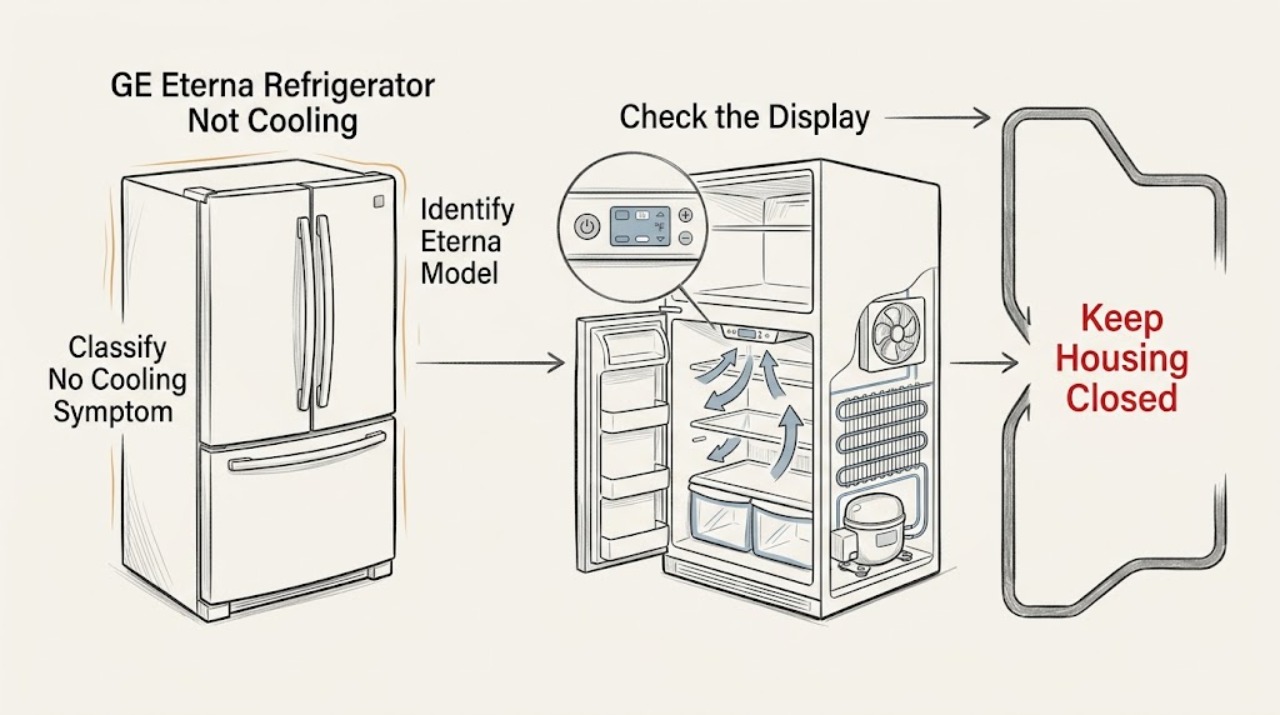
Work through in order
Diagnostic checks
Use only checks that match the exact appliance or system and its official guide.
-
Check 1
Record whether the refrigerator has interior lights, control response, compressor/fan sound, freezer cooling, fresh-food cooling, frost, water, or an error/display message. Check from outside for smoke, burning odor, unusual heat, sparking, a wet outlet/cord, or a repeated trip.
Expected result: There is no light or control response, lights work but both sections are warm, the freezer is cold but fresh food is warm, the compressor/fan is silent, or a hazard is present.
Next step: For a hazard, leave the unit off and arrange qualified service/electrical help. Otherwise continue with model and external power checks without moving or opening the refrigerator.
Stop if: Do not restore power to a wet/damaged unit, repeatedly cycle the plug, or remove covers to hear components.
Why this matters
Why: No light can indicate a power path issue, while lights with warmth shift attention to settings, airflow, defrost, fan/compressor, or refrigeration. A hazard overrides diagnosis.
-
Check 2
Read the complete model and serial number from the accessible label or paperwork without moving the refrigerator or removing trim. Use GE's literature search and the model-specific Owner's Manual to identify control positions, defrost behavior, light type, airflow openings, and any demo/showroom mode.
Expected result: The Eterna model is legible and a matching manual is available, the manual cannot be found, or the appliance has a control/display layout unlike the reference material.
Next step: Follow only the matching model manual. If the model cannot be safely identified, stop at external observations and provide the label information to service rather than guessing a component.
Stop if: Do not remove panels or make a model assumption from the Eterna badge alone.
Why this matters
Why: GE says Eterna models had a different feature mix and are no longer manufactured. A generic GE cooling instruction cannot establish the correct control sequence or part.
-
Check 3
Verify that the plug is seated in the wall outlet and that the outlet has power, only if both are dry and accessible. Check the refrigerator and freezer controls against the exact manual and confirm they were not set to OFF or a showroom/demo state. Do not reset a breaker repeatedly.
Expected result: The outlet is dead, the plug is loose/damaged, the controls were off or in demo mode, lights work but controls do not respond, or power and settings are normal.
Next step: Have a qualified electrician correct a dead or repeatedly tripping circuit. Correct only a normal model-documented setting or demo mode; if controls remain abnormal, arrange appliance service.
Stop if: Do not touch a scorched/wet outlet, open the control housing, or use live electrical measurements.
Why this matters
Why: GE's no-cooling guidance uses the interior light and outlet to separate a power problem from a warm-running refrigerator; GE also documents demo mode as a state that can disable cooling while leaving normal controls/lights visible on some models.
-
Check 4
Note whether the refrigerator was recently unplugged, had a power interruption, or is temporarily quiet at a time consistent with its model-specific defrost operation. Keep the doors closed and allow the exact manual's normal recovery period rather than repeatedly unplugging and reconnecting.
Expected result: The unit was just power-interrupted, the compressor/fans are quiet but the manual indicates defrost, cooling returns without intervention, or the refrigerator remains warm beyond the model-specific period.
Next step: Monitor a hazard-free unit through one normal documented recovery while protecting food. If it stays warm, cycles abnormally, or repeatedly loses cooling, arrange service.
Stop if: Do not force a compressor start, alter the defrost timer, or repeatedly cycle power.
Why this matters
Why: GE says defrost temporarily stops compressor and fans, and a short outage can activate automatic compressor-overload recovery. A normal recovery does not prove a component failure; persistent warmth after it shifts the case to service diagnosis.
-
Check 5
Inspect the closed-door fit and visible gasket perimeter for a folded seal, food package, shelf, or drawer preventing closure. Inside the refrigerator, move only items visibly blocking the model's air vents or air tower, leaving space as the exact manual specifies. Do not disassemble the liner or fan cover.
Expected result: A door does not close/seal, the gasket is visibly displaced or damaged, food blocks an air opening, or doors and airflow are unobstructed.
Next step: Remove only an obvious obstruction and reseat a visibly displaced gasket without tools. If the gasket, hinge/alignment, or cooling problem persists, arrange model-matched service.
Stop if: Do not remove the door, force the gasket, open the evaporator cover, or use a tool to reach a fan.
Why this matters
Why: GE identifies door closure, gaskets, and blocked airflow as factors that can affect refrigerator temperature. A sealed door and open visible airflow make defrost, fan, control, or sealed-system causes more likely.
-
Check 6
Without removing freezer panels or scraping ice, record whether frost is absent, light and even, concentrated around a door edge, or a thick/uneven layer on an interior wall. Note whether the freezer is cold while the fresh-food section is warm and whether the door gasket seals.
Expected result: There is heavy or asymmetric frost, frost only around a leaking gasket/door edge, a cold freezer with warm fresh food, or no abnormal frost.
Next step: Correct only a visible door obstruction; do not manually defrost with heat or sharp tools. Arrange service for heavy/uneven frost, recurrent frost, or a warm fresh-food section with a cold freezer.
Stop if: Do not chip ice, use a hair dryer/open flame, remove an evaporator cover, or test defrost parts.
Why this matters
Why: The pattern can help a technician distinguish an air/door symptom from an airflow or defrost-related symptom, but a frost pattern alone does not identify a heater, sensor, fan, or refrigerant fault.
-
Check 7
Stop user troubleshooting and arrange qualified appliance service when external power, controls, documented recovery, door fit, and visible airflow checks do not restore cooling, or when the compressor/fan, frost, wiring, or sealed-system behavior appears abnormal. Provide the model, temperature pattern, timing, sounds, frost, and any display code.
Expected result: Cooling returns after a safe external correction, or the unit remains warm, repeatedly cycles, has a heavy/uneven frost pattern, unusual noise, or a safety symptom.
Next step: Keep doors closed and protect food; leave a hazardous or severely abnormal unit off and arrange GE-qualified appliance service. Use an electrician for a house-circuit problem.
Stop if: Do not remove covers, handle refrigerant, test capacitors/relays, force motors, or perform live tests.
Why this matters
Why: A successful correction supports monitoring. Persistent loss can involve a fan, compressor, thermostat/control, defrost system, or sealed refrigeration circuit; GE's general guidance does not select one part without model-specific diagnosis.
Use your observations
Decision map
Find the observation that best matches what you see, then follow the next safe action.
-
PATH 01Safety boundary
What you see
The fresh-food light and controls are dead, and the outlet or plug is not supplying safe, normal power.
Do this next
Have the outlet/circuit evaluated and restored by a qualified electrician; reconnect only when the outlet and cord are dry and sound.
Why this path and its safety boundary
Why it matters: A house power path, plug, or refrigerator power connection is more likely than a confirmed cooling-system failure.
Safety stop: Do not touch a wet/scorched outlet, repeatedly reset a breaker, or open the refrigerator electrical area.
-
PATH 02Safety boundary
What you see
Interior lights work, but the refrigerator is warm and the exact manual or display indicates OFF, showroom/demo mode, or an incorrect temperature setting.
Do this next
Correct only the documented setting or demo-mode sequence, then allow the manual's stabilization time. If the state returns or cooling does not recover, arrange service.
Why this path and its safety boundary
Why it matters: A model-specific control state is more likely than loss of incoming power. GE notes demo mode can leave lights and controls functioning while cooling is disabled on some models.
Safety stop: Do not use undocumented button combinations or alter wiring to exit demo mode.
-
PATH 03Safety boundary
What you see
The refrigerator was recently unplugged or lost power, or the compressor and fans are temporarily quiet during a normal model-specific defrost period, with no hazard.
Do this next
Keep doors closed and wait through the exact documented recovery without repeated resets. Escalate if the unit remains warm, repeatedly enters an abnormal state, or does not resume cooling.
Why this path and its safety boundary
Why it matters: GE says defrost stops the compressor/fans and power interruption can trigger automatic overload recovery. This is not proof that the compressor has failed.
Safety stop: Do not force a restart or access the compressor/defrost controls.
-
PATH 04Safety boundary
What you see
A door does not seal, a gasket/food item blocks closure or airflow, or the freezer has heavy/uneven frost while the fresh-food section is warm.
Do this next
Correct only a visible obstruction and document the frost pattern. Do not chip, heat, or dismantle the freezer; arrange service for persistent or heavy frost/cooling loss.
Why this path and its safety boundary
Why it matters: Door leakage, blocked air movement, or a defrost/airflow fault is more likely than a simple thermostat setting. Frost pattern alone cannot identify the internal part.
Safety stop: No sharp tools, open flame, hair dryer, panel removal, or fan/defrost testing.
-
PATH 05Safety boundary
What you see
Power, settings, door fit, airflow, and documented recovery are normal, but temperatures remain high or the unit has abnormal compressor/fan behavior, repeated cycling, asymmetric frost, odor, heat, or electrical symptoms.
Do this next
Leave hazardous equipment off and arrange qualified appliance service with the exact model, serial, temperature readings, timing, frost pattern, and sound history.
Why this path and its safety boundary
Why it matters: A fan, compressor/start device, control, defrost system, or sealed refrigeration circuit may be involved. Eterna's discontinued status and model variation make a generic part diagnosis unsafe.
Safety stop: Do not open the rear cover, test capacitors or relays, handle refrigerant, or perform live measurements.
Helpful context
Understand the symptom
Eterna identity matters more than the badge
GE's official Eterna page says the line began as a special dealer-marketed series with a different feature mix and is no longer manufactured. An Eterna refrigerator may therefore have a different control layout, dispenser, icemaker, light, or defrost arrangement from a later GE model. Find the complete model and serial number on the appliance and use GE's model-specific literature search; do not choose a thermostat, fan, relay, or control board from the Eterna name alone.
First distinguish no cooling from no running
Open the fresh-food compartment briefly and note whether the interior light works, whether the temperature controls respond, and whether the unit is silent, humming, cycling, or temporarily quiet. GE says a defrost cycle can stop the compressor and fans, while a short power interruption can produce an automatic compressor-overload recovery delay. These observations are not permission to open the rear cover or repeatedly reset the refrigerator. Protect perishable food and use the exact manual for temperature and recovery guidance.
Leave the sealed system and energized parts closed
Stop using the refrigerator and isolate power only from a dry, safe position for smoke, burning odor, sparking, a hot or damaged cord, water near electrical parts, exposed wiring, or repeated breaker trips. Do not remove the rear cover, access a capacitor or compressor, pierce tubing, handle refrigerant, force a fan, or perform live voltage tests. A qualified appliance technician must diagnose persistent cooling loss, heavy or asymmetric frost, internal fan/compressor faults, and sealed-system issues.
When checks do not resolve it
Need a professional?
Arrange qualified service when cooling does not recover after the exact model's safe external checks, when heavy/uneven frost or a freezer/fresh-food imbalance persists, or when compressor, fan, defrost, control, or sealed-system diagnosis is needed. Stop immediately for smoke, burning odor, unusual heat, sparking, water near electrical parts, a damaged cord/outlet, or repeated electrical trips.
Safety scope: The user may check a dry accessible outlet, normal control setting, door closure, visible gasket/airflow obstruction, and model-documented recovery state. Qualified service must handle internal fans, compressor/start devices, defrost components, wiring, control boards, sealed-system/refrigerant work, panel removal, and live tests. Isolate power only from a dry, safe position.
Have this ready
- Complete model and serial number, control layout, fresh-food and freezer temperatures, whether lights and controls work, power-interruption history, door/gasket and airflow observations, frost pattern, compressor/fan sound and timing, display text, and any hazard symptom. Do not recreate a hazardous condition.
Common questions
FAQ
Why is my GE Eterna refrigerator warm even though the light works?
Lights with no cooling shift the check away from a total power loss. Verify the exact model's temperature settings and demo/showroom state, allow for a normal defrost or power-recovery period, and check door closure and visible airflow. Persistent warmth needs service diagnosis.
Can a GE Eterna refrigerator stop cooling during defrost?
Yes, temporarily. GE says the compressor and fans do not run during a model-dependent defrost cycle. Keep the doors closed and wait through the documented cycle; if cooling does not resume or the condition repeats abnormally, arrange service.
Is there one GE Eterna refrigerator reset that fixes no cooling?
No universal reset should be assumed. GE says Eterna models had different feature mixes. Use only the exact manual's control or demo-mode procedure, and do not repeatedly unplug the refrigerator; a short outage can already trigger automatic compressor-overload recovery.
What should I do if the freezer is cold but the fresh-food section is warm?
Check that the fresh-food door seals and that visible air openings are not blocked. Record any heavy or uneven freezer frost. Do not remove the evaporator cover or manually chip/heat the frost; a persistent imbalance needs qualified airflow, defrost, fan, or sealed-system diagnosis.
Can I test the compressor or refrigerant on my GE Eterna refrigerator?
No. Keep the rear cover, compressor, start devices, wiring, and sealed refrigeration circuit closed. Provide the model, temperature pattern, sounds, and frost observations to a qualified appliance technician, especially for heat, odor, sparking, or repeated trips.
Read the exact guide
Official sources
- GE Appliances Service and Support by Product LineGE Appliances · Supports using the model/serial number to reach the appropriate manuals, refrigerator support, and service resources; it does not identify an Eterna refrigerator's internal component.
- GE Appliances - Eterna BrandGE Appliances · Applies to Eterna-branded GE appliances and establishes that the line had a different feature mix and is discontinued; it does not diagnose a refrigerator cooling fault.
- Refrigerator - Does Not Run or CoolGE Appliances · Supports general distinctions between lights/power, controls, defrost, power-interruption recovery, and demo mode; exact controls and timing vary by model.
- Refrigerator - Not Cooling EnoughGE Appliances · Supports external settings, door closure/gaskets, airflow, interior-light behavior, and model-specific manual/service boundaries; it does not select an Eterna internal part.
- Owner manuals, installation instructions | GE AppliancesGE Appliances · Supports the need to enter the complete model number for the correct manual; it does not identify an Eterna model's cooling component.
Community feedback
Share a repair observation
Share a plain-text repair observation. Accepted observations are published automatically; this page may take a moment to update.