
On this page
Start here
Quick answer
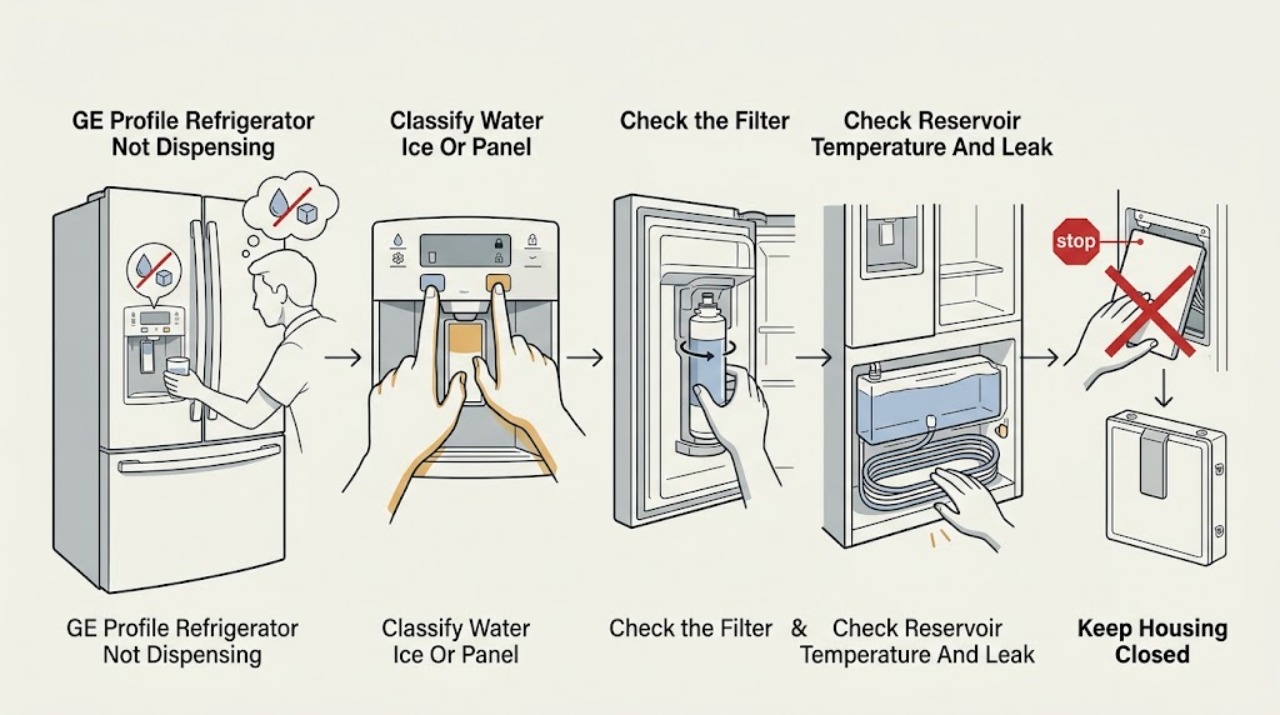
First identify whether the failure is water, cubed ice, crushed ice, the dispenser panel, or all dispenser functions. GE's support guidance separates no water from no ice and says the exact model manual controls the door wiring and lock procedure. For water, check that the refrigerator water shutoff is open, the reservoir has filled after installation or filter replacement, and the filter is not restricting flow; on applicable models, the supplied bypass plug can distinguish a clogged filter from a supply problem. A frozen or cracked chilled-water tank can stop water at the door while the icemaker still works and may leak onto the fresh-food floor, which requires service. For ice, close the doors fully, check for clumped ice or a chute jam, and confirm the bucket is seated; GE identifies moisture or frost around the auger as another possibility. A locked or unresponsive dispenser panel can sometimes recover after one model-approved short power reset, but do not repeat resets or remove door panels. If water is leaking, the panel and refrigerator reset together, the motor runs without dispensing, or there is a hot connection, smoke, burning odor, water near electricity, or a repeated power trip, stop using the dispenser and arrange qualified service.
Before you begin
Safety first
- The user may select the normal dispenser function, check doors and visible supply conditions, use an exact model's filter/bypass or air-purge procedure, clear accessible ice as documented, and perform one brief reset when dry and hazard-free. Qualified personnel must handle door harnesses, panels, valves, reservoirs, tubing, auger motors, icemakers, controls, live measurements, and repairs near water or electricity.
Work through in order
Diagnostic checks
Use only checks that match the exact appliance or system and its official guide.
-
Check 1
Select water, cubed ice, or crushed ice on the normal interface and press the cradle once with a suitable container. Record whether the panel lights, the refrigerator makes ice, the icemaker receives water, the dispenser motor or valve sounds, and whether both doors are fully closed. Do not hold the cradle while reaching into the chute.
Expected result: Water is absent or slow; ice is absent but water works; only crushed or only cubed ice fails; the panel is dark or locked; or all dispenser functions and other controls are unresponsive.
Next step: Use the water, ice, panel, or whole-appliance branch that matches the result and consult the exact model manual before changing a setting.
Stop if: Stop immediately for water near electricity, smoke, burning odor, sparks, abnormal heat, a hot connection, exposed wiring, or repeated power trips; isolate power only from a safe dry location.
Why this matters
Why: The result separates the water path, ice bucket/chute and auger path, selector/cradle, and panel/power path. A sound or a single failed selection does not identify the internal part.
-
Check 2
For no or slow water, check the visible refrigerator shutoff valve and supply line, then use the exact model guidance for a filter. On a model supplied with a bypass plug, remove the filter and install the plug only as the manual permits; after a new filter or installation, purge air only for the documented interval. Do not disconnect a pressurized line or pull a built-in refrigerator.
Expected result: The shutoff is closed; the line is kinked; the refrigerator is newly installed or the filter was just changed; flow improves with the bypass plug; or flow remains absent with the visible supply and bypass path normal.
Next step: Correct only an obvious valve or visible line condition, complete the exact air-purge procedure once, or replace a confirmed restricted filter with the model-matched part. Arrange service when flow remains absent or access is internal.
Stop if: Do not force filter housings, remove tubing under pressure, bypass a water safety device, or keep operating with a leak or water near electricity.
Why this matters
Why: A closed or restricted supply, trapped air, or clogged filter is more likely in the first patterns. No improvement with the bypass path shifts suspicion toward supply pressure, tubing, valve, reservoir, door wiring, or control; model layout determines which applies.
-
Check 3
If the icemaker makes ice but the door has no water, check the exact manual for the reservoir location and observe the fresh-food floor, behind the vegetable drawers, and visible tubing for water, frost, or a cracked tank without removing panels. Confirm the refrigerator is not set colder than the documented setting; do not thaw tubing with a heat tool.
Expected result: The reservoir or tubing appears frozen, a tank or tube is cracked or leaking, the fresh-food floor is wet, the refrigerator is set unusually cold, or no visible reservoir issue is present.
Next step: If the exact guidance permits, restore the documented temperature and allow the stated recovery period. For a leak, cracked tank, persistent no-water condition, or inaccessible tubing, keep the dispenser off and arrange service.
Stop if: Do not use a heat gun, cut tubing, remove the reservoir, or continue dispensing from a leaking or electrically wet refrigerator.
Why this matters
Why: GE says a frozen reservoir or tubing can block door water while the icemaker still gets water; a frozen tank may split and leak onto the fresh-food floor. A normal visible area does not rule out an internal reservoir, valve, or harness fault.
-
Check 4
For no ice, confirm both doors are fully closed, remove the ice bucket only as the exact manual permits, and inspect the bucket for clumped or frozen ice and the chute for a visible jam. Clear only accessible ice with the model-approved method; GE's guidance uses a wooden spoon for a chute jam on applicable models. Do not reach toward the auger, force the ejector, or use sharp tools.
Expected result: The door is open or misaligned; cubes are clumped or frozen together; ice blocks the chute; the bucket is not seated; the chute is clear but the motor is silent or hums without delivery; or the problem returns after clearing.
Next step: Restore only normal door closure, bucket seating, or accessible ice clearing. If the bucket/chute fault returns or the motor does not deliver with a clear path, keep the dispenser off and arrange service.
Stop if: Do not put fingers or tools into the chute, bypass the door interlock, remove the auger motor, or run with broken ice or water around electrical parts.
Why this matters
Why: Closure, ice clumping, seating, and a visible chute jam are more likely user-accessible causes. Persistent failure with a clear path can involve moisture or frost at the auger, a motor, coupling, control, or icemaker fault and requires diagnosis.
-
Check 5
If the dispenser panel is dark, locked, or unresponsive, check the exact model manual for the child-lock state and confirm the refrigerator's main power is stable. On a dry, hazard-free appliance, use one model-approved brief power reset; after a new installation, verify only the accessible door-harness connection described by the installation instructions. Do not remove hinge covers or door panels unless a qualified technician does so.
Expected result: The lock clears and dispensing returns; the panel recovers after one documented reset; the panel remains unresponsive; the panel and refrigerator lights reset together; or the connection is hot, wet, damaged, or repeatedly trips.
Next step: Stop repeated resets and arrange qualified appliance service for persistent panel or wiring symptoms. Use an electrician for a household outlet, cord, breaker, or supply fault.
Stop if: Do not bridge the cradle, bypass the lock, unplug repeatedly, use an extension or adapter, touch a wet or hot connection, or keep operating after smoke, odor, sparks, or a trip.
Why this matters
Why: A lock or transient control state is more likely when a documented user action restores the panel. Persistent or whole-appliance failure makes power, door wiring, control, or dispenser electronics more likely; a hot or wet connection is a safety issue.
Use your observations
Decision map
Find the observation that best matches what you see, then follow the next safe action.
-
PATH 01Safety boundary
What you see
The water dispenser is dry or slow, the icemaker may still work, and a closed valve, recent installation or filter change, kink, or bypass-flow difference is observed.
Do this next
Use the exact model's valve, air-purge, and filter/bypass instructions once. Arrange service if flow remains absent or a reservoir/tubing issue is suspected.
Why this path and its safety boundary
Why it matters: A supply restriction, trapped air, or filter issue is more likely than an ice-chute or auger fault.
Safety stop: Do not disconnect pressurized tubing, force a filter, or continue with a leak or water near electricity.
-
PATH 02Safety boundary
What you see
The icemaker receives water or makes ice but the door dispenser does not, the fresh-food floor is wet, or the model's reservoir/tubing appears frozen or cracked.
Do this next
Follow the exact temperature guidance and recovery interval only if there is no leak. For visible water, a cracked tank, or persistent no water, keep the dispenser off and arrange service.
Why this path and its safety boundary
Why it matters: GE identifies frozen or cracked chilled-water reservoir/tubing as a model-dependent water-dispenser cause; a crack can require service.
Safety stop: Do not thaw with a heat tool, remove the tank, or dispense from a leaking refrigerator.
-
PATH 03Safety boundary
What you see
Water dispenses, but cubed or crushed ice does not; the bucket is clumped, not seated, the door is not closed, or a visible chute jam is present.
Do this next
Close the doors, seat the bucket, and clear only accessible ice using the model-approved method. Arrange service if the path is clear but delivery does not return or the fault recurs.
Why this path and its safety boundary
Why it matters: The ice delivery path is more likely blocked or not engaged than the water-dispenser path.
Safety stop: Do not reach into the chute, force the auger, bypass the door interlock, or use sharp tools.
-
PATH 04Safety boundary
What you see
The dispenser panel is dark, locked, or unresponsive, especially after installation or door removal, while the refrigerator may otherwise operate.
Do this next
Use the exact manual's lock procedure and one brief documented reset. Leave door-harness and hinge-cover work to qualified service if the issue persists.
Why this path and its safety boundary
Why it matters: A model-specific lock, temporary control state, or door-harness connection is more likely than a clogged filter or ice jam.
Safety stop: Do not remove door panels, bridge the cradle, or repeatedly cycle power.
-
PATH 05Safety boundary
What you see
Water and ice both fail, the motor or valve runs without delivery, a reservoir or hose leaks, the panel and refrigerator reset together, or the symptom returns after the safe checks.
Do this next
Keep the affected dispenser off and arrange qualified GE Profile refrigerator service. Provide the exact model, water/ice result, filter and bucket status, leak location, and reset result.
Why this path and its safety boundary
Why it matters: An internal valve, reservoir, tubing, auger, icemaker, control, wiring, or supply fault is possible; the symptom does not select a part.
Safety stop: Stop for water near electricity, smoke, burning odor, abnormal heat, a hot connection, exposed wiring, or repeated power trips; do not continue operation.
Helpful context
Understand the symptom
Name the failed dispenser function first
“Not dispensing” can mean no water, no ice, only crushed ice, a slow stream, or a dead dispenser panel. Test only the normal user selector and cradle once, with a container in place, and record whether the refrigerator still makes ice, whether water enters the icemaker, whether the panel lights, and whether both doors are fully closed. GE's model support pages provide the owner's manual and troubleshooting links for a specific GE Profile model, so do not transfer a lock, harness, filter, or reset sequence from a different style.
Water flow and ice delivery use different paths
No water at the door can come from a closed supply, air after installation or filter replacement, a clogged filter, frozen tubing or reservoir, or a door wiring issue. No ice at the chute can instead involve a closed door, clumped ice, a chute obstruction, or moisture/frost around the auger. A refrigerator that makes ice but will not dispense water points toward the water-dispenser path; a refrigerator that dispenses water but makes no ice points toward the icemaker path. These distinctions narrow the diagnosis but do not prove a valve, motor, or control failure.
Use filters and resets only as documented
On models with a water filter, GE describes a supplied bypass plug as a comparison test: improved flow with the bypass plug points toward a restricted filter. After a replacement filter, air can remain in the line and the reservoir may need to refill. A locked or unlit panel can have a model-specific lock state or, on some new installations, a temporary control lock-up. Use the exact manual for the lock and reset, once only. Do not remove a door harness, bridge the cradle, access the auger motor, or open the dispenser housing.
Safety boundary
Stop conditions
- Stop immediately for water near the plug, controls, or internal electrical area, smoke, burning odor, sparks, abnormal heat, exposed wiring, a hot or damaged cord or receptacle, or repeated breaker trips; isolate power only from a safe dry location.
- Do not remove door panels, dispenser housings, auger motors, valves, reservoirs, or internal tubing, and do not perform live electrical tests.
- Do not put fingers or sharp tools in the ice chute, bypass a door or cradle interlock, force an ejector, or use a heat tool to thaw tubing or ice.
- Do not repeatedly reset the refrigerator, use an extension or adapter, disconnect pressurized water tubing, or continue dispensing from a leaking refrigerator.
- If cooling is failing or a water leak is present, protect food and keep the affected function off while arranging qualified service.
When checks do not resolve it
Need a professional?
Arrange qualified GE Profile refrigerator service when no water remains after the exact supply, air, filter, and temperature checks; a reservoir or tube is frozen, cracked, or leaking; an ice bucket or chute fault returns; the auger or valve runs without delivery; the dispenser panel remains locked or unresponsive; or water and ice fail together. Use an electrician for a hot, damaged, wet, loose, or repeatedly tripping household supply. Stop immediately for smoke, burning odor, sparks, abnormal heat, water near electricity, or exposed wiring. Provide the full model and serial information, dispenser function affected, filter and bypass result if applicable, door/bucket status, leak location, and safe steps attempted.
Safety scope: The user may select the normal dispenser function, check doors and visible supply conditions, use an exact model's filter/bypass or air-purge procedure, clear accessible ice as documented, and perform one brief reset when dry and hazard-free. Qualified personnel must handle door harnesses, panels, valves, reservoirs, tubing, auger motors, icemakers, controls, live measurements, and repairs near water or electricity.
Common questions
FAQ
What should I check first if my GE Profile refrigerator will not dispense water?
Identify whether the icemaker still gets water, then check the visible shutoff valve, recent installation or filter replacement, air in the reservoir, filter restriction, and the exact model's bypass-plug procedure. A frozen or cracked reservoir can stop door water while the icemaker works and may leak onto the fresh-food floor.
Why does my GE Profile refrigerator make ice but not dispense it?
Confirm both doors close, the bucket is seated, and ice is not clumped or blocking the chute. GE also notes moisture or frost around the auger can affect delivery. Clear only accessible ice using the exact model method; persistent failure needs service.
Can a GE refrigerator filter stop the dispenser?
Yes, on models with a water filter. GE says a clogged or partially clogged filter can cause no or slow water, and a supplied bypass plug can help compare flow. Use only the exact model's filter and bypass instructions; a result does not diagnose every water-path fault.
What if the GE Profile dispenser panel is locked or does not light up?
Check the exact Owner's Manual for the lock state. GE says some new or existing refrigerators may recover after a brief documented power reset, and door-harness connections matter after door removal. If the panel remains unresponsive, arrange service rather than removing the door panel.
When should I stop troubleshooting a GE Profile refrigerator dispenser?
Stop for a leak, water near electricity, smoke, burning odor, abnormal heat, a hot or damaged connection, exposed wiring, or repeated power trips. Arrange service for a cracked reservoir, persistent no water or ice, a motor or valve that runs without delivery, or a panel that remains unresponsive.
Read the exact guide
Official sources
- Refrigerator - Dispenser Not Getting WaterGE Appliances · Applies to GE refrigerators with a water dispenser; exact reservoir, filter, door-harness, and control arrangement varies by model.
- Refrigerators, Freezers and Icemakers Troubleshooting and SupportGE Appliances · Applies to GE refrigerator support generally; exact model and dispenser architecture determine the relevant path.
- Refrigerator - Not Getting Water from the DispenserGE Appliances · Applies to refrigerator water dispensers; reservoir and bypass details are model-dependent, and top-freezer models may not have a reservoir.
- Refrigerator - Normal Operation of DispenserGE Appliances · Applies to GE refrigerators with external water or ice dispensers; exact cradle and selector design varies.
- Troubleshooting for PSS26SGPSSGE Appliances · Directly applies to PSS26SGPSS and demonstrates model-specific GE Profile support; do not transfer its controls to another model.
- Refrigerator - No Power to the DispenserGE Appliances · Applies to GE refrigerators whose dispenser panel does not light or work; exact reset and wiring details remain model-specific.
- Refrigerator - Dispenser Control Panel Not WorkingGE Appliances · Applies to GE refrigerator dispenser panels; lock and wiring locations depend on the model.
- Refrigerator - Not Dispensing IceGE Appliances · Applies to refrigerators with an ice dispenser; door, bucket, chute, and auger layout varies by model.
Community feedback
Share a repair observation
Share a plain-text repair observation. Accepted observations are published automatically; this page may take a moment to update.