
On this page
Start here
Quick answer
Treat a GE Profile refrigerator that trips a breaker as an electrical safety issue, not a routine cooling reset. First note whether the breaker trips immediately, only when the refrigerator is connected or starts, or after it has run for a while, and whether there is a hot plug, burning odor, smoke, water near electrical parts, or visible damage. GE says the refrigerator's Owner's Manual or Installation Instructions determine the required electrical supply, and recommends an individual properly grounded circuit; GE also advises against extension cords and adapters for refrigeration appliances. If the breaker trips immediately with the refrigerator unplugged, the house wiring or breaker box is the likely service boundary for an electrician. If the circuit holds with the refrigerator disconnected but trips when the appliance is reconnected, the appliance needs qualified diagnosis. Do not repeatedly reset the breaker, substitute a larger breaker, bypass grounding, open the rear cover, or make live measurements. Leave the refrigerator unplugged when there is a hazard or repeated trip, protect food safely, and arrange electrician or GE Profile appliance service based on the observed pattern.
Before you begin
Safety first
- Do not repeatedly reset the breaker, install a larger breaker, bypass grounding, use an extension cord or adapter, open the rear cover, probe live wiring, force a cycle, or replace an internal part without qualified diagnosis. Isolate power only when safe.
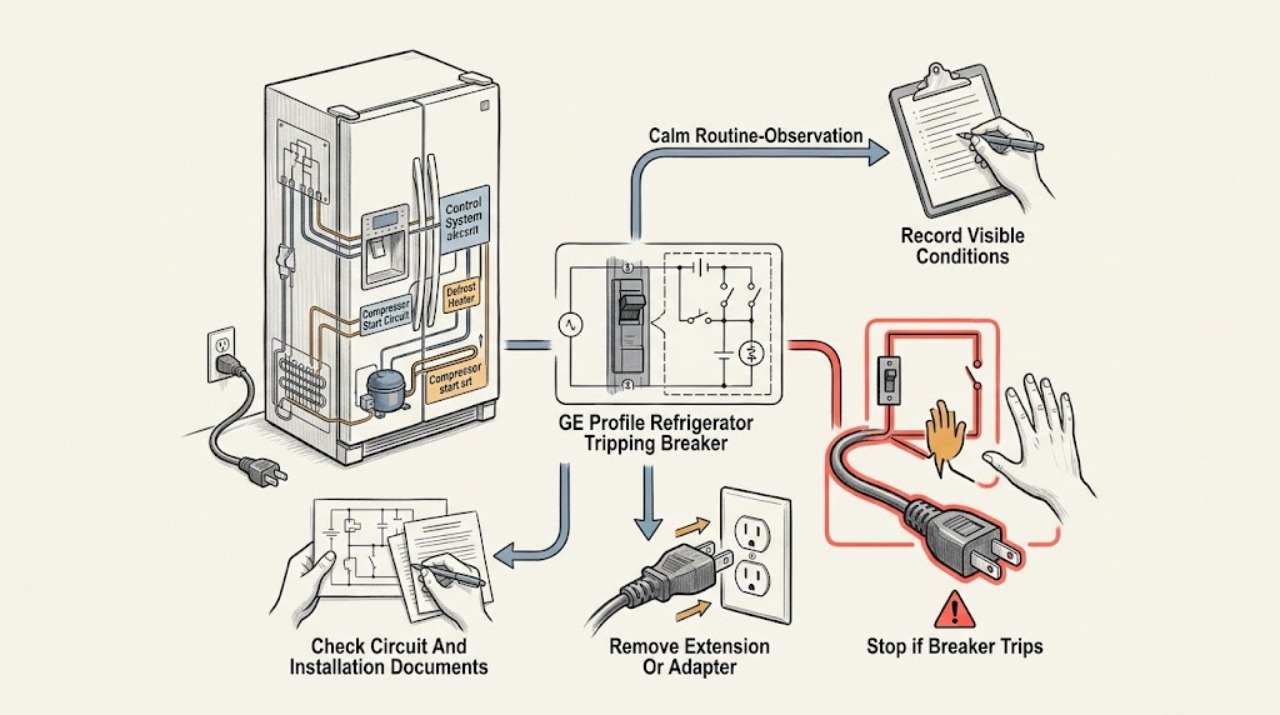
Work through in order
Diagnostic checks
Use only checks that match the exact appliance or system and its official guide.
-
Check 1
Record the exact GE Profile model, whether the breaker trips immediately on reset, when the refrigerator is connected, at compressor/defrost start, or after running, and whether the display or interior light goes dark. Look for smoke, odor, heat, sparking, water, scorch marks, or cord/receptacle damage without touching damaged parts.
Expected result: The trip is immediate, appliance-load dependent, delayed, or accompanied by an electrical/water hazard.
Next step: Use the matching branch below and give the model and timing to the electrician or appliance technician. If any hazard is present, leave the refrigerator out of service and do not restore power to test.
Stop if: Do not repeatedly reset the breaker or deliberately run the refrigerator to reproduce the trip.
Why this matters
Why: Immediate and load-independent behavior points toward the house circuit or breaker; an appliance-dependent trip points toward the refrigerator or its connection; a hazard overrides both and requires a stop-use response.
-
Check 2
From the model label and Installation Instructions, check the specified circuit, grounding, and installation requirements. Observe whether other appliances share the circuit, but do not remove an electrical cover or alter the breaker, outlet, wiring, or grounding.
Expected result: The refrigerator is not on the model-required individual/dedicated circuit, the grounding or receptacle is uncertain, or the installation matches the documented requirement.
Next step: Have an electrician correct or verify the circuit and receptacle. If the installation is documented as correct but the refrigerator still trips it, continue only with external observations and arrange appliance service.
Stop if: Do not install a larger breaker, remove the ground pin, use an adapter, or continue operating an appliance on a questionable circuit.
Why this matters
Why: GE says the model documents determine electrical requirements and recommends an individual properly grounded circuit. An incorrect or uncertain installation is an electrician/installer issue, not evidence that an internal refrigerator part should be replaced.
-
Check 3
Check whether the GE Profile refrigerator is connected through an extension cord, adapter, power strip, or altered grounding arrangement. If so, stop using that arrangement; do not substitute another cord or adapter as a test.
Expected result: An extension cord/adapter or missing ground is present, or the refrigerator is connected directly to the documented grounded receptacle.
Next step: Have the proper receptacle and circuit verified by an electrician, then follow the model Installation Instructions. If a compliant connection still trips, arrange appliance diagnosis.
Stop if: Do not use a bypass, adapter, underspecified cord, or larger breaker to keep the refrigerator powered.
Why this matters
Why: GE strongly recommends against extension cords for refrigerators and other refrigeration appliances and says not to cut the grounding prong or use an adapter. An improper connection can create a safety or overload path without proving an appliance defect.
-
Check 4
Only if there is no heat, odor, water, damage, or sparking and the plug is safely accessible, disconnect the refrigerator once, then observe whether the breaker can be reset without the refrigerator connected. Do not pull a built-in unit out or reach behind it to perform this check.
Expected result: The breaker trips immediately even with the refrigerator disconnected, or it holds until the refrigerator is reconnected.
Next step: For an unplugged immediate trip, call an electrician. If the circuit holds but trips when the refrigerator is reconnected, leave the appliance unplugged and arrange GE Profile appliance service.
Stop if: Do not repeat the reset, reconnect a tripping refrigerator, or perform any energized measurement.
Why this matters
Why: GE says an immediate trip after the refrigerator is unplugged typically points to house wiring or the breaker box; a trip only after reconnection makes the appliance or its connection more likely. This is a routing observation, not a repair test.
-
Check 5
Without opening panels, note whether the trip occurs during compressor start, after a defrost event, when an interior light or fan starts, or after the refrigerator has run for a while. Record whether cooling, frost, water, or display behavior changed before the trip.
Expected result: The trip follows a repeatable appliance cycle, follows an unrelated house load, or has no consistent timing.
Next step: Keep the appliance disconnected if it trips again and provide the timing to the appropriate professional. Do not force a defrost cycle, enter diagnostic mode, or run a live test.
Stop if: Do not remove a cover, touch a compressor or heater, or attempt to reproduce a trip under load.
Why this matters
Why: A repeatable appliance-cycle pattern helps a technician investigate a model-specific heater, start circuit, motor, control, or wiring path. An unrelated house load or inconsistent trip may point toward the circuit or breaker; neither observation identifies a component by itself.
-
Check 6
Stop and arrange professional service for any repeated trip, immediate trip with the refrigerator disconnected, appliance-dependent trip after a compliant connection, hot/damaged plug or cord, scorch marks, smoke, burning odor, sparking, water near electrical parts, or exposed wiring.
Expected result: The circuit and appliance remain stable after one safe external correction, or a trip/hazard persists.
Next step: Leave a persistent or hazardous case disconnected, isolate power only if safe, and contact an electrician for the house circuit or GE Profile-qualified appliance service for an appliance-dependent fault.
Stop if: Do not restore power to test, change breaker size, bypass grounding, open the refrigerator, or order an internal part from the trip symptom alone.
Why this matters
Why: A stable correction supports monitoring, while a persistent trip needs an electrician, appliance technician, or both based on whether it occurs with the refrigerator disconnected. GE lists shorted heaters, timers, loose wires, and failed components among possible appliance causes but does not make them user diagnoses.
Use your observations
Decision map
Find the observation that best matches what you see, then follow the next safe action.
-
PATH 01Safety boundary
What you see
With no hazard present, the refrigerator is disconnected and the breaker trips immediately when reset, or the circuit will not hold without the appliance.
Do this next
Leave the refrigerator disconnected and call a qualified electrician to diagnose the circuit or breaker. Do not keep resetting it.
Why this path and its safety boundary
Why it matters: GE says this pattern typically points to house wiring or the fuse/breaker box rather than the refrigerator itself.
Safety stop: Do not reconnect the refrigerator or install a larger breaker to test the circuit.
-
PATH 02Safety boundary
What you see
The breaker holds with the GE Profile refrigerator disconnected but trips when the refrigerator is connected or starts, using a documented compliant connection.
Do this next
Keep the refrigerator disconnected and arrange qualified GE Profile appliance service. Provide the trip timing and model; do not reconnect it repeatedly.
Why this path and its safety boundary
Why it matters: An appliance or appliance-connection fault is more likely. GE lists a shorted heater, timer, loose electrical wire, or failed component as possible refrigerator causes, but the symptom cannot select one.
Safety stop: Do not remove the rear cover, test live parts, or replace a heater, compressor start component, control, or wire yourself.
-
PATH 03Safety boundary
What you see
The refrigerator uses an extension cord, adapter, altered plug/ground, shared or uncertain circuit, or a receptacle that does not match the model installation requirements.
Do this next
Stop using the arrangement and have an electrician verify the receptacle, grounding, circuit, and breaker against the exact Installation Instructions.
Why this path and its safety boundary
Why it matters: The electrical installation is not established as safe or compliant. GE recommends an individual properly grounded circuit and strongly recommends no extension cord or adapter for refrigeration appliances.
Safety stop: Do not remove the ground pin, use an adapter, substitute a larger breaker, or run the refrigerator through a power strip.
-
PATH 04Safety boundary
What you see
The compliant installation holds initially but trips repeatedly when the compressor, defrost, fan, or another appliance cycle occurs, or trips after the refrigerator has run for a while.
Do this next
Leave the refrigerator disconnected after the next trip and arrange appliance service; have an electrician verify the circuit if the circuit behavior is uncertain or other loads also cause trips.
Why this path and its safety boundary
Why it matters: A model-specific appliance load or component fault becomes more relevant than a simple loose plug, but timing alone cannot distinguish a heater, motor, control, wiring, or breaker problem.
Safety stop: Do not force cycles, enter diagnostic mode, or make an energized measurement.
-
PATH 05Safety boundary
What you see
Smoke, burning odor, sparking, hot or damaged cord/receptacle, water near electrical parts, melted insulation, exposed wiring, or repeated severe breaker operation is present.
Do this next
Keep clear, isolate power only if safe, leave the refrigerator disconnected, and contact emergency electrical help when appropriate or a qualified electrician/appliance service provider.
Why this path and its safety boundary
Why it matters: This is an immediate stop-use condition and may involve a dangerous house or appliance fault; normal troubleshooting does not apply.
Safety stop: Do not touch wet or damaged parts, restore power to test, or open the refrigerator.
Helpful context
Understand the symptom
The timing of the trip changes the diagnosis
Record whether the breaker trips as soon as it is reset, when the refrigerator is plugged in, when the compressor or defrost cycle starts, or only after the unit has operated for some time. Also note whether the refrigerator's display or interior light goes dark and whether other appliances on the circuit lose power. GE's breaker guidance separates an immediate trip with the appliance disconnected from a trip caused by the appliance under load; neither pattern authorizes opening the refrigerator.
Verify the installation only from the outside
Use the exact GE Profile model and its Installation Instructions to confirm the required circuit and grounding arrangement. GE recommends a dedicated individual circuit and says the rating plate and model documents contain the applicable requirements. Do not use an extension cord, adapter, altered plug, or larger breaker to keep the refrigerator running. If the outlet, plug, cord, or receptacle is hot, scorched, loose, wet, or damaged, stop and use an electrician rather than touching or testing it.
Do not guess an appliance part from a breaker trip
GE lists several possible appliance causes, including a shorted heater, timer, loose electrical wire, or failed component. The same symptom can also arise from the receptacle, wiring, breaker, overload, or an incorrect installation. A trip pattern can decide whether the first call is to an electrician or appliance service, but it cannot select a compressor start device, heater, control, or harness without model-specific professional testing.
Stop repeated resets and live diagnosis
Leave the refrigerator disconnected when a breaker trips repeatedly or there is smoke, burning odor, a hot or damaged cord, melted receptacle, water near electrical parts, sparking, or exposed wiring. Do not repeatedly reset the breaker, replace it with a larger rating, probe the outlet or appliance while energized, remove the rear cover, bypass grounding, or work around the compressor, defrost heater, or control wiring. Isolate power only when safe and have the electrical or appliance fault diagnosed by a qualified professional.
When checks do not resolve it
Need a professional?
Call a qualified electrician if the breaker trips immediately with the refrigerator disconnected or the circuit installation is incorrect or uncertain. Call GE Profile or qualified appliance service if the circuit holds alone but trips when the refrigerator is connected or during its cycles. Stop immediately for smoke, burning odor, sparking, hot/damaged wiring, water near electrical parts, or repeated severe trips.
Safety scope: Do not repeatedly reset the breaker, install a larger breaker, bypass grounding, use an extension cord or adapter, open the rear cover, probe live wiring, force a cycle, or replace an internal part without qualified diagnosis. Isolate power only when safe.
Have this ready
- Complete GE Profile model number, circuit/receptacle arrangement, use of any cord or adapter, whether other loads share the circuit, exact trip timing, whether the breaker holds with the refrigerator disconnected, compressor/defrost/run timing, and any heat, odor, smoke, sparking, water, scorch, cord, or wiring symptom.
Common questions
FAQ
Why does my GE Profile refrigerator keep tripping the breaker?
The cause may be the house circuit/breaker, an improper connection, or an appliance fault such as a shorted heater, timer, loose wire, or failed component. The key observation is whether the breaker holds with the refrigerator disconnected. Do not keep resetting it or open the refrigerator to investigate.
What should I do if the breaker trips immediately even when my GE Profile refrigerator is unplugged?
Leave the refrigerator disconnected and call a qualified electrician. GE says an immediate trip after the appliance is unplugged typically points to house wiring or the breaker box. Do not reconnect the refrigerator or install a larger breaker to test it.
Can I use an extension cord or adapter to stop my GE Profile refrigerator from tripping?
No. GE strongly recommends against extension cords for refrigeration appliances and says not to cut off the grounding prong or use an adapter. Have the receptacle and individual grounded circuit checked against the exact Profile Installation Instructions.
Should I replace the compressor or defrost heater after a breaker trip?
Not from a trip alone. GE lists several possible causes, and the same symptom can come from the circuit or breaker. Leave the unit disconnected after a repeated or appliance-dependent trip and have the exact model and circuit diagnosed by a qualified professional.
Read the exact guide
Official sources
- Refrigerator - Electrical Requirements and Breaker SizeGE Appliances (GE Profile support) · GE refrigerators and related refrigeration appliances; exact requirements must be confirmed in the model Installation Instructions.
- Troubleshooting for PSF26NGPBBGE Appliances (GE Profile) · Exact PSF26NGPBB GE Profile side-by-side refrigerator; use the appliance's own model support for other Profile models and formats.
- GE Appliance - Circuit Breaker TripsGE Appliances (GE Profile support) · GE appliances, including refrigerators; appliance and house-circuit diagnosis must be separated by the observed trip pattern.
- Refrigerator & Freezer - Extension Cord or AdapterGE Appliances (GE Profile support) · GE refrigeration appliances, including refrigerators, freezers, ice machines, and beverage centers.
Community feedback
Share a repair observation
Share a plain-text repair observation. Accepted observations are published automatically; this page may take a moment to update.