
On this page
Start here
Quick answer
Some sparking is normal on a GE gas cooktop: GE says selecting one sealed burner can make multiple igniters spark because they share a spark-control system. The abnormal pattern is clicking with every knob fully OFF, clicking that continues after a burner is lit and the knob is moved from LITE, or clicking after cleaning that does not stop once the appliance dries. With all burners off and cool, disconnect power before cleaning and check only the model-approved burner cap, burner head and electrode seating. If clicking persists, GE says to unplug or switch off the breaker and turn off the gas until service. If you smell unburned gas, do not touch switches or try to light anything: leave the area and call the gas supplier or emergency service from outside.
Before you begin
Safety first
- Keep all knobs OFF when not deliberately operating a burner. Do not open the cooktop, touch ignition wiring, adjust gas pressure, bypass safety devices, use a match to compensate for a fault, or keep the appliance energized when clicking persists. Turn off power and gas and call service as GE directs.
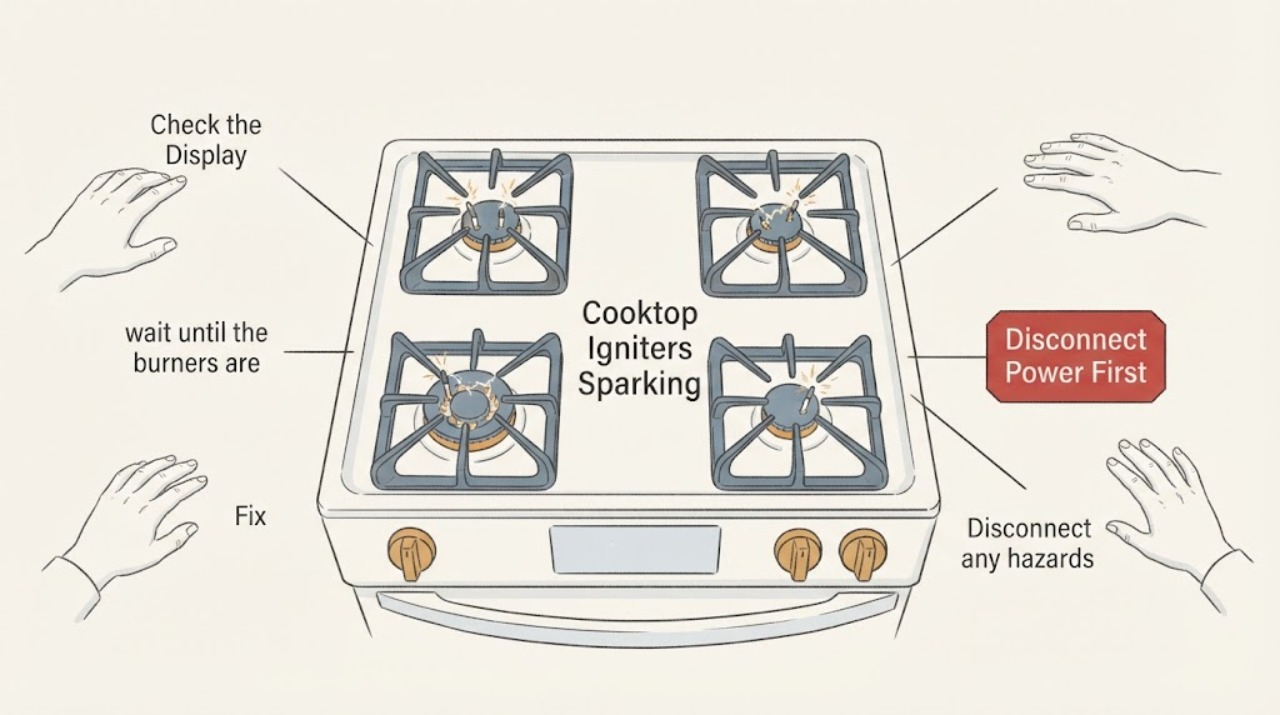
Work through in order
Diagnostic checks
Use only checks that match the exact appliance or system and its official guide.
-
Check 1
From a safe position, classify when the clicking or sparking occurs: only while one burner is being turned to LITE, on several burners during that ignition, after the flame is established, or while every knob is OFF.
Expected result: Several igniters spark during one selected ignition; clicking stops when the knob leaves LITE; clicking continues after lighting; or clicking occurs with controls OFF.
Next step: If multiple igniters spark only during a selected ignition and stop normally, continue to the model's normal operation. If clicking continues after lighting or with knobs OFF, stop using the cooktop and move to the power/gas safety branch.
Stop if: If the sound or spark cannot be identified without approaching a hot burner or suspected gas, stop observing and arrange service.
Why this matters
Why: GE describes multiple sparks during one sealed-burner ignition as normal, but persistent clicking after lighting or in the OFF position is a service condition.
-
Check 2
Turn every burner knob fully to OFF and confirm that each knob has returned to its normal position; do not remove knobs or controls while the appliance is energized.
Expected result: The clicking stops when a knob is fully OFF; a knob remains partly in LITE; or clicking continues with all knobs fully OFF.
Next step: If a knob was not fully OFF, correct it without force and confirm that the clicking stops. If clicking continues with all knobs OFF, do not keep cycling the controls; disconnect power and gas as GE directs and arrange service.
Stop if: If all knobs are OFF and there is no clicking, continue only if another ignition symptom remains; do not invent a control or igniter diagnosis.
Why this matters
Why: GE identifies a knob not completely OFF as a simple cause of clicking, while clicking that persists in OFF is not normal operation.
-
Check 3
If the cooktop was recently cleaned or had a spill, wait until the burners are OFF and cool, disconnect power, then follow the exact manual to inspect and dry the accessible burner heads, caps and ignition area.
Expected result: Moisture or soil is visible; a burner head or cap is not seated or matched to its burner; the white ceramic electrode is not flush; or all visible parts are dry and correctly placed.
Next step: Remove only accessible parts authorized by the model manual, dry and clean them without opening the gas system, and reinstall each cap/head in its matching position. If the electrode or part will not seat without force, stop and call service.
Stop if: If parts are dry and correctly seated but clicking persists, do not open the cooktop or replace an igniter/control part based on the symptom; use the service branch.
Why this matters
Why: GE says moisture, clogged ignition/flame ports, an electrode that is not seated flush, and mismatched burner parts can cause slow ignition or continuous clicking.
-
Check 4
After any model-approved cleaning and complete drying, observe one normal ignition from a safe position without touching the burner or reaching over a flame.
Expected result: The burner lights and clicking stops after the knob leaves LITE; the burner does not light; or clicking continues after the flame is established.
Next step: If the burner lights and clicking stops, use the cooktop normally while monitoring it. If it does not light or clicking continues after lighting, turn the knob OFF, stop testing and arrange service; do not manually relight it.
Stop if: If no safe observation can be made, keep the cooktop out of service and provide the model and symptom to a technician.
Why this matters
Why: GE distinguishes normal ignition from a spark that continues after lighting. A failure to light or persistent clicking can require service after the accessible cap/head/electrode checks.
-
Check 5
If clicking persists with all knobs OFF or any unburned-gas odor is present, stop operating the cooktop and follow the gas/electrical shutdown boundary instead of repeating ignition tests.
Expected result: There is persistent clicking with OFF controls but no gas odor; or there is a rotten-egg/unburned gas smell, flame irregularity, smoke or another emergency sign.
Next step: For persistent clicking without odor, unplug or switch off the breaker and turn off gas until a service person checks the cooktop. For gas odor, do not touch electrical switches or phones inside, extinguish flames, leave the area and call the gas supplier or fire department from outside.
Stop if: If neither condition is present and the cooktop operates normally, monitor it and use the exact manual for future cleaning; stop if the clicking returns.
Why this matters
Why: GE directs service for persistent clicking and treats unburned gas odor as abnormal; gas odor requires evacuation and emergency contact, not appliance troubleshooting.
Use your observations
Decision map
Find the observation that best matches what you see, then follow the next safe action.
-
PATH 01Next step
What you see
Several igniters spark only while one sealed burner is selected, and the clicking stops after the burner lights and the knob leaves LITE.
Do this next
Continue normal use without touching the burners while they click; use the exact manual for burner cleaning and operation.
Why this path and its safety boundary
Why it matters: GE identifies multiple sparks during one selected burner ignition as normal on sealed-burner designs.
-
PATH 02Next step
What you see
Clicking started after cleaning or a spill, and moisture, soil, a displaced electrode or a mismatched cap/head is found while the cooktop is cool and disconnected.
Do this next
Clean and dry only the accessible parts allowed by the model manual, reinstall the matching burner parts, and stop if the electrode or cap will not seat without force.
Why this path and its safety boundary
Why it matters: GE lists those conditions as causes of slow ignition or continuous clicking.
-
PATH 03Next step
What you see
Clicking continues after lighting, continues with every knob OFF, or the burner still will not light after the accessible dry/clean/reseat checks.
Do this next
Turn controls OFF, disconnect power and gas as GE directs, keep the cooktop out of service and arrange qualified appliance service. Do not open the cooktop or substitute an igniter part.
Why this path and its safety boundary
Why it matters: The normal ignition explanation no longer fits; GE directs persistent clicking or unresolved ignition problems to service.
-
PATH 04Next step
What you see
Unburned gas or rotten-egg odor is present, or smoke/flame behavior is unsafe.
Do this next
Do not touch switches, use a phone inside, light a match or turn on an appliance. Extinguish open flames if it is safe, leave the area and call the gas supplier or fire department from outside.
Why this path and its safety boundary
Why it matters: GE treats unburned gas odor as abnormal and requires an emergency gas-safety response rather than diagnosis.
Helpful context
Understand the symptom
Normal sparks versus a fault
A GE sealed-burner cooktop may make several igniters click and spark when one burner is selected. That is intentional. Clicking with all controls OFF, clicking that remains after the flame is established and the knob is moved off LITE, or repeated clicking after cleaning is a different pattern. The exact number and layout of igniters varies by model, so do not infer a failed spark module from the number of visible sparks.
Moisture, burner parts and electrode seating
GE lists moisture after cleaning, soil in the burner head or ignition ports, an electrode that is not seated flush, and a cap or head on the wrong burner as possible ignition causes. Work only when all burners are OFF and cool, disconnect power before cleaning, and follow the exact owner's manual for your cooktop's removable parts. Do not poke into gas passages or open the cooktop to reach the ignition wiring.
Gas odor changes the response
A brief combustion odor when a gas appliance first starts is different from unburned gas. GE says an unburned or rotten-egg gas smell is not normal. Do not keep testing the igniters, operate switches, use a phone inside, light a match or relight a burner. Leave the area and call the gas supplier or emergency service from outside.
When checks do not resolve it
Need a professional?
Arrange qualified GE appliance service when igniters keep clicking after a burner lights, click with all knobs OFF, fail to ignite after the model-approved dry/clean/reseat checks, or require power and gas to be shut off. For unburned-gas odor, leave immediately and call the gas supplier or emergency service from outside. Do not open the cooktop, adjust gas pressure, bypass ignition safety, manually relight a burner, or keep testing a persistent spark.
Safety scope: Keep all knobs OFF when not deliberately operating a burner. Do not open the cooktop, touch ignition wiring, adjust gas pressure, bypass safety devices, use a match to compensate for a fault, or keep the appliance energized when clicking persists. Turn off power and gas and call service as GE directs.
Common questions
FAQ
Is it normal for all GE cooktop igniters to spark when I light one burner?
On GE sealed-burner gas cooktops, yes. GE says the igniters can share a spark-control module, so multiple igniters may spark even though gas flows to the selected burner. The clicking should stop after normal ignition and the knob leaves LITE.
Why does my GE cooktop keep clicking after the burner lights?
GE directs service when an igniter continues clicking after lighting and the knob is moved to the heat position. Turn the knob OFF and do not keep testing; if the clicking persists, disconnect power and gas as GE directs and arrange service.
Can moisture after cleaning make GE cooktop igniters spark?
Yes. GE says moisture in the burner head ignition or flame ports can cause continuous clicking until the burner dries, and also lists a displaced electrode or mismatched burner cap/head. Disconnect power before cleaning and follow the exact model manual.
What should I do if the igniters click while all GE cooktop knobs are off?
Make sure every knob is completely OFF. If clicking continues, GE recommends service; as a safeguard, unplug or switch off the breaker and turn off the gas until a service person checks the cooktop.
What if I smell gas while the GE cooktop is sparking?
Treat it as an emergency. Do not touch electrical switches, use a phone inside, light a match or turn on an appliance. Leave the area and call the gas supplier or fire department from outside.
Read the exact guide
Official sources
- Gas Range & Cooktop - Surface Burners SparkingGE Appliances · GE sealed-burner gas ranges and cooktops; exact number of burners and spark layout vary by model.
- Gas Range & Cooktop - One or More Burners Are ClickingGE Appliances · GE gas ranges and cooktops covered by the support article; exact cooktop model is not supplied.
- Gas Range - Gas OdorsGE Appliances · GE gas ranges and related gas cooking appliances; used only for the gas-odor emergency boundary.
- Gas Range & Cooktop - Electric Ignition for Surface BurnersGE Appliances · GE gas cooking products; burner and griddle designs vary by model, so only the general ignition and service boundary is used.
- If You Smell Gas in Your HomeGE Appliances · GE gas-safety page for suspected gas odor in a home; it is used only for emergency actions, not burner diagnosis.
- Gas Range & Cooktop - Common Causes for Slow Ignition, No Ignition or Clicking on Surface BurnersGE Appliances · GE gas ranges and cooktops; exact model manual controls which burner parts are removable and how they are cleaned.
Community feedback
Share a repair observation
Share a plain-text repair observation. Accepted observations are published automatically; this page may take a moment to update.