
On this page
Start here
Quick answer
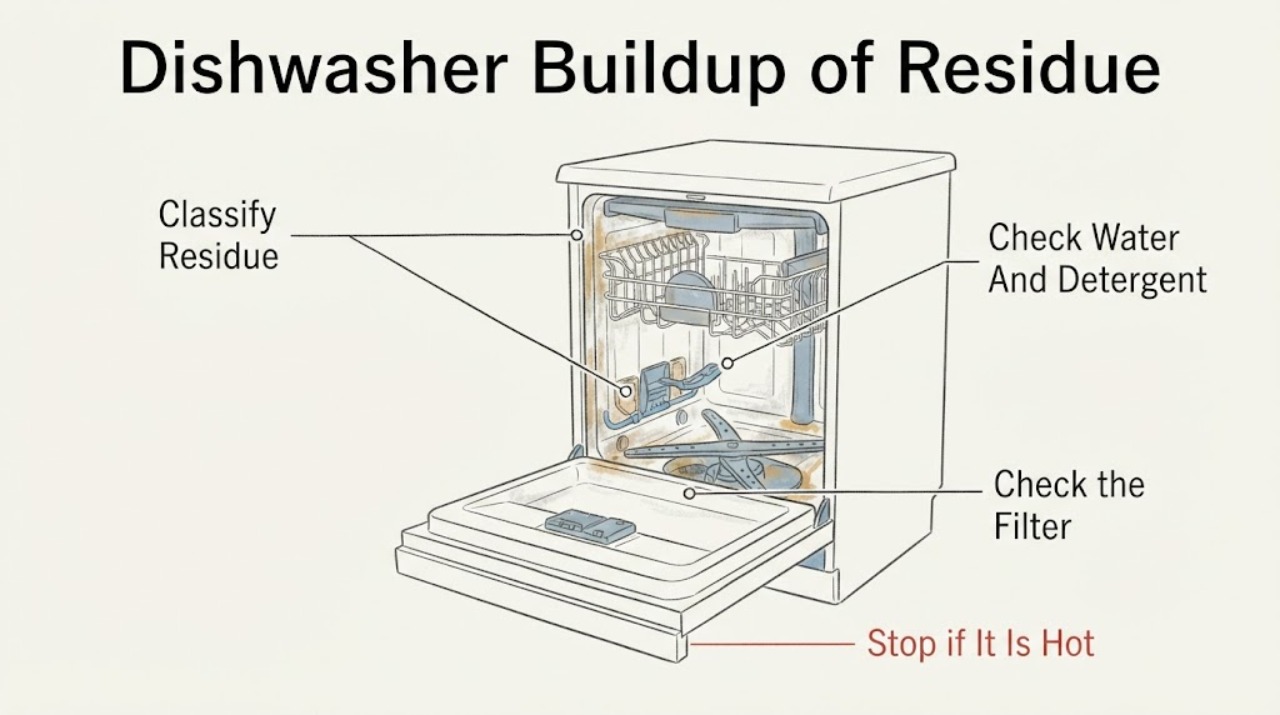
First identify the residue instead of treating every deposit as a failed part. GE says a white milky film on glassware, dishes or the tub is commonly a detergent/mineral film, especially in hard-water areas. Gritty or food residue points toward detergent freshness and amount, water temperature, loading, clogged filters or blocked spray-arm jets. Check the model’s filters and accessible spray arms, use only automatic-dishwasher detergent, keep detergent fresh and dry, and confirm the incoming water is hot enough for the model; GE publishes 120°F as a wash-performance target. For a confirmed white film or mineral/soap buildup, use one manufacturer-documented cleaning method such as a dishwasher cleaner, citric-acid wash or vinegar rinse, following the safety exclusions for metal items and delicate trim. If buildup returns after these checks, water remains in the tub, the spray arms or filters cannot be cleaned safely, or washing performance stays poor, arrange GE service rather than guessing at a heater, pump or water-softener fault.
Work through in order
Diagnostic checks
Use only checks that match the exact appliance or system and its official guide.
-
Check 1
Inspect a clean glass, dish and the tub interior for color, texture and distribution of the buildup before choosing a cleaner.
Expected result: The deposit is a white/milky film across surfaces, gritty detergent residue, food debris, isolated staining or visible scale on a rack/spray arm.
Next step: Use the matching water/detergent/debris or film-removal path. Photograph the pattern and record the model if it is not clear.
Why this matters
Why: GE associates white film with detergent/mineral buildup, while food or undissolved detergent points toward wash inputs and debris restrictions; the patterns do not prove a failed part.
-
Check 2
Check that the dishwasher receives hot water, use only automatic-dishwasher detergent that is fresh and dry, and follow the model’s amount and rinse-aid guidance.
Expected result: Water is below the model’s stated target, detergent is old/lumpy or unsuitable, or the amount/rinse aid does not match the manual.
Next step: Correct only the documented input condition and run the appropriate cycle once. If residue remains, continue to the filter/spray-arm check rather than increasing detergent blindly.
Why this matters
Why: GE says water temperature, detergent quality/amount and rinse aid affect how detergent dissolves and whether film or residue remains.
-
Check 3
With the dishwasher stopped and cool, clean only the model-approved removable filters and inspect spray-arm openings for food or mineral blockage.
Expected result: Filters or jets are clogged, or they are clear and spray arms can rotate without obstruction.
Next step: Clean or clear the accessible restriction without damaging jets, then use a suitable load. If access is unclear or residue persists, use the model manual or service.
Why this matters
Why: GE says debris restrictions reduce wash performance and can leave food or detergent residue; clear paths do not prove the heater or pump is healthy.
-
Check 4
If the pattern is white film or mineral/soap buildup, choose one GE-documented treatment—dishwasher cleaner, citric acid or vinegar rinse—and follow its material exclusions and cycle instructions.
Expected result: The film clears after one treatment, or it remains/returns across otherwise clean loads.
Next step: Do not combine acids or use harsher chemicals. If the film persists, record the result and arrange support rather than replacing a part from the appearance alone.
Why this matters
Why: GE says these treatments can remove white film and interior buildup, but recurrence indicates an unresolved water, detergent, loading or appliance condition.
-
Check 5
Record the exact model, residue type, cycle, detergent, measured incoming-water temperature, filter/spray-arm condition and cleaning result if buildup continues.
Expected result: Residue returns after documented checks, wash performance remains poor, water remains in the tub, or there is leaking or an electrical/thermal warning.
Next step: Keep the dishwasher out of use for leaks, standing water or electrical/thermal warnings and arrange GE service for persistent residue or poor washing.
Why this matters
Why: The remaining problem exceeds an accessible cleaning correction and does not identify a specific heater, pump, valve or control component.
Use your observations
Decision map
Find the observation that best matches what you see, then follow the next safe action.
-
PATH 01Next step
What you see
A white or milky film coats clean glassware and the tub, especially in a hard-water setting, with no gritty food debris.
Do this next
Use one GE-documented film-removal treatment with the stated material exclusions, then reassess the next clean load.
Why this path and its safety boundary
Why it matters: GE associates this pattern with phosphate-free detergent/mineral film rather than automatically with etching or a failed dishwasher part.
-
PATH 02Next step
What you see
Gritty food or detergent residue remains and filters, spray-arm jets, water temperature, detergent or loading are incorrect.
Do this next
Correct the accessible input or blockage according to the model manual and run the appropriate cycle once.
Why this path and its safety boundary
Why it matters: GE treats these as wash-performance inputs that can leave residue without proving an internal component failure.
-
PATH 03Next step
What you see
The rack or spray arm is restricted by residue, food debris or a blocked jet.
Do this next
Clean only the model-approved accessible filter, rack or jet area; do not force a rack or damage the spray openings.
Why this path and its safety boundary
Why it matters: GE says debris and residue can reduce spray action, make racks stick and leave dishes dirty.
-
PATH 04Next step
What you see
Residue returns after a suitable cleaning treatment and correct water/detergent/loading checks, or there is standing water, leaking or a warning symptom.
Do this next
Stop for leak, standing-water or electrical/thermal warnings and arrange GE service with the recorded evidence.
Why this path and its safety boundary
Why it matters: The problem is unresolved and residue alone cannot identify a heater, pump, valve or control-board fault.
Helpful context
Understand the symptom
Classify the residue before cleaning
Look at the color, texture and location. A white or milky film on glasses, dishes and the tub is the pattern GE associates with detergent/mineral film, often in hard-water areas. Gritty food particles or detergent left in the cup point toward wash performance, water temperature, loading or a blocked filter/spray arm. A single stain or damaged glass is a different question from a coating that returns across the load.
Check water, detergent and loading inputs
GE says the dishwasher should receive hot water and publishes 120°F as a general wash-performance target. Keep automatic-dishwasher detergent fresh and dry, use the amount suited to water hardness, and do not use ordinary liquid dish soap. Load dishes so spray arms and wash towers can rotate and use rinse aid as the model manual permits. These corrections address residue formation without assuming an internal part has failed.
Clean accessible filters and spray-arm openings
Food debris can clog filters and spray-arm jets, reducing wash action and leaving residue. GE says removable fine and ultra-fine filters should be cleaned according to the model instructions and that blocked jets can be cleared carefully without damaging them. Do not remove a filter or spray arm that the exact manual does not identify as user-removable, and do not reach into a running or energized appliance.
Use one documented film-removal treatment
For white film or confirmed mineral/soap buildup, GE documents a dishwasher cleaner, a citric-acid wash or a vinegar rinse. Its citric-acid procedure uses 3–4 ounces of crystals in the detergent cup, followed by a detergent cycle, and says to remove metal items and delicate silver/gold-trim pieces. The white-film guidance also describes a vinegar rinse after the detergent cup opens. Choose one method that the model and dishware can tolerate; do not combine acids or improvise stronger chemicals.
Escalate if residue keeps returning
If the residue returns after correct detergent, water, loading, accessible filter/spray-arm checks and one suitable cleaning treatment, record the model, residue appearance, water temperature, detergent type and cycle. Persistent poor cleaning can require service, but residue alone does not identify a heater, pump, water valve or control-board fault. Stop using the dishwasher if there is leaking, a burning smell, exposed wiring or standing water that does not drain.
When checks do not resolve it
Need a professional?
Arrange GE or qualified dishwasher service when residue returns after documented cleaning and wash-performance checks, filters/jets cannot be accessed safely, water remains in the tub, the appliance leaks, or an electrical or thermal warning appears. Do not choose a heater, pump, valve or control board from residue alone.
Common questions
FAQ
What causes white film in a GE dishwasher?
GE says a white or milky film can come from phosphate-free detergent and is most often seen in hard-water areas. It can also be associated with mineral or soap buildup rather than a failed heater or pump.
Can old detergent cause residue?
Yes. GE says old or lumpy detergent may not dissolve and can leave gritty residue. Keep detergent fresh and dry and use only detergent made for automatic dishwashers.
Should I replace a dishwasher part if residue keeps returning?
Not from residue alone. First record the model and check water, detergent, loading, accessible filters, spray-arm jets and one suitable cleaning treatment. Persistent buildup or poor washing needs service diagnosis rather than a guessed heater, pump or valve.
Read the exact guide
Official sources
- Dishwasher - Citric Acid Wash for Interior Cleaning and StainsGE Appliances · Official GE dishwasher procedure for soap, food, mineral or stain buildup in plastic and stainless interiors.
- Dishwasher - How to Get the Best Wash PerformanceGE Appliances · Official GE dishwasher guidance for spray-arm clearance, 120°F water, fresh detergent, rinse aid and model-manual routing.
- Dishwasher - Detergent and Rinse Agent TipsGE Appliances · Official GE dishwasher guidance on detergent type/freshness/amount and rinse-agent film prevention.
- Dishwasher - Removing White Film or ResidueGE Appliances · Official GE dishwasher guidance linking white/milky film to detergent and hard-water conditions and documenting cleaner, citric-acid and vinegar options.
- Dishwasher - Not Washing ProperlyGE Appliances · Official GE dishwasher guidance covering water temperature, detergent, filters, spray-arm jets, loading and service boundary.
- Dishwasher - Racks Squeaking or StickingGE Appliances · Official GE dishwasher guidance linking detergent/mineral buildup to rack wheels/slides sticking and recommending center-pull/cleaning guidance.
Community feedback
Share a repair observation
Share a plain-text repair observation. Accepted observations are published automatically; this page may take a moment to update.