
On this page
Start here
Quick answer
If BBQ sauce has burned onto the heating element of a GE GSD3360K55SS dishwasher, stop using the dishwasher, disconnect power from a safe point, and wait until the element and tub are completely cool. GE says food residue on a heating element can be scraped with a non-metallic object such as a wooden spoon or wiped with a cloth dampened with dish soap and water. First make sure the deposit is actually sauce or other food, not melted plastic, a cracked or damaged element, or residue around an electrical connection. Do not use metal tools, abrasive cleaners, oven cleaner, or a hot-cycle test. If the residue cannot be removed, the element is damaged, or a burning odor persists, leave the dishwasher out of service and arrange qualified service.
Before you begin
Safety first
- Do not touch a warm heating element, clean with power connected, open the dishwasher cabinet, probe live wiring, bend or remove the element, use metal or abrasive tools, apply oven cleaner or solvent, or run a heated cycle to test an unidentified deposit.
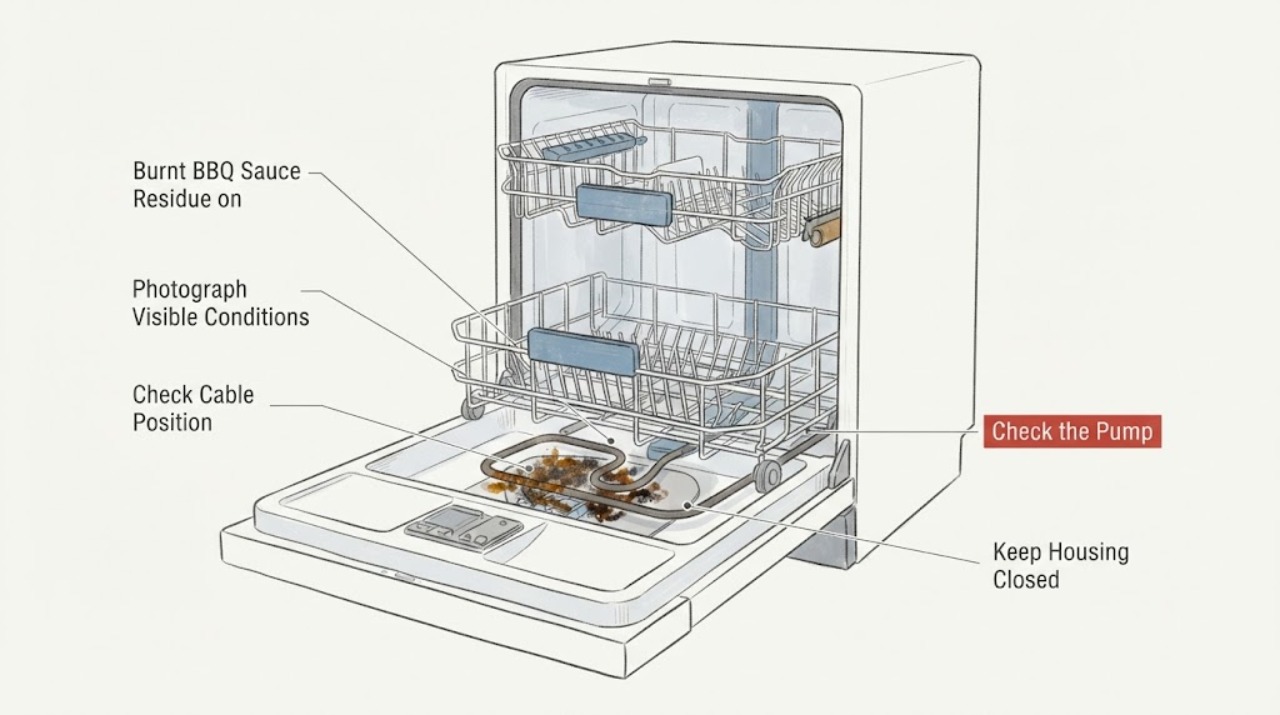
Work through in order
Diagnostic checks
Use only checks that match the exact appliance or system and its official guide.
-
Check 1
Stop the dishwasher and photograph the residue before disturbing it. Record the full rating-plate model as GE GSD3360K55SS, where the spill landed, whether the lower rack or a plastic item was above it, and whether there was smoke, a sharp electrical smell, or a breaker trip. Disconnect power from a dry, safely reachable point before any cleaning.
Expected result: The deposit is a localized brown/black sauce-like film or crust on the visible element, or it is glossy/plastic-like, fused to the element, accompanied by smoke/odor, or associated with a crack, blister, or missing element coating.
Next step: Continue only if the dishwasher is dry, de-energized, completely cool, and the deposit is clearly food. If its identity is uncertain or any electrical or physical damage is visible, leave it disconnected and arrange qualified service.
Stop if: Do not touch the element while warm, scrape before power is isolated, reset a tripping circuit, or open the dishwasher cabinet.
Why this matters
Why: A localized food deposit supports GE's cool-cleaning path. A plastic-like fused deposit or visible heater damage is not established as ordinary sauce residue, and smoke, electrical odor, or a trip is a safety stop.
-
Check 2
With power isolated and the element completely cool, remove the lower rack only if it comes out normally and inspect the deposit from above. If it is clearly dried BBQ sauce or food residue, loosen it gently with a wooden spoon or another non-metallic object, or wipe with a cloth dampened with dish soap and water. Do not use a knife, wire brush, abrasive pad, oven cleaner, or force against the element.
Expected result: The food residue lifts without bending, cracking, scraping through the element surface, or exposing a damaged area; alternatively it is fused, cannot be removed without force, or reveals a crack, bulge, exposed conductor, or melted plastic.
Next step: For a cleanly removed food film, wipe away cleaner residue and leave the element dry before any later use. For fused material, damage, or uncertainty, stop and request service rather than heating or prying it.
Stop if: Do not bend, lift, sand, drill, cut, or pull the element; do not apply water while power is connected or allow liquid to run into the tub openings or electrical areas.
Why this matters
Why: GE's support guidance permits non-metallic scraping or a damp soapy cloth for food residue after complete cooling. Resistance to gentle cleaning or a newly visible defect makes the condition more than a simple sauce spill.
-
Check 3
Inspect the surrounding tub bottom, rack, and nearby visible area for the source of the spill. Remove only loose, cool sauce-coated debris that is plainly accessible; do not dismantle the pump, sump, spray arm, or heater. Check whether a lightweight plastic item could have fallen onto the element and whether any food or object is blocking a spray-arm path.
Expected result: The sauce came from a dish and no plastic or hardware is damaged, or a plastic article is melted/fused, a rack is contacting the element, the spray arm is obstructed, or debris is at the pump inlet.
Next step: Correct only a loose accessible loading issue and follow the exact manual for any owner-removable rack or spray-arm part. Arrange service for fused plastic, a damaged rack or element, a blocked pump area, or any part that does not match the manual.
Stop if: Do not reach beneath the tub, remove the sump cover or heater, use metal tools in spray jets, or operate with a damaged or displaced element.
Why this matters
Why: A source dish or loose food deposit is consistent with a one-time spill. Melted plastic, rack/heater contact, or an obstruction can cause recurring odor or poor washing and is not solved by treating every mark as sauce.
-
Check 4
After the residue is removed or service has confirmed the element is safe, check from outside the appliance for persistent burnt odor, smoke staining, a damaged door or tub, or water near electrical parts. Do not run a heated cycle merely to burn off a remaining mark. If a later test is permitted by the exact manual, use one normal cycle and stop immediately for any returning odor or smoke.
Expected result: The visible sauce residue is gone and no odor or damage remains, or a burning smell, smoke, arcing, melting, abnormal heat, leak, or incomplete cycle returns.
Next step: Keep the dishwasher out of service and arrange qualified appliance or electrical service for any returning odor, smoke, damage, leak, or incomplete cycle. Provide the model, photos, and whether sauce, plastic, or another object was involved.
Stop if: Do not keep restarting the dishwasher, touch a hot element, bypass a control or thermal device, or perform live electrical tests.
Why this matters
Why: A clean, dry element without a continuing safety symptom supports a one-time food-spill explanation. Persistent odor or a hazard indicates remaining material, heater/tub damage, or another appliance fault that visual cleaning cannot certify.
Use your observations
Decision map
Find the observation that best matches what you see, then follow the next safe action.
-
PATH 01Next step
What you see
The deposit is clearly dried BBQ sauce or food residue, the element is intact and completely cool, power is isolated, and the residue lifts with gentle non-metallic or damp-cloth cleaning.
Do this next
Remove the loosened residue, wipe away cleaner residue, let the area dry, and use the exact owner manual before any normal cycle. Stop if odor or smoke returns.
Why this path and its safety boundary
Why it matters: This pattern fits GE's documented food-residue path rather than proving a failed heater or a need for a replacement element.
-
PATH 02Next step
What you see
The mark is glossy or plastic-like, fused to the element, accompanied by a melted item, or cannot be removed without force.
Do this next
Do not improvise with metal tools, solvents, heat, or a replacement material. Keep power isolated and arrange qualified appliance service if the item cannot be safely identified or removed without risk.
Why this path and its safety boundary
Why it matters: The symptom is more consistent with melted plastic or a bonded/unknown deposit than with a simple BBQ sauce film. GE's plastic-removal guidance still requires caution around a hot element, while persistent or unremovable material may require service.
-
PATH 03Next step
What you see
The element is cracked, blistered, displaced, visibly burned through, or the tub/rack is damaged; or there was smoke, arcing, burning odor, a breaker trip, or water near electrical parts.
Do this next
Leave the dishwasher disconnected and arrange qualified appliance service, with qualified electrical or plumbing help for the external hazard. Do not run another cycle to locate the fault.
Why this path and its safety boundary
Why it matters: This is a heater, fire, electrical, or water-damage safety boundary, not ordinary food cleanup. A visible mark cannot prove that the element's insulation or circuit remains safe.
-
PATH 04Next step
What you see
The food mark is gone, but the dishwasher continues to smell burnt, smokes, heats abnormally, leaks, or stops before completing a cycle.
Do this next
Stop use and provide service with the model, photos, cycle history, and whether the residue was sauce, plastic, or uncertain material. Do not order a heater from appearance alone.
Why this path and its safety boundary
Why it matters: The spill is not sufficient to explain the continuing symptom. Remaining residue, melted material, a damaged heating circuit, or another appliance fault needs diagnosis beyond external cleaning.
Helpful context
Understand the symptom
BBQ sauce is an organic food spill, but once it has charred it can look like melted plastic or damage to the black heating element. That classification matters: GE provides a cool, de-energized cleaning path for food residue, while a melted item, a damaged element, or a continuing burning odor needs a different stop-and-service decision. A normal wash cycle is not a safe way to test whether the deposit has cleared.
The opened GE owner-center page identifies the GSD3360KSS support family and its owner manual. Confirm the complete rating-plate identity, including the assigned GSD3360K55SS suffix, before following any model-specific control or removal instruction. The steps below stay at the visible element and interior-cleaning boundary and do not authorize cabinet, wiring, or heater replacement work.
When checks do not resolve it
Need a professional?
Call GE or a qualified appliance technician for fused or unidentified residue, visible element/tub/rack damage, a persistent burnt odor or smoke, a breaker trip, a leak, or any symptom that returns after a clearly successful cool food-residue cleanup.
Safety scope: Do not touch a warm heating element, clean with power connected, open the dishwasher cabinet, probe live wiring, bend or remove the element, use metal or abrasive tools, apply oven cleaner or solvent, or run a heated cycle to test an unidentified deposit.
Have this ready
- Provide the complete rating-plate model GSD3360K55SS, photos before and after cleaning, the exact location and appearance of the deposit, whether BBQ sauce or a plastic item was involved, cycle history, smoke or odor observations, and any breaker, leak, or damage details.
Common questions
FAQ
Can BBQ sauce burned onto a GE dishwasher heating element be cleaned?
If it is clearly food residue, GE says to disconnect power and wait until the element is completely cool, then use a non-metallic object such as a wooden spoon or a cloth dampened with dish soap and water. Do not clean a warm or energized element.
Should I run the dishwasher to burn off the sauce?
No. First isolate power and remove the cool food residue. A heated test can spread smoke or odor and cannot prove that an unidentified deposit, melted plastic, or damaged element is safe.
How can I tell BBQ sauce from melted plastic on the element?
A localized dull, sauce-like film that lifts gently after cooling supports food residue. A glossy or fused deposit, a melted item on the rack, or material that requires force should be treated as plastic or unidentified. Do not use metal tools or solvents; request service if it will not lift safely.
When does burnt residue mean the GE dishwasher needs service?
Use service for a damaged or displaced element, fused or unremovable material, persistent burning odor, smoke, arcing, a breaker trip, a leak, abnormal heat, or an incomplete cycle after cleaning. Do not order a replacement heater solely from a dark mark.
Read the exact guide
Official sources
- Removing Plastic from Dishwasher ElementGE Appliances · Used only to distinguish a plastic-like fused deposit from food residue and to reinforce the non-metallic-tool and heat caution; it does not authorize a hot-cycle procedure for an unidentified BBQ sauce deposit.
- User Manual & Care for GSD3360KSS | GE AppliancesGE Appliances · Opened GE support page identifies the standard-tub dishwasher support page and links the owner manual. It does not independently prove that every suffix of GSD3360K55SS has identical controls or parts.
- Dishwasher - Burning Odor, Removing Plastic from ElementGE Appliances · Directly supports distinguishing food residue from melted plastic, complete cooling and power isolation before cleaning, non-metallic or damp-cloth cleaning for food residue, and service for persistent odor or unremovable material.
- Dishwasher - Standard Lower Spray Arm RemovalGE Appliances · Supports waiting for the interior and element to cool and not removing the lower spray arm unless the exact owner manual allows it; it is not a heater or pump repair instruction.
- Dishwasher - OdorsGE Appliances · Supports checking food or plastic near the element, pump inlet, and spray-arm path, waiting for the element to cool, and treating persistent burning odor as a service concern. Exact model removal instructions control.
- 49-55114-1 Owner's Manual - DishwashersGE Appliances · Supports the model-family safety boundary not to touch the heating element during or immediately after use, to disconnect power before maintenance, to keep enclosure panels in place, and to avoid assuming a hot-cycle result proves a safe heater.
Community feedback
Share a repair observation
Share a plain-text repair observation. Accepted observations are published automatically; this page may take a moment to update.