
On this page
Start here
Quick answer
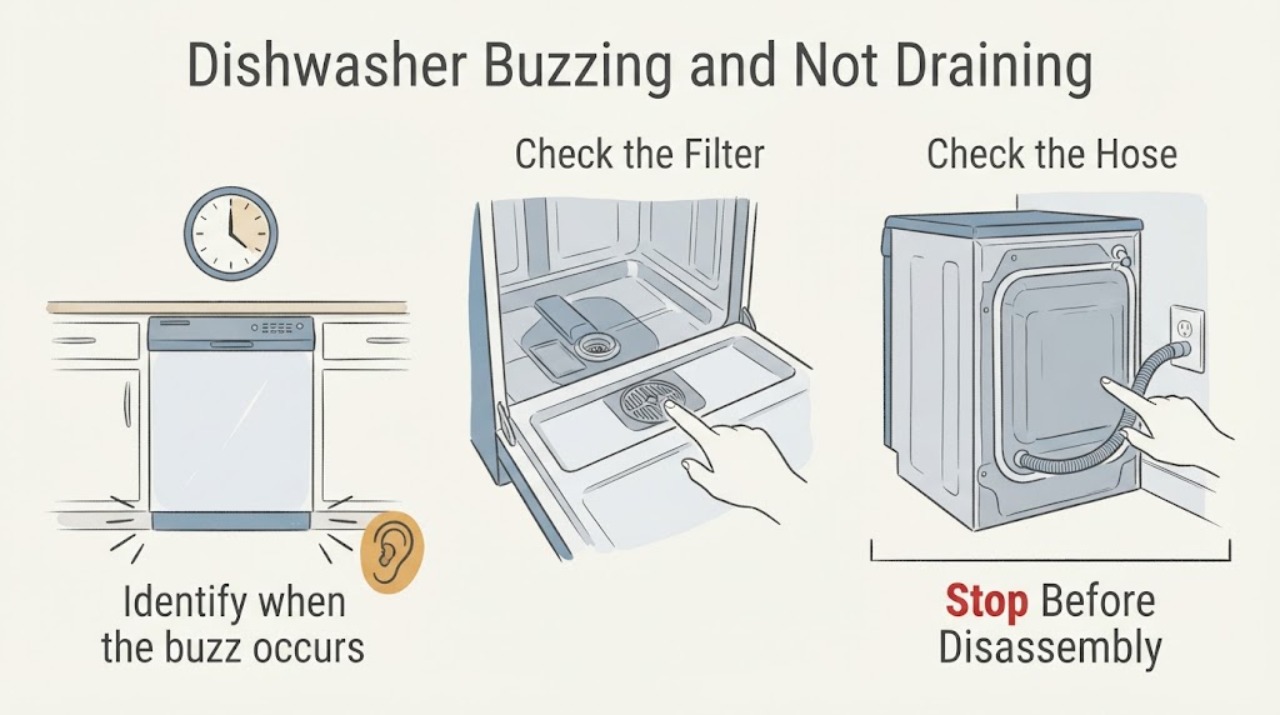
A GE dishwasher's buzz is not enough to identify a failed pump. GE says humming can come from the fan, soft-food disposer, or drain pump, and the drain pump may pause and restart during a normal drain. First note when the buzz occurs and whether excessive water remains. If water remains, check only the user-accessible filter/sump area, sink or disposer, air gap, drain hose, and documented high-loop installation; use the exact model manual for any model-specific procedure. Do not put hands in a disposer or use drain cleaner. If the noise is abnormal or the dishwasher still will not drain after these external checks, stop and arrange service.
Work through in order
Diagnostic checks
Use only checks that match the exact appliance or system and its official guide.
-
Check 1
Identify when the buzz occurs and check the water level after the dishwasher stops: note whether it is during wash circulation, the drain portion, or after the cycle, and whether water covers the tub bottom.
Expected result: A short hum or brief pause/restart during drain can be normal GE operation. Excess water left in the tub supports a real draining symptom; a small amount of clean water can be normal on models without an Ultra Fine filter, while water in the sump area is normal on models with one.
Next step: If water is excessive, continue with the external drain-path checks below. If the buzz is grinding, unusually loud, or occurs without the expected water/cycle context, stop repeated testing and use the service branch.
Why this matters
Why: The phase separates a normal operating hum from a drain complaint without proving which internal motor or pump is involved.
-
Check 2
With the dishwasher stopped, inspect only the model-provided Fine/Ultra Fine filter and the visible sump area for paper, large objects, or food debris; do not reach into a hidden pump opening.
Expected result: Look for a filter that is blocked or not seated and for noodles, lettuce, bones, paper, or other large debris covering the rear sump area. Compare the water level with the filter configuration described by GE and the exact model manual.
Next step: Remove only loose, visible debris and clean or reseat a user-accessible filter as the exact manual permits. If the area is clear or the problem returns, continue to the sink-side checks and then service.
Why this matters
Why: GE identifies filter/sump blockage as a possible reason for excessive water, but a visible obstruction does not prove a failed drain pump.
-
Check 3
Inspect the sink-side drain path without disconnecting plumbing: check the dishwasher drain hose below the sink for a kink or blockage, check the sink drain, and if an air gap is installed inspect its cap for debris.
Expected result: A kinked hose, clogged sink, or debris in the air gap can restrict discharge. If a disposer was recently installed or replaced, the disposer drain plug may still be present.
Next step: Correct only a visible, accessible obstruction according to the appliance/disposer instructions. Never put hands in a disposer, and do not use drain cleaner in the dishwasher. If the path is clear and draining still fails, arrange service.
Why this matters
Why: These are external plumbing or installation conditions that can prevent draining and can coexist with a normal drain-pump hum; they do not identify an internal dishwasher part.
-
Check 4
Check detergent and visible installation conditions: confirm that the product is dishwasher detergent, not hand soap, and that the amount has not produced heavy suds; where there is no air gap, compare the drain-hose high loop with the exact installation instructions.
Expected result: Excessive suds or a missing/incorrect high loop can interfere with draining. Do not assume a generic hose height or detergent amount when the GE model and installation instructions differ.
Next step: Stop adding non-dishwasher soap or excess detergent and follow the exact model/installation instructions. Do not dismantle the pump or change plumbing based on a buzz alone.
Why this matters
Why: GE lists wrong or excessive detergent as a cause of oversudsing that can prevent proper draining and requires a high drain loop when an air gap is not used.
-
Check 5
Make the service decision from the combined result: consider the problem unresolved if excessive water remains, the buzz is abnormal, the external drain path is clear, or the dishwasher is portable with a unicouple connection.
Expected result: GE says persistent draining problems after these suggestions need service; it specifically directs portable dishwashers that do not drain through a unicouple to service, while a portable unit connected by a drain hose can use the listed checks.
Next step: Stop the cycle and schedule GE or qualified appliance service. Keep hands out of the disposer, avoid drain cleaner, and do not open the cabinet or replace a part without exact model-specific instructions.
Why this matters
Why: A persistent paired symptom has crossed the safe user-check boundary; it is not evidence that the drain pump, disposer, valve, or control has failed.
Use your observations
Decision map
Find the observation that best matches what you see, then follow the next safe action.
-
PATH 01Next step
What you see
If the buzz is brief or pauses/restarts during the drain portion and little or no abnormal water remains
Do this next
Monitor the next cycle for normal completion; consult the exact owner manual if the sound is new or changes.
Why this path and its safety boundary
Why it matters: GE describes drain-pump start/stop and humming from several operating components as normal possibilities.
-
PATH 02Next step
What you see
If the buzz occurs during draining and excessive water remains in the tub
Do this next
Work through the visible filter and sink-side checks, then arrange service if the water remains.
Why this path and its safety boundary
Why it matters: The sound may be normal motor operation while a filter, sump, sink, hose, air-gap, detergent, or installation condition is restricting drainage; the symptom does not identify a pump fault.
-
PATH 03Next step
What you see
If the filter and sink-side path are clear but the dishwasher still stops with water or the noise is grinding/unusually loud
Do this next
Stop repeated testing and schedule service; do not open the cabinet or bypass a control.
Why this path and its safety boundary
Why it matters: The official external checks have not resolved the drain/noise concern and the internal cause is not established by the symptom.
-
PATH 04Next step
What you see
If the dishwasher is portable and uses a unicouple connection
Do this next
Stop the cycle and arrange service rather than improvising a sink connection or internal repair.
Why this path and its safety boundary
Why it matters: GE specifically routes a portable dishwasher that is not draining through a unicouple to service; the ordinary drain-hose suggestions apply only when it is connected by a drain hose.
Helpful context
Understand the symptom
“Buzzing” is a timing clue, not a component diagnosis. GE lists humming from the fan, soft-food disposer, or drain pump as potentially normal and says a drain pump can start and stop several times during a drain. Pair the sound with the cycle stage and the amount of water left in the tub. The checks below stay at the visible filter, sump, sink, air-gap, hose, detergent, and installation level because no GE model number was supplied.
When checks do not resolve it
Need a professional?
Arrange GE or qualified appliance service if the dishwasher still retains excessive water after the visible filter, sump, sink, air-gap, hose, detergent, and installation checks; if the buzz is abnormal or persistent; or if a portable dishwasher with a unicouple will not drain. Do not put hands in a disposer, use drain cleaner in the dishwasher, open the cabinet, bypass a control, or diagnose/replace a pump from sound alone.
Common questions
FAQ
Is a humming or buzzing sound always a bad drain pump?
No. GE says humming can come from the cooling fan, soft-food disposer, or drain pump, and the drain pump can pause and restart during draining. Pair the sound with the cycle stage and water level before deciding whether the drain symptom persists.
How much water in the bottom of a GE dishwasher is normal?
GE says that on models without an Ultra Fine filter, 1 to 2 cups of clean water covering the bottom can be normal. On models with an Ultra Fine filter, water in the sump/filter area is normal but it should not cover the tub bottom. Confirm the filter configuration in the exact model manual.
Can I use drain cleaner or reach into the disposer to clear the dishwasher?
No. GE says not to use drain cleaner in the dishwasher and warns not to put hands into a garbage disposer because of serious injury risk. Use only the visible, documented checks, then arrange service if the drain path remains blocked.
Read the exact guide
Official sources
- Dishwasher - Humming SoundGE Appliances Product Support · Official GE Appliances support article explaining normal dishwasher humming; it is used only to avoid treating a buzz as proof of pump failure.
- Dishwasher - Not DrainingGE Appliances Product Support · Official GE Appliances support article for dishwasher not-draining symptoms without a model-specific code; exact model instructions govern model-dependent filter and installation details.
- Dishwasher - Normal / Abnormal NoisesGE Appliances Product Support · Official GE Appliances support article for dishwasher operating sounds; it distinguishes normal humming and drain pauses from abnormal sound categories but does not diagnose a specific model part.
Community feedback
Share a repair observation
Share a plain-text repair observation. Accepted observations are published automatically; this page may take a moment to update.