
On this page
Start here
Quick answer
Do not use the GE HDA2100V35WW dishwasher again until the Fabuloso has been removed and any human exposure has been addressed. Fabuloso's own FAQ says its products are not formulated or intended for dishes, should not be heated, and must not be mixed with chlorine bleach; the GE dishwasher manual says to use only detergent or rinse agent made for dishwashers and warns that the wrong detergent can create suds that spill out. Stop the cycle, keep people away from fumes or overflow, and do not add vinegar, bleach, ammonia, another cleaner, or a heated rinse to 'neutralize' it. If anyone was splashed, inhaled fumes, or swallowed any product, rinse or move to fresh air as appropriate and use webPOISONCONTROL or a local poison center with the exact bottle available. Once the dishwasher is cool and there is no exposure hazard, follow the exact GE manual's cold-water pump-out procedure for suds; otherwise leave it off and arrange GE or qualified service.
Before you begin
Safety first
- Do not heat the cleaner, mix it with bleach, vinegar, ammonia, or another chemical, open the dishwasher panels, reach into the sump, touch wiring or the heater, probe live parts, or bypass controls. Keep people away from fumes, overflow, and contaminated liquid.
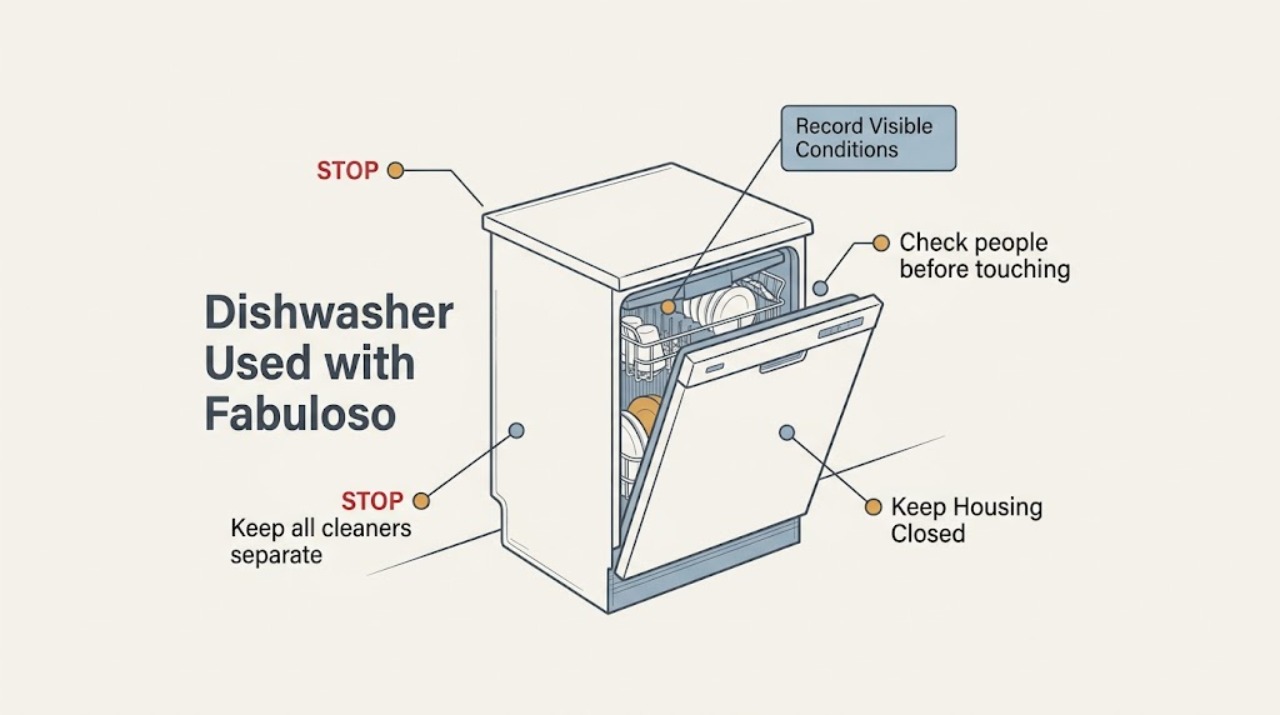
Work through in order
Diagnostic checks
Use only checks that match the exact appliance or system and its official guide.
-
Check 1
Stop the dishwasher at once. If it is still running, use its normal cancel/stop control only from a dry, safe position; do not start another cycle or add water, detergent, vinegar, bleach, ammonia, or another cleaner. Record the exact Fabuloso product name, approximate amount, cycle, whether it reached a heated stage, and whether there are suds, odor, overflow, or a leak.
Expected result: The cycle is still running or hot, there are expanding suds or overflow, the product or amount is unknown, or the cycle stopped with little visible residue.
Next step: Keep the appliance out of service and keep the bottle or label. If there is active overflow, protect people from the liquid without touching contaminated material unnecessarily and arrange qualified appliance help after any human exposure is addressed.
Stop if: Do not run a heated rinse, repeatedly restart the dishwasher, or combine products to remove the cleaner.
Why this matters
Why: Fabuloso's official FAQ says the product is not intended for dishes and should not be heated. The GE manual warns that a non-dishwasher detergent can fill the appliance with suds and spill; the visible amount alone does not establish that the appliance or dishes are safe.
-
Check 2
Check people before touching the dishwasher. For cleaner in an eye, remove contact lenses and irrigate immediately with plenty of room-temperature water for 15–20 minutes. For skin contact, remove contaminated clothing and rinse with running water for at least 15 minutes. For inhalation, leave the area for fresh air and ventilate without lingering over the dishwasher. If swallowed, do not induce vomiting; follow the product label and contact poison experts.
Expected result: There is persistent eye pain or vision trouble, worsening skin pain/redness/swelling or blistering, coughing or breathing difficulty, swallowing exposure, or no human exposure.
Next step: Use webPOISONCONTROL or the local poison center promptly and have the exact bottle, label, amount, timing, age, and symptoms ready. Seek emergency care for severe symptoms after the immediate rinse or fresh-air step.
Stop if: Do not taste residue, induce vomiting, apply a home neutralizer, or keep someone in a fume-filled room to inspect the appliance.
Why this matters
Why: Poison Control says cleaner exposures must be assessed by route, product, amount, symptoms, and time. Severe breathing trouble, collapse, seizure, or inability to awaken is an emergency; a lack of symptoms does not make an unknown amount safe to guess about.
-
Check 3
Keep all cleaners separate. Do not add chlorine bleach, vinegar or another acid, ammonia, dishwasher detergent, drain opener, or any purported neutralizer to the tub. Keep the room ventilated and stay away if the odor becomes sharp or irritating; do not use heat to evaporate or burn off the product.
Expected result: Only the original Fabuloso was used and the odor is fading, another cleaner was already added, or the odor causes eye, nose, throat, or breathing symptoms.
Next step: Leave the area and use webPOISONCONTROL or a poison center for exposure guidance. Keep the dishwasher off; if another chemical was added or symptoms persist, do not attempt appliance cleanup until the exposure advice and ventilation conditions are clear.
Stop if: Do not try to identify fumes by smelling closely, pour chemicals into the tub, or restore heat as a test.
Why this matters
Why: Fabuloso's official FAQ prohibits mixing with chlorine bleach, and Poison Control warns that household-cleaner mixtures can create dangerous fumes. An irritating odor after a mixed or heated exposure is a people-safety issue, not a cue to run another cycle.
-
Check 4
After the cycle has stopped, the dishwasher is cool, and no person is being exposed, inspect only the accessible tub area and floor for contained suds, pooled liquid, a leak, or a strong residual odor. Do not touch the heating element immediately after use; the GE manual says to wait at least 20 minutes before interior cleaning. If the problem is only contained suds, use the GE manual's cold-water dilution and pump-out procedure exactly; do not improvise a heated rinse.
Expected result: There are contained suds with no leak or strong fumes, broad overflow or a leak, persistent strong odor/residue, or an abnormal drain/control response.
Next step: For contained suds only, follow the manual's cold-water/pump-out instructions and stop if the condition worsens. For overflow, leak, persistent odor, abnormal draining, or uncertain chemical residue, leave the appliance off and arrange GE or qualified service after poison-control guidance where relevant.
Stop if: Do not open panels, reach into the sump, touch wiring or the heater, or keep repeating cycles to chase the smell.
Why this matters
Why: The exact GE manual provides a cold-water and pump-out path for wrong-detergent suds, but it does not make Fabuloso a dishwashing product or prove that a residue-heavy or mixed-chemical event is safe. Overflow, a leak, or an abnormal appliance response needs more than a rinse cycle.
-
Check 5
Set aside the affected dishes and any utensil or rack that still has visible cleaner, suds, or odor. Do not use them for food until all residue is gone and they have been rewashed with a product intended for automatic dishwashers or according to product-specific poison-control/manufacturer advice. Do not assume that one empty heated cycle makes food-contact surfaces safe.
Expected result: Dishes are visibly coated, smell strongly of cleaner, show no residue or odor after safe re-washing, or the appliance cannot complete a normal drain without renewed suds.
Next step: Keep questionable dishes out of food service and ask the product manufacturer or poison-control experts for formulation-specific guidance. Have GE service assess the dishwasher if residue, odor, suds, leak, drain, or control symptoms remain.
Stop if: Do not serve food on dishes that retain cleaner odor or residue and do not use a chemical additive to mask it.
Why this matters
Why: Fabuloso's FAQ does not authorize use on dishes, and a household cleaner's exact formulation and exposure amount are not established by the dishwasher's appearance. Persistent suds or odor also indicate that the appliance has not been cleared for normal use.
-
Check 6
When requesting help, provide the full GE model HDA2100V35WW, the exact Fabuloso variant and label, approximate quantity, cycle and temperature if known, time since exposure, whether another product was added, photos of overflow or residue, and any symptoms or appliance changes. Do not identify a failed pump, heater, valve, or control from suds alone.
Expected result: The appliance drains and has no visible residue or odor after the safe, manual-directed procedure, or the issue persists or includes a leak, abnormal drain, control problem, repeated suds, or strong odor.
Next step: Return the dishwasher to use only when the residue/odor issue is resolved and the safe instructions from the manufacturer or poison experts support it. Otherwise leave it off and arrange GE or qualified appliance service.
Stop if: Do not open the appliance, probe live parts, bypass controls, or order a part based only on the Fabuloso incident.
Why this matters
Why: A contained wrong-detergent event may resolve without proving an internal part failure; persistent symptoms cross into appliance diagnosis, while human exposure needs product- and route-specific poison guidance. The exact model and product label are necessary to avoid guessing.
Use your observations
Decision map
Find the observation that best matches what you see, then follow the next safe action.
-
PATH 01Next step
What you see
The cycle was stopped, no one was exposed, no other chemical was added, suds are contained, and the appliance is cool with no leak or strong irritating odor.
Do this next
Follow the exact GE manual's cold-water dilution and pump-out procedure, then inspect for residual suds or odor. Do not use a heated rinse or add another chemical.
Why this path and its safety boundary
Why it matters: This is the narrow low-risk appliance branch: the event is consistent with wrong-detergent suds rather than proof of a failed component, but Fabuloso still is not approved for dishes or heating.
-
PATH 02Next step
What you see
Suds escape onto the floor, liquid leaks, the drain or controls respond abnormally, or the strong odor remains after the appliance is stopped and cool.
Do this next
Keep the dishwasher off, protect people from the liquid or fumes without mixing cleaners, and arrange GE or qualified appliance service. Do not restart to confirm the fault.
Why this path and its safety boundary
Why it matters: The incident is no longer just a contained detergent mistake; water/electricity, drain, or persistent-residue risk requires an appliance safety boundary.
-
PATH 03Next step
What you see
Cleaner reached a person's eye, skin, lungs, or stomach, or the exact product/amount is unknown and symptoms are present.
Do this next
Use the immediate Poison Control first-aid steps and contact webPOISONCONTROL or a local poison center with the bottle available; use emergency services for severe breathing trouble, collapse, seizure, or inability to awaken.
Why this path and its safety boundary
Why it matters: Human exposure takes priority over appliance cleanup. Route, amount, product formulation, symptoms, and timing change the recommended response.
-
PATH 04Next step
What you see
Bleach, vinegar, ammonia, or another cleaner was added, or the dishwasher was heated after the multipurpose cleaner was added and irritating fumes developed.
Do this next
Leave the area for fresh air, ventilate if it can be done without exposure, and obtain poison-control guidance. Keep the dishwasher off until the exposure concern is resolved, then arrange service if appliance residue or operation is abnormal.
Why this path and its safety boundary
Why it matters: A possible mixed-chemical or heated-fume exposure is more urgent than residue removal; smelling the tub or running another cycle cannot establish safety.
Helpful context
Understand the symptom
This is both a chemical-use mistake and a dishwasher residue problem. The exact Fabuloso formulation and amount matter for a human exposure, so do not infer safety from the absence of visible damage or from a pleasant smell. GE's manual supports dishwasher detergent or rinse agent only; Fabuloso's FAQ does not authorize using its multipurpose cleaner on dishes or heating it.
The safest sequence is to stop adding chemicals, address people before the appliance, prevent a heated repeat cycle, and then use only the GE model manual's cold-water and pump-out guidance if the situation is limited to contained suds and no one is being exposed. A strong odor, overflow, leak, abnormal drain, or residue that remains after the safe procedure is a reason to stop and obtain help rather than keep running cycles.
When checks do not resolve it
Need a professional?
Request GE or qualified appliance service for a leak or overflow, persistent suds or odor, abnormal draining or controls, or residue that cannot be cleared using the exact model manual without opening the machine. Contact poison-control experts first for any human exposure or mixed-chemical concern.
Safety scope: Do not heat the cleaner, mix it with bleach, vinegar, ammonia, or another chemical, open the dishwasher panels, reach into the sump, touch wiring or the heater, probe live parts, or bypass controls. Keep people away from fumes, overflow, and contaminated liquid.
Have this ready
- Provide model HDA2100V35WW, exact Fabuloso product name and label, approximate amount, cycle and heat stage, time elapsed, any added product, photos of residue or overflow, drain/control behavior, and exposure symptoms.
Common questions
FAQ
Is the GE dishwasher safe after someone ran it with Fabuloso?
Do not assume it is safe immediately. Stop use, do not heat or mix chemicals, address any human exposure, and keep the Fabuloso bottle. If the issue is only contained suds and the appliance is cool, follow the exact GE manual's cold-water pump-out guidance. Persistent odor, residue, overflow, leak, or abnormal draining needs manufacturer or qualified service advice.
Can I add bleach, vinegar, ammonia, or dishwasher detergent to remove Fabuloso?
No. Fabuloso says not to mix its products with chlorine bleach, and adding other cleaners can create irritating or dangerous fumes. Do not improvise a neutralizer or run a heated cycle to burn off or evaporate the cleaner.
What should I do if Fabuloso got on a person's skin or in an eye?
For skin, remove contaminated clothing and rinse with running water for at least 15 minutes. For an eye, remove contacts and irrigate with room-temperature water for 15–20 minutes. Use webPOISONCONTROL or a local poison center with the exact bottle and seek urgent care for severe or persistent symptoms.
Can I just run an empty hot cycle to rinse the dishwasher?
Do not use repeated heat cycles as a cleanup experiment. Fabuloso's official FAQ says its products should not be heated. After the dishwasher is cool and there is no exposure hazard, use only the GE manual's cold-water and pump-out instructions for contained suds; get service if odor, residue, leaks, or abnormal operation remain.
Read the exact guide
Official sources
- Frequently Asked Questions | FabulosoFabuloso · Official Fabuloso FAQ used for the product's own boundaries; exact variant still matters for exposure advice.
- Get help online or by phonePoison Control, National Capital Poison Center · Supports escalation for an actual or uncertain human cleaner exposure, not appliance diagnosis.
- GEAppliances.com Owner's Manual DishwashersGE Appliances · Exact manual link for the assigned model; supports detergent, suds, cooling, pump-out, and service safety boundaries.
- Multi-Purpose Cleaner | FabulosoFabuloso · Supports the need to identify the exact product label and follow its stated use; it is not a dishwasher-use authorization or a substitute for product-specific exposure advice.
- What's that smell?: Identifying unknown fumes in your homePoison Control, National Capital Poison Center · Supports leaving and ventilating for irritating or unknown fumes; does not identify the Fabuloso formulation or appliance residue.
- First aid: Act fast!Poison Control, National Capital Poison Center · General immediate first aid; poison-control experts remain the source for product-specific follow-up.
- Replacement PartsGE Appliance Parts · Exact model page used to lock the assigned HDA2100V35WW identity and to open the linked dishwasher manual.
- Cleaning sprays: How harmful are they?Poison Control, National Capital Poison Center · General route-specific cleaner exposure guidance; use the exact Fabuloso label and poison-control assessment for formulation-specific decisions.
Community feedback
Share a repair observation
Share a plain-text repair observation. Accepted observations are published automatically; this page may take a moment to update.