
On this page
Start here
Quick answer
Start by locating the mark. GE says dishwasher interiors do not typically rust; a rust-colored mark commonly comes from a rust-prone object, a rack or nearby part carrying surface iron, or the household water supply. A light transferable stain can often be treated with GE's citric-acid procedure in an empty dishwasher, while extensive rack rust is not repairable and a pitted, perforated, leaking, or electrically damaged interior needs service. Do not use steel wool, chlorine or caustic cleaners on stainless surfaces, do not put Iron-Out in the detergent cup, and do not keep running the dishwasher if corrosion is associated with a leak, smoke, burning odor, or exposed wiring.
Before you begin
Safety first
- Do not continue running the dishwasher when corrosion is paired with a leak, smoke, burning odor, or exposed wiring. Do not open panels, use live electrical tests, scrub with steel wool, use chlorine or caustic cleaners, coat a damaged tub or rack, or put Iron-Out in the detergent cup.
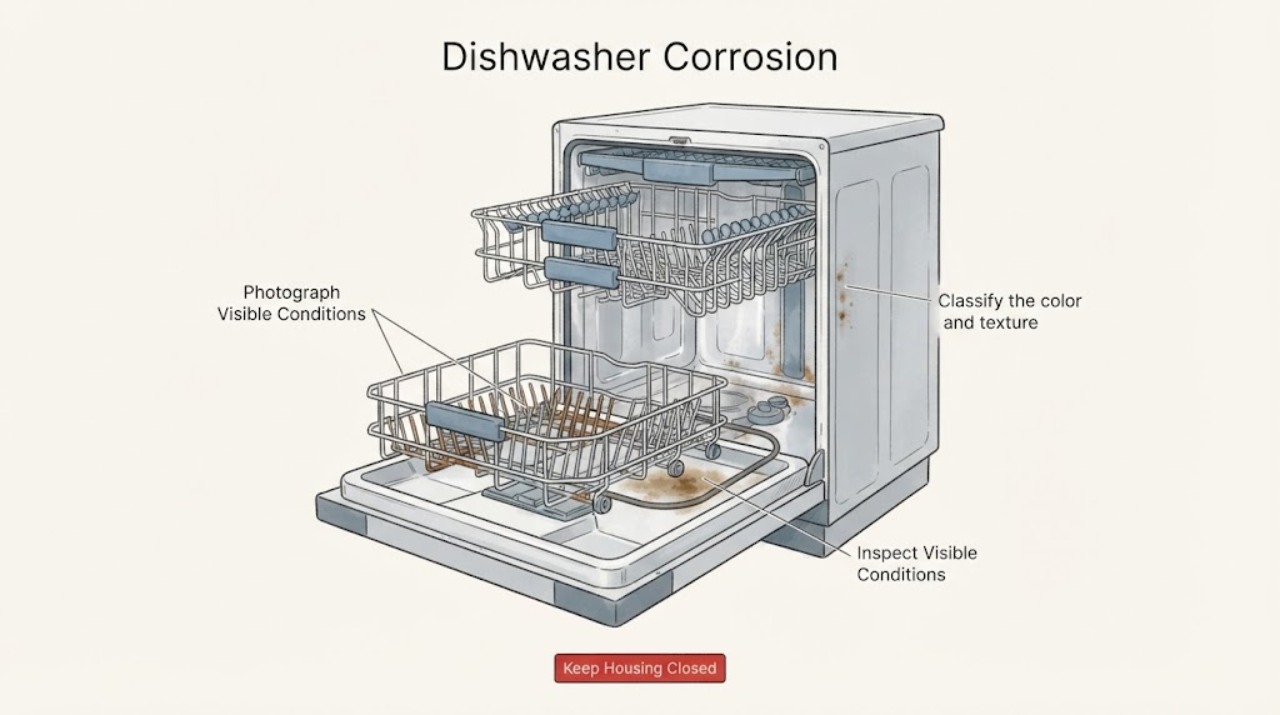
Work through in order
Diagnostic checks
Use only checks that match the exact appliance or system and its official guide.
-
Check 1
With the dishwasher idle and safe to inspect, photograph the mark and record its exact location: on a dish or utensil, rack wire, heating element or support, tub floor or wall, door edge, or near a water connection. Also record whether there is pitting, a hole, standing water outside the tub, smoke, a burning odor, or exposed wiring.
Expected result: The mark is a loose surface deposit with no pit or leak; it is on a rusty rack; it is on the tub surface; or it is paired with a leak, smoke, burning odor, or exposed wiring.
Next step: If there is a leak, smoke, burning odor, or exposed wiring, stop the dishwasher and arrange qualified service; disconnect power or water only if that can be done safely. Otherwise continue with the matching stain or rack check without scraping the surface.
Why this matters
Why: Location separates a transferable stain or rack problem from possible tub or electrical damage. A color alone cannot identify a corroded internal part.
-
Check 2
Inspect the load and rack without removing panels. Look for a rusty pan, utensil, rack contact point, broken rack coating, or metal item touching the tub; then remove only the clearly rust-prone item or correct the contact.
Expected result: A rust-prone object or rack contact is present, or the mark remains on the tub after the object is removed.
Next step: Keep the object out of the dishwasher and monitor the location. If the rack has extensive rust, plan rack replacement; if the tub is pitted, perforated, or leaking, use service rather than a cosmetic coating or abrasive repair.
Why this matters
Why: GE identifies objects placed inside and rust appearing from racks or nearby stainless parts as common sources; removal can prevent recurrence, but a mark that remains does not prove the tub itself is failing.
-
Check 3
Classify the color and texture before choosing a cleaner. Compare gray or brown buildup, white film, red/pink/orange food stain, and yellow ring or deposit under the heating element; do not assume each is corrosion.
Expected result: The deposit matches a mineral or iron buildup, white film, tomato-based stain, or a yellow mineral ring rather than loose rust.
Next step: Use the matching GE cleaning guidance: citric acid for mineral/iron buildup, a vinegar rinse for spots or film, and normal cleaning/loading changes for food staining. Do not use citric acid expecting it to remove tomato staining.
Why this matters
Why: GE says gray/brown deposits can be calcium or iron, white film can be minerals or detergent residue, red/pink/orange marks are generally tomato-based, and a yellow ring under the element can be mineral buildup.
-
Check 4
For a loose rust or mineral deposit on a plastic or stainless interior, remove all silverware, aluminum, other metals, and patterned dishes or glasses. Fill the detergent cup with three to four ounces of citric-acid crystals, close it, run a normal cycle, then run another cycle without crystals but with a full cup of detergent.
Expected result: The deposit lightens after one treatment, needs a second treatment, or does not change and the surface is pitted or damaged.
Next step: Repeat only the GE-supported treatment when the mark is a removable deposit and the interior remains intact. Stop cleaning experiments and arrange model-specific service for pitting, perforation, leakage, or a persistent source.
Why this matters
Why: GE supports this sequence for interior rust and mineral staining and says severe mineral buildup may need a second treatment. Lack of improvement, pitting, or a hole is not a reason to escalate the chemical strength or scrub aggressively.
-
Check 5
Check the visible rack coating, tub surface, and area around the heating element after the machine is cool; do not use steel wool, steel brushes, chlorine or caustic cleaners, and do not put Iron-Out in the detergent cup. If the source appears to be household water, note whether staining is widespread and whether other fixtures show rust.
Expected result: Rack rust is extensive, staining is widespread and recurs, or the tub/part is pitted, leaking, or damaged near wiring.
Next step: Replace an extensively rusted rack through model-specific parts support; consult a plumber for suspected rusty household water; and stop using the dishwasher and arrange qualified appliance service for tub damage, leakage, smoke, burning odor, or electrical damage.
Why this matters
Why: GE says extensive rack rust is not repairable, recurring overall staining may come from household water, and surface iron around the heating element or supports can be cosmetic. These observations still cannot select an internal part or prove that the water supply is the only cause.
-
Check 6
Find the full GE model and serial information from the rating tag or QR code before ordering a rack or arranging repair, then use GE's dishwasher support path for the exact appliance.
Expected result: The model is identified, or the tag cannot be read and the rack, tub, or source remains uncertain.
Next step: Provide the exact model, region, photos, stain location, rack condition, leak/odor status, and whether the citric-acid treatment changed the mark to GE or a qualified servicer. Do not order a rack or internal part from dimensions or a symptom alone.
Why this matters
Why: GE's support page routes the QR code or model/serial tag to model-specific dishwasher support. A generic appearance does not establish rack fit, tub construction, or a repair part.
Use your observations
Decision map
Find the observation that best matches what you see, then follow the next safe action.
-
PATH 01Next step
What you see
The mark is loose or superficial, a rusty object or rack contact is visible, and the tub has no pit, hole, or leak.
Do this next
Remove the source and use the GE citric-acid treatment only with the required empty-machine precautions; monitor for recurrence.
Why this path and its safety boundary
Why it matters: GE says rust is commonly introduced by objects and that surface iron around racks, heating elements, or stainless supports is usually cosmetic.
-
PATH 02Next step
What you see
The rack coating is broken in multiple places or rack wires are extensively rusted, while the tub itself remains intact.
Do this next
Identify the exact model and confirm the replacement rack through GE support; do not paint, coat, or sand the rack inside the dishwasher.
Why this path and its safety boundary
Why it matters: GE states that rack rust is not repairable and recommends replacing racks when rusting becomes extensive.
-
PATH 03Next step
What you see
The deposit is gray/brown or white film without metal pitting, or red/pink/orange marks follow tomato-based food use.
Do this next
Use the relevant GE citric-acid or vinegar-rinse guidance and correct loading or detergent conditions; do not use citric acid as a treatment for tomato staining.
Why this path and its safety boundary
Why it matters: GE associates these patterns with calcium/iron, hard-water or detergent residue, or tomato-based food rather than automatically with corrosion.
-
PATH 04Next step
What you see
The tub is pitted or perforated, water is escaping, corrosion is near wiring, or the appliance produces smoke or a burning odor.
Do this next
Stop using the dishwasher and arrange qualified GE or appliance service; disconnect power or water only when safe. Do not run another cycle, open panels, or attempt a coating, seal, or live electrical repair.
Why this path and its safety boundary
Why it matters: This is beyond a cosmetic stain or routine cleaning decision, and the symptom does not identify a safe user-replaceable part.
-
PATH 05Next step
What you see
Gray, brown, or yellow staining returns throughout the dishwasher after a documented cleaning, and other household fixtures also show rust or mineral deposits.
Do this next
Have the household water/plumbing source assessed and provide GE service with the exact model if staining persists or is paired with leakage or damage.
Why this path and its safety boundary
Why it matters: GE says overall yellow staining can come from household water and that rust from the water supply may indicate a plumbing problem; recurrence does not prove a dishwasher component failure.
Helpful context
Understand the symptom
Corrosion is not automatically a failed dishwasher tub
Photograph the mark before cleaning and note whether it is on a dish, rack wire, heating element or nearby bracket, tub floor or wall, door edge, or around a water connection. GE says the interior is designed to resist staining and that rust-colored deposits usually have an identifiable source. A stain on a rack or on the tub under a heating element can be surface iron rather than the steel part itself rusting; pitting, a hole, active leakage, or damage near wiring is a different service decision.
Separate rust from mineral, detergent, and food staining
Gray or brown deposits can be calcium or iron from the water, white film can be hard-water mineral or detergent residue, and red, pink, or orange marks are often tomato-based food staining. GE says citric acid helps mineral deposits but will not remove tomato staining. A white film on a stainless, plastic, or hybrid tub has a separate GE vinegar-rinse procedure, so do not label every colored mark as corrosion or reach for an abrasive cleaner first.
Use only the GE-supported low-risk cleaning path
For a loose rust or mineral deposit on a plastic or stainless dishwasher interior, follow the GE citric-acid procedure exactly and keep the machine empty of silverware, aluminum, and other metals; remove patterned dishes and glasses as well. Do not run Iron-Out through the detergent cup. If the rack coating has failed and rust is extensive, cleaning is not a repair: GE recommends rack replacement rather than attempting to restore the rack coating.
Only after diagnosis
Potential parts
- dishwasher rack
Consider only when the exact model confirms that rack wires or coating are extensively rusted; GE says extensive rack rust is not repairable.
Confirm the full GE model and the manufacturer's fit information before ordering; rack appearance or dimensions alone are not enough.
When checks do not resolve it
Need a professional?
Arrange GE or qualified appliance service for a pitted or perforated tub, any active leak, corrosion near wiring, smoke or burning odor, extensive rack rust when the model-specific replacement is unclear, or staining that returns after the source and water condition have been addressed. Stop using the dishwasher for electrical or leak symptoms and do not open panels or test live circuits.
Safety scope: Do not continue running the dishwasher when corrosion is paired with a leak, smoke, burning odor, or exposed wiring. Do not open panels, use live electrical tests, scrub with steel wool, use chlorine or caustic cleaners, coat a damaged tub or rack, or put Iron-Out in the detergent cup.
Have this ready
- Provide the full model and serial information, region, photos of the mark and rack/tub, exact location, whether the tub is pitted or leaking, any smoke or odor, whether other fixtures show rust, and what changed after the GE-supported cleaning procedure.
Common questions
FAQ
Does rust-colored staining mean my GE dishwasher tub is rusting through?
Not necessarily. GE says dishwasher interiors do not typically rust and identifies rust-prone objects, rack or nearby surface iron, and household water as common sources. Look for pitting, a hole, leakage, or recurrence after removing the source; those conditions need service rather than more abrasive cleaning.
Can I run citric acid in a GE dishwasher to remove corrosion?
GE supports a citric-acid treatment for removable rust or mineral staining: use three to four ounces in the detergent cup for a normal cycle, then run a second cycle with a full cup of detergent and no crystals. Keep silverware, aluminum, other metals, patterned dishes, and patterned glasses out during the treatment, and do not use the procedure to address pitting or a leak.
What if the GE dishwasher rack is rusty?
GE says rack rust is not repairable and recommends replacing the rack when rusting becomes extensive. Identify the exact model before ordering; do not paint, sand, or coat a rack for use inside the dishwasher.
Should I use steel wool, bleach, or Iron-Out on dishwasher corrosion?
Avoid steel wool, steel brushes, chlorides, and caustic cleaners on stainless surfaces. GE specifically says not to put Iron-Out in the detergent cup for a dishwasher cycle. Use only the GE-supported procedure that matches a removable stain, and stop for service when the surface is damaged or leaking.
Read the exact guide
Official sources
- Dishwasher - Removing Spots or Film from Glassware or TubGE Appliances · Opened GE's official dishwasher support article. It is used only to distinguish spots or film from corrosion and to describe the documented user-level vinegar rinse.
- Dishwasher - Interior Rust StainingGE Appliances · Opened GE's official dishwasher support article. It is general GE dishwasher guidance; no exact model is supplied in the task, so it is used for family-level stain identification and user-level cleaning boundaries only.
- Dishwasher - Interior StainingGE Appliances · Opened GE's official dishwasher support article. It supports family-level color and residue distinctions, not a diagnosis of a particular model's tub or component.
- How to Clean Rust from Stainless SteelGE Appliances · Opened GE's official stainless-care article. It is used for the general prohibition on steel wool, steel brushes, chlorides, and caustic cleaners; it is not treated as a model-specific dishwasher-tub repair procedure.
- Support for GE DishwashersGE Appliances · Opened GE's official dishwasher support page. It supports identifying the exact model and using GE's model-specific support/service route; it does not establish a corrosion component diagnosis.
Community feedback
Share a repair observation
Share a plain-text repair observation. Accepted observations are published automatically; this page may take a moment to update.