
On this page
Start here
Quick answer
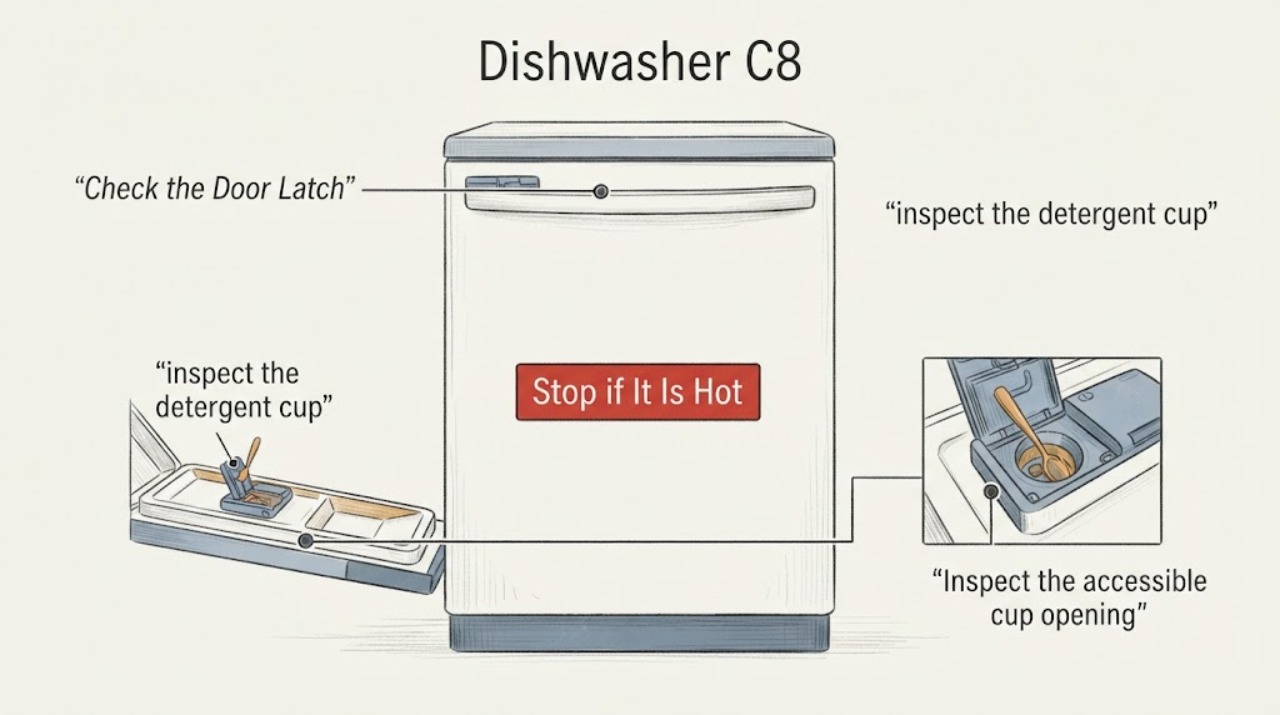
On GE dishwashers that use this code, C8 means the detergent cup is blocked from opening fully; it is not a generic diagnosis that the dispenser motor, pump, or control board has failed. With the dishwasher stopped and safe to open, record the exact C8 display and model, remove only a visible dish, utensil, pod, or residue that is blocking the cup, then close and latch the door and wait about 30 seconds as GE directs. If the cup still will not open, C8 returns, the cup is damaged, or removing the obstruction would require force or disassembly, stop and arrange qualified appliance service. GE notes that not all codes appear on all models, so use the exact Owner's Manual if the display or model does not match.
Work through in order
Diagnostic checks
Use only checks that match the exact appliance or system and its official guide.
-
Check 1
Confirm that the dishwasher itself shows the complete code C8, then record the model number, cycle, whether the door is normally latched, and whether there is standing water, a visible leak, smoke, heat, or electrical damage. Do not start a cycle just to reproduce the display.
Expected result: C8 is clearly shown on a GE dishwasher with no hazard, the display is a different code or wording, the model is unknown, or a leak/electrical symptom is also present.
Next step: Continue only when the appliance and code are confirmed and there is no hazard. If the display or model does not match, use that model's Owner's Manual or GE support; if a leak or electrical hazard is present, keep the dishwasher off and arrange service.
Stop if: Stop immediately for water near electrical parts, smoke, burning odor, sparks, a hot/damaged cord, repeated breaker trips, or a door/latch that cannot be operated normally.
Why this matters
Why: GE defines C8 for its detergent cup only in the applicable electronic-control code table and warns that not all codes appear on all models. A different display or a safety hazard changes the decision path.
-
Check 2
With the cycle stopped and the door opened normally, inspect the detergent cup and the rack immediately in front of it. Remove only a visible silverware item, pan handle, tall dish, or other load item that prevents the cover from moving; do not reach under the tub or force the cover.
Expected result: A dish or utensil is touching the cup, the cup is visibly clear, or the cup/door area is wet, cracked, bent, or otherwise damaged.
Next step: If a visible load item was blocking the cup, reposition it so the cover has clearance and proceed to the detergent check. If the cup is damaged or the obstruction cannot be removed without force, leave the dishwasher off and arrange service.
Stop if: Do not pry the cover, bend the rack, defeat the door switch, remove the dispenser, or put hands into a running dishwasher.
Why this matters
Why: GE's C8 instruction gives a blocked cup as the direct meaning and names silverware or a pan as examples. A clear but damaged cup is not evidence that the obstruction has been fixed.
-
Check 3
Inspect the accessible cup opening with the dishwasher off. Wipe away loose old detergent only from the visible cup, and check that a pod or tablet is seated without binding the cover; if powder is used, note whether it is fresh and loose rather than caked.
Expected result: Soap residue is caked in the cup, a pod/tablet is wedged against the cover, powder is lumpy, or the cup is clean and unobstructed.
Next step: Remove only accessible residue and correct the detergent placement according to the exact model instructions. If the cup is already clean and free, continue to the single confirmation step; if it cannot be cleaned without disassembly, stop and call service.
Stop if: Do not use tools, solvents, sharp objects, or force to clear the latch, and do not open panels to reach the dispenser mechanism.
Why this matters
Why: GE identifies residue, a binding pod/tablet, and lumpy powder as reasons a detergent cup may not open. These observations support cleaning or correcting the load, but they do not identify an internal dispenser part.
-
Check 4
Identify the cup design and control type from the exact manual before trying any opening or reset step. GE describes sliding, round-handle, and square flip-up covers; its separate timer procedure applies only to mechanical-control models and must not be used on an electronic model.
Expected result: The model manual matches the cup and gives a normal user step, the dishwasher has a mechanical timer, the dishwasher has electronic controls, or the model/cup type is uncertain.
Next step: Follow only the matching manual's ordinary user instruction. If the model or control type cannot be confirmed, stop at the external inspection and use GE support or qualified service.
Stop if: Do not force the cup, rotate an electronic control as though it were a mechanical timer, bypass an interlock, or remove the control/dispenser assembly.
Why this matters
Why: Cup designs and controls differ by model and age. GE says not to force the cup or attempt the mechanical-timer procedure on an electronic model, so an uncertain identity is not a reason to try a generic sequence.
-
Check 5
After a visible obstruction or residue issue is corrected, close and latch the door normally and wait once for about 30 seconds, as GE specifies for C8. Record whether the cup opens and whether the code clears; do not keep repeating resets or cycles.
Expected result: The cup opens and C8 clears, C8 returns with the cup free, the cup remains closed, the dishwasher will not start, or water/leak/electrical symptoms appear.
Next step: If C8 returns or the cup remains closed, leave the dishwasher off and provide service with the model, exact display, cup type, obstruction/residue findings, and the result of this one check. Stop immediately if a hazard appears.
Stop if: Do not force the cup, repeatedly restart the dishwasher, order a dispenser or control part from C8 alone, or perform live electrical tests.
Why this matters
Why: A one-time recovery after an obvious obstruction supports a blocked-cover condition. A recurring code or cup that remains closed leaves a latch, dispenser mechanism, timer/control, or other model-specific fault unresolved; the code alone cannot select a part.
Use your observations
Decision map
Find the observation that best matches what you see, then follow the next safe action.
-
PATH 01Next step
What you see
C8 clears after a dish, utensil, pod, or accessible residue is removed and the cup opens after the normal door-latch wait.
Do this next
Reload the rack so the cup has clearance and run one normal cycle only if the door, cup, and dishwasher remain safe. If C8 returns, stop repeating the test and arrange service.
Why this path and its safety boundary
Why it matters: The observed pattern fits GE's blocked-cup explanation more closely than a code-only internal component diagnosis.
-
PATH 02Next step
What you see
The cup is visibly clear and clean, but it stays closed or C8 returns after the one model-appropriate confirmation step.
Do this next
Keep the dishwasher out of service and arrange qualified GE or appliance service with the exact model, code photo, cup design, and observations. Do not purchase a component from C8 alone.
Why this path and its safety boundary
Why it matters: An unresolved latch, dispenser mechanism, timer/control, or other model-specific fault is possible; C8 does not identify which part has failed.
-
PATH 03Next step
What you see
The model or control type is uncertain, the display is not actually C8, or the proposed step would require force, a panel removal, or an electronic-control workaround.
Do this next
Stop at the external observation stage and use the exact Owner's Manual or qualified service for that model. Preserve the complete display and model information.
Why this path and its safety boundary
Why it matters: The published GE procedures are model- and control-dependent, so applying a mechanical-timer or generic dispenser procedure could damage the appliance or defeat a safety interlock.
-
PATH 04Next step
What you see
C8 is accompanied by a leak, water near electrical parts, smoke, burning odor, sparks, a hot/damaged cord, or repeated breaker trips.
Do this next
Stop using the dishwasher. Isolate power only if it is dry and safe to do so without touching damaged parts, and contact qualified appliance/electrical service; use emergency services for an active fire.
Why this path and its safety boundary
Why it matters: This is an immediate appliance or electrical safety condition, not a detergent-cup troubleshooting branch.
Helpful context
Understand the symptom
C8 is a narrow GE dishwasher state: the detergent cup cannot open fully. That is different from treating every detergent-dispensing complaint as a failed pump or control. GE's code page links C8 to a blocked cup and its detergent-cup guidance identifies rack loading, a pod or tablet binding the cover, and hardened detergent residue as user-visible possibilities. The exact model still matters because GE says its code list is not present on every model.
Keep the check external and low risk. Do not pry the cup, force the door latch, reach into a running dishwasher, remove the dispenser assembly, or open electrical covers. A cup that remains stuck after the visible obstruction is gone needs model-specific service rather than a part chosen from C8 alone.
When checks do not resolve it
Need a professional?
Arrange qualified GE or appliance service if C8 returns after one external obstruction/residue check, the cup remains closed, the cup or latch is damaged, the model/control type cannot be confirmed, or the exact manual directs service. Stop immediately for a leak, water near electrical parts, smoke, burning odor, sparks, a hot or damaged cord, or repeated breaker trips. Do not force the dispenser, bypass the door switch, remove panels, perform live electrical tests, or choose a part from C8 alone.
Common questions
FAQ
What does C8 mean on a GE dishwasher?
GE's opened dishwasher code table defines C8 as the detergent cup being blocked from opening fully. Remove only a visible obstruction, close and latch the door, and wait about 30 seconds. If it returns or the cup remains closed, arrange service rather than guessing a part.
Is GE dishwasher C8 the same as a general detergent-not-dispensing problem?
No. C8 is a specific blocked-opening state in GE's code table. A detergent residue or pod can contribute, but the display does not prove a pump, control board, or dispenser assembly failure.
Should I force open the detergent cup when C8 appears?
No. GE's guidance is to remove a visible obstruction and close/latch the door, not to pry the cup. The mechanical-timer procedure is limited to matching mechanical models and must not be attempted on electronic models; use the exact manual or service when the cup stays stuck.
Read the exact guide
Official sources
- Dishwasher - Detergent Cup Not ClosingGE Appliances · Opened official GE Appliances support page for a cup that will not close; used for model-dependent control behavior, pod interference, latch residue, and service boundary.
- Dishwasher - Error, Fault or Function CodesGE Appliances · Opened official GE Appliances support page for dishwasher codes; it defines C8 and states that not all codes are found on all models.
- Dishwasher - Opening Detergent Cup - Mechanical TimersGE Appliances · Opened official GE Appliances support page used only for the conditional mechanical-timer distinction and the instruction not to force or use it on electronic models.
- Dishwasher - Detergent Cup Did Not OpenGE Appliances · Opened official GE Appliances support page for a detergent cup that did not open; it covers cup designs, load obstruction, residue, pods/tablets, and powder condition.
Community feedback
Share a repair observation
Share a plain-text repair observation. Accepted observations are published automatically; this page may take a moment to update.