
On this page
Start here
Quick answer
A GE dishwasher door that will not stay open is usually a balance or installation symptom, not proof that a spring or hinge is broken. First note whether the door falls down, pulls upward toward closed, or lies open but lets the lower rack roll. GE's opened support guidance ties these behaviors to leveling, cabinet interference, rack position, hinge alignment and model-dependent side spring tension, especially when a custom door panel changes the load. Check only for visible obstructions, a crooked or cabinet-contacting door, rack interference and installation level. Do not force the door, remove the spring or hinge, bypass the latch, or adjust an unknown model's spring. Disconnect power before any maintenance and arrange qualified service for a damaged hinge, spring/cable, panel, latch or unresolved imbalance.
Before you begin
Safety first
- No generic spring adjustment, door removal, hinge/cable replacement, latch bypass or live electrical work is provided.
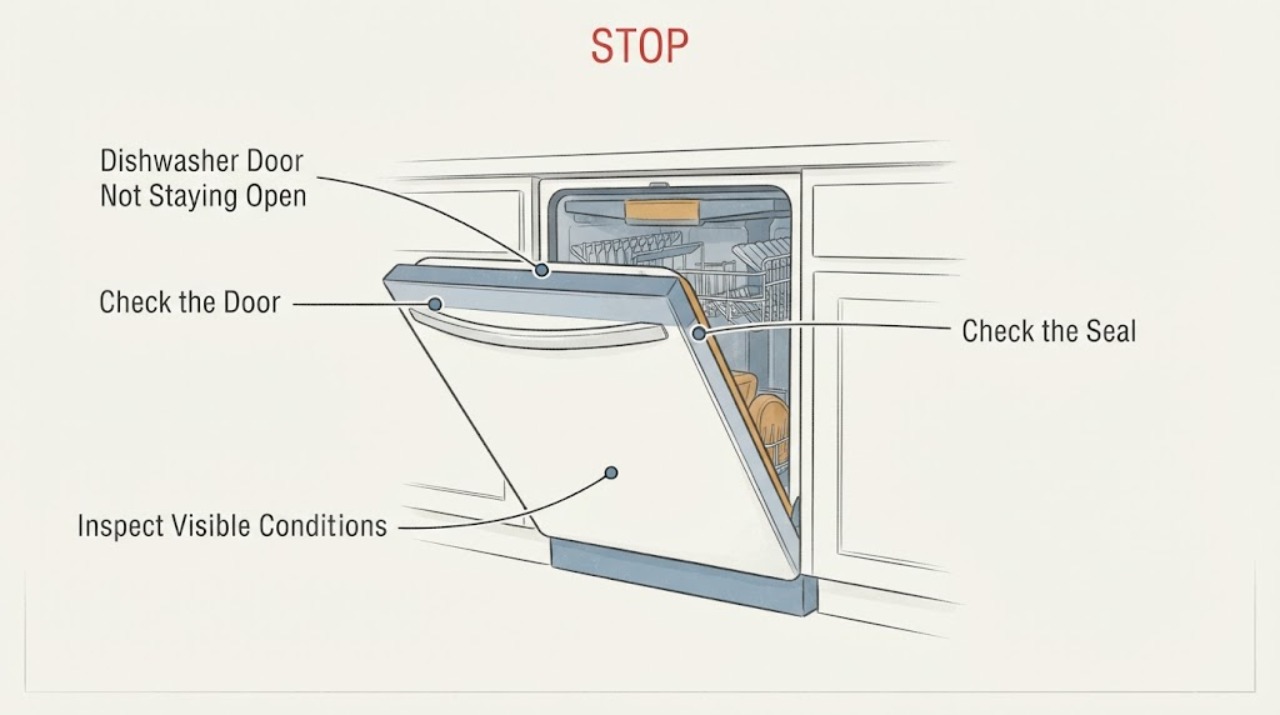
Work through in order
Diagnostic checks
Use only checks that match the exact appliance or system and its official guide.
-
Check 1
Classify the movement with the dishwasher empty and the door supported by your hand: note whether it falls downward, pulls upward toward closed, or lies open but does not remain level.
Expected result: The door moves toward the floor, rises toward closed, or stays open while the lower rack rolls in/out.
Next step: Use the matching branch below and record the full model before considering any installation-specific adjustment.
Stop if: If the movement cannot be observed safely, stop handling the door and arrange service instead of forcing it through a cycle.
Why this matters
Why: These are different balance/alignment observations. GE says an open door should lie flat and links rack movement to door balance or levelness; they do not identify one universal failed part.
-
Check 2
Inspect the visible door path for cabinet or countertop contact, a crooked door, a rack or utensil protruding at the front, and an upper rack that is uneven or not fully seated.
Expected result: The door contacts the cabinet, appears off alignment, or a rack/load blocks or pushes the door; alternatively the visible path is clear.
Next step: Remove only the accessible load obstruction and stop using the appliance if the door is crooked or contacts the cabinet; have the installer or service correct alignment.
Stop if: If the path is clear but the door still will not stay open, continue with levelness and panel/balance checks without removing hardware.
Why this matters
Why: GE identifies cabinet interference, rack position, loading and a door that may have come off a hinge as causes of closing/alignment problems that can also affect door movement.
-
Check 3
Check levelness from outside using the exact model's installation guidance; where GE's general check applies, place a level on the top rack rail and observe whether the door or rack moves because the unit is angled.
Expected result: The dishwasher is visibly out of level, the rack rolls when the door is open, or the unit appears level and stable.
Next step: If recently installed, contact the installer. Otherwise adjust leveling only if the exact installation instructions cover the model and the appliance can be made safe; do not pull the unit out or reach underneath as a generic step.
Stop if: If the unit is level but the door imbalance remains, preserve the observation for model-specific service.
Why this matters
Why: GE says levelness affects door operation and that a fully open door with racks rolling can indicate the dishwasher is angled forward; this is an installation issue, not proof of a spring failure.
-
Check 4
Identify whether the door has a custom wood or accessory panel and record its documented weight and installation status; do not remove the panel or change spring positions on an unknown model.
Expected result: A custom panel was added or changed, the panel is visibly loose/damaged, or the dishwasher has the original unmodified door.
Next step: Stop at identification and use the exact model installation instructions or a qualified installer/service technician to verify panel and balance compatibility.
Stop if: If no panel change explains the symptom, continue only with visible alignment checks and service escalation; do not infer a broken spring from the door motion.
Why this matters
Why: GE says side-mounted spring tension is adjusted during installation for accessory/wood-panel weight and that heavier panels may require a different spring arrangement. The support page does not make one spring setting universal.
-
Check 5
With power disconnected, inspect only visible edges for a damaged hinge cover, spring/cable fragment, sharp metal, loose panel or leaking door seal; do not reach into the underside or side spring area.
Expected result: A spring/cable, hinge, panel or seal appears damaged, or no visible damage is found.
Next step: Keep the dishwasher unused and arrange qualified service; do not tape, tie, bend or substitute a spring or hinge.
Stop if: If no damage is visible but the door still falls or rises, use the model-specific service path rather than opening the appliance.
Why this matters
Why: Visible damage can make the door unsafe or unbalanced, but the absence of visible damage does not clear concealed spring, hinge or mounting hardware.
-
Check 6
Stop troubleshooting and arrange qualified service or installer correction when the door cannot stay open, slams or drops, contacts the cabinet, leaks, has a damaged balance part, or remains unsafe after external installation checks.
Expected result: The door remains unstable, a hinge/spring/cable/panel is damaged, the door will not latch, or water/electrical risk is present.
Next step: Leave the dishwasher off, disconnect power if safe, keep children away from the door, record the model/serial and panel details, and contact the installer or qualified appliance service. Do not run a cycle with an unstable door or missing enclosure panel.
Why this matters
Why: GE's support guidance routes unresolved alignment, balance and latch concerns to model-specific installation instructions or service; the owner manual limits repairs beyond specifically recommended work.
Use your observations
Decision map
Find the observation that best matches what you see, then follow the next safe action.
-
PATH 01Next step
What you see
The open door lies flat but the lower rack rolls in or out, or the whole dishwasher appears angled forward.
Do this next
Check levelness from outside and follow only the exact model installation instructions; have the installer or service correct it if the unit cannot be safely leveled.
Why this path and its safety boundary
Why it matters: GE associates this pattern with spring balance or leveling rather than a confirmed door-part failure.
-
PATH 02Next step
What you see
The door hits the cabinet, is visibly crooked, or a rack, utensil or panel blocks its path.
Do this next
Remove only an accessible load obstruction; stop using the dishwasher and arrange installer/service alignment for cabinet, hinge or panel interference.
Why this path and its safety boundary
Why it matters: The installation or loading is interfering with door movement and may also prevent a safe seal or latch.
-
PATH 03Next step
What you see
A custom panel was added or the door weight changed, and the door now falls or pulls upward.
Do this next
Use the exact installation documentation or a qualified installer/service technician to verify panel weight and spring arrangement; do not access the springs yourself.
Why this path and its safety boundary
Why it matters: GE documents model-dependent side-spring adjustment for accessory/wood-panel weight; the symptom does not authorize a generic spring setting or part choice.
-
PATH 04Next step
What you see
The door drops, slams, has a loose hinge or cable, leaks, exposes sharp damage, or cannot latch safely.
Do this next
Keep the appliance off and children away, disconnect power if safe, and obtain qualified service without forcing or bypassing the door hardware.
Why this path and its safety boundary
Why it matters: This is a pinch, leak or electrical/service boundary rather than a routine loading adjustment.
Helpful context
Understand the symptom
A GE dishwasher door that will not stay open can move in opposite directions: it may drop toward the floor, spring upward toward closed, or remain open while the lower rack rolls. Those observations are useful, but none confirms a broken spring, hinge or cable. GE's opened guidance starts with installation, leveling, cabinet/rack interference and door alignment, while side-spring tension and custom-panel weight are model-dependent.
Before touching anything, protect hands from the door edge and keep children away from the moving door. Check the door and racks from outside, identify the model from the rating label, and use its installation instructions for any balance specification. Do not force the door or copy a spring adjustment from another GE model.
Disconnect power before maintenance. A door that is crooked, contacts the cabinet, has a loose hinge, damaged spring/cable, damaged panel or cannot be balanced through documented installation checks should remain unused until a qualified technician or the installer examines it.
When checks do not resolve it
Need a professional?
Contact the installer or qualified GE appliance service when the door falls or rises despite a clear path and level cabinet, the door is crooked or off a hinge, a spring/cable/panel is damaged, the dishwasher leaks or cannot latch, or the model-specific installation instructions do not resolve the imbalance. Provide the complete model/serial, installation date, panel type/weight if applicable, and which direction the door moves.
Safety scope: No generic spring adjustment, door removal, hinge/cable replacement, latch bypass or live electrical work is provided.
Common questions
FAQ
Why does my GE dishwasher door fall open or pull itself closed?
The direction of movement is a balance observation. GE points owners first to levelness, cabinet/rack interference, alignment and model-dependent spring tension, especially when a custom panel changes the door weight. It does not prove one spring or hinge is broken.
Can I adjust the dishwasher door springs myself?
GE says side spring tension can be adjusted during installation, but exact positions depend on the model and door-panel load, and the support page warns about sharp edges. For an unknown model or an already installed appliance, use the exact installation instructions or qualified service rather than reaching into the spring area.
What does it mean if the lower rack rolls when the door is open?
GE says the open door should lie flat; rack movement can indicate spring balance or a dishwasher that is not level. Check levelness externally and use the model installation instructions, then arrange service if the condition remains.
Read the exact guide
Official sources
- Dishwasher - Side Mounted Door SpringsGE Appliances · GE dishwasher side-mounted spring design, custom-panel balance and spring-adjustment safety guidance
- Dishwasher - Door Does Not Close ProperlyGE Appliances · GE dishwasher installation, cabinet interference, rack position and hinge-alignment checks
- Dishwasher - Door Will Not LatchGE Appliances · GE dishwasher door safety, power-disconnection, loading/obstruction and latch service boundary
- Dishwasher - Racks Roll In or Out On Their OwnGE Appliances · GE dishwasher door-flat, spring-balance and leveling symptoms
- Dishwasher - Adjusting Leveling LegsGE Appliances · GE dishwasher levelness and model-specific leveling guidance affecting door operation
- GE Dishwasher Owner's Manual 49-5916GE Appliances · The named legacy GE GSD2200/GSD2201/GSD2600/GSD2700 dishwasher families; installation, maintenance and door safety boundaries
Community feedback
Share a repair observation
Share a plain-text repair observation. Accepted observations are published automatically; this page may take a moment to update.