
On this page
Start here
Quick answer
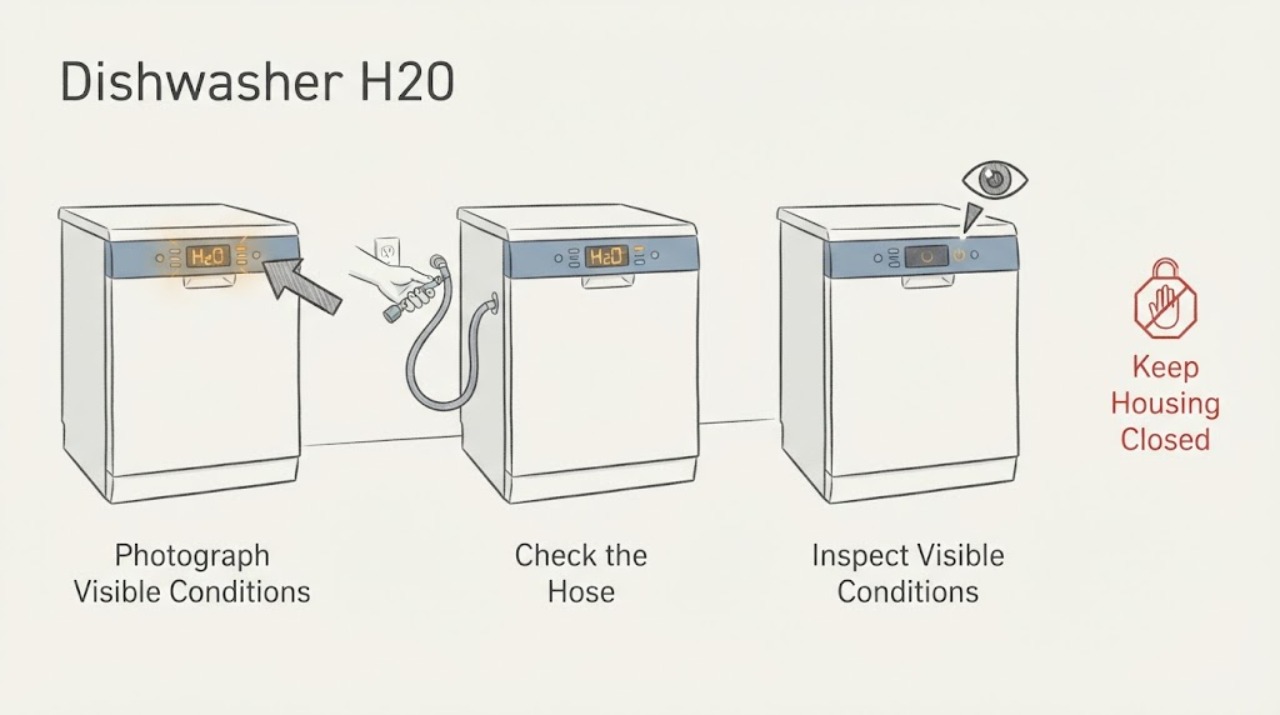
GE's public dishwasher article titled H20 in Display says H20 means the dishwasher is getting too little water or no water during its timed fill phase. Before thinking about a valve, sensor, or control part, record the exact display character (H20 versus H2O), the complete model number, the cycle stage, and whether there is standing water or a leak. From a safe, dry position, confirm that the hot-water shutoff under the sink is fully open, the visible inlet hose is not kinked, and the dishwasher is level; do not disconnect the hose or perform a pressure test. GE's H20 article mentions selecting another cycle option and returning to the desired option to clear the display, but without the model this is not a license to use a hidden reset or a part-specific procedure. If H20 returns after the external supply and level checks, leave the dishwasher off and arrange qualified service rather than replacing an unknown component.
Before you begin
Safety first
- Consumer checks are limited to recording the exact display and model, confirming the visible hot-water shutoff and inlet hose, observing level, water presence, cycle stage, and external damage, and using the published cycle-option step only when the exact controls and safety conditions match. Do not disconnect the inlet line, make pressure or live electrical measurements, open the sump or control area, bypass a float or interlock, or select a part from H20.
Work through in order
Diagnostic checks
Use only checks that match the exact appliance or system and its official guide.
-
Check 1
Photograph or write down the display exactly as shown, including H20 versus H2O, extra characters, flashing lights, and the cycle or option in progress. Read the complete model and serial label before applying any reset or code table.
Expected result: The display is clearly H20, the display is H2O or another code, or the model/lettering is incomplete.
Next step: Use the exact GE Owner's Manual for the recorded model and display. If the notation cannot be confirmed, preserve the photo and arrange service rather than copying a different model's reset or parts advice.
Stop if: Do not remove panels, disconnect a hose, or search for a hidden service display.
Why this matters
Why: GE's dedicated page is titled H20, while its general code overview renders the low-water entry H2O and warns that not all codes occur on all models. Without the full model, the notation and exact instructions remain scoped uncertainty.
-
Check 2
From a safe, dry position under the sink, confirm that the hot-water shutoff feeding the dishwasher is fully open. Inspect only the visible inlet hose for a kink, crushing, or obvious leak; do not loosen the connection or test household pressure.
Expected result: The valve was partly or fully closed, the visible hose is kinked or damaged, or the valve and hose look normal.
Next step: Correct only an obvious safe valve or hose position and monitor one permitted cycle. If H20 returns with the supply normal, stop and provide the exact model and observations to service.
Stop if: Do not disconnect the inlet line, add fittings, perform a pressure test, or touch a leaking connection.
Why this matters
Why: GE says a closed supply or inadequate incoming pressure can prevent enough water entering during the timed fill phase. A clear visible supply path does not prove that the internal valve, sensor, or control is good.
-
Check 3
Observe the dishwasher's installation from outside: check that it is not visibly leaning and that there is no standing water, active leak, or water near the electrical connection. Do not pull an under-counter dishwasher out to check its base.
Expected result: The appliance appears tilted, water is present, there is an active leak, or the unit appears level and dry.
Next step: For a safe, externally visible installation issue, use the model instructions or an installer; do not shim or move a secured appliance casually. For water or a leak, stop the cycle, close the water supply, isolate power only if safe, and arrange service.
Stop if: Do not tilt, pull, shim, remove the toe-kick, or restore power to a wet appliance.
Why this matters
Why: GE notes that a tilted dishwasher can make the water level seem low in parts of the tub. Water or a leak changes the decision to stop-use; a level, dry unit still needs the exact model if H20 persists.
-
Check 4
Record when H20 appears: immediately at fill, only on one named cycle, after recent plumbing work or a shutoff, or after a prior part replacement. Also note whether the tub remains empty, partly filled, or has water left from an earlier cycle.
Expected result: H20 follows plumbing work or a closed valve, occurs only on one cycle, appears across cycles, or appears with standing water.
Next step: Correct only the visible supply condition documented for the model. If H20 recurs across cycles or appears with standing water, leave the dishwasher off and request service; do not infer a replacement part from timing alone.
Stop if: Do not reach into the sump or pump, run a leaking unit, or use the earlier replacement as proof of a new diagnosis.
Why this matters
Why: GE lists first use, recent household plumbing work, and a recently closed dishwasher supply as common H20 circumstances. A cycle-specific display or standing water may indicate a different model-dependent fill/drain path and cannot be resolved by the H20 meaning alone.
-
Check 5
Only when the dishwasher is dry, there is no leak or electrical hazard, and the exact model's normal controls match GE's public guidance, select a different cycle option and return to the desired option once. Observe whether the same display returns; do not use a hidden key sequence or repeat breaker resets.
Expected result: The display clears and a cycle starts, H20 returns, the dishwasher will not fill, or a hazard appears.
Next step: If it clears, monitor one cycle and keep the code record. If H20 returns, the tub remains empty, or any hazard appears, stop using the dishwasher and arrange qualified GE/appliance service.
Stop if: Do not repeatedly clear the display, reset the breaker, open the control area, or order a valve, sensor, pump, or board from H20 alone.
Why this matters
Why: GE publishes the option-change step for its H20 article, but a cleared display does not establish that the water supply or internal component is repaired. A recurring display after safe external conditions are normal needs service.
Use your observations
Decision map
Find the observation that best matches what you see, then follow the next safe action.
-
PATH 01Next step
What you see
The display is confirmed as H20, the hot-water valve was not fully open or the visible inlet hose was kinked, and the display does not return after the safe correction.
Do this next
Keep the valve fully open and the hose undamaged, then monitor normally. If the code returns, stop and use the exact model documentation or service.
Why this path and its safety boundary
Why it matters: The external water-supply condition explains the timed low-fill event better than a confirmed internal part failure.
-
PATH 02Next step
What you see
H20/H2O returns across cycles after the visible valve, hose, and level checks are normal, or the dishwasher still receives no water.
Do this next
Leave the dishwasher off and request qualified service with the complete model, exact display notation, cycle stage, water level, and prior replacement history. Do not choose a part from the code.
Why this path and its safety boundary
Why it matters: GE recommends service after adequate household supply/pressure, a fully open valve, and correct leveling have been confirmed. The display cannot distinguish an internal valve, sensing, wiring, or control issue.
-
PATH 03Next step
What you see
The display is H2O rather than H20, is unlisted for the model, or appears only on a cycle that the exact Owner's Manual treats differently.
Do this next
Preserve the exact display and model label, follow only the matching manual, and contact service if the manual does not identify the code. Do not copy another GE platform's instructions.
Why this path and its safety boundary
Why it matters: GE's general code page warns that not all codes appear on all models, and the character difference may change the applicable guidance. A generic H20 interpretation is not enough to select a reset or component.
-
PATH 04Next step
What you see
Standing water, an active leak, water near electrical parts, smoke, burning odor, sparks, a hot/damaged cord, or a repeated breaker trip is present.
Do this next
Stop the dishwasher, close the water supply, isolate power only from a safe dry position if possible, and obtain qualified appliance or electrical help. Use emergency procedures for active smoke or fire.
Why this path and its safety boundary
Why it matters: This is an immediate water, electrical, or fire-safety stop condition, regardless of whether H20 is also displayed.
Helpful context
Understand the symptom
H20 is useful as a water-fill symptom, not as a component diagnosis. GE's dedicated public article says the dishwasher is receiving too little or no water during a timed fill phase and names a fully open hot-water valve and correct leveling as first checks. The broader GE code page shows the same family as H2O and says codes are not universal across models. Treat the lettering, complete model, and cycle stage as part of the problem identity.
The previous replacement of an unknown part does not prove that part caused the display or that another part is needed. With no model number, keep the path to visible supply and programme observations. Do not open the sump, disconnect a water line, make live or pressurized measurements, or repeatedly reset a dishwasher that is leaking or wet near electrical parts.
When checks do not resolve it
Need a professional?
Contact qualified appliance service for a recurring H20/H2O, no fill after normal external supply, a model-unmatched display, or any need to access a valve, sensor, pump, control, or wiring. Use qualified electrical help for damaged power parts or repeated breaker trips.
Safety scope: Consumer checks are limited to recording the exact display and model, confirming the visible hot-water shutoff and inlet hose, observing level, water presence, cycle stage, and external damage, and using the published cycle-option step only when the exact controls and safety conditions match. Do not disconnect the inlet line, make pressure or live electrical measurements, open the sump or control area, bypass a float or interlock, or select a part from H20.
Have this ready
- Provide the complete GE model and serial, exact H20/H2O characters, selected cycle, time in the cycle, standing-water or leak status, hot-water valve and visible hose observations, installation-level observation, prior replacement history, and reset result.
Common questions
FAQ
What does H20 mean on a GE dishwasher?
GE's dedicated H20 article says the dishwasher is receiving too little water or no water during its timed fill phase. Check the fully open hot-water valve, visible inlet hose, and level from safe positions; a recurring display needs the exact model and service rather than a guessed part.
Is GE H20 the same as H2O?
Do not assume the characters without checking the display. GE's dedicated page is titled H20, while its general code table renders the low-water entry H2O and warns that codes are not universal across models. Photograph the display and read the complete model before using a code-specific instruction.
Can I replace the water valve because H20 appears?
No. GE's public guidance first addresses household supply, valve position, level, and the exact display/model. H20 does not identify a valve, sensor, harness, pump, or control as the failed part, and the absent model prevents a safe compatibility decision.
What if H20 appeared after another part was replaced?
Treat the timing as a clue, not proof of causation. Record what was replaced without reopening the machine, verify the visible supply and exact display, and arrange service if H20 returns or the dishwasher will not fill.
Read the exact guide
Official sources
- Dishwasher - H20 in DisplayGE Appliances · Public GE consumer guidance for a dishwasher display titled H20; it is used for the low-water/timed-fill meaning, fully open hot-water valve, level check, and option-change clear step. It does not establish a model-specific component or compatibility diagnosis.
- Dishwasher - Error, Fault or Function CodesGE Appliances · General GE dishwasher code overview; it explicitly warns that not all codes appear on all models and is used to keep H20/H2O and model-specific reset decisions scoped.
Community feedback
Share a repair observation
Share a plain-text repair observation. Accepted observations are published automatically; this page may take a moment to update.