
On this page
Start here
Quick answer
On GE dishwashers, the H20 display means the dishwasher did not receive enough water or no water during its timed fill phase. First record the model and the cycle showing the code. If the sink area and water valve are dry and safe to reach, confirm the hot-water supply valve under the sink is fully open, look for a kinked inlet hose, and confirm the dishwasher is level. GE says H20 can appear on a first run, after house plumbing work or after the dishwasher supply was turned off. Select another cycle and return to the desired cycle only as the GE guidance describes. GE’s code table says some models or cycles need service instead; if the code returns after adequate supply, an open valve, a clear hose and correct leveling, do not open the dishwasher or guess a valve/sensor—arrange GE service.
Before you begin
Safety first
- Do not open the base, remove the inlet valve, probe wiring, disconnect a wet hose, move a built-in dishwasher, bypass a float/leak feature or repeatedly run cycles to force filling.
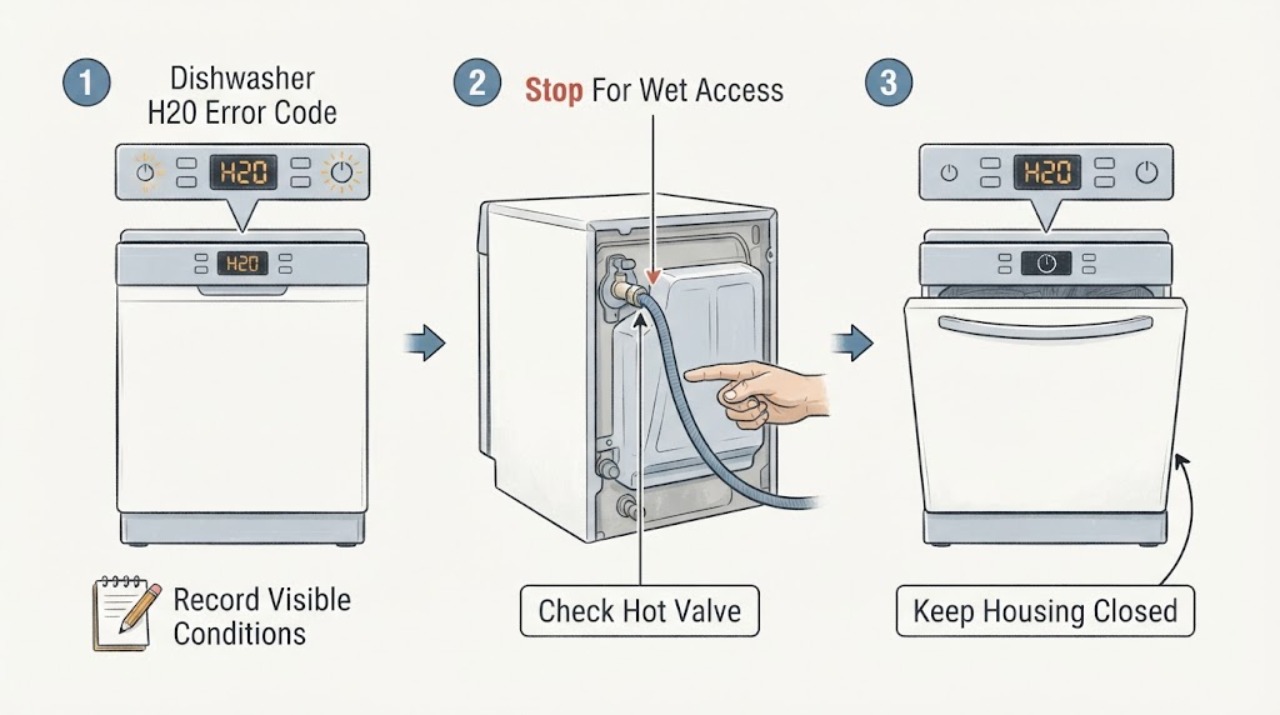
Work through in order
Diagnostic checks
Use only checks that match the exact appliance or system and its official guide.
-
Check 1
Record the exact display characters, the cycle selected, when the code appears, whether the dishwasher is a first run, and the full model number.
Expected result: The display reads H20/H2O on one or several cycles, or the characters differ from H20.
Next step: Use the exact model manual and the matching branch below; do not infer a component from the code text alone.
Why this matters
Why: GE warns that not all codes appear on all models and provides cycle-dependent H2O guidance; a different display must not be mapped to this page.
-
Check 2
Do not reach under the sink or behind the dishwasher if water is present near the outlet, cord, hoses or cabinet; stop the cycle and keep the area clear.
Expected result: The sink/cabinet area is wet or the water valve cannot be reached safely, or the area is dry.
Next step: If access is dry, continue only with the visible valve/hose check; otherwise obtain qualified appliance/electrical help and leave the dishwasher off.
Why this matters
Why: A water-fill code does not justify contact with wet electrical equipment or a hose connection.
-
Check 3
From a dry, accessible position, confirm that the hot-water shutoff valve under the sink nearest the dishwasher is fully open.
Expected result: The valve was closed/partly closed, or it was already fully open.
Next step: If the valve was closed, use the exact GE cycle guidance once; if it was open or H20 returns, proceed to hose/level and service branches without opening the machine.
Why this matters
Why: GE identifies a recently turned-off or incompletely open supply as a common H20 cause; an open valve does not prove the internal valve is faulty.
-
Check 4
With the dishwasher off and the area dry, look at the visible inlet hose for a kink or compression; do not disconnect or pull a built-in dishwasher.
Expected result: The hose is visibly kinked/compressed, or no external restriction is visible.
Next step: Correct only an obvious external kink without disturbing connections; if the code persists, use model-matched service.
Why this matters
Why: GE’s code table points to an inlet-hose check for H2O on some cycles; a clear hose does not clear the internal fill system.
-
Check 5
Check from outside that the dishwasher is not visibly tilted or leaning; do not remove it from cabinetry to level it.
Expected result: The appliance is visibly tilted or appears level.
Next step: Have installation corrected using the exact model instructions; do not move a connected dishwasher as a diagnostic test.
Why this matters
Why: GE says a tilted appliance can make water fall too far forward or back and give the sense that the water level is low.
-
Check 6
After the safe external checks, select another cycle and return to the desired cycle only as GE’s H20 guidance describes; do not repeatedly reset or run cycles to force a fill.
Expected result: The code clears once, returns on the same cycle, or appears on multiple cycles.
Next step: Follow the code-table cycle branch and arrange service if H20 persists after supply, hose and level checks.
Why this matters
Why: A cycle change may clear the display, but a returning code remains a low-water/service symptom rather than proof of a particular part.
-
Check 7
Give GE service the model, exact code, affected cycle(s), water-valve status, hose/level observations, recent plumbing work and whether the dishwasher fills at all.
Expected result: H20 persists, appears only on a service-restricted cycle, or the external conditions are correct.
Next step: Keep the dishwasher off or use only a cycle GE specifically permits while arranging model-matched service; do not open the base or replace a part.
Why this matters
Why: GE recommends service once supply/pressure, valve position and leveling are confirmed; the evidence does not identify a fill valve, pressure sensor or control failure.
Use your observations
Decision map
Find the observation that best matches what you see, then follow the next safe action.
-
PATH 01Next step
What you see
H20 appears on first use, after house plumbing work or after the dishwasher water supply was turned off.
Do this next
From a dry safe position, verify the under-sink hot-water valve is fully open and the visible hose is not kinked; use the exact model installation guidance before service.
Why this path and its safety boundary
Why it matters: GE lists these as common contexts for insufficient fill.
-
PATH 02Next step
What you see
H20 appears only during a 1-Hour Wash cycle.
Do this next
Arrange service rather than transferring the other-cycle hose advice to this case; follow the exact model manual while waiting.
Why this path and its safety boundary
Why it matters: GE’s code table gives a cycle-specific service recommendation for this pattern.
-
PATH 03Next step
What you see
H20 appears during AutoSense, Heavy, Normal or Light and the inlet hose is visibly kinked.
Do this next
Correct only the visible kink without disconnecting the appliance, then use model guidance; call service if the code returns.
Why this path and its safety boundary
Why it matters: GE’s code table directs a hose check for H2O on these other cycles; the visible kink is a supply-path issue, not proof of an internal valve failure.
-
PATH 04Next step
What you see
The valve is fully open, the hose is clear, the dishwasher is level and H20 continues.
Do this next
Keep the dishwasher from repeated testing and arrange GE service with the model and cycle details.
Why this path and its safety boundary
Why it matters: GE says persistent H20 after those conditions warrants service; the code does not identify a specific internal component.
-
PATH 05Next step
What you see
The under-sink area, outlet or dishwasher base is wet or the displayed characters are not H20/H2O.
Do this next
Stop use, avoid wet electrical contact and obtain qualified help; record the exact display before selecting a different code guide.
Why this path and its safety boundary
Why it matters: This is either an electrical/water safety issue or an identity mismatch, not a safe H20 troubleshooting branch.
Helpful context
Understand the symptom
Confirm the exact display and cycle
Record the model number, the exact characters shown, and the cycle in which they appear. GE’s dedicated page calls the display H20, while its broader code table renders the low-water entry as H2O and warns that not all codes are on all models. Do not transfer an H20 interpretation from another brand or from a different GE appliance.
Check the dry, accessible supply path
If the floor and under-sink area are dry, confirm the hot-water valve nearest the dishwasher is fully open and look for an externally visible kink in the inlet hose. GE says the dishwasher’s timed fill can fail when water pressure is off or too low. Do not disconnect a wet hose, reach into the dishwasher cabinet or remove the inlet valve.
Check level and recent plumbing work
GE says a tilted dishwasher can make the water level seem low and lists first use, recent house plumbing work and a recently closed supply as common contexts. Record whether the code began after installation or plumbing work; do not move a built-in dishwasher or change its connections to test the theory.
Use the cycle-specific service boundary
GE’s code table distinguishes H2O appearing only during a 1-Hour Wash from H2O appearing during other cycles. On some models it allows another cycle while service is arranged; on others it points to an inlet-hose check or service. If the code persists after the documented external checks, the model-specific manual and qualified service must determine whether an internal water valve, sensor or control is involved.
When checks do not resolve it
Need a professional?
Arrange GE service if H20 persists after the hot-water valve, visible hose and leveling checks, if it appears on a cycle GE marks for service, or if the appliance has an internal leak/fill concern. Use the exact model manual because code availability varies by model.
Safety scope: Do not open the base, remove the inlet valve, probe wiring, disconnect a wet hose, move a built-in dishwasher, bypass a float/leak feature or repeatedly run cycles to force filling.
Have this ready
- Provide the full model number, exact H20/H2O characters, cycle(s), first-use/recent-plumbing context, valve position, visible hose condition, level observation and whether any water reached the cabinet or outlet.
Common questions
FAQ
What does H20 mean on a GE dishwasher?
GE’s dedicated support page says H20 means the dishwasher received too little water or no water during its timed fill phase. The broader GE code table renders the entry as H2O and warns that code availability varies by model.
What should I check first?
If the under-sink area is dry and safe, confirm the hot-water shutoff valve nearest the dishwasher is fully open, look for a visible inlet-hose kink, and confirm the dishwasher is level. Do not open the machine or disconnect a wet hose.
Why does H20 happen after plumbing work?
GE lists first use, recent house plumbing work and a recently turned-off dishwasher water supply as common contexts. Record that timing and use model-specific installation guidance rather than assuming an internal valve failure.
Can I keep using the dishwasher?
GE’s code table gives cycle-dependent guidance, including service for some 1-Hour Wash H2O cases and possible use of another cycle while service is arranged in some models. Follow the exact model manual; do not repeatedly run cycles to force a fill.
Read the exact guide
Official sources
- Owner’s Manual & Installation InstructionsGE Appliances · Official GE manual portal used only to require exact model documentation; no unseen manual rule is cited.
- Dishwasher - H20 in DisplayGE Appliances · Direct GE dishwasher H20 support page; model is not supplied by the task, so it is used for general H20 meaning and external checks only.
- Dishwasher - Will Not Run or Has No PowerGE Appliances · Official GE dishwasher power/safety page used only for wet/power access and service boundary.
- Dishwasher - Error, Fault or Function CodesGE Appliances · Direct GE code table that warns not all codes appear on all models; used for H2O cycle-specific scope and service boundary.
Community feedback
Share a repair observation
Share a plain-text repair observation. Accepted observations are published automatically; this page may take a moment to update.