
On this page
Start here
Quick answer
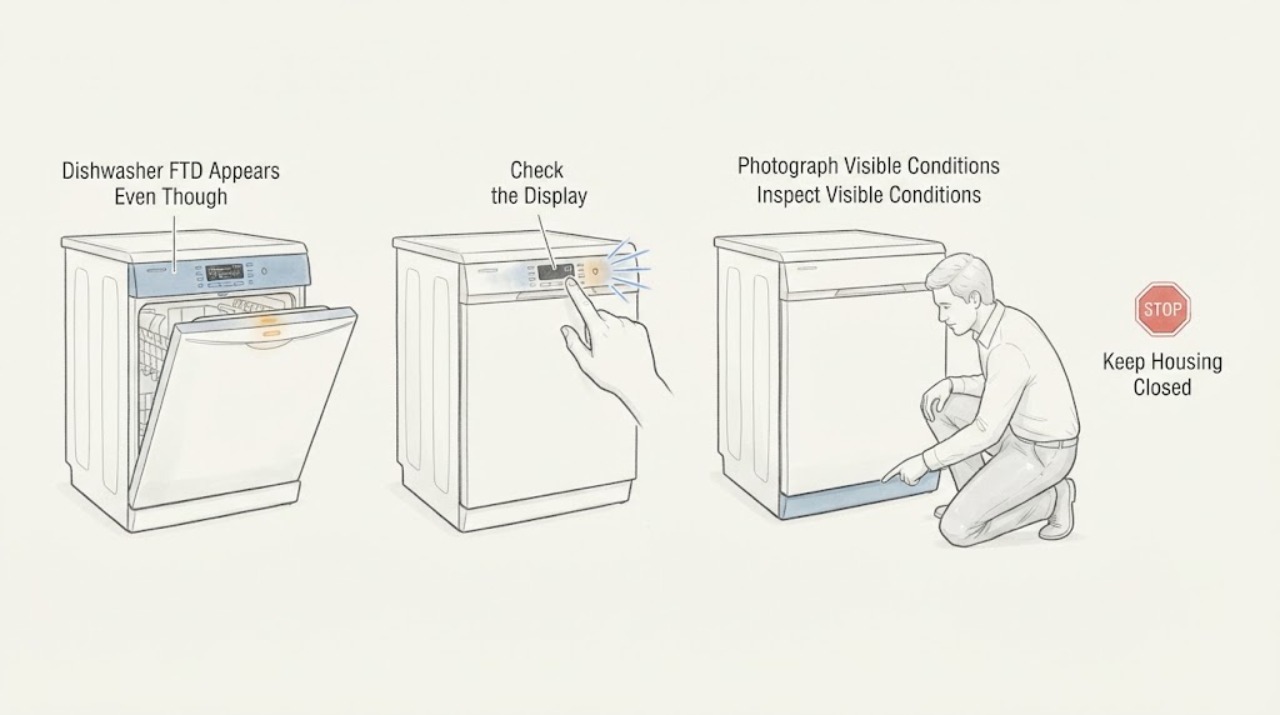
On the GE GDT630PYM5FS, FTD means GE's dishwasher fault table has detected a failure to drain. Seeing water leave the tub once does not prove the dishwasher completed every timed pump-out or that the control received the expected drain or pressure feedback. First record whether water remains across the tub floor or only in the filter or sump area, then inspect the accessible drain hose, air gap or disposer connection, sink drain, and high-loop arrangement with the dishwasher off. Do not enter service mode, reach into the pump, dismantle the sump, or make live tests. If the external path is clear but FTD returns early in the cycle, give qualified service the exact timing and model rather than guessing a pump or pressure sensor.
Before you begin
Safety first
- Do not enter service mode, open the control area, make live electrical measurements, reach into the pump, dismantle the sump, disconnect hidden plumbing, or remove a pressure-sensor assembly as an ordinary-user step. A sensor or pump may be involved, but FTD and one apparent drain do not identify a part.
Work through in order
Diagnostic checks
Use only checks that match the exact appliance or system and its official guide.
-
Check 1
Stop the dishwasher when FTD appears and check for a leak, water near electrical parts, smoke, burning odor, a hot or damaged cord, or a tripped breaker. If any is present, keep it out of use and isolate power only from a dry, safe position; otherwise leave the door closed until the unit is safe to inspect. Do not run another cycle just to reproduce the code.
Expected result: There is a leak or electrical hazard, or the tub and surrounding area are dry with no visible hazard.
Next step: Arrange qualified appliance or electrical service for a hazard. Otherwise continue with the exact display, water-level, and external drain observations.
Stop if: Do not touch wet controls, restore power to a wet appliance, remove covers, reach under the tub, or continue a leaking cycle.
Why this matters
Why: A hazard changes the task from drain diagnosis to stop-use service. Without a hazard, the next decision is whether the tub actually retained water and where, not whether the pump can be heard once.
-
Check 2
Photograph or transcribe the complete display as FTD, F56, another code, or a blinking pattern. Record the exact GDT630PYM5FS model label, selected cycle and options, time from start to FTD, whether the code appears during the first pump-out or later, and whether the pump sound or water flow changes before the code.
Expected result: FTD is stable on the exact model, the code appears only after a vent or service procedure, another code is shown, or the model and display are uncertain.
Next step: Keep the photo and timing record for service. If the identity is not confirmed as GDT630PYM5FS with FTD, use the matching manual instead of borrowing a code meaning.
Stop if: Do not enter service mode, clear stored faults repeatedly, or choose a pump or sensor from a partial character.
Why this matters
Why: GE says not all codes appear on all models. FTD is a drain-failure label, while a different code or test result may have a different meaning; timing separates an early pump-out timeout from a later-cycle recurrence.
-
Check 3
With the dishwasher off and safe to open, observe the water position without reaching into the pump or sump: note whether water covers the usable tub floor, is limited to the filter or sump area, or is absent after the pump-out. Look for only plainly visible food, paper, or a displaced filter at the tub surface; do not dismantle the filter housing or sump.
Expected result: Water covers the tub floor, water remains only around the filter or sump, the tub is empty, or visible debris or filter displacement is present.
Next step: Correct only a plainly visible loose filter or surface obstruction as the manual permits. If the tub floor remains wet or FTD recurs despite an apparently empty tub, stop owner testing and provide the water-location and timing record to service.
Stop if: Do not reach into a pump, probe the sump, remove the circulation or drain assembly, or use drain cleaner.
Why this matters
Why: GE notes that water in a sump or filter area can be normal on models with an Ultra Fine filter, while water covering the tub floor indicates excess retained water. A visually empty tub after one pump-out does not rule out a timed or feedback-related FTD.
-
Check 4
Inspect only the accessible drain installation under the sink and at the sink: look for a kinked or crushed hose, a blocked air gap, a clogged sink or disposer connection, a disposer plug left in place after installation, or a missing or low high-loop arrangement. Keep hands out of the disposer and do not pull the dishwasher out to reach hidden connections.
Expected result: A visible hose or sink-side restriction is present, the drain installation does not match the expected high-loop or air-gap arrangement, or the accessible path appears clear.
Next step: Correct only an obvious external installation issue with the appliance off, then use the model-approved normal cycle once if there is no leak or electrical hazard. If FTD returns, stop and request service.
Stop if: Do not put hands in a disposer, disconnect pressurized plumbing, remove the pump, dismantle the sump, or run the dishwasher with a leak.
Why this matters
Why: GE lists hose, air-gap, disposer, and high-loop restrictions as supported external causes. A clear sink-side path does not prove the internal pump, pressure path, wiring, or control has completed the timed drain decision.
-
Check 5
Compare the timing record with the symptom pattern: note whether FTD appears while water is visibly falling, after the tub seems empty, only in the early wash stage, or after several normal stages. Note whether the pump-out sound is steady, stops early, or changes, but do not open the control area or make an energized test.
Expected result: FTD appears with standing water or slow fall, FTD appears early despite a tub that empties, or FTD recurs after the tub is empty and the external path is clear.
Next step: Give the exact cycle stage, elapsed time, water position, and sound pattern to qualified service. Do not treat one successful drain as proof the recurring fault is repaired.
Stop if: Do not run repeated cycles, enter service mode, probe a sensor, bypass a control, or make live electrical measurements.
Why this matters
Why: Standing water keeps a physical restriction or pump-out problem high on the list. Early FTD with apparent flow raises a timing or drain-feedback question; a recurring code after complete emptying may involve an internal pressure path, sensor, wiring, or control, none of which the code alone identifies.
-
Check 6
Prepare a service packet with the exact model and serial label, FTD photographs, cycle and elapsed-time record, water position after pump-out, drain-hose and air-gap observations, leak or hazard observations, and any prior work. Ask for a diagnosis that states what test isolated the cause before any pump, pressure-sensor, harness, or control part is proposed.
Expected result: The provider can reproduce or isolate the failure with a stated result, cannot reproduce FTD, or proposes a component from the code alone.
Next step: Use GE or qualified appliance service for internal drain, pressure, wiring, or control diagnosis. Keep the dishwasher out of service if FTD returns, water remains, or any leak appears.
Stop if: Do not authorize blind parts swapping, open the control area, dismantle the pump, or make live tests as an ordinary-user step.
Why this matters
Why: A repair proposal is stronger when it explains why apparent draining still produced an FTD and identifies the observed failed condition. A part guess does not distinguish a restricted path, a pump that loses performance, a pressure-feedback issue, or a control decision.
Use your observations
Decision map
Find the observation that best matches what you see, then follow the next safe action.
-
PATH 01Next step
What you see
FTD appears with water covering the tub floor, a slow fall in water level, a kinked hose, blocked air gap or disposer connection, or a missing high loop.
Do this next
Correct only the plainly visible sink-side issue with the dishwasher off and run at most the model-approved normal retry. If water remains or FTD returns, arrange service without dismantling the pump or sump.
Why this path and its safety boundary
Why it matters: A physical drain restriction or installation problem is more likely than a purely false display, although the code can recur if the restriction was only partly corrected.
-
PATH 02Next step
What you see
The tub appears to empty, but FTD returns in the early wash stage or after a repeatable pump-out interval and the accessible hose, air gap, disposer, and sink path are clear.
Do this next
Stop repeated owner testing and give service the exact elapsed time, cycle stage, water position, and sound pattern. Request a documented diagnosis rather than a pump or sensor replacement based only on FTD.
Why this path and its safety boundary
Why it matters: One observed discharge does not prove the complete timed drain decision succeeded. An internal drain or pressure-feedback path, pump performance issue, wiring, or control interpretation remains possible; the display does not select a part.
-
PATH 03Next step
What you see
Water remains only in the filter or sump area and does not cover the tub floor, with no leak or electrical hazard.
Do this next
Record the water location and inspect only visible filter or surface debris as the exact manual permits. If FTD recurs, request service instead of treating normal sump water as a pump failure.
Why this path and its safety boundary
Why it matters: GE says some water in a sump or filter area can be normal on models with an Ultra Fine filter. The FTD timing, exact water location, and recurrence still matter; a normal sump level does not validate repeated FTD.
-
PATH 04Next step
What you see
A leak, water near electrical parts, smoke, burning odor, hot or damaged cord, repeated breaker trip, or exposed damage accompanies FTD.
Do this next
Keep the dishwasher off, isolate power only if safe, and arrange qualified appliance or electrical service. Do not restore power to test a wet unit.
Why this path and its safety boundary
Why it matters: The symptom is now a stop-use safety event, not an ordinary drain-clearance exercise.
-
PATH 05Next step
What you see
The display is not clearly FTD, the model is not GDT630PYM5FS, or the message appeared only after a different test or reset procedure.
Do this next
Photograph the complete display and model label, then use the matching GE manual or service route. Do not enter service mode or order a part from an uncertain code.
Why this path and its safety boundary
Why it matters: GE states that not all fault codes occur on all models. A different display or platform cannot safely inherit FTD's drain meaning or this model's external path.
Helpful context
Understand the symptom
FTD is a drain-failure indication, not a guarantee that no water moved. GE's code table uses FTD or F56 for failure to drain and points to the hose, air gap, and disposer. A dishwasher can therefore pump enough water to look normal while still exceeding a timed pump-out window, retaining water in the wrong area, or reporting an unexpected drain or pressure state. The useful distinction is complete emptying of the tub, the time and stage at which FTD appears, and whether the accessible drain installation is restricted.
The exact GDT630PYM5FS identity is supported by GE's model-specific parts diagram. A Reddit thread about this same model describes early-cycle FTD even though the owner saw normal draining, followed by a reported improvement after pressure-sensor cleaning. That community result is a lead for a technician, not permission to remove the sensor or pump: an incorrectly resealed sensor can leak, and a clean hose does not rule out an internal pump, pressure path, wiring, or control problem.
When checks do not resolve it
Need a professional?
Book GE or qualified appliance service for recurring FTD after the accessible drain path is clear, apparent drainage followed by an early-cycle FTD, persistent water, an inaccessible restriction, or any suspected internal pump, pressure, wiring, or control issue. Use qualified electrical service for circuit, cord, outlet, or repeated-trip concerns.
Safety scope: Do not enter service mode, open the control area, make live electrical measurements, reach into the pump, dismantle the sump, disconnect hidden plumbing, or remove a pressure-sensor assembly as an ordinary-user step. A sensor or pump may be involved, but FTD and one apparent drain do not identify a part.
Have this ready
- Provide the exact GDT630PYM5FS model and serial information, the complete FTD display, cycle and elapsed-time details, whether FTD appears before or after visible water flow, water location after pump-out, hose/air-gap/disposer/high-loop observations, leak or hazard details, and any previous repairs.
Common questions
FAQ
What does FTD mean on the GE GDT630PYM5FS?
GE lists FTD or F56 as failure to drain. It directs owners to check the drain hose, air gap, and disposer, but the code does not identify a specific pump, pressure sensor, or control part.
Why can it show FTD if I watched water drain out?
A visible discharge can still be incomplete, too slow for the timed pump-out, or accompanied by a drain or pressure-feedback state the control did not accept. Record the exact stage, elapsed time, and water position instead of treating one flow event as proof the fault is gone.
Is water in the bottom of the dishwasher always a blockage?
No. GE says water in a sump or filter area can be normal on models with an Ultra Fine filter, while water covering the tub floor is excess retained water. Compare the location and recurrence with the exact model guidance.
Should I clean or replace the pressure sensor for FTD?
Do not remove or replace it based on the code alone. The exact-model Reddit report is anecdotal and includes a reported improvement after pressure-sensor cleaning, but the safe owner path is external drain checks and a documented service diagnosis because disassembly can create leaks and other causes remain possible.
Can I keep using the dishwasher after one successful drain?
Only a single model-approved retry is reasonable after a plainly visible external restriction is corrected and there is no leak or electrical hazard. If FTD returns, water remains, or the code appears early despite apparent drainage, stop repeated cycles and arrange service.
Read the exact guide
Official sources
- GE Dishwasher FTD Error, but it Drains FineReddit r/appliancerepair · Exact Reddit post opened for a lived report matching GE GDT630PYM5FS and early-cycle FTD despite apparent drainage; community advice and outcome are anecdotal and not a universal repair procedure.
- Assembly View for INSTALLATION PARTS | GDT630PYM5FSGE Appliances · Official GE Appliances model diagram opened to confirm the exact GDT630PYM5FS identity and the model-specific drain-hose listing; it does not define FTD or authorize internal repair.
- Dishwasher - Not DrainingGE Appliances · Official GE Appliances drain-support page opened for model-safe external observations and service boundary; internal pump and pressure components are not owner-selected from this page.
- Dishwasher - Error, Fault or Function CodesGE Appliances · Official GE Appliances support page opened for the FTD definition and listed external drain checks; GE notes that not all codes are present on every model.
Community feedback
Share a repair observation
Share a plain-text repair observation. Accepted observations are published automatically; this page may take a moment to update.