
On this page
Start here
Quick answer
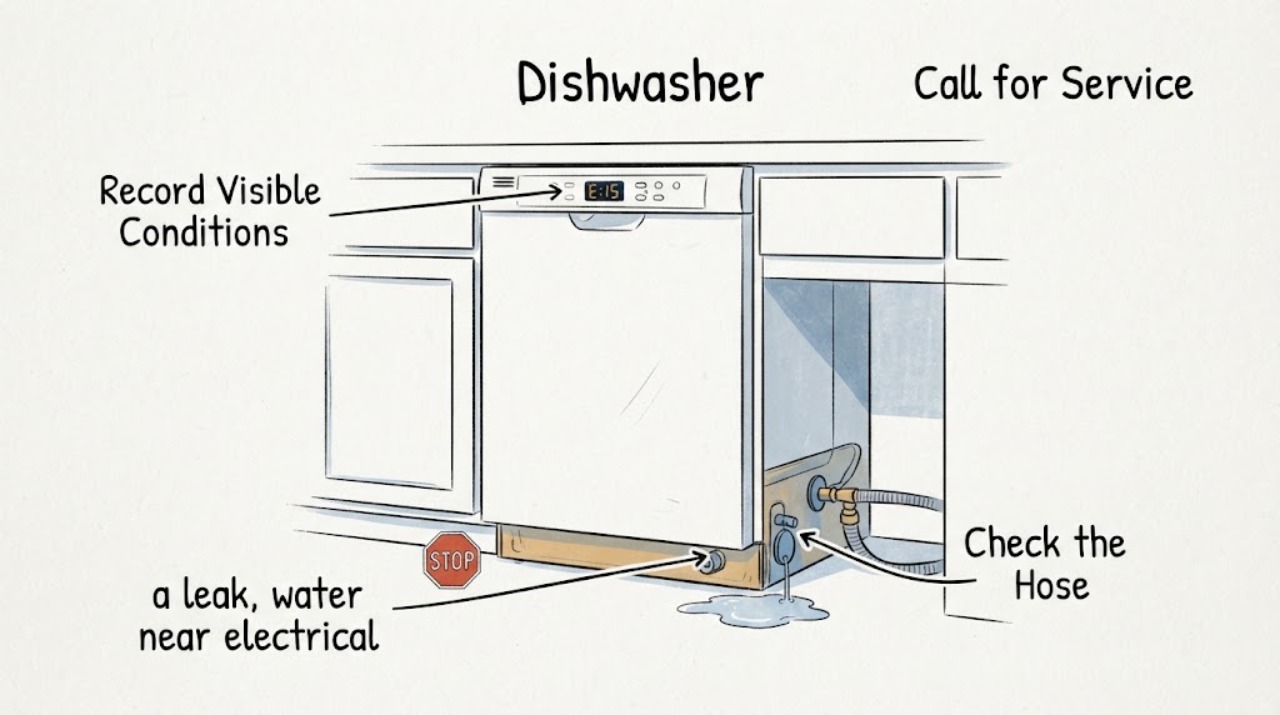
For the GE GDT60PMR6ES, do not combine H2O and FTD into one guessed part failure. GE's common dishwasher code page describes FTD/F56 as failure to drain and H2O as a low-water situation, while also warning that not every code appears on every model. If H2O appears at the point where the dishwasher should drain and the tub is full, that timing does not fit a simple fill-only explanation; record the sequence as a possible drain-path or water-level-sensing/control mismatch. Check only safe, visible hose, air-gap/disposer, supply, and model-authorized filter areas. If the sequence returns, stop repeated cycles and have the exact GDT60PMR6ES diagnosed.
Work through in order
Diagnostic checks
Use only checks that match the exact appliance or system and its official guide.
-
Check 1
Stop the cycle and write the exact display, including whether it says H2O, H20, FTD, or F56. Record the cycle and stage, whether the tub is empty or full, whether the drain pump keeps running, and whether this occurred before or after any sensor, float, pump, or plumbing work.
Expected result: H2O appears during fill with little water, H2O appears during a drain attempt with standing water, FTD appears while water remains, or FTD appears while the tub is dry and the pump continues to run.
Next step: Photograph the display and keep this timeline for service. Do not infer a component from the code combination or continue cycling to reproduce it.
Why this matters
Why: GE's code definitions are stage-sensitive: H2O normally directs attention to low fill water and FTD to failure to drain. A full tub at the H2O point is a conflicting pattern, while a dry tub with indefinite drain behavior is not evidence that a new part is required.
-
Check 2
If there is standing water, a leak, water near electrical parts, smoke, a burning smell, sparks, or a hot/damaged cord, stop using the dishwasher. From a safe dry position, turn off the water supply and isolate power only if that can be done without touching wet electrical parts.
Expected result: The dishwasher and surrounding electrical area are dry with no odor, or a leak/electrical hazard is present.
Next step: Keep the dishwasher out of service and arrange qualified appliance or electrical help for any hazard. If dry and safe, continue only with visible external checks.
Why this matters
Why: Water and electrical hazards override code-clearing steps. FTD or H2O does not make it safe to run a leaking or electrically damaged appliance.
-
Check 3
For H2O that occurs during the initial fill, inspect from under the sink that the dishwasher hot-water shutoff is fully open and the visible inlet hose is not kinked or crushed. Do not loosen a pressurized connection or use this fill check to explain H2O that appears during draining.
Expected result: The shutoff is closed or the hose is visibly restricted, or the supply and visible hose are normal.
Next step: Correct only a plainly closed shutoff or visible routing issue, then follow the exact manual for one permitted retry. If H2O returns or appears at drain time, stop and request service.
Why this matters
Why: A closed supply or visible inlet restriction can explain a genuine low-fill H2O event. If water was already in the tub and the machine was trying to drain, this check does not resolve the contradictory timing.
-
Check 4
After power is isolated and only if the exact GDT60PMR6ES instructions authorize access, inspect the visible drain hose route, air gap, and disposer connection for kinks, crushing, blockage, or an incorrect connection. Look at the accessible tub/filter area only as the manual permits; do not dismantle the sump, pump, or floor protection.
Expected result: The hose or household drain path is visibly restricted, the tub/filter area has accessible debris, or all visible drain paths are clear.
Next step: Correct only a visible external restriction or documented filter issue. If water remains or either code returns, leave the dishwasher off and provide the observations to service.
Why this matters
Why: GE directs FTD owners to the drain hose, air gap, and disposer. A clear external path makes the H2O-at-drain sequence a service-level sensing/control question rather than proof that a pump or sensor should be replaced.
-
Check 5
Compare the order of events before and after any prior work: old FTD behavior, the exact part or float work performed, the first successful or failed cycle afterward, and the point at which H2O now appears. Do not run service mode, bridge a sensor, or swap another component as a test.
Expected result: The new H2O appears only when the tub should drain, FTD returns after visible drainage checks, or the code pattern changes between cycles without a clear external change.
Next step: Stop repeated testing and give the technician the before/after timeline, full model, codes, water state, and visible hose results.
Why this matters
Why: A changed code sequence shows that the prior intervention changed the symptom or control response, not that the new sensor/float or the control board is proven defective. A changing combination needs diagnosis of the complete fill, drain, and water-level feedback path.
-
Check 6
Only when there is no leak or electrical hazard and the exact manual allows it, use one normal Start/Reset or power reset. Restore power once and observe the display without starting repeated cycles or opening the machine while it is running.
Expected result: The display clears and the dishwasher remains normal, the same combination returns, or the dishwasher remains full or repeatedly tries to drain.
Next step: Do not reset again. Leave the dishwasher unused and arrange model-specific service if either code returns, the tub remains full, or the drain pump runs unexpectedly.
Why this matters
Why: GE says a power reset may clear a fault but recommends service when the code persists. A one-time clear cannot prove that the underlying drain or level-sensing condition is repaired.
Use your observations
Decision map
Find the observation that best matches what you see, then follow the next safe action.
-
PATH 01Next step
What you see
H2O appears during fill and there is little or no water in the tub, with a closed or visibly restricted hot-water supply path.
Do this next
Correct only the visible supply or inlet-hose issue allowed by the exact manual and make one permitted retry. If H2O returns, call service.
Why this path and its safety boundary
Why it matters: This fits GE's low-water description more closely than a drain failure.
-
PATH 02Next step
What you see
H2O appears when the dishwasher should drain and the tub is full, or H2O follows an earlier FTD sequence after sensor/float work.
Do this next
Do not keep pressing Start or swap another part. Leave the machine off after safe isolation and provide the complete code timeline to qualified service.
Why this path and its safety boundary
Why it matters: The stage and water state conflict with a fill-only interpretation. The prior work changed the observed code behavior but does not identify a board, sensor, pump, or harness as the failed part.
-
PATH 03Next step
What you see
FTD remains with standing water and a visible hose, air-gap, disposer, and permitted filter path is restricted.
Do this next
Correct only the visible external restriction or documented filter issue. If water remains or FTD returns, stop and arrange service.
Why this path and its safety boundary
Why it matters: A visible drain-path restriction is more plausible than an unexplained control fault, but it still does not justify opening the pump or sump.
-
PATH 04Next step
What you see
The visible drain path is clear, the tub is still full or the pump runs unexpectedly, and H2O/FTD recur after one permitted reset.
Do this next
Keep the dishwasher out of service and give the technician the exact GDT60PMR6ES model, code order, water state, prior work, and reset result.
Why this path and its safety boundary
Why it matters: This is a persistent drain and water-level feedback symptom beyond safe owner checks; the exact combination cannot select a replacement component.
-
PATH 05Next step
What you see
There is a leak, water near electrical parts, smoke, burning odor, sparks, a damaged cord, or repeated breaker trip.
Do this next
Do not touch wet controls or restore power. Isolate utilities only from a safe position and obtain qualified or emergency help.
Why this path and its safety boundary
Why it matters: The condition is an immediate water, fire, or electrical stop rather than a troubleshooting branch.
Helpful context
Understand the symptom
Read the two displays in context
FTD and H2O are not interchangeable labels. GE's common guide uses FTD/F56 for a drain failure and H2O for a low-water condition, but it also says codes are not present on every model. The important extra fact here is when H2O appears. H2O during a fill with little or no water points toward a supply check; H2O when the tub is full and the appliance should be draining is a conflicting observation that should be handed to service, not forced into the fill definition.
A repair changed the symptom, not the diagnosis
The exact community report records FTD with a pump apparently running while the tub was dry, followed by H2O at drain time and standing water after a pressure-sensor/float replacement. That chronology is useful evidence that the prior intervention did not establish a root cause. It is not proof that the replacement sensor, drain pump, control, or harness is the next part to replace.
Stay with external and documented checks
Visible drain routing, the household air gap or disposer connection, the hot-water shutoff, and the model-authorized filter or sump access are the only reasonable owner-level observations here. Do not dismantle the pump or sump, reach into a running appliance, bypass leak protection, enter service mode, or make live measurements.
When checks do not resolve it
Need a professional?
Call qualified service when H2O appears during a drain attempt with standing water, FTD or H2O returns after visible external checks and one permitted reset, the tub remains full, the pump runs unexpectedly, or the exact code sequence changed after prior sensor/float or pump work.
Have this ready
- Provide GE GDT60PMR6ES, exact display text, code order, cycle stage, tub water state, visible hose/air-gap/disposer findings, any leak or odor, prior work and part identity, and the result of the one permitted reset.
Common questions
FAQ
Does H2O always mean the dishwasher is not getting water?
GE describes H2O as a low-water situation, but the opened common-code page says not all codes occur on all models. If H2O appears when the tub is full and the machine should be draining, record that timing instead of treating it as a simple inlet-hose fault.
What does FTD mean on this GE dishwasher?
GE lists FTD or F56 as failure to drain and directs owners to check the drain hose, air gap, and disposer. A recurring code after those visible checks needs service; it does not name the drain pump as the part to replace.
Why can H2O appear after an earlier FTD?
The code sequence can change after an intervention, but that only shows that the symptom or control response changed. An H2O display during a drain attempt with standing water is a conflicting stage pattern that needs the full timeline and model-specific diagnosis.
Should I replace the pressure sensor, drain pump, or control board?
No part is established by H2O plus FTD alone. Do not swap another component, enter service mode, dismantle the sump, or make live measurements. Give service the exact GDT60PMR6ES and the code/water-state sequence.
Read the exact guide
Official sources
- GE GDT60PMR6ES h2o and FTD Fault CodesReddit r/Appliances · Exact user-reported GE GDT60PMR6ES H2O/FTD sequence; community evidence only.
- Dishwasher - H20 in DisplayGE Appliances · GE GDT60PMR6ES topic evaluated against GE dishwasher H2O fill guidance; exact-model manual confirmation remains required.
- Dishwasher - Error, Fault or Function CodesGE Appliances · GE GDT60PMR6ES topic evaluated against GE dishwasher common-code guidance; the page states that not every code appears on every model.
Community feedback
Share a repair observation
Share a plain-text repair observation. Accepted observations are published automatically; this page may take a moment to update.