
On this page
Start here
Quick answer
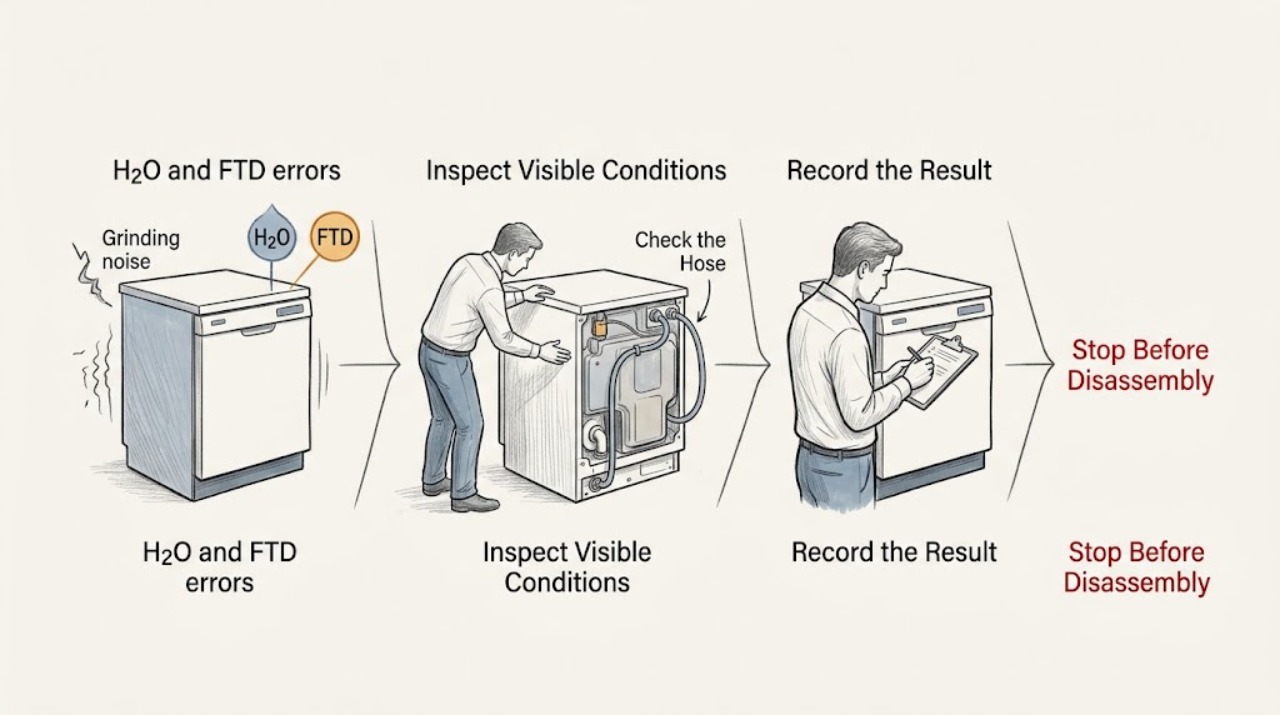
On a GE GDP665SYN8FS, H2O and FTD are different signals: GE defines H2O as a low-water situation and FTD/F56 as failure to drain. When FTD appears with a new grinding noise after an inlet-valve replacement, do not assume the replacement valve fixed the original problem or immediately buy a drain pump. Stop if the sound is harsh, the tub is leaking, or water is near electrical parts. With power off and the floor dry, record whether water is standing, whether the inlet hose is kinked, whether the accessible drain hose/air gap/disposer path is clear, and whether the noise occurs during fill, wash circulation, or drain. A recurring H2O/FTD combination or a grinding pump sound needs qualified diagnosis; an exact-model community case shows that multiple parts can be replaced while a concealed wiring or leak issue remains.
Work through in order
Diagnostic checks
Use only checks that match the exact appliance or system and its official guide.
-
Check 1
Stop the dishwasher and observe from a dry, safe position. Record the exact display, whether the tub is empty or holding water, when the grinding starts, and whether there is a leak, burning smell, smoke, hot connection, or breaker trip. Do not reach into standing water or a moving pump.
Expected result: The noise occurs during fill, wash circulation, or drain; water is standing; or a leak/electrical hazard is present.
Next step: For water near electrical parts, smoke, burning odor, a hot cord, an uncontrolled leak, or repeated breaker trips, isolate power only from a safe dry location and arrange qualified appliance/electrical service. Otherwise continue only with external checks while powered off.
Why this matters
Why: Timing separates the H2O supply symptom from the FTD drain symptom and helps distinguish a circulation sound from a drain-pump sound. A leak or electrical symptom is a stop-use condition, not a reason to run another diagnostic cycle.
-
Check 2
For H2O, check only the accessible household supply: confirm the dishwasher shutoff is open, the inlet hose is not kinked or crushed, and the connection near the recently replaced valve is dry. Do not disconnect the supply line, probe the valve, or make live electrical measurements.
Expected result: The supply is closed or restricted, the hose is kinked, a connection is wet, or the visible supply path is normal but H2O returns.
Next step: Correct only an obvious dry hose or shutoff condition and run no more than one supervised model-appropriate retry. If H2O returns, the connection leaks, or access requires removing panels, stop and arrange service.
Why this matters
Why: GE associates H2O with a low-water situation and specifically identifies an inlet-hose check for many cycles. A normal external supply does not prove the replacement valve, sensor, wiring, or control is good.
-
Check 3
For FTD, with power disconnected and the floor dry, inspect only the visible drain hose, air gap, and disposer connection for a kink, blockage, or incorrect connection. Note whether the tub remains full after the attempted drain. Do not dismantle the sump or reach into a pump with tools.
Expected result: The drain hose, air gap, or disposer path is visibly restricted, the tub remains full, or the accessible path is clear while FTD returns.
Next step: Correct only the visible external restriction and make one controlled drain observation if there is no leak or abnormal noise. If FTD returns, water remains, or the pump grinds, leave the dishwasher off and request service.
Why this matters
Why: GE lists the hose, air gap, and disposer as the first FTD checks. A clear external route with retained water leaves an internal drain pump, concealed hose, control, or wiring issue unresolved; it does not identify which part failed.
-
Check 4
Compare the grinding noise with the water state without opening panels: does it occur with an empty tub, only after water enters, only during drain, or continuously after the cycle is stopped? Keep the dishwasher off if the sound is harsh or recurring; do not add water to mask the noise.
Expected result: Grinding is tied to drain, grinding occurs with little/no water, the noise follows water entry during circulation, or the noise stops when the appliance is unplugged.
Next step: Do not order or install a pump based only on the sound. Provide the noise timing, H2O/FTD sequence, water level, and recent inlet-valve work to a qualified technician; stop immediately for heat, odor, leak, or electrical symptoms.
Why this matters
Why: A noise that follows drain or a low-water condition may involve a pump or foreign material, while a noise during circulation may involve a different motor path. These observations narrow the technician's test but cannot safely prove a component from sound alone.
-
Check 5
Prepare the repair handoff with the model and serial, exact code sequence, cycle/option, water level, noise timing, inlet-valve replacement date and part identity if known, hose/air-gap findings, and any visible leak or wiring damage. Do not continue replacing the pressure switch, pump, valve, or control board without a model-specific diagnosis.
Expected result: The symptom can be reproduced, the sequence is intermittent, or the dishwasher has already had one or more parts replaced without a lasting change.
Next step: Leave the dishwasher out of service if FTD or grinding recurs and request qualified GE/appliance service. Ask the technician to verify the drain path and electrical/mechanical condition before selecting another part.
Why this matters
Why: A reproducible sequence helps separate supply, drain, pump, pressure-sensor, harness, and control paths. Multiple unsuccessful part changes are evidence that a component-by-component guess is not resolving the fault.
Use your observations
Decision map
Find the observation that best matches what you see, then follow the next safe action.
-
PATH 01Next step
What you see
H2O appears with a visibly kinked or restricted inlet hose, the connection is dry, and no FTD or grinding occurs.
Do this next
Correct only the accessible hose or shutoff condition and make one supervised retry. Stop and request service if H2O returns or the connection leaks.
Why this path and its safety boundary
Why it matters: A visible supply restriction is more likely than a confirmed internal failure, consistent with GE's H2O guidance.
-
PATH 02Next step
What you see
FTD appears with standing water and a blocked or kinked visible drain path, but no grinding, leak, or electrical hazard is present.
Do this next
Correct only the visible hose, air-gap, or disposer condition and run one controlled drain observation. Escalate if water remains or FTD returns.
Why this path and its safety boundary
Why it matters: The external discharge route is the first supported explanation; a pump or control replacement is premature.
-
PATH 03Next step
What you see
H2O is followed by FTD, the visible supply and drain routes are clear, and grinding begins during drain or with little water.
Do this next
Stop repeated cycles and request qualified service with the complete timeline. Do not infer that the inlet valve, drain pump, pressure sensor, or control board is defective from the code pair alone.
Why this path and its safety boundary
Why it matters: The sequence leaves a low-water/sensing issue and a separate drain-pump or foreign-material issue in play; the recent inlet-valve replacement does not resolve either diagnosis.
-
PATH 04Next step
What you see
The exact-model symptom persists after the drain pump, pressure switch, or control work, or a technician finds water or a short near a vent or other internal assembly.
Do this next
Keep the dishwasher off and have a qualified technician inspect for leaks, harness damage, and the correct pump/sensor command under the exact model's service procedure. Do not open the door, base, or control area casually.
Why this path and its safety boundary
Why it matters: The exact-model community report shows that repeated parts replacement can coexist with an unresolved wiring/leak path; a concealed fault is more important to investigate than another guessed part.
-
PATH 05Next step
What you see
Water is near electrical parts, the cord or connection is hot/damaged, smoke or burning odor appears, a breaker trips, or grinding becomes severe.
Do this next
Keep clear, isolate power only from a safe dry location, shut off water if safe, and obtain qualified appliance/electrical or emergency help. Do not restore power to collect more observations.
Why this path and its safety boundary
Why it matters: This is an immediate water, electrical, or mechanical stop-use boundary.
Helpful context
Understand the symptom
Read H2O and FTD as separate observations
GE's code table says H2O indicates a low-water situation and directs the owner to check the inlet hose in most wash cycles; FTD or F56 means the dishwasher failed to drain and directs attention to the drain hose, air gap, and disposer. The codes can occur in sequence without proving that the inlet valve, drain pump, pressure sensor, or control board is the failed component. The grinding sound adds a separate mechanical observation that should change the stop-use decision rather than be folded into a generic code reset.
Why the recent inlet-valve replacement matters
A valve replacement changes the history, not the diagnosis. A kinked or restricted supply hose can still produce H2O, while FTD and grinding can point toward the drain path, pump area, a foreign object, or another fault. Keep the replaced part and installation date in the service notes, but do not keep swapping parts based on the order in which the codes appeared.
When checks do not resolve it
Need a professional?
Arrange qualified service when H2O returns after the accessible supply check, FTD returns after the hose/air-gap/disposer check, grinding persists, the tub remains full, or the problem continues after an inlet-valve replacement. Stop immediately for leaks, water near electrical parts, smoke, burning odor, a hot or damaged connection, repeated breaker trips, or severe grinding; isolate power and water only from a safe dry location. Do not probe a live valve or pump, bypass a sensor/interlock, or keep replacing parts based on the code sequence alone.
Common questions
FAQ
Does FTD after replacing the GE inlet valve mean the new valve is bad?
No. GE defines FTD as failure to drain, so first separate the drain path and water level from the earlier H2O supply symptom. A recent valve replacement changes the repair history but does not prove the cause of a later FTD or grinding noise.
Can I keep running the dishwasher to hear where the grinding comes from?
Do not repeatedly run it when FTD, standing water, grinding, a leak, heat, or odor is present. Record whether the sound occurs during fill, circulation, or drain from a safe position and give that information to a technician.
Is H2O the same code as FTD on a GE dishwasher?
No. GE lists H2O as a low-water situation and FTD/F56 as failure to drain. They can occur in sequence, but the sequence does not select a single failed component.
Read the exact guide
Official sources
- Dishwasher - Error, Fault or Function CodesGE Appliances · Official GE dishwasher code table opened for the assigned GDP665SYN8FS topic; the task spells the low-water code H20 while GE's page renders H2O, and GE states not all codes appear on all models, so the exact GDP665SYN8FS manual remains controlling.
- GE dishwasher FTD already replaced partsReddit r/appliancerepair · Exact-model community report; useful for the post-repair FTD sequence and reported wiring finding, not an official GE diagnosis or universal part recommendation.
Community feedback
Share a repair observation
Share a plain-text repair observation. Accepted observations are published automatically; this page may take a moment to update.