
On this page
Start here
Quick answer
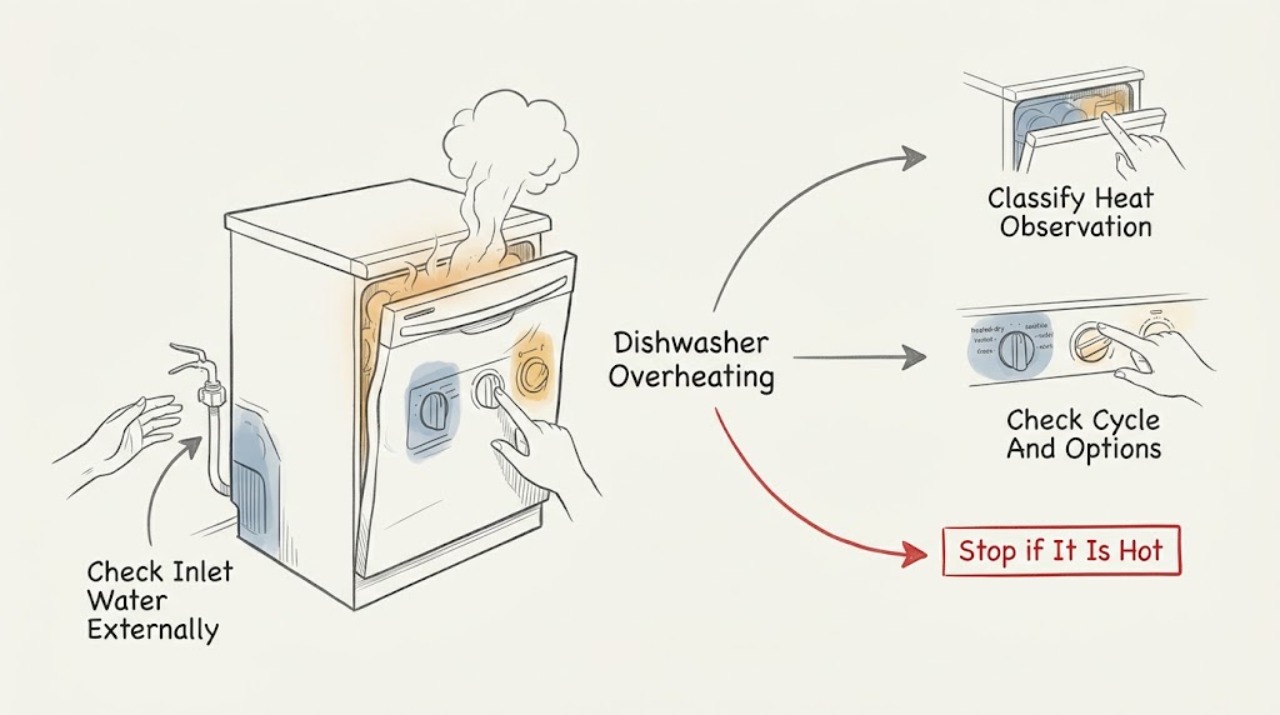
Stop the cycle and do not touch the tub or heater while hot. First record whether the concern is normal steam/hot dishes, a selected Heated Dry/Hi-Temp/Sanitize option, water hotter than GE's recommended inlet range, melted plastic or a burning odor, or a heater that appears to stay on. GE says some sanitize cycles briefly reach about 160°F, a hidden-heater model can heat rinse water to about 155°F with Power Dry, and the recommended incoming range is at least 120°F but not above 150°F. Those temperatures do not by themselves prove overheating. If plastic is melting, smoke or a burning odor persists, the tub/wiring is damaged, or a breaker trips, disconnect power when safe and leave the dishwasher out of service. Do not run another cycle to test it, open the door panel, probe wiring, or replace a heater or control from heat alone.
Before you begin
Safety first
- The owner may record the model and selected options, measure hot water at the nearby sink, and inspect an exposed tub area only after the dishwasher is fully cool and disconnected. Qualified appliance/electrical service must handle hidden heaters, pump assemblies, control panels, sensors, wiring, thermal protection, live testing, and water-heater changes.
Work through in order
Diagnostic checks
Use only checks that match the exact appliance or system and its official guide.
-
Check 1
From outside the dishwasher, record the complete GE model number, selected cycle/options, and the point in the cycle when the heat was noticed. Note steam, unusually hot exterior surfaces, melted plastic, smoke, odor, damaged dishes, a heater-visible model versus hidden-heater model, and any breaker/GFCI event. Do not touch the tub or element.
Expected result: The report is normal steam/hot dishes, a selected high-heat or dry option, inlet-water concern, melted material/burning odor, or a persistent heater/control symptom.
Next step: Use the matching branch and exact owner's manual. Keep the door closed until the machine is cool if there is any sign of melting or burning.
Stop if: Stop immediately for smoke, sparks, arcing, persistent burning odor, melted wiring/plastic, a hot/damaged cord, water near electrical parts, or repeated protection trips.
Why this matters
Why: Cycle stage and evidence separate intended heating from a potentially hazardous failure. The model determines whether a heater is visible and which options are present.
-
Check 2
With the dishwasher off and safe to operate the controls, compare the selected cycle and options with the exact GE manual. Look for Heated Dry, Hi-Temp Wash/Rinse, Extra Hot Wash, Added Heat, Dry Boost, Steam, Sani-Rinse, or a model-specific sanitize option; do not change several settings at once or start a test cycle while a hazard is present.
Expected result: A high-heat/dry/sanitize option was intentionally selected, the cycle is within the manual's expected behavior, or no such option explains the heat.
Next step: For normal option behavior, use the manual's settings and loading guidance. If heat is abnormal without a selected option or persists after a model-appropriate setting change, arrange service rather than testing repeatedly.
Stop if: Do not force a reset, enter diagnostics, override a thermal control, or run a high-heat cycle to see whether the symptom returns.
Why this matters
Why: GE says several options intentionally extend heating or raise rinse temperatures, and their availability varies by model. An expected option can explain warmth, but not melting, smoke, or persistent burning odor.
-
Check 3
If the concern is unusually hot water or damaged dishes without smoke/melting, measure the hot water at the nearby sink with a cooking thermometer, not inside the dishwasher. GE's general guidance is 120–150°F for incoming water; do not adjust a water heater beyond its safe installation instructions or apply a stainless-tub maximum to every model.
Expected result: The external hot-water supply is within GE's general range, above 150°F, or the measurement/model/tub construction is uncertain.
Next step: If the supply is above the model-appropriate limit, stop using the dishwasher until the water-heating setup is corrected by a qualified professional. If supply is suitable but the dishwasher still overheats, use service.
Stop if: Do not open plumbing connections, alter a gas/electric water-heater safety control, measure inside a running dishwasher, or continue use when dishes or components are melting.
Why this matters
Why: GE warns that incoming water above 150°F can damage dishes and, on plastic-tub models, rubber components, tub walls, or the water valve. The dishwasher's own heating options are separate from excessive incoming water.
-
Check 4
Only after the dishwasher is fully cool and disconnected, inspect the visible tub area for packing material, a fallen plastic item, or food residue touching an exposed heating element. If the model has a hidden heater, do not search for it by removing the pump or floor; if nothing is visible, do not infer that the heater is defective.
Expected result: A foreign item or packing material is visibly contacting an exposed element, the element/tub shows damage, the model has a hidden heater, or no visible cause is present.
Next step: Leave the appliance out of service for any melted, damaged, or persistent-burning condition. Use only the exact model manual or qualified service for removal/repair; do not improvise around the element.
Stop if: Do not scrape a hot element, use metal tools, open the pump or door panel, remove a hidden heater, or reconnect power to check the result.
Why this matters
Why: GE identifies packing material and plastic/food on an exposed element as possible sources of melting or burning odor. A hidden heater is integrated into the pump assembly and requires model-specific service access.
-
Check 5
If abnormal heat returns without an expected option, the heater appears to remain energized, the supply is suitable, or any burning/melting/electrical symptom persists, cancel use and document the model, cycle/options, stage, temperature evidence, odor, damage, and protection events for service.
Expected result: The symptom persists after safe external checks or the evidence includes melted parts, smoke, burning odor, damaged insulation, arcing, or repeated trips.
Next step: Keep the dishwasher disconnected and arrange qualified appliance service; use electrical service for wiring, outlet, breaker, smoke, sparks, or arcing concerns.
Stop if: Do not replace a heater, thermostat, sensor, board, or pump from the symptom alone; do not perform live voltage or resistance tests.
Why this matters
Why: A persistent pattern may involve the heater, temperature sensor, control, hidden wash-pump heater, wiring, or installation supply. GE's public guidance does not identify an internal part from overheating alone.
Use your observations
Decision map
Find the observation that best matches what you see, then follow the next safe action.
-
PATH 01Safety boundary
What you see
The heat occurs during a documented Heated Dry, Hi-Temp, Extra Hot, Steam, Sani-Rinse, or sanitize option, with no melting, smoke, burning odor, or damage.
Do this next
Confirm the exact model's option behavior and use the manual's loading guidance. Choose a lower-heat or natural-dry option only if the manual provides it and no hazard is present.
Why this path and its safety boundary
Why it matters: GE intentionally uses heat in these options, and a momentarily high internal temperature is not automatically an overheat fault.
Safety stop: Stop if heat is accompanied by melting, persistent burning odor, smoke, damaged wiring, or an electrical protection event.
-
PATH 02Safety boundary
What you see
External sink measurement shows incoming water above the general GE limit, or the tub/plumbing construction is unknown and dishes or rubber parts show heat damage.
Do this next
Stop using the dishwasher until a qualified professional corrects the water-heater/supply condition according to the model and local requirements. Do not compensate by changing internal dishwasher settings.
Why this path and its safety boundary
Why it matters: GE says water above 150°F can damage dishes and, on plastic-tub models, rubber components, tub walls, or the water valve. This is an installation/supply issue as well as an appliance symptom.
Safety stop: Do not alter water-heater safety controls, open plumbing connections, or continue a cycle with melting or damaged parts.
-
PATH 03Safety boundary
What you see
After cooling and disconnection, a visible plastic item, food residue, or packing material is found against an exposed heating element, with odor or melting localized there.
Do this next
Keep power disconnected, follow only the exact model's cooled-element instructions, and use service if material cannot be removed safely or odor persists. Do not perform the cycle-based removal procedure as a diagnostic test.
Why this path and its safety boundary
Why it matters: GE identifies these foreign materials as possible causes of a burning odor or melted plastic. The heater and residue may remain hot long after the cycle stops.
Safety stop: Do not touch a hot element, use metal tools, reconnect power, or continue if the element, tub, wiring, or insulation is damaged.
-
PATH 04Safety boundary
What you see
Heat is abnormal without an expected option, returns after the supply and visible checks, or the model has a hidden heater and persistent overheating, melting, odor, or control behavior.
Do this next
Leave the dishwasher disconnected and arrange qualified appliance service, providing the exact model, cycle stage, options, and evidence record.
Why this path and its safety boundary
Why it matters: This makes a temperature-control, heater, hidden wash-pump heater, wiring, or related internal fault more likely, but no component can be confirmed by external heat alone.
Safety stop: Do not remove the pump or door panel, bypass thermal protection, or run live measurements.
Helpful context
Understand the symptom
Heat is expected in a dishwasher, but the symptom still needs classification
A hot tub, steam, or warm dishes can be part of wash, sanitize, or dry operation. Overheating becomes a service concern when heat is paired with melted plastic, smoke, a persistent burning odor, damaged parts, abnormal controls, or a protection trip. Record the stage and evidence rather than judging temperature by touch.
GE heater architecture is not uniform
Some GE dishwashers expose a Calrod-style element at the bottom of the tub; others use a hidden heater integrated into the wash-pump assembly. A hidden heater cannot be judged by looking for a glowing element, and an exposed element must never be touched while hot. Use the exact model manual before interpreting what you see.
Treat smoke, burning, melting, and electrical damage as stop signs
Cancel the cycle and disconnect power from a dry, safe position when there is smoke, arcing, a burning smell, melting plastic, a hot or damaged cord, or a tripped protection device. Do not reopen a hot machine to investigate, run a confirming cycle, or make a live measurement.
Only after diagnosis
Potential parts
- model-matched heating element or hidden heater/wash-pump assembly
Consider only after qualified service confirms that the correct GE model's heater or integrated heater assembly is defective rather than a selected option, excessive inlet temperature, foreign material, or control fault.
GE models use exposed and hidden heater architectures; verify the complete model number and official fit information before any part decision. - model-matched temperature sensor or control component
Consider only when qualified diagnosis shows the heater is being controlled incorrectly after supply temperature and visible obstruction checks are excluded.
Overheating, hot dishes, or a long cycle does not identify a sensor or control part, and live testing is not an owner-level check. - model-matched tub seal, insulation, or wiring repair
Consider only after service documents physical heat damage to a specific tub, insulation, connector, or wire and confirms the repair is safe for that model.
Tub materials and heater layouts vary by GE model; do not order a heat-damaged component from appearance alone.
When checks do not resolve it
Need a professional?
Keep the GE dishwasher out of service and arrange qualified appliance service when heat occurs without an expected option, returns after safe supply/setting checks, the heater appears to stay on, the model has a hidden heater with persistent abnormal heat, or plastic, insulation, wiring, or dishes melt. Disconnect power when safe for smoke, sparks, arcing, persistent burning odor, water near electrical parts, or a repeated protection trip, and use electrical service as appropriate. Do not run another test cycle, touch a hot element, open panels, or bypass thermal protection.
Safety scope: The owner may record the model and selected options, measure hot water at the nearby sink, and inspect an exposed tub area only after the dishwasher is fully cool and disconnected. Qualified appliance/electrical service must handle hidden heaters, pump assemblies, control panels, sensors, wiring, thermal protection, live testing, and water-heater changes.
Common questions
FAQ
Is a hot GE dishwasher automatically overheating?
No. Heated Dry, Hi-Temp, Extra Hot, Steam, Sani-Rinse, and sanitize options intentionally raise temperature. Judge the report by cycle stage and evidence: melting, smoke, persistent burning odor, damage, or a protection trip is not normal option behavior.
What incoming water temperature should a GE dishwasher have?
GE's general guidance is at least 120°F and not more than 150°F at the dishwasher supply. Measure at the nearby sink with a cooking thermometer; do not measure inside a running dishwasher or apply a model-specific limit without the exact manual.
Why is plastic melting in my GE dishwasher?
GE says plastic, food, or packing material can fall onto an exposed heating element and melt or burn. Cancel use, disconnect power, and wait for the element to cool. Do not run a cycle to reproduce the problem; persistent odor or damage needs service.
Does a GE dishwasher with a hidden heater get hot?
Yes. GE says some models use a hidden heater integrated into the wash-pump assembly, and Power Dry can heat rinse water to approximately 155°F. The hidden design is model-specific and should not be opened or tested by the owner.
When should I stop using a GE dishwasher for overheating?
Stop and disconnect power when safe for smoke, sparks, arcing, persistent burning odor, melting, damaged wiring/insulation, water near electrical parts, or a repeated breaker/GFCI trip. Also arrange service for heat that returns without an expected option or after suitable incoming water is confirmed.
Read the exact guide
Official sources
- Dishwasher - Hidden HeaterGE Appliances · GE dishwasher hidden-heater architecture, wash-pump integration, and Power Dry heating behavior
- User Manual & Care for PDW7300GBBGE Appliances · GE Profile PDW7300GBB dishwasher identity and exact-model manual/support routing
- Dishwasher - Maximum Inlet Water TemperatureGE Appliances · GE dishwasher inlet-temperature limits by tub type and sanitize-cycle temperature context
- Dishwasher - Calrod Wattage RatingsGE Appliances · GE dishwasher exposed Calrod heater architecture and model-dependent heater ratings
- Dishwasher - Option DefinitionsGE Appliances · GE dishwasher Added Heat, Extra Hot Wash, Heated Dry, Hi-Temp, Dry Boost, Steam, and model-specific option behavior
- Dishwasher - Correct Water TemperatureGE Appliances · GE dishwasher recommended incoming hot-water range and safe external sink measurement
- Dishwasher - Burning Odor, Removing Plastic from ElementGE Appliances · GE dishwasher exposed-heater foreign material, unplugged cooling, burning odor, and service boundary
- Dishwasher - Sani-Rinse OptionGE Appliances · GE dishwasher Sani-Rinse option and model-dependent high-temperature cycle behavior
- Support for GE DishwashersGE Appliances · GE dishwasher model-specific support, troubleshooting, and qualified service routing
Community feedback
Share a repair observation
Share a plain-text repair observation. Accepted observations are published automatically; this page may take a moment to update.