
On this page
Start here
Quick answer
A warm tub and some steam during or after a high-temperature, sanitize, or heated-dry phase can be normal: KitchenAid says its dishwashers may pause to heat water, and the interior should feel warm and may contain steam. Do not treat about 120°F incoming water as an overheating limit; KitchenAid presents it as a water-temperature recommendation for cleaning performance. First determine whether the heat is limited to a normal hot phase and whether there is any smoke, burning odor, sparking, melted material, a hot or discolored plug, or a repeated breaker trip. If there is an electrical or burning warning sign, stop using the dishwasher and arrange qualified service. After it is fully cool, perform only an accessible, model-appropriate check; do not open panels or test live wiring.
Before you begin
Safety first
- Owner checks stop at slow door opening, cycle/option identification, safe hot-water observation, external power observation, and a fully cooled accessible inspection only when the exact model guidance permits it. Electrical testing, panel or inner-door removal, heater or sensor work, and part replacement require qualified service.
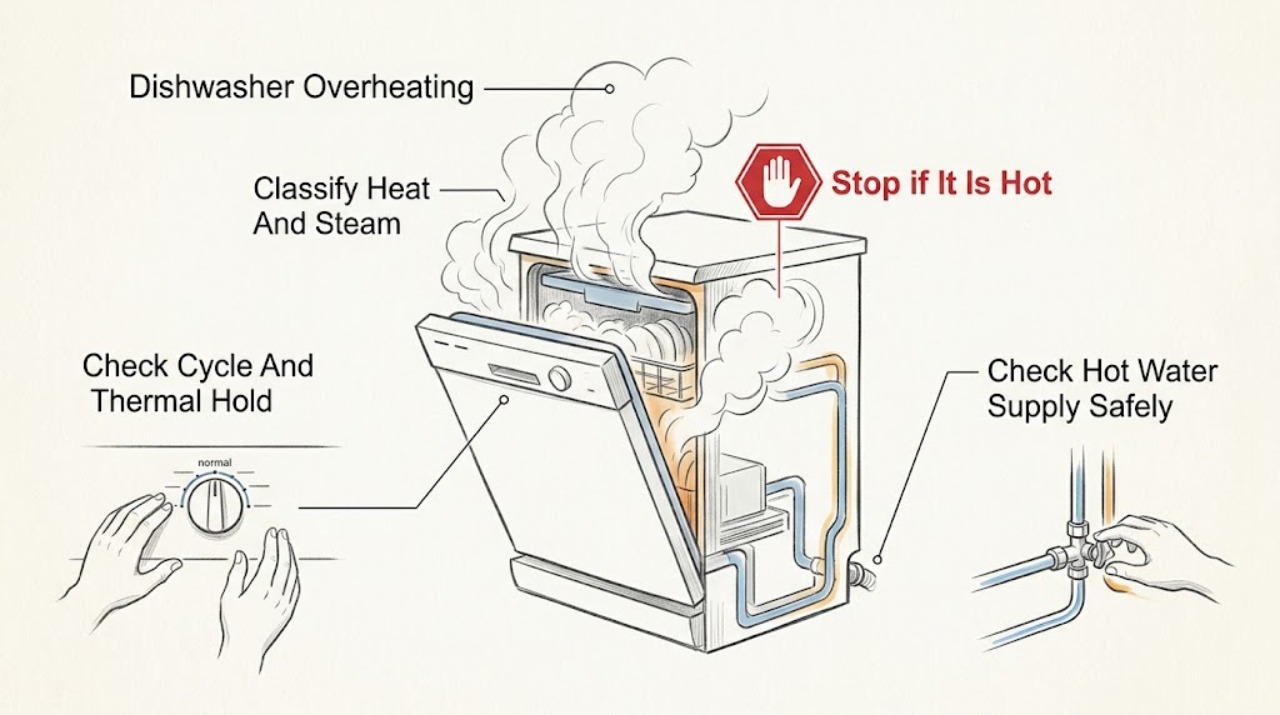
Work through in order
Diagnostic checks
Use only checks that match the exact appliance or system and its official guide.
-
Check 1
Without touching the heating element or reaching into the tub, note when the heat or steam appears: during a sanitize, high-temperature, or heated-dry phase; only when the door is opened after a cycle; immediately from the start; or together with smoke, burning odor, sparks, melted material, or a hot/discolored plug or cord.
Expected result: The tub is warm or steamy only during or after a documented hot/dry phase and there are no warning signs, or heat occurs immediately or with smoke, odor, visible damage, sparks, abnormal electrical heat, or a repeated breaker trip.
Next step: For normal warmth or steam, continue with the exact model instructions and the safe supply check. For any warning sign, stop using the dishwasher and arrange qualified appliance or electrical service.
Stop if: Do not touch hot surfaces, open the door quickly into steam, recreate smoke or sparking, or continue a cycle to see whether an electrical warning worsens.
Why this matters
Why: Warmth and steam limited to a hot phase can be normal KitchenAid operation. Immediate or electrically accompanied heat is not explained by normal steam guidance and requires the stop boundary.
-
Check 2
Check the selected cycle and options against the exact KitchenAid model instructions. Note whether Sanitize, Hi-Temp Wash, Heated Dry, or another hot option is selected, and whether the cycle is merely pausing or taking longer while the dishwasher heats water.
Expected result: A hot option is selected and the pause or longer time occurs during a heating phase, or the dishwasher becomes unusually hot outside that phase, shows an error, fails to heat, or stops with a breaker event.
Next step: Allow a normal hot phase to complete once if there are no safety signs. If the symptom is outside the expected phase, an error recurs, or protection trips, stop using the unit and use model-specific service.
Stop if: Do not change heater settings, bypass a temperature sensor, or repeatedly restart a cycle that produces abnormal heat, odor, smoke, sparks, or a breaker trip.
Why this matters
Why: KitchenAid says thermal holds and a longer cycle can occur while the internal heater and sensors bring water to condition. An error, no-heat result, or electrical event is not established as a normal thermal hold.
-
Check 3
From a safe position, run the hot-water faucet nearest the dishwasher briefly before a cycle and observe whether the incoming water is cold, warm, or hot. Do not disconnect the inlet hose, adjust a water heater, or treat the KitchenAid recommendation as a universal overheating cutoff.
Expected result: The supply is cold or unusually cool, the supply is hot, or the supply area leaks or cannot be checked safely.
Next step: If the supply is cold, address the household hot-water issue through the appropriate plumbing or appliance professional. If it is hot but the dishwasher overheats or shows warning signs, keep the dishwasher off and arrange service.
Stop if: Stop for a leaking valve or hose, scalding water, water near electrical parts, or any need to open plumbing or change heater controls.
Why this matters
Why: KitchenAid recommends about 120°F incoming water for best cleaning and explains that the dishwasher may extend heating when conditions are not met. This check can explain cycle performance, but it cannot prove that an internal heater is safe or faulty.
-
Check 4
If the concern is a melted-plastic or charred-food odor and there was no smoke or active electrical hazard, disconnect power according to the exact model procedure and wait until the dishwasher is completely cool. Then inspect only the visible area around the heating element for loose plastic or food debris; remove accessible debris only with a nonmetallic tool and only when the model guidance permits it.
Expected result: The heating area is clear, loose debris is present and removable after cooling, or material is fused, the element appears damaged, or the odor persists or returns.
Next step: After a clear, fully cooled inspection, use the exact model instructions for a single monitored cycle only if no safety warning remains. Otherwise keep the unit off and arrange qualified service.
Stop if: Do not inspect while hot, scrape with metal, remove the element, open the inner door or panels, probe wiring, or run the dishwasher after smoke, sparks, a hot/discolored cord, or a repeated breaker trip.
Why this matters
Why: Accessible debris can account for a localized odor according to KitchenAid's odor guidance. Fused material, damaged heating hardware, persistent odor, or an electrical warning is not a user-level part diagnosis.
-
Check 5
From a dry, safe position, observe the accessible plug, cord, outlet, or breaker without opening electrical covers. Record whether the breaker trips again, the plug or cord is hot/discolored, or power is absent; do not perform live electrical tests.
Expected result: The connection looks normal and remains powered, the breaker trips again, the cord or plug is hot/discolored or damaged, or smoke, sparks, or burning odor is present.
Next step: Stop using the dishwasher for any abnormal pattern and contact qualified appliance or electrical service. Provide the exact model, cycle/options, timing of heat or steam, and any error or odor description.
Stop if: Do not use an extension cord, change breaker ratings, repeatedly reset a tripped breaker, open a junction box, remove panels, or handle a smoking or energized appliance.
Why this matters
Why: A normal external connection does not clear an internal heating fault. Repeated protection trips or visible electrical damage indicate a hazard that should not be reset or diagnosed by continued operation.
Use your observations
Decision map
Find the observation that best matches what you see, then follow the next safe action.
-
PATH 01Safety boundary
What you see
The dishwasher is warm or steamy during or after Sanitize, Hi-Temp, or Heated Dry, the cycle may pause for heating, and there is no smoke, burning odor, visible damage, electrical heat, or repeated breaker trip.
Do this next
Open the door slowly and stand back from steam. Use the exact model instructions for the selected option and continue only while no warning sign develops.
Why this path and its safety boundary
Why it matters: This pattern is consistent with KitchenAid's description of normal heat, steam, and thermal holds; warmth alone does not prove overheating.
Safety stop: Stop if heat becomes immediate or localized outside the expected phase, or if smoke, odor, sparks, damage, or a breaker event appears.
-
PATH 02Safety boundary
What you see
The dishwasher is not obviously overheating, but the cycle is long or the results suggest that water is not reaching the expected condition; the hot tap is cold or only warm.
Do this next
Have the household hot-water or plumbing issue checked safely, and use the exact KitchenAid model guidance for water temperature and cycle options. Arrange appliance service if the dishwasher still fails to heat or reports an error.
Why this path and its safety boundary
Why it matters: Incoming water conditions can affect heating time and cleaning performance, but this observation does not identify an internal heater or sensor failure.
Safety stop: Do not set an unverified temperature limit, change heater controls, or open plumbing or appliance panels.
-
PATH 03Safety boundary
What you see
After a complete cool-down, there is localized melted plastic or food debris around the accessible heating area, with no active smoke, sparks, hot/discolored cord, or repeated breaker trip.
Do this next
Remove only loose accessible debris with a nonmetallic tool when the exact model guidance permits it. Keep the unit off and arrange service if material is fused, the element is damaged, or the odor returns.
Why this path and its safety boundary
Why it matters: KitchenAid's dishwasher odor guidance supports an accessible, cool inspection for melted plastic or food debris. It does not establish that a heating element or other part is safe to replace from the smell alone.
Safety stop: Stop immediately if the odor is electrical, smoke or sparks are present, the appliance is still hot, or inspection would require disassembly.
-
PATH 04Safety boundary
What you see
Heat occurs immediately or outside a normal hot phase, or there is smoke, burning electrical odor, sparking, a hot/discolored plug or cord, visible damage, or a breaker that trips again.
Do this next
Stop use, keep clear of smoke or live electrical parts, and isolate power only from a safe dry position if that can be done without contact with damaged equipment. Arrange qualified appliance or electrical service.
Why this path and its safety boundary
Why it matters: This is not a normal steam or thermal-hold pattern. CPSC and USFA guidance treat overheated or damaged appliance electrical parts as a stop-and-service condition.
Safety stop: Do not touch damaged wiring, repeatedly reset protection, remove panels, use an extension cord, or recreate the fault for testing.
Helpful context
Understand the symptom
Warmth and steam can be part of a normal hot phase
Do not diagnose overheating from warmth alone. KitchenAid describes a dishwasher pausing during a cycle to heat water, and its drying guidance says the interior should feel warm and may contain steam. Opening the door during or just after a high-temperature or drying phase can release heat and steam, so open it slowly and stand back. A warm tub with no smoke, burning odor, visible damage, or electrical warning sign is a different pattern from an appliance that is overheating electrically or melting material.
Incoming water temperature is a performance check, not an overheat threshold
KitchenAid recommends about 120°F incoming water for best cleaning and explains that the internal heater and sensors can lengthen a cycle while the water reaches the required condition. Run the hot tap until it is hot before starting a cycle only if the faucet can be operated safely. That guidance helps separate a long or cool cycle from an overheating diagnosis; it does not authorize setting a universal maximum temperature or changing the dishwasher's heater controls.
Treat odor, smoke, sparks, and electrical heat as a stop boundary
Stop the cycle and keep away from smoke, sparks, a burning electrical odor, a hot or discolored plug or cord, or a breaker that trips again. CPSC identifies unusual electrical sounds, sparks, overheated electrical parts, and burning odor as wiring hazards; its guidance says to unplug and stop using an appliance when the cord or plug overheats or sparks. Do not reach into a smoking or energized appliance, repeatedly reset the breaker, or remove a junction box or control panel.
Inspect the heating area only after complete cooling
If the concern is a melted-plastic or charred-food smell and there was no active electrical hazard, wait until the dishwasher is completely cool before any accessible inspection. KitchenAid's dishwasher odor guidance says to check around the heating element for melted plastic or food debris and to remove accessible material only when cool, using a nonmetallic tool. This is a model-appropriate visible check, not permission to remove the element, inner door, panels, or wiring. If material is fused, the element is damaged, or the smell returns, stop and arrange service.
Safety boundary
Stop conditions
- Stop using the dishwasher for smoke, sparks, a burning electrical odor, a hot or discolored plug or cord, visible electrical damage, or a breaker that trips again.
- Do not open the door quickly into a hot steam plume, touch the heating element while hot, or continue a cycle to reproduce abnormal heat.
- Do not bypass temperature controls, use an extension cord, change breaker ratings, repeatedly reset protection, or perform live electrical tests.
- Do not remove the heating element, inner door, junction box, control panel, or wiring. Owner checks stop at safe external observations and a fully cooled, model-appropriate accessible inspection.
When checks do not resolve it
Need a professional?
Arrange KitchenAid or qualified appliance service when the dishwasher heats outside its expected hot phase, shows an error or no-heat condition, repeatedly overheats, produces a returning melted-material or electrical odor, trips the breaker, or has a damaged heating area, plug, cord, or other electrical part. Use qualified electrical service for a damaged connection or protection that will not remain reset, and do not recreate a hazardous symptom.
Safety scope: Owner checks stop at slow door opening, cycle/option identification, safe hot-water observation, external power observation, and a fully cooled accessible inspection only when the exact model guidance permits it. Electrical testing, panel or inner-door removal, heater or sensor work, and part replacement require qualified service.
Common questions
FAQ
Is it normal for a KitchenAid dishwasher to be hot inside?
A warm interior and some steam can be normal during or after a hot, sanitize, or heated-dry phase. KitchenAid also describes pauses while the dishwasher heats water. Warmth alone is not proof of overheating; smoke, burning odor, sparks, electrical damage, or a repeated breaker trip changes the situation to stop-and-service.
Why does my KitchenAid dishwasher pause during a cycle?
KitchenAid says a dishwasher may pause two or three times to heat water, and the internal heater and sensors can make a cycle longer. A pause without warning signs can be a thermal hold. An error, no-heat condition, smoke, odor, or electrical event needs model-specific service rather than repeated restarts.
Does 120°F mean my KitchenAid dishwasher is overheating?
No. KitchenAid presents about 120°F incoming water as a recommendation for cleaning performance, not as a universal overheating limit. Do not change heater controls or set a temperature cutoff from that number; use the exact model guidance and escalate abnormal heat or electrical symptoms.
What should I do if my KitchenAid dishwasher smells like melted plastic?
Stop and let it cool completely. If there was no smoke, sparking, burning electrical odor, or breaker event, KitchenAid's odor guidance supports checking the accessible area around the heating element for melted plastic or food debris and removing only loose material with a nonmetallic tool. Fused material, a damaged element, a returning odor, or any electrical warning requires service.
When is dishwasher steam dangerous?
Steam released during or after a hot cycle can be expected, so open the door slowly and stand back. Treat steam with smoke, a burning odor, sparks, melted material, a hot or discolored cord or plug, or a repeated breaker trip as a stop condition. Do not keep operating to reproduce it.
Can I test the KitchenAid dishwasher heating element myself?
This page supports only a fully cooled, accessible visual check when the exact model guidance permits it. Do not remove the element, inner door, control panel, or wiring or perform live electrical tests. A no-heat result, error, abnormal heat, recurring odor, or electrical warning should be diagnosed by qualified service.
Read the exact guide
Official sources
- Melted Plastic or Charred Food Odor - DishwasherKitchenAid Product Help · KitchenAid Product Help dishwasher odor guidance; inspection is limited to a fully cooled, accessible area and does not authorize component disassembly.
- Dishes Not Drying: Quick Fix GuideKitchenAid Product Help · KitchenAid dishwasher drying guidance; exact drying options vary by model.
- Water Temperature - DishwasherKitchenAid Product Help · KitchenAid dishwasher operating guidance; the water-temperature recommendation is not an overheating threshold.
- Adding Items to Dishwasher During a CycleKitchenAid Product Help · KitchenAid dishwasher guidance; models and cycle options vary.
- How Water Temperature Affects Cycle TimeKitchenAid Product Help · KitchenAid dishwasher tip; exact cycle behavior and options vary by model.
- Appliance and Electrical Fire SafetyU.S. Fire Administration · General home-appliance safety; not a KitchenAid dishwasher diagnostic source.
- CPSC Guide to Home Wiring HazardsU.S. Consumer Product Safety Commission · General residential electrical safety; it does not diagnose a KitchenAid dishwasher component.
Community feedback
Share a repair observation
Share a plain-text repair observation. Accepted observations are published automatically; this page may take a moment to update.