
On this page
Start here
Quick answer
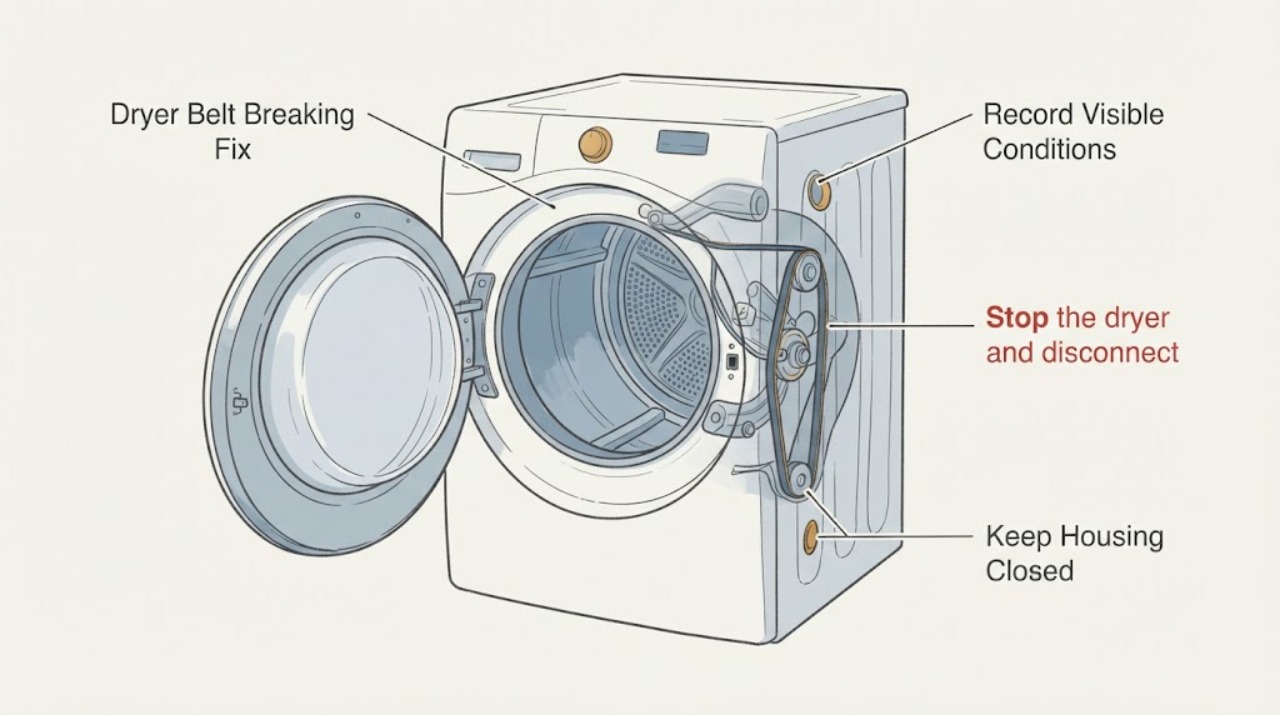
A GE dryer belt that breaks repeatedly should be treated as a service problem, not solved by repeatedly fitting another generic belt. GE says a broken or loose belt can leave the drum turning freely and recommends service; its support material also notes that heavy, wet loads can make a drive belt slip, while a frayed belt can cause thumping. Record the complete model number, stop running the dryer if the belt is broken, loose or making abnormal noise, and disconnect power before any maintenance. GE's public guidance does not prove whether the repeated failure is caused by a bearing, slide, felt, pulley, motor or another internal part, so do not use a cross-model replacement step or part number without model-matched evidence.
Work through in order
Diagnostic checks
Use only checks that match the exact appliance or system and its official guide.
-
Check 1
Record the complete GE dryer model and serial information, how many belts failed, how long each lasted, whether the drum stopped, and whether the failure followed a heavy or wet load, a thump, scraping or a burning smell.
Expected result: The model is known and the failure pattern is repeatable, or the model is missing and the history is limited to a broken belt.
Next step: Use the exact model manual and provide the failure history to GE or a qualified servicer. Do not order a belt solely from a photograph, a generic GE belt listing or another model's dimensions.
Why this matters
Why: GE routes washer/dryer support through model-specific resources, and repeated failures need the exact family rather than a generic belt route or part number.
-
Check 2
Stop the dryer and disconnect its power before any visual inspection or maintenance; do not run it to see whether a broken belt will hold.
Expected result: The drum no longer tumbles, the drum turns unusually freely, the belt is loose/broken, or the dryer has exposed damage, sharp edges or a burning smell.
Next step: Leave the dryer out of service and arrange qualified repair. Do not remove cabinet panels, reach around the drum, bypass the door switch or energize the dryer with a damaged belt.
Why this matters
Why: GE says a freely turning drum can indicate a broken or loose belt and that service is required. GE also instructs owners to disconnect power before maintenance and warns of sharp edges.
-
Check 3
Review the load pattern without restarting the damaged dryer: note whether the failures followed unusually heavy or wet loads, repeated overloading, or a drum that was difficult to turn before the belt failed.
Expected result: A heavy, wet load preceded a one-time slip, or belts fail again under ordinary loads and the drum-drive symptom persists.
Next step: Do not use a smaller load as a substitute for inspection after repeated belt failure. Give the load history to the servicer and follow only model-specific operating limits once the mechanical issue is cleared.
Why this matters
Why: GE says heavy, wet loads can cause the drive belt to slip. That may explain a single event but does not establish why a belt repeatedly breaks under normal loads.
-
Check 4
Classify any sound or visible symptom that occurred before the break, such as thumping, scraping, repeated squeaking, or a foreign object near the lint-filter opening, without reaching into the cabinet or drum-drive area.
Expected result: There was a thump or repeated abnormal squeak, scraping at the drum, or no warning symptom before the belt failed.
Next step: Discontinue use and report the sound timeline. Do not infer a bearing, slide, felt, pulley or motor failure and do not follow an internal replacement procedure without an exact model and qualified inspection.
Why this matters
Why: GE associates a frayed or damaged belt with thumping and identifies drum slides, the front seal and foreign objects as possible sources of abnormal noise, but does not say which internal part caused a repeated belt break.
Use your observations
Decision map
Find the observation that best matches what you see, then follow the next safe action.
-
PATH 01Next step
What you see
The drum turns unusually freely, no longer tumbles, or the belt is visibly broken or loose with power disconnected.
Do this next
Keep the dryer unplugged and arrange model-matched service. Do not run it, bypass the door switch or open the cabinet to route a belt by guesswork.
Why this path and its safety boundary
Why it matters: GE identifies a broken or loose belt as a service condition rather than a reason to keep testing the dryer.
-
PATH 02Next step
What you see
The only known event was a heavy, wet load and there is no repeated belt failure, abnormal sound or visible damage.
Do this next
Do not restart a dryer that has a broken or damaged belt. Provide the load history to service and follow the exact model's load guidance after repair clearance.
Why this path and its safety boundary
Why it matters: GE says a heavy, wet load may make the drive belt slip, but that observation does not prove the belt is healthy or explain a repeated break.
-
PATH 03Next step
What you see
Thumping, scraping, repeated squeaking or another abnormal sound occurred before the belt broke or returns after a repair.
Do this next
Stop use and have the drum-drive system inspected by a qualified servicer. Do not replace only the belt repeatedly or guess the internal component.
Why this path and its safety boundary
Why it matters: GE treats these as abnormal noise patterns and notes that a damaged belt can thump, while drum slides, the front seal or foreign objects can create scraping; the source does not identify a single failed part.
-
PATH 04Next step
What you see
A replacement belt has failed again under ordinary loads, or the exact model and belt fit cannot be confirmed.
Do this next
Keep the dryer out of service, collect the model/serial number and prior repair history, and schedule GE or qualified appliance service. Do not use a cross-model belt, alter pulleys or test the motor while energized.
Why this path and its safety boundary
Why it matters: The evidence is insufficient for a user-level part diagnosis, and repeated internal mechanical failure needs model-specific inspection.
Helpful context
Understand the symptom
Why a second broken belt changes the decision
One belt failure does not identify the reason it failed. A repeated failure means the belt and the drum-drive system need model-specific inspection. GE's public guidance supports checking the load and recognizing a freely turning drum or abnormal thumping, but it does not support naming a bearing, slide, felt, pulley, motor or control as the cause without inspection.
Use the exact model before ordering or replacing a belt
GE directs owners to model-specific support and its official belt product pages warn that fit must be confirmed by model number. The available belt/bearing video is described as applying to many older dryers, not all GE families. Record the model and serial tag and use the matching manual or qualified servicer rather than copying a belt route from another dryer.
Keep the repair boundary safe
Do not keep running a dryer with a broken, loose or repeatedly damaged belt. GE says to disconnect power before maintenance and warns that sharp edges may be present. Repeated belt breakage is an internal mechanical repair decision; the safe user contribution is the model, symptom history, load pattern and visible external observations, not a guessed component replacement.
When checks do not resolve it
Need a professional?
Arrange service whenever the belt is broken or loose, the drum turns freely, or the dryer makes abnormal thumping, scraping or repeated squeaking., Treat repeated belt breakage as an internal mechanical inspection problem; provide the exact model and prior repair history rather than repeatedly installing a generic belt., Disconnect power before maintenance and do not remove panels, bypass safety switches, reach past sharp edges or perform energized tests.
Have this ready
- complete GE model and serial number
- number of belt failures and dates or approximate run time between failures
- whether each failure followed a heavy/wet load or normal load
- sounds or symptoms before each break and whether the drum turned freely
- any prior belt, bearing, slide, felt, pulley or motor work and the exact part identification used
Common questions
FAQ
Can a heavy load cause a GE dryer belt to break?
GE says a heavy, wet load can make the drive belt slip. That can be relevant to a single event, but it does not prove the cause of repeated belt breakage. Do not keep running a dryer with a damaged belt; give the load history to a servicer.
Can I install the same GE dryer belt again?
Do not assume a generic or previously used belt fits the dryer. GE's official belt pages say to confirm fit by appliance model, and the belt/bearing support video applies only to many older dryers. Repeated failure needs model-matched inspection rather than another guessed replacement.
Does a thumping sound prove the dryer bearing or pulley is bad?
No. GE says a frayed or damaged belt can thump and also lists drum slides, the front seal and foreign objects among possible abnormal-noise sources. Those observations do not identify one internal failed part, so stop use and arrange qualified inspection.
Read the exact guide
Official sources
- Dryer - Drum Slide and Bearing ReplacementGE Appliances · Official GE support page; says the linked material covers many older dryers and is not a universal model-specific repair procedure.
- Dryer - Drum Does Not TurnGE Appliances · Official GE support article for dryers; external symptom guidance only, not a repeated-belt root-cause diagnosis.
- Support for GE Washers and DryersGE Appliances · Official GE support hub; directs owners to model/serial or QR-based support and qualified service.
- Dryer - NoisesGE Appliances · Official GE support article; supports symptom classification and service boundary, not a particular internal failed part.
- GE Appliance Product - How to Schedule Repair ServiceGE Appliances · Official GE service article; confirms dryers are covered by major-appliance service routing.
- DRYER DRUM DRIVE BELT - WE12M29GE Appliances · Specific official part page used only for GE's model-fit warning; it does not establish that WE12M29 fits the unmodeled task dryer.
Community feedback
Share a repair observation
Share a plain-text repair observation. Accepted observations are published automatically; this page may take a moment to update.