
On this page
Start here
Quick answer
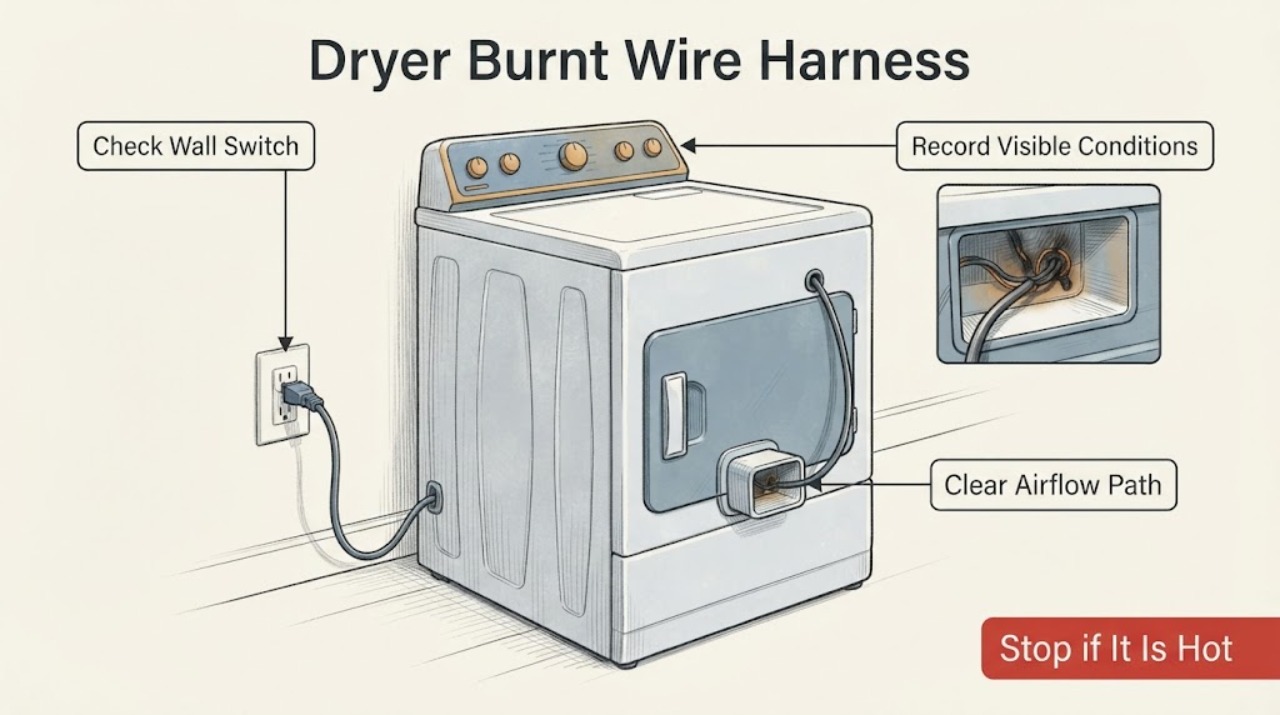
A burnt wire harness in a GE dryer is an electrical and fire-safety condition, not a normal drying symptom. Stop the dryer, keep it de-energized, and do not reconnect, bypass, splice, tape, replace a fuse repeatedly, open the cabinet, or test the harness live. GE says burned, broken or frayed dryer wires or terminal connections require replacement, while its vent guidance warns that lint restriction can create a fire hazard. After the appliance is safely isolated, only record the exact model, electric or gas type, visible external damage, odor/smoke history and vent configuration for a qualified GE or appliance service professional.
Work through in order
Diagnostic checks
Use only checks that match the exact appliance or system and its official guide.
-
Check 1
Stop the dryer immediately. If it is running, use the normal stop control only if it responds normally; then disconnect power or switch off the dryer circuit only from a dry, undamaged, accessible control point. For a gas dryer, do not touch gas components; if there is a gas smell, leave the area and follow local gas-emergency guidance.
Expected result: The dryer is fully stopped and isolated, or power cannot be isolated safely because the plug, receptacle, cord, area or appliance is hot, wet, arcing or damaged.
Next step: Do not reconnect or test the dryer. Keep people and combustible material away; use qualified appliance service, and use emergency services if there is active smoke, flame or an immediate fire hazard.
Why this matters
Why: A burnt harness requires a de-energized safety boundary. An unsafe isolation point is itself a reason to keep away and obtain emergency or qualified help.
-
Check 2
Without removing panels or touching the damaged wiring, record the exact visible location, any melted insulation or scorch marks that can be seen from the existing safe position, the presence of smoke or burning odor, and whether a breaker, fuse or outlet protection operated.
Expected result: Damage is limited to an already visible area, or the suspected harness is behind a cover, inside the cabinet, wet, hot or not safely viewable.
Next step: Photograph only from a safe, de-energized position if this can be done without contact. Do not open the cabinet, probe conductors, splice wires, bypass protection or use a continuity or live-voltage test; schedule model-specific repair.
Why this matters
Why: A visible symptom helps the servicer triage the job but does not identify the failed circuit, overload, connection or protective device. An inaccessible or energized area must not be investigated by the user.
-
Check 3
With the dryer isolated and without opening its cabinet, note whether the lint filter was present and clean, whether the external exhaust hood flap can move freely, and whether the outside duct outlet is visibly blocked. Do not run the dryer to check airflow and do not disassemble the vent or appliance around damaged wiring.
Expected result: Lint is heavy, the outside hood is blocked, the duct is crushed or restricted, or the visible vent path appears clear.
Next step: Give the observations to the servicer and have the full vent path assessed against the exact installation instructions. Leave the dryer off until the electrical damage and contributing conditions are professionally evaluated.
Why this matters
Why: GE says lint buildup and restricted exhaust can create fire hazards and lengthen drying time. A clear visible path does not rule out hidden restriction and none of these observations proves the harness's initiating cause.
-
Check 4
Read the model and serial tag only from a normal accessible location and record whether the dryer is electric or gas. Do not rely on a similar GE model's wiring diagram, harness listing or terminal instructions.
Expected result: The complete tag and appliance type are available, or the tag is missing, unreadable or conflicts with the assumed GE family.
Next step: Provide the complete tag, region, installation date if known, photos taken safely, and the damage history to GE or a qualified servicer. Do not order a harness or wiring kit from a generic listing.
Why this matters
Why: GE says power-cord and exhaust requirements vary by installation and model. Without the exact identity, a harness, cord, fuse, terminal or gas/electric procedure cannot be verified.
-
Check 5
Tell the servicer that the topic is a burnt wire harness and include whether the dryer was running, heating, stopping, tripping protection, smelling of burning, or showing extended drying time when the damage was noticed.
Expected result: The damage is a one-time visible event, or there were repeated trips, smoke, burning odor, heat damage or prior wiring/vent work.
Next step: Keep the dryer de-energized until the servicer inspects and repairs it under the exact model instructions. Do not resume operation merely because a smell fades or a breaker resets.
Why this matters
Why: Repeated electrical or heat symptoms increase the urgency and the need to identify the initiating fault before any replacement. A replacement harness alone is not a verified root-cause repair.
Use your observations
Decision map
Find the observation that best matches what you see, then follow the next safe action.
-
PATH 01Next step
What you see
If there is active smoke, flame, arcing, a hot outlet, or a strong burning/electrical odor
Do this next
Leave the area, use emergency services as appropriate, and do not re-enter or touch the appliance until it is safe.
Why this path and its safety boundary
Why it matters: This is an immediate fire or electrical hazard, not a troubleshooting opportunity.
-
PATH 02Next step
What you see
If the harness damage is visible but the dryer is now de-energized and there is no active emergency
Do this next
Keep it out of service, document the model and safe observations, and arrange qualified appliance service without opening or splicing the wiring.
Why this path and its safety boundary
Why it matters: The condition still requires model-specific electrical repair; the initiating cause is not established by the visual damage alone.
-
PATH 03Next step
What you see
If lint, a blocked hood, crushed duct or unusually long drying time is also present
Do this next
Have the complete exhaust path and the damaged electrical system assessed before any return to service.
Why this path and its safety boundary
Why it matters: Restricted airflow is a relevant fire-risk condition that may have contributed, but it does not prove the cause of the burned harness.
-
PATH 04Next step
What you see
If a breaker or fuse tripped, or the dryer stopped after the wiring overheated
Do this next
Do not reset and retry; leave the appliance isolated and tell the servicer the protection event and timing.
Why this path and its safety boundary
Why it matters: Protective operation does not identify a safe reset path and repeated energizing can worsen damage.
Helpful context
Understand the symptom
Treat a burnt harness as a stop condition
A visible burned harness, melted insulation, charred terminal or repeated electrical smell is evidence of heat damage, not a normal dryer odor. GE's support page says burned, broken or frayed wires or terminal connections require replacement. That does not identify the initiating fault or authorize a user to open the cabinet, join conductors, bypass a protective device or energize the dryer to see what happens.
Vent and lint are contributing conditions to document
GE says a partially clogged exhaust can lengthen drying time and heavy lint accumulation can create a potential fire hazard. Its installation guidance requires model-specific exhaust information and warns about unsuitable ducts, internal lint buildup and improper termination. These facts justify a professional vent assessment, but they do not prove that restricted airflow caused this harness damage.
Electrical and gas models have different boundaries
GE's power-cord guidance says electric dryer cord and supply requirements vary with the home's wiring, while gas dryers have separate installation requirements and must be exhausted safely. Without a model and appliance type, do not infer a harness layout, terminal arrangement, cord configuration or gas-component fault from another GE family.
Give the servicer a useful, safe history
Record the full model and serial information, whether the dryer is electric or gas, where the damage was seen without reopening the cabinet, whether there was smoke, arcing, a burning odor, tripped protection, extended drying time, crushed ducting or recent installation work. Leave the appliance isolated while service determines which wiring and safety components require model-specific replacement and what caused the heat damage.
When checks do not resolve it
Need a professional?
Arrange qualified GE or appliance service for any burnt harness, melted insulation, charred terminal, damaged power cord, repeated trip, smoke, electrical/burning odor or heat damage. Use emergency services for active smoke or flame.
Have this ready
- Provide the exact model and serial tag, electric/gas type, location of visible damage, photos made without opening or touching the appliance, protection events, odor/smoke history, drying-time changes, and vent or installation history.
Common questions
FAQ
Can I splice or tape a burnt GE dryer wire harness?
No. A burnt harness requires qualified model-specific electrical repair. Do not splice, tape, bypass protection or reopen the cabinet; keep the dryer de-energized and give the servicer the exact model and damage history.
Could a clogged vent have caused the burnt harness?
Restricted airflow and lint buildup are fire-risk conditions according to GE, so the vent should be assessed. They do not prove the cause of a particular harness failure, and the dryer should remain off until the electrical damage and vent are professionally evaluated.
Should I reset the breaker and see whether the dryer runs?
No. A reset does not establish that the wiring is safe. Repeated energizing can worsen heat damage; leave the appliance isolated and report the trip or fuse event to qualified service.
What information does GE service need?
Provide the complete model and serial information, whether the dryer is electric or gas, where the damage was observed, any smoke or burning odor, protection trips, drying-time changes, recent installation work and safe photos. Do not open the appliance to obtain more information.
Read the exact guide
Official sources
- Dryer - OdorGE Appliances · Opened GE Appliances odor guidance. It distinguishes initial-use odor from installed-dryer burning or musty odor associated with possible lint buildup and directs gas-flame concerns to repair.
- Dryer - Power CordsGE Appliances · Opened GE Appliances power-cord guidance. It explains that electric dryer cord type varies with the home's wiring and that installation instructions control the connection; it also distinguishes gas dryer cord context.
- Electric Dryer - Runs But Does Not HeatGE Appliances · Opened GE Appliances support guidance. It states that burned, broken or frayed power-cord wires or terminal connections require replacement and routes unresolved issues to service. The article does not reproduce its cabinet-opening step.
- Dryers Minimize the Fire HazardGE Appliances · Opened GE Appliances fire-hazard guidance. It says to clean the lint filter each use, keep combustible materials away, and avoid combustible substances or unsuitable articles in the dryer.
- Dryer - Installation Information for Exhaust DuctingGE Appliances · Opened GE Appliances installation guidance. It says exhaust requirements are model-specific, warns about restricted or unsuitable ducts, and explains why internal venting is not recommended for GE/Hotpoint dryers.
- Dryer - How to Clean Exhaust / Vent DuctGE Appliances · Opened GE Appliances exhaust-cleaning guidance. It warns that heavy lint accumulation can create a fire hazard and begins by turning off electrical supply before duct work.
Community feedback
Share a repair observation
Share a plain-text repair observation. Accepted observations are published automatically; this page may take a moment to update.