
On this page
Start here
Quick answer
For a GE dryer making a new drum noise, unplug it before inspecting it, remove only accessible objects from the drum or lint-filter opening, and verify that the cabinet is level and on a solid floor. GE treats a persistent thump, hum, metal scrape, or squeak that does not fade after startup as a service issue; a damaged belt, worn drum slides, or an object at the front seal can require qualified repair. Do not keep running a noisy Craigslist dryer while guessing at parts.
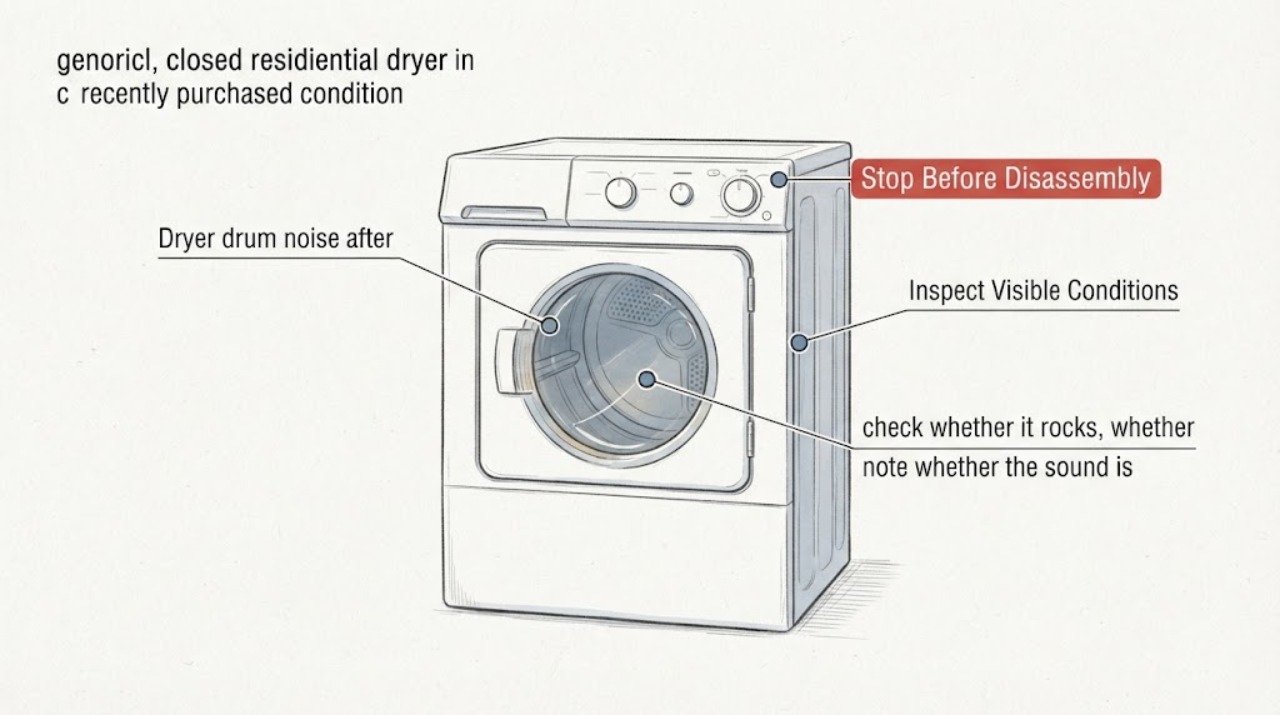
Work through in order
Diagnostic checks
Use only checks that match the exact appliance or system and its official guide.
-
Check 1
Unplug the dryer, remove the lint filter, and use a light to look for a loose object in the drum and in the visible lint-filter opening. If you must reach into that opening, use work gloves and do not force anything past an edge.
Expected result: You find a coin, paper clip, button, zipper piece, or another loose object in an accessible area.
Next step: Remove only the accessible object, refit the lint filter, and stop if the noise remains or the object is trapped at the seal or inside the cabinet.
Why this matters
Why: GE says objects in the drum can rattle or scrape as the drum rotates, while the lint-filter opening may have sharp edges.
-
Check 2
With the dryer off, check whether it rocks, whether anything is leaning against it, and whether it sits on a solid floor. Place a level on top from side to side and then front to back if you can do so safely.
Expected result: The cabinet rocks or the level shows that the dryer is not level.
Next step: Adjust the leveling legs according to GE's leveling guidance, keeping all required legs in contact with the floor; if the dryer still moves or makes the same noise, discontinue use and arrange service.
Why this matters
Why: GE says an unlevel dryer, an insecure floor, or contact with another object can create vibration or noise.
-
Check 3
If the dryer is safe to observe briefly, note whether the sound is only the first few seconds after startup or whether it continues as the drum turns. Do not run a full load to see whether a persistent noise goes away.
Expected result: A startup squeak fades after the first few seconds, or the sound continues during rotation.
Next step: If it fades and does not return, monitor it; if it continues or returns, unplug the dryer and use the service path rather than continuing to operate it.
Why this matters
Why: GE describes a short startup squeak as potentially normal, but classifies a continuing squeak, thump, hum, or repeating chirp as an abnormal noise that needs further attention.
-
Check 4
Classify the persistent sound without removing panels: listen for a thump, hum, repeating chirp, or metal scrape, and note whether it changes with drum rotation. Keep the dryer unplugged after recording the symptom.
Expected result: The sound is a thump, hum, repeating chirp, or metal scrape that remains after the external checks.
Next step: Do not select a belt, slide, bearing, motor, or blower from the sound alone. Give the servicer the sound description, model/serial information, and the fact that the unit was recently acquired used.
Why this matters
Why: GE lists these as abnormal patterns; it specifically says a frayed or damaged belt can thump and that an object at the front seal or worn drum slides can scrape, with service recommended for those conditions.
-
Check 5
Find and photograph the GE model and serial tag before requesting a part or appointment, then use GE's washer-and-dryer support route for the exact model.
Expected result: The model is available, or the tag cannot be read or is missing.
Next step: Provide the exact model to a qualified servicer if available. If the tag is missing or the noise persists without a verified model-specific procedure, stop using the dryer rather than guessing at a replacement part.
Why this matters
Why: GE directs owners to model-specific support and identifies the model/serial tag as the route to the correct support information; without it, a sound cannot establish part compatibility.
Use your observations
Decision map
Find the observation that best matches what you see, then follow the next safe action.
-
PATH 01Next step
What you see
An accessible object is found in the drum or lint-filter opening and the noise matches rattling or scraping.
Do this next
Remove only what is accessible with power disconnected; if the sound remains, stop and arrange qualified service.
Why this path and its safety boundary
Why it matters: The object is a plausible source of the sound, but an object at the front seal or inside the cabinet is outside the safe external check.
-
PATH 02Next step
What you see
The dryer rocks, is not level, or touches another object or an insecure surface.
Do this next
Correct the leveling or contact issue using the GE guidance; if the sound remains, discontinue use and seek service.
Why this path and its safety boundary
Why it matters: The installation can be adding vibration or noise, and GE's leveling guidance applies to the external setup.
-
PATH 03Next step
What you see
The squeak is limited to startup and disappears after a few seconds.
Do this next
Monitor it without opening the dryer; if it persists, becomes louder, or changes into a thump, hum, chirp, or scrape, stop and use the service branch.
Why this path and its safety boundary
Why it matters: GE identifies that brief startup squeak as a sound that can be normal.
-
PATH 04Next step
What you see
A thump, hum, repeating chirp, or metal scrape continues after the accessible checks.
Do this next
Discontinue use and give a qualified servicer the exact model/serial and sound description; do not run the dryer to test a guessed part.
Why this path and its safety boundary
Why it matters: GE treats the continuing pattern as abnormal and identifies belt, seal/slide, or other service-level causes without making a sound-only diagnosis.
-
PATH 05Next step
What you see
The Craigslist dryer has no readable model/serial tag or its prior repair history is unknown.
Do this next
Keep the dryer unplugged if the noise is persistent and have a qualified servicer identify the appliance before any internal repair or part order.
Why this path and its safety boundary
Why it matters: The correct repair procedure and part fit cannot be verified from the brand and noise alone.
Helpful context
Understand the symptom
Start with the sound and the machine's history
A used dryer bought through Craigslist may have an unknown model, installation history, and maintenance history. The sound alone cannot identify a motor, belt, slide, or bearing. Record whether the noise is a brief startup squeak, a repeating chirp, a thump, a hum, or a metal scrape, and find the model and serial tag before ordering any part. GE's support page lists the sound categories and directs owners to model-specific support when needed.
What you can check without opening the cabinet
The useful first checks are the drum, the lint-filter opening, the floor, and anything leaning against the cabinet. GE says to disconnect power before maintenance, warns that the lint-filter opening can have sharp edges, and recommends service when an object at the front seal or a worn drum slide is causing scraping. Cabinet panels, the belt path, motor, blower, and internal supports should be left to a qualified servicer unless the exact model documentation authorizes a repair.
When checks do not resolve it
Need a professional?
Stop using the dryer and arrange qualified service if the noise persists after the external checks, if it is a thump, hum, repeating chirp, or metal scrape, if an object appears trapped at the front seal or inside the cabinet, or if the model/serial information is unavailable for a model-specific repair decision.
Common questions
FAQ
Can I identify the bad GE dryer part from a video or sound alone?
No. A sound can narrow the observation branch, but GE's guidance covers several possible sources and directs service for persistent abnormal noise. Confirm the exact model and have the dryer inspected before ordering a belt, slide, bearing, motor, or blower.
Is a brief squeak when a GE dryer starts always a failure?
Not necessarily. GE says a startup squeak that goes away after the first few seconds can be normal; a squeak that continues or develops after heating should be treated as abnormal and escalated.
Should I keep using a noisy dryer I bought used?
Do not keep running it while an unusual noise remains unresolved. GE advises discontinuing use until a qualified servicer checks an unusual noise when the listed checks do not resolve it.
Read the exact guide
Official sources
- Dryer - LevelingGE Appliances · General GE dryer leveling and anti-tip guidance; exact installation details remain model-specific.
- Dryer - NoisesGE Appliances · General GE dryer noise guidance when no model is supplied; external checks and service boundary.
- Washers & Dryers TroubleshootingGE Appliances · GE washer/dryer support navigation, model/serial support route, dryer FAQ and service escalation.
Community feedback
Share a repair observation
Share a plain-text repair observation. Accepted observations are published automatically; this page may take a moment to update.