
On this page
Start here
Quick answer
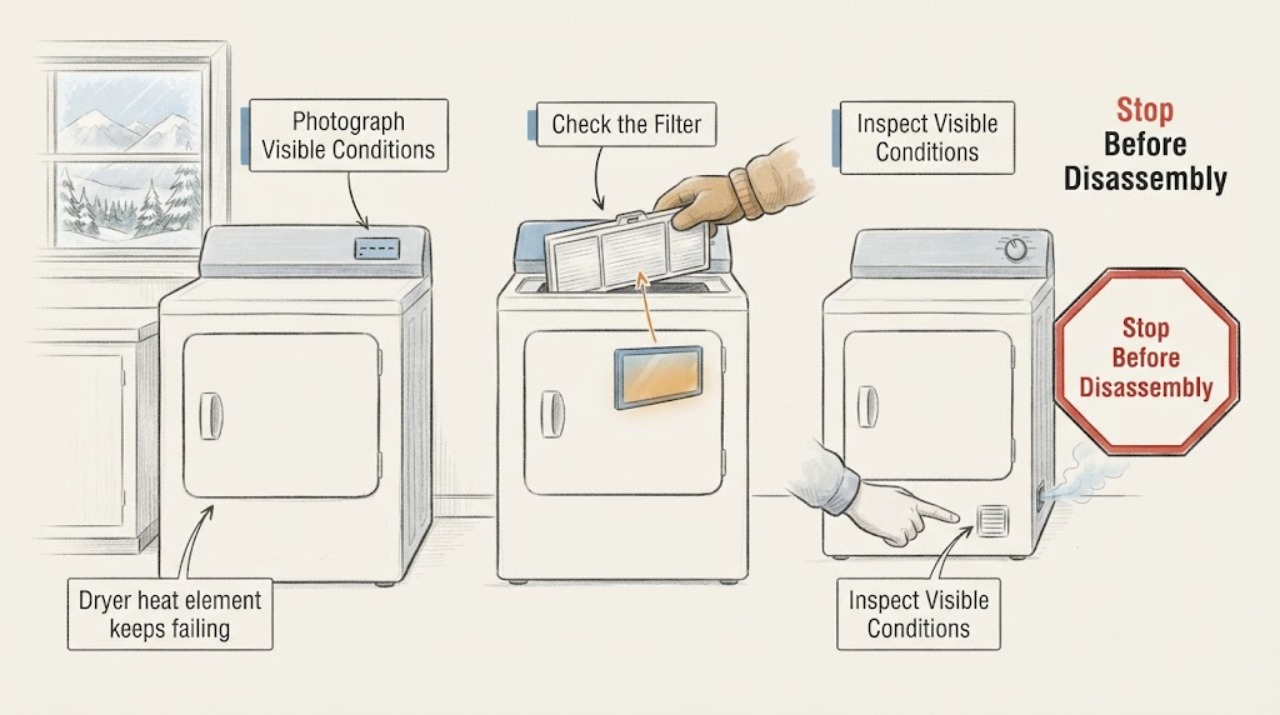
Treat a repeatedly failed heating element in the GE GFD14ESSNWW as a symptom to investigate, not proof that another element is the only part needed. GE identifies this model as a front-load vented electric dryer and specifies an outdoor exhaust system, so first check the accessible lint filter, the outside wall cap, and the visible transition duct for blockage, crushing, or a disconnected joint. In a mountain home, also record whether the dryer or exhaust runs through a cold or unheated area: GE says the control system needs an installation temperature above 50°F for satisfactory operation and that a dryer exposed to below-freezing temperatures for an extended period should warm before startup. Check the breaker or other external power indication without opening the electrical panel. Keep the dryer off if airflow is weak, the cabinet overheats, a breaker trips again, smoke or a burning smell appears, or the element has visibly failed; do not install another heater or measure live terminals before the vent, environment, and supply are evaluated.
Work through in order
Diagnostic checks
Use only checks that match the exact appliance or system and its official guide.
-
Check 1
Stop using the dryer and record the reported element failure without opening the cabinet: when the element failed, whether it was visibly broken or only stopped heating, the selected cycle and temperature, drying time, cabinet heat, odor or smoke, and whether a breaker or fuse changed state. Photograph only from the normal access area if safe.
Expected result: The element is visibly damaged, heat stopped without visible damage, the dryer became unusually hot, a burning smell or smoke occurred, or a breaker/fuse operated.
Next step: Keep the dryer off for smoke, burning odor, abnormal heat, visible damage, or a repeated trip. Give the technician the failure sequence and do not run another cycle to reproduce it.
Why this matters
Why: A visible heater failure or protective-device event confirms a service symptom but does not identify why it happened. Overheating, smoke, odor, or a power event raises the safety priority above another heater replacement; no visible damage leaves airflow, supply, control, and heater causes open.
-
Check 2
With the dryer off, clean the front lint filter as GE documents and inspect the filter opening only from the user-accessible side. Do not run the dryer without the filter, spray cleaner into the cabinet, or treat the screen as proof that the rest of the exhaust path is clear.
Expected result: The filter is packed, coated with residue, damaged, missing, or clean and correctly seated.
Next step: Clean or correctly reseat the filter only as the manual permits. If it is damaged, missing, or the dryer overheated, leave the dryer off and arrange service; do not substitute an unapproved filter.
Why this matters
Why: A restricted or improperly maintained filter can reduce airflow and increase heat, while a clean filter does not rule out lint inside the cabinet or a blocked house duct. A damaged or missing filter is an immediate stop condition.
-
Check 3
From outside the home, inspect the exhaust hood or wall cap while the dryer is off: check that the flap can move freely and that lint, snow, ice, birds, insects, or another obstruction is not blocking it. From the dry, accessible area near the dryer, look for a crushed, disconnected, excessively bent, or visibly leaking transition duct; do not open the dryer cabinet or reach into the wall duct.
Expected result: The wall cap is blocked or frozen, the flap does not move freely, the transition duct is crushed or disconnected, the route passes through a cold unheated area, or the visible path is clear.
Next step: Remove only loose debris at the outside cap without entering the duct, and have a qualified person inspect or clean the full exhaust system when blockage, long/cold routing, or internal lint is suspected. Keep the dryer off if airflow is weak or heat is excessive.
Why this matters
Why: GE says a partially clogged exhaust can lengthen drying, and its installation manual warns that crushed or collapsed ducting obstructs airflow and raises fire risk. A cold or unheated run can also accumulate condensation and lint; a clear exterior opening does not prove the hidden duct or cabinet is clean.
-
Check 4
Check the mountain-home environment without moving the appliance: note the room temperature around the dryer, whether the appliance sat below freezing, whether the exhaust passes through an unheated space, and whether a seasonal cold snap preceded the failure. Do not use a heater, flame, or hair dryer to warm the cabinet or duct.
Expected result: The dryer is installed below GE's stated 50°F control-system condition, was exposed to extended freezing temperatures, the duct runs through an unheated area, or the installation remains above the stated condition with no freeze exposure.
Next step: Allow the appliance to return naturally to the manual's permitted operating environment before any normal use, and have a qualified installer inspect cold-route ducting for condensation or lint. Do not restart while the heater is damaged or the cause remains unexplained.
Why this matters
Why: GE's GFD14 installation instructions say the dryer should be installed above 50°F for satisfactory control operation and should warm before startup after extended below-freezing exposure. GE also notes that insulation in an unheated duct area reduces condensation and lint buildup. These facts make environmental and exhaust checks relevant, but they do not prove that cold alone destroyed a heater.
-
Check 5
From the normal user-accessible area, check whether the dryer display powers on and whether an external breaker or fuse indication has changed. Compare the symptom with GE's manual note that a dryer may tumble but not heat when a fuse is blown or one breaker has tripped. Do not open the electrical panel, perform electrical measurements, remove the terminal cover, or repeatedly reset a protective device.
Expected result: The display is dark, the drum tumbles but there is no heat, an external breaker or fuse indication is abnormal, or controls and power appear normal.
Next step: If a breaker trips again, smells hot, or the outlet/cord is damaged, leave the dryer disconnected and use a qualified electrician. Otherwise provide the power symptom and exact model to GE-qualified appliance service; do not perform live tests.
Why this matters
Why: A tumble-without-heat result can be consistent with an incomplete electrical supply as well as a heating circuit problem; it is not evidence that the element alone failed. A dark display or repeated trip needs electrical and appliance service, while normal external power keeps airflow, heater, control, and connection diagnosis open.
-
Check 6
Compile the service record without restarting the dryer: full model and serial information from the label behind the door, electric-dryer identity, heater-failure evidence, cycle and temperature, load, drying-time changes, filter and exhaust observations, room/duct temperature conditions, power-device history, and any smell or smoke. Do not order a replacement element until the service path confirms the exact part and cause.
Expected result: The record shows repeated heater failure with restricted airflow, cold/condensing duct conditions, a power event, abnormal heat or odor, or no surrounding abnormality.
Next step: Keep the dryer off and give the record to qualified appliance service, adding a qualified electrician when the evidence points to the outlet, cord, breaker, or supply. Resume use only after the cause and safety controls are addressed.
Why this matters
Why: The pattern helps service decide whether to inspect exhaust and internal lint, the electrical supply and connections, temperature protection and controls, or the heater circuit. It still does not prove a compatible element or a single root cause.
Use your observations
Decision map
Find the observation that best matches what you see, then follow the next safe action.
-
PATH 01Next step
What you see
The lint filter, outside hood, or visible transition duct is restricted, crushed, disconnected, frozen, or producing weak exhaust, especially if drying times lengthened or the cabinet became very hot.
Do this next
Keep the dryer off and have a qualified person inspect and clean the complete exhaust path and interior. Do not install another element and continue testing until airflow and fire-risk conditions are corrected.
Why this path and its safety boundary
Why it matters: Restricted exhaust or lint accumulation is a leading system-level explanation to investigate before condemning another heater, but an accessible cleaning check does not rule out lint inside the cabinet or a hidden duct fault.
-
PATH 02Next step
What you see
The dryer or duct was exposed to extended freezing conditions, the installation is below GE's stated 50°F environment, or an unheated exhaust run shows condensation or seasonal blockage, with no smoke or active electrical hazard.
Do this next
Let the appliance warm naturally within the manual's operating conditions and have the exhaust route evaluated for condensation, insulation, blockage, and lint. Keep the dryer off if the heater is damaged or overheating occurred.
Why this path and its safety boundary
Why it matters: The mountain-winter environment is a relevant contributing condition to verify. GE's manual addresses startup after freezing exposure and condensation/lint buildup in unheated ductwork, but it does not establish cold as the sole cause of a failed heater.
-
PATH 03Next step
What you see
The drum tumbles but there is no heat, the display or controls are abnormal, a breaker or fuse has operated, or the cord/outlet is hot or damaged.
Do this next
Stop using the dryer and have a qualified electrician or appliance technician evaluate the supply and appliance. Do not open the electrical panel, probe live terminals, or repeatedly reset a tripping breaker.
Why this path and its safety boundary
Why it matters: An incomplete supply or electrical/heating-circuit issue remains possible; the symptom cannot distinguish a supply fault from the heater, control, sensor, or connection without qualified testing.
-
PATH 04Next step
What you see
The exhaust and environment are documented as acceptable, external power appears normal, but the heating element repeatedly fails or a new failure is accompanied by smoke, burning odor, unusual heat, or protective-device operation.
Do this next
Leave the dryer disconnected and provide the complete failure record to qualified GE appliance service. Do not run a cycle with a damaged heater, missing panel, or bypassed safety component.
Why this path and its safety boundary
Why it matters: An internal heater, temperature-protection, wiring, control, or other model-specific fault needs service diagnosis. Replacing the element alone is not justified by the user-reported component label.
Helpful context
Understand the symptom
The assigned model is GE GFD14ESSNWW, a 24-inch front-load vented electric dryer. A heater that fails more than once can reflect heat and airflow conditions, a supply or connection issue, environmental exposure, or an unconfirmed internal fault. The user-reported element diagnosis should remain a hypothesis until the failure is documented and the surrounding conditions are checked.
GE's owner and installation manual warns that collapsed or crushed venting can obstruct airflow and increase fire risk, requires the dryer to exhaust outdoors, and calls for periodic qualified cleaning of the appliance interior and exhaust duct. A clear lint screen alone does not prove that the internal cabinet or house duct is clear.
Do not operate a dryer with a damaged or partially disassembled heater, missing panels, a missing lint filter, a hot plug or cord, smoke, sparks, or a strong burning odor. Disconnect power only from a safe, accessible means; do not open the distribution panel, probe energized terminals, bypass thermal protections, or keep resetting a tripping breaker.
When checks do not resolve it
Need a professional?
Keep the GE GFD14ESSNWW off and arrange qualified appliance service when a heater has failed visibly or repeatedly, airflow is weak, the exhaust path or cabinet may contain lint, the dryer overheats, or the cause remains unexplained after external checks. Use a qualified electrician for a hot or damaged cord/outlet, abnormal breaker behavior, a dark display, or any supply diagnosis. Stop immediately for smoke, sparks, fire, a strong burning electrical odor, or worsening heat; do not open panels, measure live terminals, bypass thermal protections, run without the lint filter, or install another heater before the exhaust, environment, and supply are evaluated.
Common questions
FAQ
Does a repeatedly failed heater mean I only need another heating element?
No. Treat the heater as a symptom until exhaust airflow, internal lint, environment, electrical supply, connections, and temperature protection are evaluated. GE warns that restricted airflow can increase fire risk, and the model manual says a dryer may tumble without heat after a fuse or breaker issue.
Can a mountain winter cause the GE GFD14ESSNWW heater to fail?
Cold conditions are relevant to check but are not proven to be the sole cause. GE says the control system needs an installation temperature above 50°F for satisfactory operation and that the dryer should warm before startup after extended below-freezing exposure. An unheated exhaust route can also accumulate condensation and lint.
Why does the dryer tumble but not heat after the element failed?
GE's manual says a blown fuse or tripped breaker can allow the dryer to tumble without heating. That observation can also occur with a heating-circuit fault, so do not open the panel or measure live power; have the supply and dryer diagnosed safely.
Is cleaning the lint filter enough after a heater failure?
No. Clean the user-accessible filter as directed, but GE also calls for inspection and periodic qualified cleaning of the appliance interior and exhaust duct. Check the outside hood and visible transition duct without entering the cabinet; weak exhaust or overheating requires service.
Read the exact guide
Official sources
- User Manual & Care for GFD14ESSNWWGE Appliances · The exact GE model page identifies GFD14ESSNWW as a front-load vented electric dryer and links its owner manual, maintenance, troubleshooting, and installation resources.
- Dryer - How to Clean Exhaust / Vent DuctGE Appliances · GE recommends at least annual exhaust inspection/cleaning, warns that heavy lint accumulation can be a fire hazard, and gives an external wall-cap flap check; use the model manual for any model-specific access.
- Dryer - How to Clean Lint FilterGE Appliances · GE describes the front lint-filter removal and cleaning frequency and says to unplug before cleaning the filter opening; it does not replace qualified interior or duct cleaning.
- GFD14 Owner's Manual & Installation InstructionsGE Appliances · This PDF was opened through the exact GFD14ESSNWW GE Owner Center. It states the GFD14 safety, venting, environmental, electrical, maintenance, and no-heat troubleshooting guidance used here; it does not prove a repeated element has one root cause.
Community feedback
Share a repair observation
Share a plain-text repair observation. Accepted observations are published automatically; this page may take a moment to update.