
On this page
Start here
Quick answer
A brief squeak for the first few seconds after a GE dryer starts can be normal, but GE classifies a squeak that appears after the dryer heats up or a short chirp that repeats every few seconds as an abnormal noise pattern. Unplug the dryer before maintenance, then check the safe external causes GE lists: level and solid placement, exposed loose screws, and foreign objects below the lint filter or in the drum. Do not open the cabinet or assume a belt, drum slide, seal, or motor is failed from sound alone. If the squeak continues, returns after heating, or is joined by scraping, thumping, burning odor, or unusual heat, discontinue use and arrange qualified service.
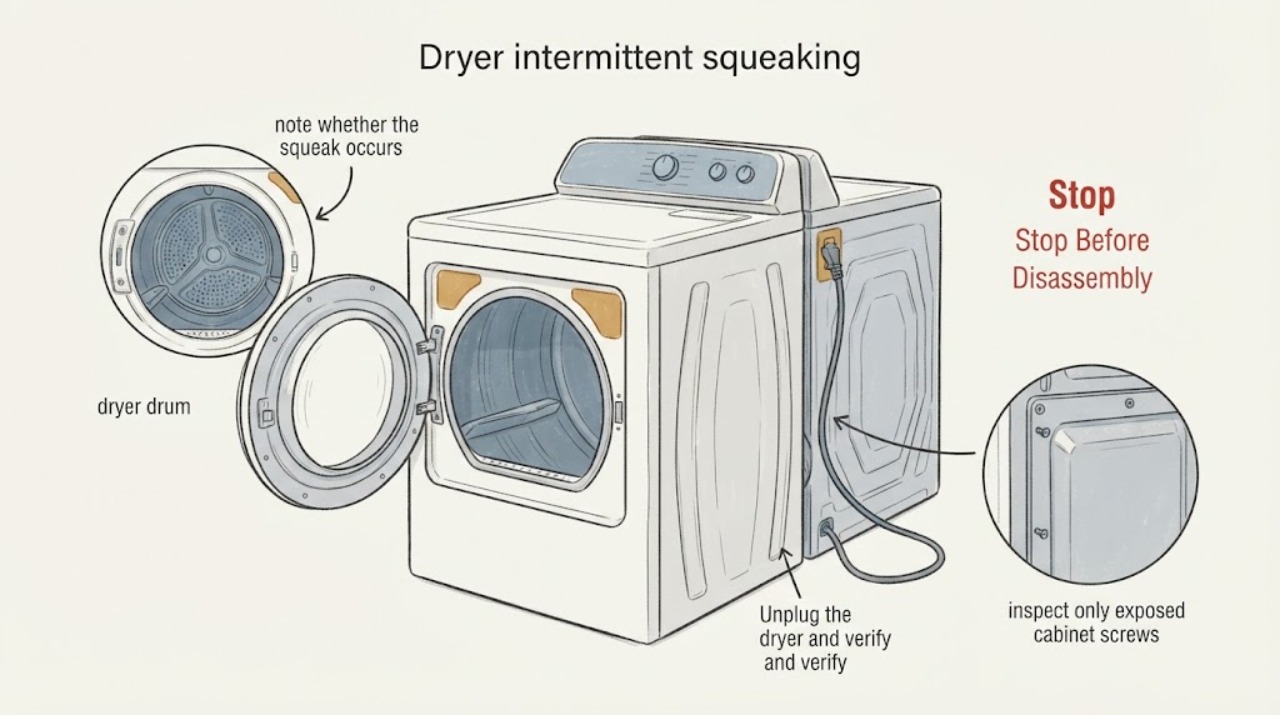
Work through in order
Diagnostic checks
Use only checks that match the exact appliance or system and its official guide.
-
Check 1
From a safe position, note whether the squeak occurs only during the first seconds of startup, begins after the dryer has heated, or repeats as a short chirp every few seconds. Also note whether it changes with drum rotation or a particular cycle.
Expected result: The squeak fades after startup, appears only once warm, or repeats at short intervals while the drum turns.
Next step: Monitor only the brief startup pattern that disappears. For the warm-only or repeating pattern, stop unnecessary testing and continue with the unplugged external checks; plan service if it persists.
Why this matters
Why: GE calls a brief startup squeak normal, but identifies a squeak after heating and a short repeating chirp as sounds that are not normal.
-
Check 2
Unplug the dryer and verify that it is level on a flat, solid floor, with no object leaning against the cabinet or vibrating against it.
Expected result: The cabinet rocks, the floor is uneven, or an adjacent object contacts the dryer; alternatively, the dryer is stable and clear.
Next step: Correct only a safe placement or contact issue and retest only after the dryer is reassembled and safe. If the squeak remains, do not compensate by tightening internal hardware; arrange service.
Why this matters
Why: GE lists level, secure placement and contact with surrounding objects as external checks for abnormal dryer noise. A stable installation does not prove which internal component is making a squeak.
-
Check 3
With power disconnected, inspect only exposed cabinet screws and fasteners for looseness, without removing panels or reaching into the cabinet.
Expected result: An exposed screw is loose, or all visible fasteners are secure.
Next step: If a visible screw is loose, correct it without opening the cabinet and reassess. If the sound continues or no safe external fastener is implicated, stop and request service.
Why this matters
Why: GE says loose cabinet screws may cause a squeaking sound. Secure visible hardware only if the model instructions make the task clear; a secure exterior does not clear the drum or drive system.
-
Check 4
After unplugging and removing the lint filter, look down into the opening for a visible foreign object. If an object must be reached, protect your hand from sharp edges and remove only what is safely accessible; also check the drum for loose coins, paper clips, buttons, or zippers.
Expected result: A visible object is below the filter or in the drum, or the openings and drum are clear.
Next step: Remove only a safely accessible foreign object, restore the filter, and reassess after the dryer is fully closed. If the object is not safely reachable or the noise persists, arrange service rather than disassembling the dryer.
Why this matters
Why: GE says objects below the lint filter can create noise and that coins, clips, buttons, or zippers can cause rattling or scraping as they move in the drum. A clear drum does not identify a hidden belt, slide, seal, or motor issue.
-
Check 5
Check the surrounding vent and installation conditions externally for kinks, collapse, lint obstruction, or an unusually hot cabinet, especially if the noise appears after heating; do not disconnect a gas-dryer vent for a test.
Expected result: The vent is restricted or the dryer is unusually hot, or the visible vent path is clear and temperature is normal.
Next step: Correct safe external vent conditions or have the duct professionally cleaned. If heat, odor, or abnormal noise remains, discontinue use and arrange service; never operate a gas dryer with its vent disconnected.
Why this matters
Why: GE says restricted airflow can allow heat and humidity to build inside the drum and increase drying problems. That can coexist with noise but does not prove a squeak is caused by the vent or a particular part.
-
Check 6
If the sound remains after the external checks, record the model number, gas or electric type, cycle, timing, and whether the sound is squeak, chirp, scrape, or thump for the service appointment.
Expected result: The sound disappears after an external correction, or it remains/reappears after warm-up or is joined by scraping, thumping, odor, or heat.
Next step: Keep the dryer unplugged if the abnormal pattern remains and arrange qualified service. Do not order or install a belt, slide, seal, or motor based on sound alone.
Why this matters
Why: Improvement after a placement, fastener, object, or vent correction supports that external condition. A persistent or recurring pattern requires qualified diagnosis; GE lists worn slides/seals and damaged belts as service-level possibilities, not owner-confirmed diagnoses.
Use your observations
Decision map
Find the observation that best matches what you see, then follow the next safe action.
-
PATH 01Next step
What you see
The squeak occurs only for the first few seconds after startup and then disappears with no other symptom.
Do this next
Monitor it. If it starts lasting longer, returns after heating, repeats as a chirp, or changes to scraping/thumping, discontinue use and arrange service.
Why this path and its safety boundary
Why it matters: GE identifies this brief startup squeak as a normal dryer sound.
-
PATH 02Next step
What you see
The squeak begins after the dryer heats up or repeats as a short chirp every few seconds.
Do this next
Stop using the dryer after the safe external checks and request qualified service; do not keep running it to reproduce the sound.
Why this path and its safety boundary
Why it matters: GE lists both patterns as abnormal dryer noises rather than normal startup behavior.
-
PATH 03Next step
What you see
A loose external screw, unstable placement, contact with another object, or a safely removable foreign object is found.
Do this next
Correct only the visible condition with the dryer unplugged, restore all removed parts, and reassess once. Escalate if the noise remains.
Why this path and its safety boundary
Why it matters: GE lists these as owner-level external causes that can create squeaks, rattles, or scraping sounds.
-
PATH 04Next step
What you see
The sound persists after external checks, or the dryer also scrapes, thumps, overheats, smells scorched, or shows vent restriction.
Do this next
Unplug the dryer and arrange qualified service. Do not open the cabinet, bypass a safety device, operate a gas dryer without its vent, or choose an internal replacement part from the symptom alone.
Why this path and its safety boundary
Why it matters: GE recommends discontinuing use for unresolved unusual noise because continued operation can wear other parts; a damaged belt, drum slide, seal, or other internal condition requires service diagnosis.
Helpful context
Understand the symptom
The timing of the squeak is the first useful clue
GE describes two different patterns: a startup squeak that fades after the first few seconds, and abnormal sounds such as a squeak that begins after the dryer heats up or a short chirp that repeats every few seconds. Record when the sound starts and whether it changes with heat or drum rotation before assuming an internal part is defective.
Unplug before looking or reaching
Disconnect the dryer from power before maintenance or cleaning. Do not reach deep into the lint-filter opening without protecting against its sharp edges, do not remove cabinet panels, and do not operate a gas dryer with its vent disconnected. Stop using the dryer for an unresolved unusual noise rather than repeatedly reproducing it.
Match the sound pattern to the next safe step
A brief startup squeak that disappears can be monitored. A squeak after warm-up or a repeating chirp does not fit GE's normal startup description. A scraping sound can come from a foreign object, drum seal, or slide, while a thump can involve the belt; those observations justify service but do not identify a part for an unknown model.
When checks do not resolve it
Need a professional?
Discontinue use and arrange qualified service when a squeak continues beyond startup, appears after heating, repeats as a chirp, persists after safe external checks, or is accompanied by scraping, thumping, unusual heat, a burning odor, or vent restriction. Unplug before maintenance; do not open the cabinet, reach past sharp edges, operate a gas dryer without its vent, or order an internal part from the sound alone.
Common questions
FAQ
Is a squeak when a GE dryer starts normal?
GE says a startup squeak can be normal if it goes away after the first few seconds. A squeak that continues, begins after the dryer heats, or repeats as a short chirp is listed as abnormal and needs service if external checks do not resolve it.
Why does the squeak appear only after the GE dryer warms up?
GE lists a squeak that develops after heating as an abnormal noise pattern. Unplug the dryer, check only the listed external conditions, and arrange qualified service rather than assuming a particular internal part.
Can a coin or object below the lint filter make a GE dryer squeak?
GE says foreign objects below the lint filter or in the drum can create noise. Look only with power disconnected and protect against sharp edges; do not disassemble the cabinet to reach an object.
Should I keep running a GE dryer that squeaks intermittently?
For a brief startup squeak that disappears, GE describes monitoring as reasonable. For a warm-only squeak, repeating chirp, unresolved unusual noise, scraping, thumping, odor, or excess heat, discontinue use and arrange qualified service.
Read the exact guide
Official sources
- Dryer - Things To Check For A Venting IssueGE Appliances · GE dryers: external vent airflow, placement/level, temperature/condensation, gas-dryer vent safety and service boundary
- Dryer - Taking Too Long To Dry Clothes or Not Drying at AllGE Appliances · GE dryers: vent material/obstruction, lint filter, load, level, heat setting, power, and service checks
- Dryer - NoisesGE Appliances · GE dryers: normal startup squeak, abnormal warm-only/repeating squeak, external noise checks, sharp-edge caution and service boundary
- Dryer - Extra Care OptionGE Appliances · GE dryers: model-dependent Extra Care cooling and audible buzzer behavior
Community feedback
Share a repair observation
Share a plain-text repair observation. Accepted observations are published automatically; this page may take a moment to update.