
On this page
Start here
Quick answer
A brief squeak when a GE dryer starts can be normal if it disappears after the first few seconds. GE’s opened dryer-noise guidance treats a thumping sound, a persistent startup squeak, and several repeated or heat-related squeaks as abnormal. With the dryer stopped and unplugged before maintenance, check that it is level on a solid floor, nothing leans against it, the visible drum and lint-filter opening have no accessible foreign object, and exposed screws are not loose. Do not open the cabinet or replace a belt, slide or bearing from the sound alone. If the noise continues, is a thump or metal scrape, or returns after these external checks, discontinue use and arrange service with the exact GE model.
Before you begin
Safety first
- Limit owner checks to unplugged visual inspection of the floor, clearance, exposed screws, drum and lint-filter opening. Do not open the cabinet, reach beyond the lint-filter opening, disturb gas connections, run the dryer to test an inaccessible object, or replace a belt, slide or bearing based on sound alone.
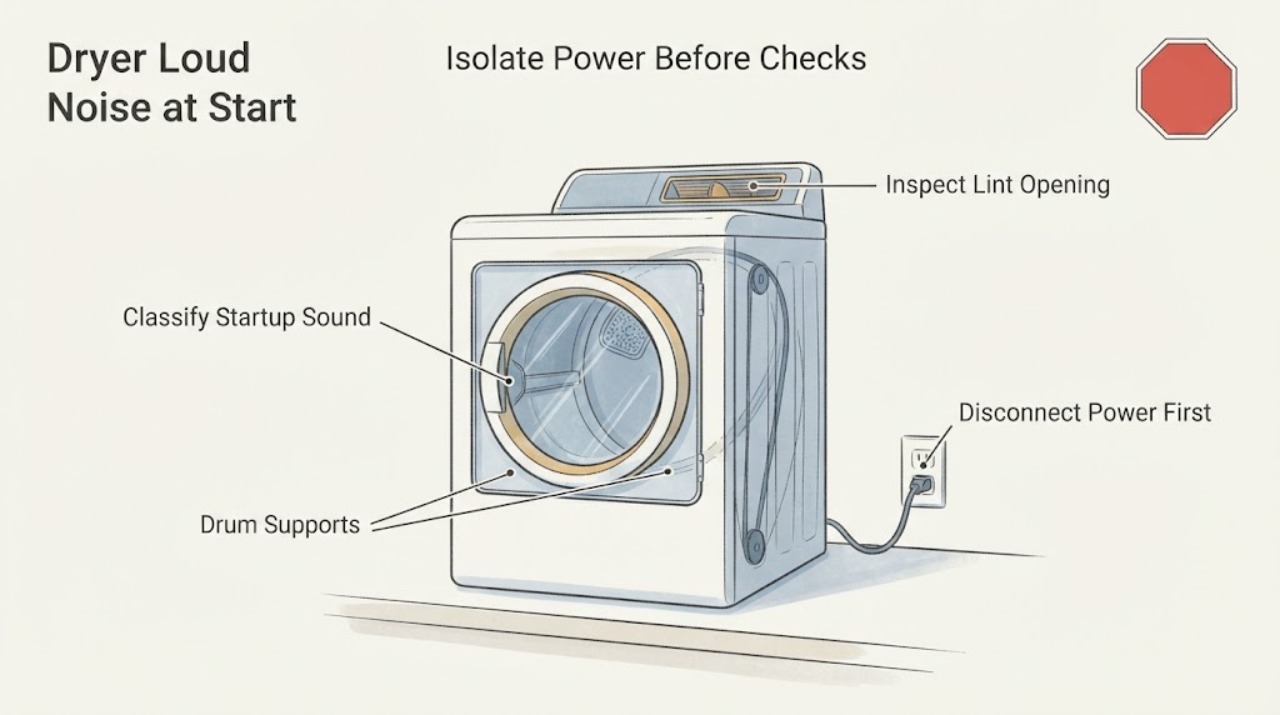
Work through in order
Diagnostic checks
Use only checks that match the exact appliance or system and its official guide.
-
Check 1
Record whether the noise is a squeak that ends within the first few seconds, a thump, a metal scrape, a rattle, or a squeak that continues or appears only after heating.
Expected result: The sound ends quickly, or it persists/repeats or is a thump, scrape or heat-related squeak.
Next step: If it is persistent or abnormal, stop using the dryer after the safe external checks and arrange service; do not infer a specific part from the sound.
Why this matters
Why: GE identifies a brief startup squeak as potentially normal but lists thumping and continuing or heat-related squeaks as abnormal.
-
Check 2
Unplug the dryer before maintenance or cleaning, then check the visible cabinet area, floor and surrounding clearance without opening panels or disturbing gas connections.
Expected result: The dryer is on an uneven or insecure surface, something leans against it, or no external installation issue is visible.
Next step: Correct only an obvious external obstruction or use the exact model’s leveling guidance. If the noise persists, use the service branch.
Why this matters
Why: GE identifies level, solid support and clear surroundings as checks for unusual dryer noises, but a stable installation does not rule out an internal issue.
-
Check 3
With power unplugged, remove the lint filter and look down into the opening for an accessible foreign object. Use work gloves if a hand must reach into the opening because GE warns that the edges can be sharp.
Expected result: A visible object is present, or the opening is clear and the noise remains unexplained.
Next step: Remove only an accessible object without reaching deeper or removing panels. If no object is accessible, stop and arrange qualified service.
Why this matters
Why: An accessible object can make contact noise, but a clear lint-filter opening does not identify a belt, support or motor fault.
-
Check 4
Inspect the empty drum for coins, paper clips, buttons, zippers or another loose item that could rattle or scrape. Do not run the dryer to make a suspected object move into reach.
Expected result: A loose item is found and removed safely, or the drum is clear and the sound continues when the drum turns.
Next step: Remove only the accessible object with power isolated. If the drum is clear or the sound is a thump, discontinue use and arrange service.
Why this matters
Why: GE lists foreign objects in the drum as a source of rattling or scraping; a clear drum shifts the problem to service evaluation rather than proving a failed drive part.
-
Check 5
Record the exact GE model/serial information, sound pattern, duration, load conditions and whether the sound changes after heating. Use GE’s model/serial-tag or QR-code support route.
Expected result: The noise disappears after a safe visible correction, or it persists/returns without an accessible cause.
Next step: Discontinue use and arrange qualified GE appliance service for persistent noise, thumping, scraping or a sound that returns after startup.
Why this matters
Why: A cleared external obstruction supports only that observation; persistent noise requires model-matched inspection and is not evidence for a generic belt, slide or bearing replacement.
Use your observations
Decision map
Find the observation that best matches what you see, then follow the next safe action.
-
PATH 01Next step
What you see
The dryer makes a squeak only at startup and it disappears after the first few seconds.
Do this next
Monitor it without opening the dryer. If the sound continues, worsens or changes to a thump or scrape, discontinue use and request service.
Why this path and its safety boundary
Why it matters: GE lists this brief startup squeak as a possible normal sound.
-
PATH 02Next step
What you see
The noise is a thump, continues after startup, repeats every few seconds, or appears after the dryer heats.
Do this next
Stop using the dryer after unplugged external checks and arrange qualified service with the exact model and sound description.
Why this path and its safety boundary
Why it matters: GE lists these patterns as abnormal or requiring service; a damaged belt is only one possibility and is not confirmed here.
-
PATH 03Next step
What you see
A loose item is visible in the drum or lint-filter opening and can be removed without reaching past the opening or opening the cabinet.
Do this next
Unplug the dryer, remove only the accessible item with care around sharp edges, and do not run the dryer if the item cannot be safely removed.
Why this path and its safety boundary
Why it matters: GE identifies foreign objects as possible sources of rattling, scraping or contact noise.
-
PATH 04Next step
What you see
The dryer is level and clear, visible objects are absent, but the noise persists or is a metal scrape.
Do this next
Discontinue use and arrange service. Do not remove the cabinet or replace a drum support, belt or slide based on sound alone.
Why this path and its safety boundary
Why it matters: GE notes that drum-front objects or worn or loose drum slides can produce metal scraping, and directs unresolved unusual noise to qualified service.
-
PATH 05Next step
What you see
The model is unknown or the sound cannot be characterized beyond “loud noise at start.”
Do this next
Find the model/serial tag or QR code, record the timing and sound, and use GE’s matching support/service route.
Why this path and its safety boundary
Why it matters: The evidence supports external classification and safety boundaries but not a model-specific component or repair instruction.
Helpful context
Understand the symptom
Classify the startup sound
Listen only long enough to describe the symptom safely: a brief squeak that disappears within the first few seconds, a thump on each start, a metal scrape as the drum turns, a rattle, or a squeak that continues or appears only after the dryer heats. GE identifies the brief startup squeak as a possible normal sound, but lists thumping and continuing or heat-related squeaks as sounds that are not normal. The sound label alone does not identify a belt, slide, bearing or motor.
Make external checks with power isolated
Before maintenance or cleaning, unplug the dryer as GE instructs. Check that the dryer is level, rests on a solid secure floor and has nothing leaning against it. Look at exposed screws for looseness. If the dryer is gas-fired, do not disturb the gas connection; a gas dryer can have normal valve clicks or a low burner roar, but a loud or unusual noise still needs model-matched service.
Look for accessible objects only
With the dryer unplugged, remove the lint filter and look down into the opening for an accessible foreign object. GE warns that the opening edges can be sharp and recommends work gloves if a hand must reach into that opening. Also check the drum for coins, clips, buttons or zippers that could rattle or scrape. Do not reach past the opening, remove panels or keep operating the dryer to force an object out.
Do not turn a sound into a part diagnosis
GE notes that a foreign object at the drum front seal or worn or loose drum slides can cause metal scraping, and that a frayed or damaged belt can make a thumping sound. Those are possible explanations, not a diagnosis of this dryer. If the sound remains after visible checks, service should inspect the model-specific drum and drive system rather than having the owner order a generic belt or support part.
Use the exact model for service
Find the model and serial tag, or use the QR code on the tag if present, and use GE’s washers-and-dryers support route for the matching manual and service path. Give the servicer the sound type, whether it disappears after startup, whether it changes with heat or drum rotation, and what visible checks were made. GE advises discontinuing use of an unusually noisy dryer until a qualified servicer checks it.
When checks do not resolve it
Need a professional?
Use the exact GE model/serial support route and a qualified servicer for persistent or abnormal noise, metal scraping, thumping, inaccessible objects or any symptom requiring internal access.
Safety scope: Limit owner checks to unplugged visual inspection of the floor, clearance, exposed screws, drum and lint-filter opening. Do not open the cabinet, reach beyond the lint-filter opening, disturb gas connections, run the dryer to test an inaccessible object, or replace a belt, slide or bearing based on sound alone.
Common questions
FAQ
Is a squeak when a GE dryer starts normal?
GE says a startup squeak can be normal when it goes away after the first few seconds. If it continues, returns repeatedly or develops after the dryer heats, GE recommends service rather than a guessed part replacement.
What does a thumping sound at startup mean on a GE dryer?
GE lists thumping as an abnormal dryer noise and notes that a frayed or damaged belt can make a thump. That is a possible explanation, not a diagnosis; discontinue use and arrange qualified service.
Can something under the lint filter cause a loud dryer noise?
Yes, GE directs owners to look down through the lint-filter opening for foreign objects, while warning that the edges may be sharp. Unplug first, use gloves if needed, remove only an accessible object and stop if it cannot be safely reached.
Read the exact guide
Official sources
- Support for GE Washers and DryersGE Appliances · Opened the GE Appliances support page directly. It directs owners to model/serial-tag or QR-code support, matching manuals and qualified service. It supports the article’s model-specific boundary because no dryer model was supplied.
- Dryer - NoisesGE Appliances · Opened the GE Appliances support article directly. It distinguishes a brief startup squeak from persistent or abnormal noises, lists level/solid-floor, clearance, visible-screw and accessible-object checks, and states that unresolved unusual noise should be checked by a qualified servicer. It does not establish a component failure for this model-less task.
Community feedback
Share a repair observation
Share a plain-text repair observation. Accepted observations are published automatically; this page may take a moment to update.