
On this page
Start here
Quick answer
A low rumble that is felt or heard more strongly on the floor below does not identify a particular dryer part. First determine whether the vibration follows the drum or load, or whether it is strongest at a loose foot, wall/vent contact, or the floor itself. With the electric dryer stopped, cool, and safely disconnected, verify the full model number, check for external contact and rocking, confirm that all feet sit firmly on a solid level surface, and compare an empty drum with a small balanced load only if no hazard is present. GE says leveling prevents vibration and that front-load anti-vibration pads can reduce vibration transferred to the floor. If the rumble remains with an empty drum, the drum rubs or catches, the floor flexes, or any heat, burning smell, smoke, sparks, or electrical damage appears, stop using the dryer and arrange qualified appliance or installation service.
Before you begin
Safety first
- Do not run the dryer while it rocks, with a damaged or hot electrical connection, or to reproduce the noise repeatedly. Do not bypass a door switch, disconnect protective parts, perform live electrical tests, open the cabinet, or alter the vent or floor structure yourself.
Work through in order
Diagnostic checks
Use only checks that match the exact appliance or system and its official guide.
-
Check 1
Before further testing, photograph or read the rating label and record the full GE model number, then note when the rumble starts (startup, steady tumble, heating, or a particular part of the cycle), whether the drum is empty or loaded, and whether the sound is louder beside the dryer or in the room below.
Expected result: The model remains only a generic 24-inch description, or the rumble is tied to a loaded drum, a cycle segment, or a lower-floor location rather than being present when the dryer is idle.
Next step: Use the full model number for any later manual lookup. Continue only with the dryer stopped and cool, and use the timing and listening locations to compare the installation/load branches below.
Why this matters
Why: A generic size description cannot support a model-specific clearance, stacking, foot, or part decision. A rumble that tracks the load or a particular drum speed is different evidence from a cabinet that vibrates while the drum is empty; hearing it below indicates transmission through the floor, not a confirmed failed component.
-
Check 2
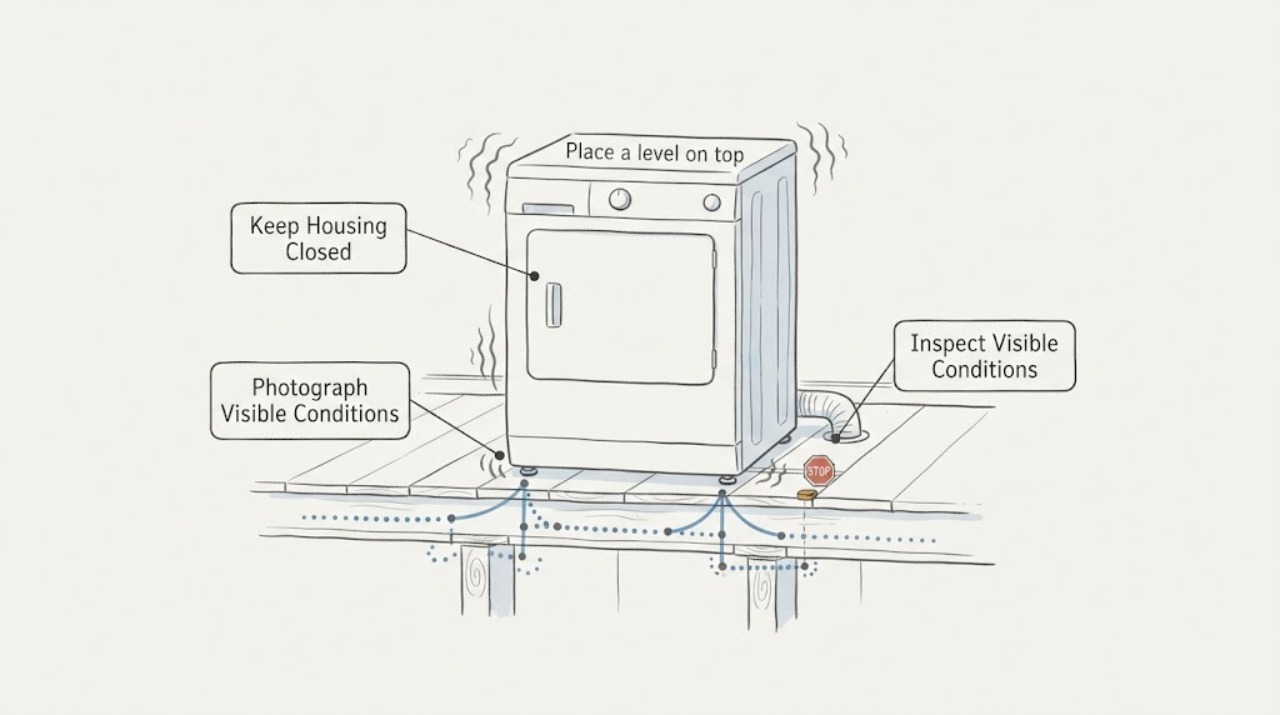
With the dryer stopped, cool, and unplugged or otherwise safely isolated, inspect the outside only: check that it is not touching a wall, cabinet, shelf, another appliance, or the vent connection, and look for an obviously loose exposed screw or a foot that is not seated. Do not pull the dryer out while it is loaded and do not remove panels.
Expected result: A cabinet, vent, or other object is touching the dryer; an exposed screw is visibly loose; or the dryer is clear of contact but still transmits a deep vibration to the lower floor.
Next step: Correct only a safe, accessible external contact or screw if the owner's instructions allow it. If the cabinet is damaged, the dryer rocks, or the rumble persists after isolation, leave it off while checking level and floor support rather than opening the cabinet.
Why this matters
Why: A contact point can act as a vibration path and make a modest dryer sound seem very loud elsewhere. If the cabinet is isolated but the lower floor still vibrates, installation resonance or an internal rotation-linked source remains possible; the sound location alone still does not name a part.
-
Check 3
Place a level on top of the empty dryer in both side-to-side and front-to-back directions, and check that every visible leveling foot is firmly bearing on a flat, solid floor. Do not treat a flexible or visibly damaged floor as a simple foot-adjustment problem.
Expected result: The level is off, the dryer rocks, a foot has a gap, or the floor visibly flexes; alternatively, the dryer is level and stable but the low rumble remains.
Next step: Adjust the feet only according to the full-model installation instructions and recheck stability. If the floor itself flexes or the vibration is materially stronger below, involve the building owner, qualified installer, or appropriate flooring/structural professional; do not claim the floor is structurally safe based on this check.
Why this matters
Why: GE states that leveling prevents vibration and that a dryer should be on a solid, secure floor. Rocking or floor flex can amplify vibration and transmit it downstairs, while a stable, isolated dryer shifts concern toward the load, vent contact, or a persistent mechanical fault without proving which one.
-
Check 4
Only after the dryer is stable, clear of contact, cool, and free of safety symptoms, compare the empty drum with one short, supervised cycle using a small balanced load. Do not use a single heavy item, overload the drum, repeat the test to chase the noise, or run the dryer if it is rocking or excessively hot.
Expected result: The rumble is absent with the empty drum but returns with a particular load, or it occurs with the empty drum and follows drum rotation or a fixed speed.
Next step: For a load-only result, stop using single heavy items and keep the dryer stable; perform at most one retest after correcting the load. For an empty-drum or recurring result, discontinue use and report the timing, load condition, and lower-floor transmission to qualified service.
Why this matters
Why: A load-dependent vibration makes load distribution or floor resonance more likely; an empty-drum, rotation-linked rumble is not explained by ordinary load balance and warrants a service assessment. Neither result identifies a roller, belt, motor, or other part without technician diagnosis.
-
Check 5
Inspect the visible exhaust hose and exterior wall cap without dismantling the dryer: look for a kink, collapse, lint obstruction, or a hose pressed against the cabinet or wall. Check that the cabinet is not unusually hot and that nothing is blocking the air inlet at floor level.
Expected result: The hose or wall cap is obstructed, the hose is transmitting contact vibration, airflow is weak, or the cabinet is unusually hot; alternatively, the visible vent and temperature are normal while the rumble continues.
Next step: Stop using the dryer until a safe, model-appropriate vent cleaning or qualified duct service corrects an obstruction or unsafe installation. Do not run it with the vent disconnected merely to make the rumble louder, and do not reach into the cabinet or duct with the machine energized.
Why this matters
Why: GE says restricted airflow can retain heat and humidity and that the dryer should be level on a flat surface. A vent contact or obstruction can add vibration or create a fire-risk heat condition, but normal visible airflow does not clear a persistent rotation-related noise.
-
Check 6
With the dryer empty, cool, and safely disconnected, look through the door and lint-filter opening for loose objects; if the design permits a gentle hand check from the opening, note rubbing, scraping, a tight spot, wobble, or abnormal resistance. Keep hands away from sharp edges and do not force the drum, lubricate it, or remove any panel.
Expected result: A loose object is accessible, or the drum feels normal; alternatively, the drum rubs, catches, wobbles, or repeats the rumble at one point of rotation.
Next step: Remove only a loose, easily reachable object and keep the dryer disconnected until the opening is clear. If rotation is abnormal or the sound remains, do not run another load; arrange qualified appliance service and provide the full model number and the vibration pattern.
Why this matters
Why: An accessible object or contact may account for a load-related rattle, but a rotation-linked rub or wobble is a stop-and-service pattern. GE identifies drum-seal objects, worn or loose slides, and a damaged belt as service-related sources for abnormal noises; that guidance does not justify choosing a replacement part from the symptom alone.
Use your observations
Decision map
Find the observation that best matches what you see, then follow the next safe action.
-
PATH 01Next step
What you see
The dryer is level and stable, the rumble is mainly present with a particular load or drum speed, and it is noticeably louder through the floor below than at the cabinet.
Do this next
Correct the load and any external contact, then do at most one supervised retest. If the lower-floor vibration remains, have a qualified installer or building professional assess the floor and isolation arrangement using the exact model's installation instructions.
Why this path and its safety boundary
Why it matters: This combined pattern makes load-dependent vibration and floor/structure transmission more likely than a confirmed failed internal part. GE's anti-vibration guidance specifically recognizes vibration transfer to the floor, but it does not establish that a pad is suitable for this incomplete model identity.
-
PATH 02Next step
What you see
The rumble returns with an empty drum, follows rotation, or is accompanied by rubbing, catching, wobble, a repeated thump, or a new worsening sound.
Do this next
Stop using the dryer and arrange qualified appliance service. Give the technician the full model number, whether the noise occurs empty, its cycle timing, and whether the vibration is strongest at the dryer or downstairs.
Why this path and its safety boundary
Why it matters: The result is not explained by load distribution alone and is consistent with an unresolved mechanical or object-at-drum issue. The symptom does not distinguish a roller, belt, support, motor, or seal, so replacing one based on the sound would be guesswork.
-
PATH 03Next step
What you see
The dryer rocks, a foot is not seated, the floor flexes, or the cabinet/vent touches a wall or nearby object; the noise reduces when the contact or stability issue is corrected.
Do this next
Follow the exact model's leveling and clearance instructions, keep the vent from pressing against the cabinet, and stop if the floor remains unstable. Escalate to the installer/building professional if correction requires moving, lifting, reinforcing, or altering the installation.
Why this path and its safety boundary
Why it matters: Installation contact or floor resonance is the leading explanation for the transmitted vibration, although a second internal problem is not ruled out if the rumble remains.
-
PATH 04Next step
What you see
The cabinet becomes unusually hot, airflow is weak, lint is visible at the hose or wall cap, or the rumble is joined by a burning/electrical smell, smoke, sparks, a hot cord/outlet, or a repeated breaker trip.
Do this next
Stop immediately. Disconnect power only if it is safe to do so and arrange qualified appliance/duct or electrical service; do not reset a tripping breaker repeatedly, bypass the door switch, or open the cabinet.
Why this path and its safety boundary
Why it matters: This is a heat, fire, or electrical safety boundary, not a noise-tuning problem. Continued operation can worsen the hazard, and the low-frequency sound should not be used to justify a DIY electrical diagnosis.
Helpful context
Understand the symptom
The task description is not a complete GE model number. Treat this as symptom-level guidance for a 24-inch front-load vented electric dryer, and read the rating label before using model-specific installation instructions or asking for a part. A vibration transmitted to the lower floor can come from the dryer, its feet, a touching vent or cabinet, the load, or the building floor; the location of the sound alone cannot distinguish them.
Because this is an electric dryer, do not apply gas-dryer instructions. Do not move a loaded dryer, operate it with an unstable connection, or open the cabinet to identify a roller, belt, motor, or other internal component.
When checks do not resolve it
Need a professional?
Stop using the dryer for persistent or worsening rumbling, empty-drum rotation noise, excessive vibration, unusual heat, a damaged cord or outlet, smoke, sparks, burning odor, or a repeatedly tripping breaker. Have a qualified technician assess the exact model instead of guessing a roller, belt, motor, or other part.
Safety scope: Do not run the dryer while it rocks, with a damaged or hot electrical connection, or to reproduce the noise repeatedly. Do not bypass a door switch, disconnect protective parts, perform live electrical tests, open the cabinet, or alter the vent or floor structure yourself.
Common questions
FAQ
Does vibration felt on the floor below prove that a GE dryer roller or motor has failed?
No. It is a location clue. First separate load-dependent vibration, foot/floor instability, and cabinet or vent contact from a rumble that occurs with an empty drum. A persistent empty-drum or rotation-linked sound needs service, but the part cannot be identified safely from the sound alone.
Should I add anti-vibration pads to this GE dryer?
GE describes anti-vibration pads as a way to reduce vibration transferred to the floor, especially on front-load models. Because the task does not include a complete model number and pads change the foot height and installation, confirm the exact model's installation instructions and have an installer assess the floor before adding anything.
Can I run the dryer with the exhaust hose disconnected to diagnose the rumble?
Not for this noise complaint. Inspect the visible hose and wall cap for contact or obstruction while stopped and cool. Do not use a disconnected vent as a repeated noise test; correct venting through model-appropriate maintenance or qualified duct service.
Read the exact guide
Official sources
- Washer & Dryer - Anti-Vibration PadsGE Appliances · Supports the floor-transmission decision; does not prove fitment for this incomplete model identity.
- GE® ENERGY STAR® 24" 4.3 Cu.Ft. Front Load Vented Electric Dryer with Stainless Steel Basket - GFD14ESSNWWGE Appliances · Identity-boundary reference only; this example is not asserted to be the user's model and is not used for model-specific procedures.
- Dryer - Things To Check For A Venting IssueGE Appliances · Generic GE dryer vent guidance; only visible, non-invasive checks are used here.
- Dryer - LevelingGE Appliances · Generic GE dryer leveling guidance; exact installation instructions still depend on the full model.
- Dryer - NoisesGE Appliances · Generic GE dryer guidance; not a substitute for the missing exact model number.
Community feedback
Share a repair observation
Share a plain-text repair observation. Accepted observations are published automatically; this page may take a moment to update.