
On this page
Start here
Quick answer
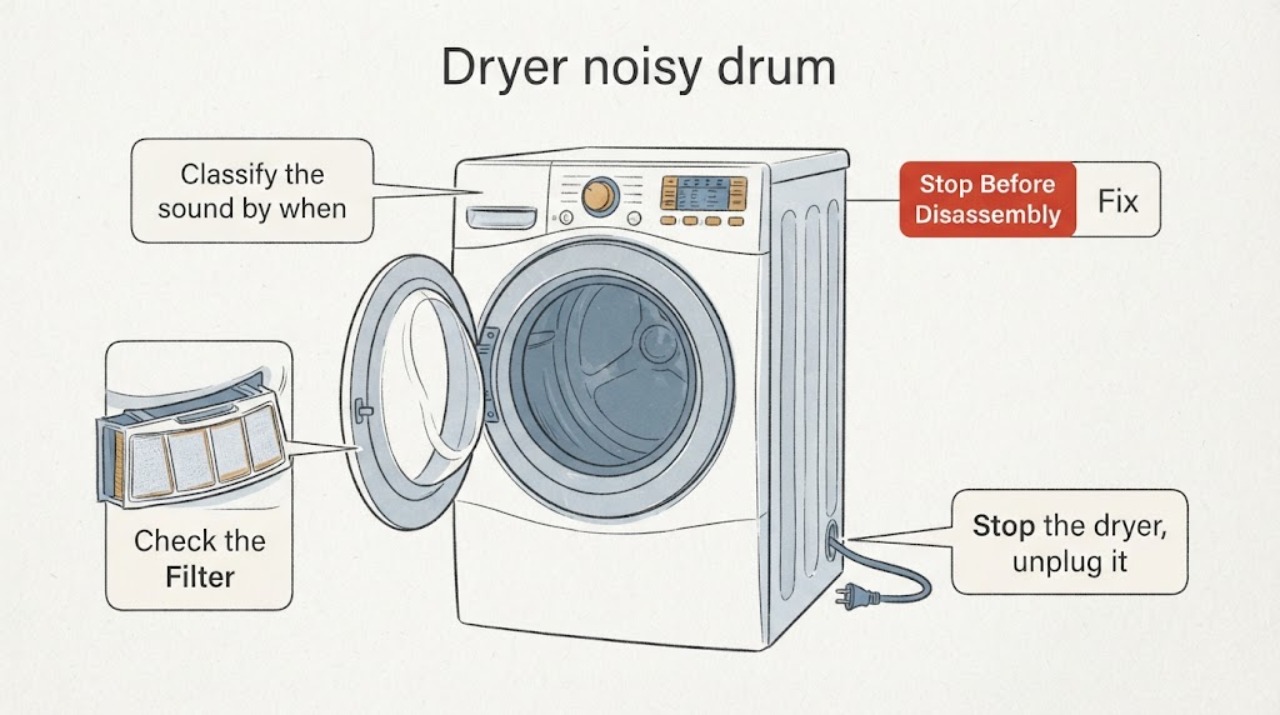
First classify the sound instead of assuming a bad roller, belt or bearing. GE says the drum turning and a brief start-up squeak can be normal, while a continuing squeak, thump, hum, chirp or metal scrape is not. With the dryer stopped and unplugged before any cleaning or reaching into openings, check the load and drum for loose objects, the lint-filter opening for a visible object, and the dryer's level and exposed cabinet screws. If the noise persists, clothes catch, the dryer overheats, or a gas dryer has a vent concern, discontinue use and arrange qualified GE service; do not open the cabinet or replace a part from the sound alone.
Work through in order
Diagnostic checks
Use only checks that match the exact appliance or system and its official guide.
-
Check 1
Classify the sound by when it occurs: only for the first few seconds, during ordinary drum rotation, after heating, at regular repeating intervals, or as a continuous thump, hum or scrape.
Expected result: The sound is only a brief start-up squeak or normal drum-turning sound, or it continues, repeats, changes with heat or sounds like thumping, humming or metal scraping.
Next step: If it is brief and stops, monitor the dryer without adding a part. If it continues or is abnormal, stop the cycle before inspecting and continue with the unplugged checks below.
Why this matters
Why: GE describes brief start-up squeak and drum rotation as normal possibilities, but identifies continuing squeak, thumping, humming, heat-related squeak, chirp and scraping as abnormal patterns.
-
Check 2
Stop the dryer, unplug it before cleaning or reaching into any opening, and inspect the load and drum for loose objects such as coins, paper clips, buttons or zippers.
Expected result: A loose item is visible in the drum or the sound changes when the item is removed; or no accessible object is found.
Next step: Remove only a freely accessible object with the appliance disconnected. Do not reach behind seals or drum edges; if the sound remains, leave the dryer off for service.
Why this matters
Why: GE says objects in the drum can create rattling or scraping as they roll, but finding no object does not prove an internal component failure.
-
Check 3
With power disconnected, remove the lint filter and look down into the opening for a visible foreign object; use work gloves if reaching is necessary because the opening edges may be sharp.
Expected result: A visible object can be removed without reaching past the opening, or the object is lodged deeper or not visible.
Next step: Remove only what is safely accessible with power disconnected. Reinstall the lint filter; if the noise continues or the object is lodged, stop and arrange qualified service.
Why this matters
Why: GE specifically lists the lint-filter opening as a possible location for foreign objects and warns about sharp edges; an inaccessible object is a service condition, not an invitation to dismantle the dryer.
-
Check 4
Check that the dryer is on a solid, secure, flat floor and use a level across the top in both directions; look for an exposed cabinet screw that is visibly loose without removing panels.
Expected result: The dryer rocks, a leg is not firmly supporting it, the level is off, or a visible screw is loose; or the unit is stable and level.
Next step: Use only the model's installation instructions for any leveling-leg adjustment and do not work under an unstable appliance. If the unit is level and the noise remains, proceed to service rather than tightening hidden hardware.
Why this matters
Why: GE says proper leveling prevents vibration and that loose cabinet screws can cause squeaking, but leveling does not identify a drum or drive-part failure.
-
Check 5
Inspect the external vent and surrounding location without disconnecting a gas dryer's vent for a test: look for a kinked or collapsed hose, blocked outside cap, excessive heat or moisture, and an unheated or unstable location.
Expected result: The vent is visibly restricted, the outside cap lacks airflow, the dryer is unusually hot or sweating, or the location is flat and the vent appears clear.
Next step: Correct only accessible external vent or placement issues according to the exact installation instructions. Do not operate a gas dryer without its vent; if heat, moisture or noise persists, stop using it and arrange service.
Why this matters
Why: GE links vent restrictions and poor location to heat, humidity and performance problems; these observations do not prove that the noise comes from the drum or a drive part.
-
Check 6
Escalate when the noise persists, clothes catch or tear, the drum produces metal scraping, the dryer overheats, or the sound is accompanied by a burning smell or abnormal operation.
Expected result: The noise remains after accessible checks, a garment catches at the drum or filter area, or the appliance shows heat, smell or other abnormal behavior.
Next step: Discontinue use, keep the dryer unplugged when safe, and provide the model/serial information, fuel type, sound timing, load and photos to a qualified GE servicer. Do not open the cabinet or replace a suspected part from the sound alone.
Why this matters
Why: GE says foreign objects at the drum front seal, worn or loose drum slides and a damaged belt require service, and continued unusual noise can wear other parts; these are possible service findings, not a user diagnosis.
Use your observations
Decision map
Find the observation that best matches what you see, then follow the next safe action.
-
PATH 01Next step
What you see
The sound is a brief start-up squeak that stops, or only the normal sound of the drum turning is heard.
Do this next
Keep the dryer level and clear of loose objects, and monitor for a change in sound, heat or operation.
Why this path and its safety boundary
Why it matters: GE lists these as possible normal sounds when they do not continue or develop into another pattern.
-
PATH 02Next step
What you see
A coin, paper clip, button, zipper or other object is visibly loose in the drum or safely accessible at the lint-filter opening.
Do this next
Unplug the dryer, remove only the safely accessible object, reinstall the lint filter and stop if the sound remains.
Why this path and its safety boundary
Why it matters: A foreign object can account for rattling or scraping without proving damage to the drum or drive system.
-
PATH 03Next step
What you see
The dryer rocks, is not level, leans against something or has a visibly loose exposed screw.
Do this next
Use the exact installation instructions for safe leveling or placement correction; arrange service if the noise continues.
Why this path and its safety boundary
Why it matters: Vibration or cabinet movement can create noise, but this does not establish a failed drum component.
-
PATH 04Next step
What you see
The noise is a continuing thump, hum, heat-related squeak, repeating chirp or metal scrape, or clothes catch at the drum.
Do this next
Discontinue use and arrange qualified GE service. Do not open the cabinet, run repeated tests or order a roller, belt or bearing from the sound alone.
Why this path and its safety boundary
Why it matters: GE treats these as abnormal patterns and identifies service-level possibilities including drum-front objects, loose slides or a damaged belt without authorizing a user diagnosis.
-
PATH 05Next step
What you see
The dryer is unusually hot, sweating, has poor airflow, or is a gas model with a vent concern.
Do this next
Stop using the dryer if the condition persists, inspect only the accessible external vent and location, and obtain model-specific service.
Why this path and its safety boundary
Why it matters: External venting or location can affect heat and moisture; a gas dryer must retain its vent because exhaust gases can enter the room.
Helpful context
Understand the symptom
A noisy drum is a sound symptom, not a parts diagnosis. GE's own guidance separates normal drum rotation and a brief start-up squeak from continuing squeaks, thumps, hums, repeating chirps and metal scraping. Note when the sound begins, whether the dryer is cold or hot, and whether it follows each drum rotation before choosing a next step.
The checks below stay outside the cabinet. They cover the load, visible foreign objects, the lint-filter opening, secure placement and external vent conditions. They do not confirm a roller, belt, slide, bearing or motor fault and do not include cabinet disassembly.
When checks do not resolve it
Need a professional?
Use qualified GE service when an unusual noise persists after the accessible checks, clothes catch, metal scraping continues, the dryer overheats or smells abnormal, or the suspected cause would require cabinet access. Do not confirm or replace a roller, belt, slide, bearing or motor from the sound alone.
Common questions
FAQ
Does a noisy GE dryer always need a new roller or belt?
No. GE lists normal drum and brief start-up sounds, foreign objects, leveling and loose exposed screws as possible explanations, while continuing thumps, scrapes and other abnormal sounds require service. The sound alone does not identify a part.
Can I reach into the lint-filter opening to remove something?
Only with the dryer unplugged and only for an accessible object. GE warns that the opening edges may be sharp and recommends work gloves if reaching is necessary. Do not dismantle the dryer to retrieve a lodged object.
What if the dryer is noisy and hot?
Stop and inspect only the accessible external vent and location. GE links restricted venting and poor placement with excess heat and moisture; do not operate a gas dryer without its vent, and arrange service if the condition persists.
Read the exact guide
Official sources
- Dryer - NoisesGE Appliances · Official GE Appliances dryer support guidance; applies at family level and does not diagnose an unspecified model's internal part.
- Dryer - LevelingGE Appliances · Official GE Appliances leveling guidance; exact leg and installation details remain model-specific.
- Dryer - Things To Check For A Venting IssueGE Appliances · Official GE Appliances venting guidance; it supports external observations and does not diagnose the noisy-drum cause.
- Frequently Asked Questions About GE DryersGE Appliances · Official GE Appliances dryer FAQ and support routing; used only for support escalation, not for a component diagnosis.
Community feedback
Share a repair observation
Share a plain-text repair observation. Accepted observations are published automatically; this page may take a moment to update.