
On this page
Start here
Quick answer
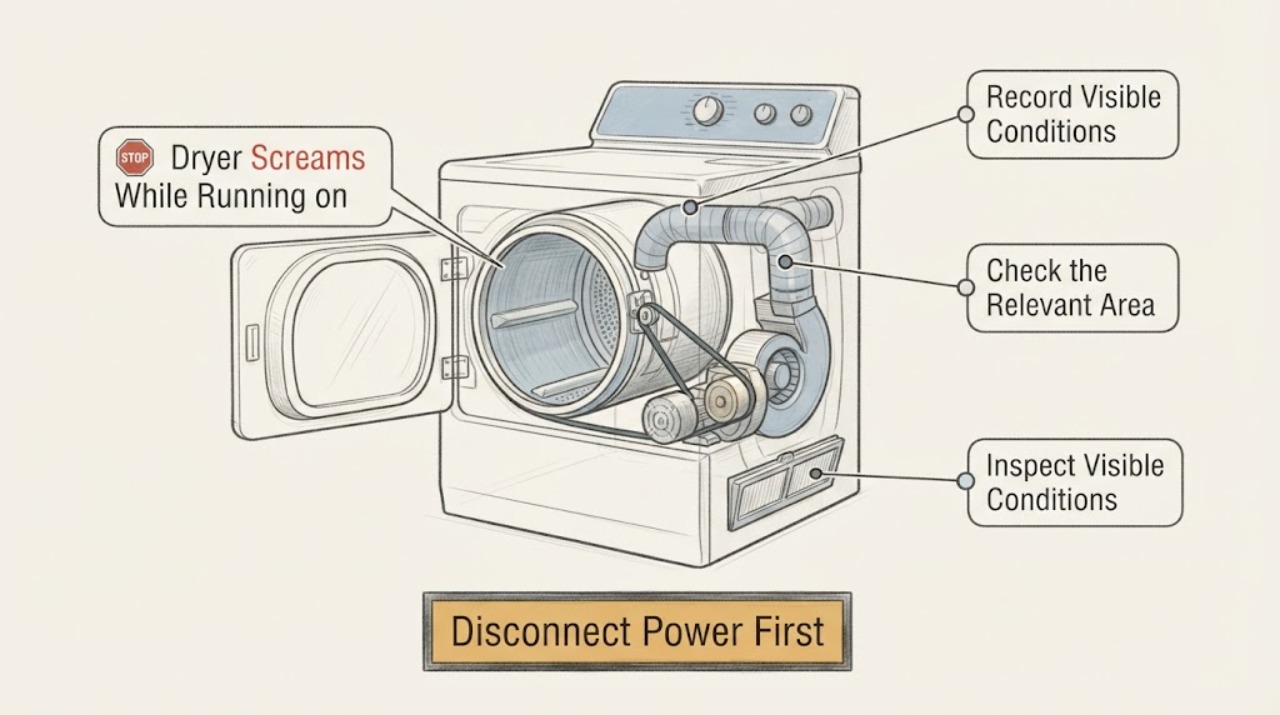
A screaming or squealing sound from a GE DBSR453EB2WW while the drum runs on a no-heat setting should be separated by timing and sound character, not by running the dryer with panels open. GE identifies a brief squeak that disappears after the first seconds as a possible normal start-up sound; a squeak that continues, appears as a repeating chirp, or follows drum rotation is not normal. Keep the dryer off and unplugged before any inspection. From outside, record whether the sound began at startup, continued throughout tumbling, followed a scrape or thump, or changed with heat selection. With power isolated, look only for a visible object below the lint filter, a loose exposed screw, an unstable floor, or an external vent obstruction. If the sound persists, the drum is hard to turn, or the noise is accompanied by heat, smoke, electrical odor, or a stalled drum, stop and arrange qualified GE dryer service; do not choose a belt, roller, bearing, or motor from the noise alone.
Before you begin
Safety first
- Owner checks stop at recording the sound and model, unplugging the cool dryer, looking for fully visible objects below the lint filter, checking exposed screws and level, and inspecting the external vent path. Do not run the dryer to reproduce the scream, touch it while rotating or hot, open the cabinet, remove the drum, touch the belt, rollers, slides, motor, blower, heater, or wiring, probe live power, or operate with a panel removed.
Work through in order
Diagnostic checks
Use only checks that match the exact appliance or system and its official guide.
-
Check 1
Stop the dryer normally, wait for the drum to stop, remove the load only after it is stationary, and disconnect power before any inspection. Record the sound from the earlier event without trying to reproduce it: a brief startup squeak, continuous scream during tumbling, repeating chirp, scrape, thump, hum, or a sound that changed when the no-heat setting was selected.
Expected result: The sound stopped within the first few seconds, continued through tumbling, repeated every few seconds, followed drum movement, or was accompanied by smoke, burning odor, unusual heat, a stalled drum, or a tripped protective device.
Next step: Keep the dryer off and unplugged. Use only the static external checks below when no hazard sign is present; arrange service immediately for a hazard sign or persistent scream.
Stop if: Do not run another cycle, touch the drum or vent while it is moving or hot, remove a panel, or operate the dryer with any cover removed.
Why this matters
Why: GE treats only the brief startup squeak that fades after a few seconds as potentially normal. Persistent, repeating, or mechanically timed noise is a service clue; smoke, heat, electrical odor, or a stalled drum is a safety stop rather than a noise-localization exercise.
-
Check 2
Confirm the rating label from an ordinary-access location and record the full GE DBSR453EB2WW model and serial information, the electric-dryer identity, the no-heat cycle, load size, and whether the noise was heard with clothes, an empty drum, or a particular item. Do not rely on a related model suffix for a part or procedure.
Expected result: The label matches DBSR453EB2WW, the exact suffix is partly unreadable, or the appliance has been described as gas despite the GE family documentation identifying the DBSR453EBWW family as electric.
Next step: Photograph or transcribe the label from a safe position and give the exact identity and prior noise history to GE service. Do not use gas-burner checks or a neighboring model's parts list for this electric dryer.
Stop if: Do not move the dryer to reach a hidden label if doing so requires handling a heavy appliance, live cord, gas line, or vent connection.
Why this matters
Why: Model and suffix identity determine the correct manual and service parts route. The GE family page supports an electric dryer identity but does not prove that every related suffix has the same internal assembly; a mismatch must be resolved before any part decision.
-
Check 3
With the dryer unplugged and cool, remove the lint filter and look down into the opening using a flashlight. Inspect only what is visible for a coin, paper clip, button, or other object; also look for a loose exposed cabinet screw and confirm the dryer is sitting on a solid, level floor with nothing leaning against it. Do not reach into a sharp or hidden opening.
Expected result: A foreign object is visibly below the filter, the drum contains a loose object, a cabinet screw is visibly loose, the cabinet rocks, or no external clue is visible.
Next step: Remove only a loose object that is fully reachable without reaching into the cabinet, tighten only an exposed screw if the manual permits and power remains isolated, and correct obvious leveling from a safe position. If the clue is hidden, sharp to access, or the sound persists, arrange service.
Stop if: Do not put a hand or tool into the lint chute, remove the drum, open the cabinet, or turn the dryer on to see whether the object moved.
Why this matters
Why: GE identifies objects below the lint filter, objects in the drum, loose cabinet screws, and an uneven or unstable installation as separate sources of rattling, scraping, or squeaking. A clear visible area does not rule out an internal drive or drum-support problem.
-
Check 4
From outside and with the dryer disconnected, inspect the rear transition duct and the outside wall cap for a kink, collapse, lint, debris, or a blocked flap. Check that the front floor-level air intake is not covered by clothing or storage. Do not disconnect the vent and run the dryer as a test.
Expected result: The duct is crushed or kinked, the wall cap is obstructed, the outside airflow was weak during a prior safe observation, the front intake is blocked, or the visible vent path is clear.
Next step: Clear only accessible lint or debris with power isolated and without dismantling the dryer. Have the duct cleaned or corrected by a qualified person when the obstruction is beyond the safe external reach; arrange appliance service for a continuing scream.
Stop if: Do not operate with a blocked vent, plastic or collapsed duct, missing lint filter, or any cabinet opened. Do not disconnect and run this dryer merely to compare the noise.
Why this matters
Why: GE says restricted airflow can make a dryer hot, sweaty, or slow to dry and requires correct metal ducting and a clear wall cap. This check can explain heat or drying symptoms accompanying the scream, but it does not identify a drum-support or drive fault and a clear duct does not make persistent noise normal.
-
Check 5
With power isolated, do not force the drum or dismantle the cabinet. Instead, record whether a prior safe observation showed the scream following drum rotation, scraping at the front seal, a thump, a motor hum or stall, or a noise that appeared only after the dryer became warm. Preserve any audio or video captured from outside without repeating the run.
Expected result: The sound followed rotation, was a front scrape, repeated chirp, thump, hum, stall, or developed only after heat; alternatively, the sound has not been localized safely.
Next step: Keep the dryer unplugged and arrange qualified GE appliance service. Provide the sound file, model suffix, no-heat setting, timing, load, visible checks, and any heat or airflow observations.
Stop if: Do not touch the belt, motor, rollers, slides, bearing, blower, wiring, or heater; do not probe live power or run with a panel removed.
Why this matters
Why: GE associates front-seal or drum-slide objects or wear with metal scraping, a damaged belt with thumping, and heat-dependent or persistent squeaks with a non-normal noise path. These patterns narrow a technician's inspection but do not establish which part is failed.
Use your observations
Decision map
Find the observation that best matches what you see, then follow the next safe action.
-
PATH 01Next step
What you see
The scream was continuous during no-heat tumbling, followed drum rotation, or returned after the startup seconds rather than fading away.
Do this next
Leave the dryer unplugged and request qualified GE service. Do not run it again to isolate the rotating component or buy a belt, roller, bearing, or motor from the description alone.
Why this path and its safety boundary
Why it matters: This is a non-normal rotation-related noise pattern. A drum-front seal or slide, foreign object, belt, support, motor, or another drive component is more plausible than GE's brief normal startup squeak, but the sound alone cannot select a part.
-
PATH 02Next step
What you see
A visible object, loose exposed screw, unstable floor, or contact with another item is found while the dryer is cool and disconnected.
Do this next
Remove only the fully reachable object or correct the safe external installation issue, then keep the dryer off until a qualified person confirms that persistent noise is not coming from the cabinet or drum support.
Why this path and its safety boundary
Why it matters: The external clue can explain a rattle or squeak without proving an internal failure. If the sound continues after the safe correction, the original clue was not a complete diagnosis.
-
PATH 03Next step
What you see
The vent is obstructed or kinked, the dryer was hot or slow to dry, or the front air intake was blocked, but the scream itself was not resolved by the visible airflow correction.
Do this next
Have the duct and wall cap cleaned or corrected as needed, keep the dryer off if it overheats, and arrange appliance service for the continuing scream or any rough drum behavior.
Why this path and its safety boundary
Why it matters: Restricted exhaust is a separate heat and drying-risk path; it can coexist with a mechanical noise. Clearing the visible vent does not clear the drum drive, and a no-heat noise does not prove the vent caused it.
-
PATH 04Next step
What you see
The dryer has smoke, burning electrical odor, a hot plug or cord, repeated protective-device trips, a stalled drum, exposed damage, or a noise that worsens with heat.
Do this next
Keep the dryer disconnected and obtain qualified appliance and, when the supply or cord is implicated, electrical service. Use emergency help for active smoke or fire; do not reset a repeatedly tripping device or continue testing.
Why this path and its safety boundary
Why it matters: This exceeds a user noise check and may involve an electrical, drive, or overheating hazard. A no-heat setting does not make a damaged dryer safe to operate.
Helpful context
Understand the symptom
What no-heat operation changes
The assigned DBSR453EB2WW is in GE's electric DBSR453EBWW family. If the dryer screamed while the drum was tumbling on a no-heat setting, the observation is useful because the sound was present without relying on a heat-producing step. It still does not identify a roller, slide, belt, bearing, motor, blower, or electrical part. Use the timing already observed—startup, continuous tumbling, a repeating chirp, scraping, or a load-related event—and do not run another cycle just to make the sound return.
Separate sound source from drying-air safety
A restricted exhaust path can make a dryer hot, sweaty, or slow to dry, while a foreign object, loose screw, leveling problem, drum-front seal or slide, or damaged belt can create noise. These paths can coexist, but a clear vent does not clear the rotating assembly, and a quiet no-heat cycle does not clear the vent or heater circuit. The homeowner boundary is external observation and cleaning only; cabinet access, drive parts, and electrical diagnosis belong to a qualified servicer.
Only after diagnosis
Potential parts
- drum-front slides or seal
Only consider this class if a qualified inspection confirms front scraping or wear at the drum support after the dryer is unplugged.
Confirm the full DBSR453EB2WW model and the current GE fit information before ordering; do not infer compatibility from a related suffix. - dryer drive belt or support/idler assembly
Only consider this class if a qualified technician confirms a rotation-related thump, squeal, stall, or belt/support wear; the no-heat scream alone is not enough.
Verify the exact model suffix and diagnosis with GE or the servicing technician before selecting a part.
When checks do not resolve it
Need a professional?
Request qualified GE appliance service for a squeal that continues beyond startup, a repeating chirp, a rotation-related scream, front scraping, rough or stalled drum, persistent noise after visible checks, or any noise with smoke, heat, burning odor, electrical symptoms, or repeated protective-device trips. Use qualified duct service for an obstructed exhaust path and qualified electrical help for a hot or damaged cord, plug, outlet, or supply.
Safety scope: Owner checks stop at recording the sound and model, unplugging the cool dryer, looking for fully visible objects below the lint filter, checking exposed screws and level, and inspecting the external vent path. Do not run the dryer to reproduce the scream, touch it while rotating or hot, open the cabinet, remove the drum, touch the belt, rollers, slides, motor, blower, heater, or wiring, probe live power, or operate with a panel removed.
Have this ready
- Provide the full DBSR453EB2WW model and serial, confirmation that it is the electric family, no-heat cycle and load, the sound timing and character, any safe audio/video captured from outside, visible object or screw findings, level and vent observations, drying-time or overheating symptoms, and whether the sound changed with heat or followed drum rotation.
Common questions
FAQ
Is a brief squeak from the GE DBSR453EB2WW always a failure?
Not necessarily. GE says a startup squeak that disappears after the first few seconds can be normal. A scream that continues, repeats, follows drum rotation, or returns on later cycles is not the same pattern; keep the dryer unplugged and arrange service if safe visible checks do not resolve it.
Can I run the dryer once with the vent disconnected to see if the scream stops?
Do not do that as a homeowner noise test. GE limits that type of vent-performance test to electric models and warns that a gas dryer must not be operated without its vent; in this case the sound should not be reproduced. Inspect the external vent path while the dryer is disconnected and use qualified service for a continuing scream.
Should I order a belt, roller, or bearing for this model?
Not from the sound alone. GE lists several different noise clues, including front-seal or slide scraping and a damaged belt causing thumping. A qualified technician should confirm the failed subsystem and exact DBSR453EB2WW fit before a part is selected.
Does a no-heat setting rule out an airflow problem?
No. The no-heat observation can help separate a sound that occurs during tumbling from one that appears only with heat, but GE still treats restricted exhaust as a separate safety and drying-performance path. Check the external duct and wall cap with power isolated and do not use a clear vent as proof that the drive is sound.
Read the exact guide
Official sources
- Installation for DBSR453EBWW | GE AppliancesGE Appliances · Opened GE installation page for the DBSR453EBWW family. It confirms the electric dryer family and links the owner manual and installation instructions; it is not used to infer exact DBSR453EB2WW component fit.
- User Manual & Care for DBSR453EBWW | GE AppliancesGE Appliances · The opened GE Owner Center identifies the DBSR453EBWW family as a 7.0 cu. ft. Super Capacity Electric Dryer and exposes its manual/service route. The supplied DBSR453EB2WW suffix is preserved and must be confirmed before parts or model-specific procedures.
- Dryer - Things To Check For A Venting IssueGE Appliances · General GE dryer venting guidance used for external duct, wall-cap, intake, and service boundaries. It is not a noise-part diagnosis; the article does not instruct the reader to disconnect and run this dryer as a sound test.
- GE Appliances Owner's Manual 49-90051GE Appliances · Opened GE-hosted older owner manual used only for general electric-dryer safety and maintenance principles: disconnect power before maintenance, clean lint/exhaust, and treat one-fuse/two-fuse no-heat behavior as a service clue. It is not claimed as the exact DBSR453EB2WW manual.
- Dryer - NoisesGE Appliances · GE's general dryer-noise guidance used for sound timing, visible object, leveling, loose screw, drum-front seal/slide, belt, and service boundaries. It does not identify a DBSR453EB2WW part by sound alone.
Community feedback
Share a repair observation
Share a plain-text repair observation. Accepted observations are published automatically; this page may take a moment to update.