
On this page
Start here
Quick answer
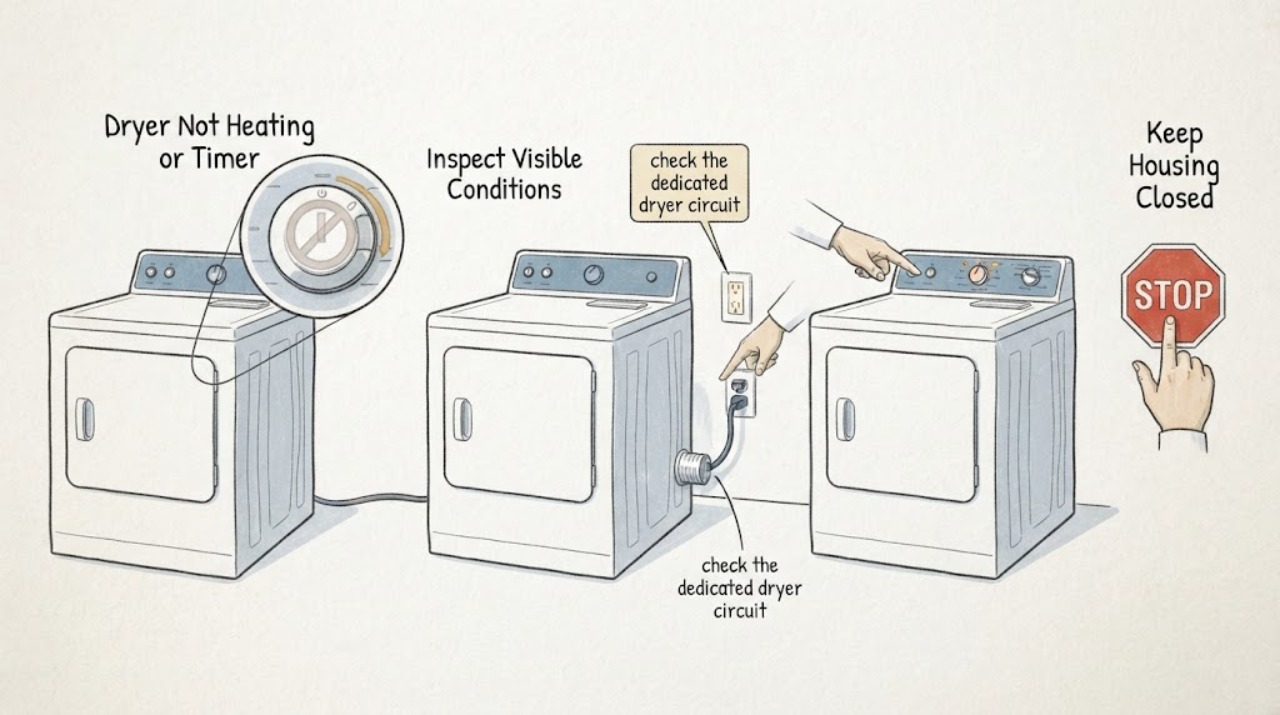
For the GE GTDP301EL0WS, separate a no-heat symptom from a timer symptom before assuming the timer is defective. GE says an electric dryer can tumble on partial supply while not heating, and recommends checking the dedicated supply, a fully reset dryer breaker, the selected dry cycle and temperature, and unobstructed airflow. GE also says a Timed Dry knob should move slowly, while an automatic-cycle knob may pause or advance intermittently as the sensor controls drying. Use those external checks first; if the drum still runs without heat, or the timer does not move through Timed Dry, stop before opening the cabinet and arrange qualified dryer service.
Work through in order
Diagnostic checks
Use only checks that match the exact appliance or system and its official guide.
-
Check 1
Run one short, supervised test on a normal heat cycle rather than Air Fluff or a cool-down setting. Confirm whether the drum tumbles, whether the load receives warm air, and whether the timer is being observed in Timed Dry or an automatic cycle.
Expected result: The drum tumbles with no warmth, the selected cycle is fluff/cool, heat returns after choosing a heat cycle, or the cycle is automatic and the timer advances only intermittently.
Next step: If the wrong cycle was selected, use the correct heat setting. If the drum runs on a heat cycle but remains cold, continue with external power and airflow checks; do not name an internal part yet.
Why this matters
Why: A cool or fluff selection can explain no heat. In an automatic cycle, intermittent or apparently delayed timer movement can be normal; no heat remains a separate decision path.
-
Check 2
From outside the appliance, check the dedicated dryer circuit and plug condition. Turn the dryer breaker fully off and then back on once, and look only for visible damage, looseness, or scorching at the plug and cord; do not remove the rear cover or touch the terminal block.
Expected result: The breaker was partially tripped, the dryer has a visible cord or plug defect, the breaker will not reset, or the supply appears normal but the dryer still tumbles without heat.
Next step: If the breaker reset restores heat, monitor one normal load. If it trips again, the cord or plug is damaged, or heat remains absent, stop using the dryer and arrange qualified service.
Why this matters
Why: GE explains that partial supply can let an electric dryer run without heating and that a partially tripped breaker may not look tripped. A damaged cord, recurring trip, or unresolved no-heat symptom needs service rather than an internal electrical test.
-
Check 3
With the dryer off and cool, clean the lint filter and inspect the visible exhaust outlet and accessible duct route for lint buildup, a crushed section, or a blocked exterior hood. Keep the front intake and outlet area clear.
Expected result: The filter or outlet is restricted, the duct is kinked or crushed, airflow outside is weak, or the visible path is clear.
Next step: Correct only accessible lint or clearance issues using the installation guidance. If the dryer still tumbles without heat after airflow and cycle checks, arrange service instead of opening the cabinet.
Why this matters
Why: GE identifies airflow and exhaust maintenance as necessary for drying; restricted airflow can make a dryer take too long or contribute to an apparent heating problem. A clear visible path does not prove the internal heater or thermal controls are good.
-
Check 4
Compare timer movement in a Timed Dry cycle without reaching into the moving drum or opening the cabinet. Let the cycle run only under normal safe operation and note whether the knob moves slowly, remains fixed for the whole timed cycle, or advances only at intervals in an automatic cycle.
Expected result: The knob moves slowly in Timed Dry, never moves during the timed cycle, advances intermittently in Automatic Dry, or remains at its starting position after the clothes are dry.
Next step: If movement matches the selected cycle, focus on the drying symptom. If it fails GE's described behavior, give the technician the exact model and cycle result and do not remove the console or timer.
Why this matters
Why: GE describes slow movement as normal in Timed Dry and intermittent movement as normal in automatic sensor cycles. No movement throughout Timed Dry, or a knob that stays at its start after the clothes are dry, is a reason to request service; it does not identify a replacement part for the user.
Use your observations
Decision map
Find the observation that best matches what you see, then follow the next safe action.
-
PATH 01Next step
What you see
The dryer heats after the correct heat cycle is selected or after one complete breaker reset, and the timer moves as expected for that cycle.
Do this next
Use the dryer normally while monitoring the next load. If the breaker trips again or heat disappears, stop and arrange qualified service.
Why this path and its safety boundary
Why it matters: The original symptom was consistent with a cycle selection or incomplete power-supply condition; this result does not prove a timer failure.
-
PATH 02Next step
What you see
The drum tumbles on a heat cycle but remains cold after the external cycle, breaker, lint, and airflow checks are complete.
Do this next
Stop repeated test cycles and arrange qualified GE dryer service. Do not remove the power-cord cover, test live terminals, or order a heater or thermostat solely from this symptom.
Why this path and its safety boundary
Why it matters: An unresolved heating, thermal, supply, control, or wiring fault remains possible. The external symptom does not distinguish the failed component.
-
PATH 03Next step
What you see
The knob advances slowly in Timed Dry but appears delayed in Automatic Dry, or moves periodically while wet clothes are still drying.
Do this next
Judge the automatic cycle by whether the load dries. If the knob never moves through a Timed Dry cycle, or remains at its starting position after the clothes are dry, request service with the exact model and cycle details.
Why this path and its safety boundary
Why it matters: That pattern can be normal sensor-cycle behavior according to GE and is not, by itself, a timer malfunction.
Helpful context
Understand the symptom
Treat no heat and timer behavior as two separate observations
The assigned model is an electric GE DuraDrum dryer in the GTDP301EL family. A dryer that tumbles without heat can have a supply, cycle, airflow, or service-level heating problem; a timer that appears not to move may be normal in an automatic cycle. Do not use a stationary automatic-cycle knob alone to diagnose a failed timer, and do not use a no-heat symptom alone to name a failed heater or thermostat.
Use the exact cycle to interpret the timer
GE distinguishes Timed Dry from automatic sensor cycles. In Timed Dry, the knob should turn slowly as time counts down. In an automatic cycle, the knob may advance at intervals or seem not to advance while the sensor continues controlling the cycle. Test timer behavior only in the selected cycle and record whether the load is actually drying.
Keep the user checks outside the cabinet
GE owner guidance emphasizes a properly rated supply, metal exhaust ducting, a clean lint filter, and qualified service. The user boundary here is cycle and temperature selection, breaker reset, visible plug and cord condition, lint filter, front clearance, and accessible exhaust path. Do not remove the rear power-cord cover, expose the terminal block, test live wiring, or replace a heating or timer component from the symptom alone.
The exact parts page confirms components, not a diagnosis
GE's parts catalog for GTDP301EL0WS shows a dryer timer knob, timer shaft, blower components, and a thermostat in the model assembly. That is useful for a technician or later model-specific parts lookup, but it does not establish that the timer, heater, thermostat, motor, or wiring is faulty. Keep any part decision conditional on a qualified diagnosis and the exact model record.
When checks do not resolve it
Need a professional?
Arrange qualified GE dryer service if the dryer still tumbles without heat after external cycle, breaker, lint, and airflow checks; if the timer never advances through Timed Dry; if it remains at the start after clothes are dry; or if there is a repeated breaker trip, scorching, smoke, burning odor, or damaged cord. Do not open the cabinet or perform live electrical tests.
Common questions
FAQ
Why does my GE electric dryer tumble but not heat?
GE says an electric dryer may run on partial supply without heating. Confirm the dedicated supply and fully reset the dryer breaker once, select a heat cycle rather than fluff or cool, and check visible airflow and lint restrictions. If it still runs cold, the remaining heating or electrical fault needs qualified service; the symptom alone does not identify a heater or thermostat.
Is it normal for the dryer timer to stop moving?
It depends on the cycle. GE says a Timed Dry knob should turn slowly, while an automatic sensor cycle may advance intermittently or appear not to move while wet clothes are drying. No movement throughout Timed Dry, or a knob that remains at the start after the clothes are dry, is a reason to request service.
Does the GTDP301EL0WS parts page prove that the timer is the failed part?
No. The exact GE parts catalog lists a dryer timer knob and timer shaft, as well as blower and thermostat components, but a parts diagram does not diagnose the no-heat symptom or provide a safe homeowner replacement procedure. Give the exact model and cycle observations to a qualified technician before choosing a part.
What should I do before service if the breaker trips again?
Stop using the dryer and arrange service. GE's no-heat guidance allows one full breaker reset as an external check, but a recurring trip, visible scorching, a damaged cord or plug, smoke, or burning odor is a stop condition rather than a reason to open the rear cover or test the terminal block.
Read the exact guide
Official sources
- Dryer - Timer is Not AdvancingGE Appliances · Official GE timer-behavior article; used for interpreting the assigned symptom, not for asserting that a timer is the failed component.
- Assembly View for BACKSPLASH, BLOWER & MOTOR ASSEMBLY | GTDP301EL0WSGE Appliances Parts · Official GE Appliances Parts page for the exact assigned model. Used only to confirm listed timer knob/shaft and related service component classes; it does not establish failure, electrical values, or a user repair method.
- Electric Dryer - Runs But Does Not HeatGE Appliances · GE official electric-dryer support article; used for supply, breaker, cycle/temperature, front-clearance and service checks. It is not used to diagnose a specific internal component on GTDP301EL0WS.
- User Manual & Care for GTDP301ELWSGE Appliances · Official GE support page identifies the closely named GTDP301ELWS family and links the owner manual; the exact assigned GTDP301EL0WS is independently confirmed by GE's exact-model parts catalog. Used for family-level product identity, maintenance and support scope, not to erase the suffix distinction.
- 49-90328 ENv04GE Appliances · GE-hosted owner manual opened from the official family support page. Used only for owner-level safety, lint/venting and service-boundary claims; not used to claim a GTDP301EL0WS-specific internal repair procedure or part fit.
Community feedback
Share a repair observation
Share a plain-text repair observation. Accepted observations are published automatically; this page may take a moment to update.