
On this page
Start here
Quick answer
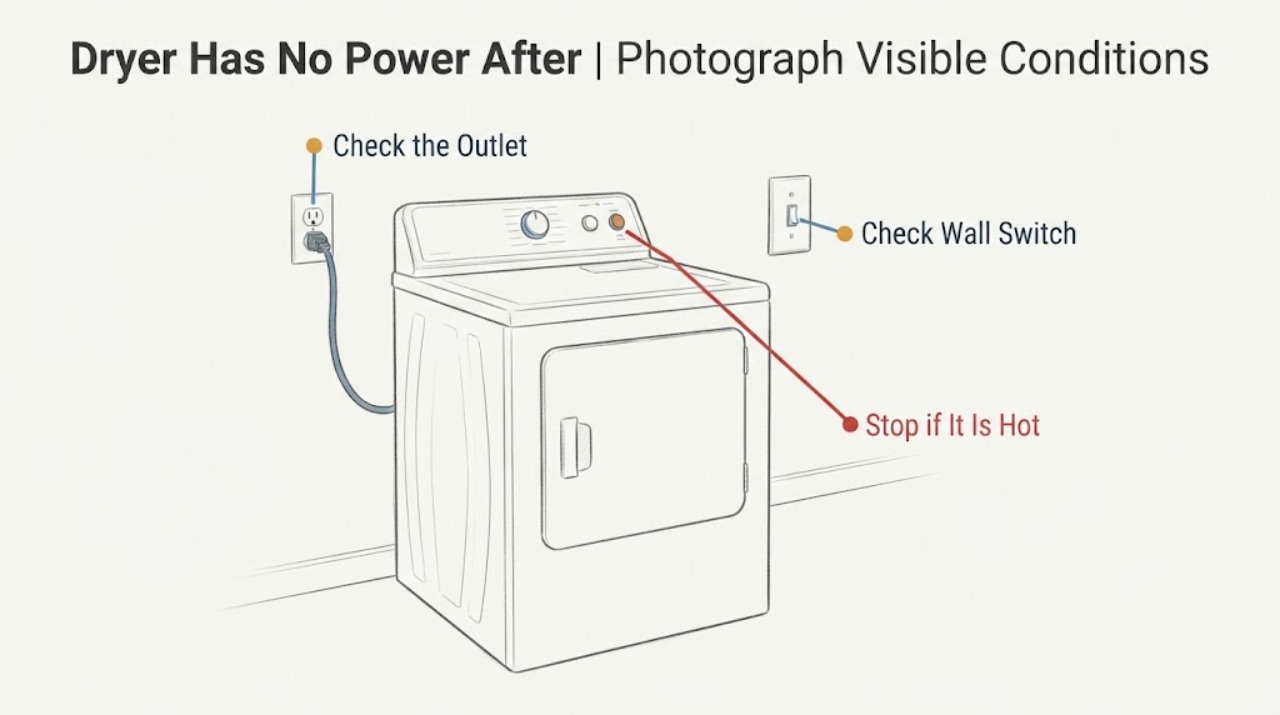
For the electric GE GTD65EBSJ0WS, a dark panel after three repairs in six months calls for a documented repair-or-replace decision, not another blind part swap. First check the dedicated breaker once, the accessible plug and outlet, and any external scorch, looseness, fraying, smoke, or burning smell; do not open the terminal area or bypass a door or thermal safety device. GE's support guidance says a failed no-start check needs repair, while its model page identifies this model family as no longer manufactured. That status does not prove that parts are unavailable or that replacement is automatically better. Repair is reasonable when a technician can identify one safe, model-compatible root cause, explain why it failed, and stand behind the work. Consider replacing only after a written diagnosis shows a repeated or safety-related failure, no supported repair path, or an overall repair plan that no longer makes sense for your household; do not use age alone or a fixed percentage rule.
Work through in order
Diagnostic checks
Use only checks that match the exact appliance or system and its official guide.
-
Check 1
Before touching the controls repeatedly, photograph the rating label and record the complete GTD65EBSJ0WS model, whether the control panel is completely dark or partly responsive, the date and symptom of each of the three recent repairs, what was replaced, and whether the same symptom returned.
Expected result: The panel is dark, the panel lights but the drum does not start, or the recent invoices show the same subsystem or symptom recurring.
Next step: Keep the timeline and receipts for the service provider. Use the exact model documentation for the next low-risk check, and do not rely on memory or a generic part list to choose repair versus replacement.
Stop if: Do not continue operating or testing if smoke, a burning smell, arcing, melting, a hot outlet, exposed wiring, or other electrical damage is present.
Why this matters
Why: A dark panel points to supply or the appliance power path, while a lit panel points to the door, cycle, Start, or internal start circuit. Repeated work on the same symptom is evidence to request root-cause review rather than another isolated repair; unrelated resolved repairs do not automatically make replacement necessary.
-
Check 2
With hands dry and without removing a cover, check the dryer plug and wall connection for full seating, looseness, scorch marks, melted plastic, fraying, heat, or a burning odor. If the laundry area itself is dead, check a nearby light or known appliance without using the dryer outlet as a test point.
Expected result: The plug or outlet is intact and cool, the whole area is without power, or the dryer connection shows heat or physical damage.
Next step: Leave the dryer disconnected and arrange qualified electrical or appliance service for any scorching, looseness, fraying, melting, heat, or burning smell. If the external connection is intact, continue to the dedicated breaker check.
Stop if: Do not use an extension cord, shared outlet, improvised adapter, or open the rear terminal area. Do not energize a damaged connection to retest it.
Why this matters
Why: An area-wide loss of power points outside the dryer. A damaged connection is an electrical hazard and can cause repeated repair failures; it is not a reason to reconnect wires or replace an internal dryer part first.
-
Check 3
At the household electrical panel, identify the dryer's dedicated breaker or fuses. If a breaker appears on but may be partially tripped, switch it fully off and back on once; do not remove fuse covers or test electrical values.
Expected result: The dryer powers up after one reset, the breaker will not stay on or trips again, or the breaker remains on while the dryer is still dark.
Next step: If it trips again or will not reset, leave it off and call a qualified professional. If it stays on but the panel remains dark, stop repeating resets and request diagnosis with the power-check result.
Stop if: Do not keep resetting a tripping breaker, substitute a larger fuse, or run the dryer to see whether a fault returns.
Why this matters
Why: A one-time reset can restore a partial trip. A repeat trip indicates an unresolved electrical condition. A normal breaker with a dead dryer shifts attention to the outlet, cord, or internal appliance path, but does not identify which internal part failed.
-
Check 4
If the panel responds and there is no hazard, close the door firmly, select a valid cycle and drying time, and press Start completely. Keep hands out of the drum and do not bypass or hold the door switch.
Expected result: The dryer starts, the door will not latch, Start does not register, or the panel responds but the motor remains silent.
Next step: If it starts, supervise the first cycle and stop for abnormal heat, smell, noise, or a repeat failure. If the door or Start control is damaged or the motor remains silent, arrange service rather than bypassing the safety circuit.
Stop if: Do not bridge, tape, hold closed, or otherwise bypass the door switch, thermal device, or Start control; do not remove the cabinet for a home test.
Why this matters
Why: GE lists door position, cycle selection, and a fully pressed Start control as no-start checks. A damaged or pushed-in door switch can prevent operation. A failed check does not establish a control board or motor without further model-specific diagnosis.
-
Check 5
Ask the provider for a written repair-or-replace assessment tied to the exact model: identify the failed subsystem, evidence that it caused the no-power condition, whether the three prior repairs were related, any electrical or ventilation root cause, exact part fit and support, repair warranty, and what additional work is foreseeable. Compare that documented plan with the practical disruption of replacement for this household, without applying a fixed age or price rule.
Expected result: The provider can isolate one repairable cause and explain the prior failures, or instead reports repeated unresolved faults, safety damage, unsupported parts, or an uncertain diagnosis.
Next step: Proceed with repair only when the diagnosis, fit, safety correction, and service coverage are clear. If those cannot be documented, leave the dryer disconnected and consider replacement after confirming the household's electrical installation and required configuration with a qualified professional.
Stop if: Do not approve a control, motor, thermal device, or other part solely because it appears in a generic listing or because the dryer is three years old; do not operate with an unresolved electrical or fire risk.
Why this matters
Why: A coherent, model-specific diagnosis and supported repair path favor repairing even when the model is discontinued. Repeated or safety-related failures, no defensible repair path, or an unsupported part recommendation make replacement a reasonable risk decision, but they still do not establish a fixed appliance lifespan.
Use your observations
Decision map
Find the observation that best matches what you see, then follow the next safe action.
-
PATH 01Next step
What you see
The breaker trips again, the plug or outlet is hot or scorched, wiring is loose or frayed, or smoke, arcing, melting, or a burning smell is present.
Do this next
Leave the dryer disconnected and the circuit off when safe to do so; arrange qualified electrical or appliance service. Do not make a repair-versus-replace decision until the supply and installation are made safe.
Why this path and its safety boundary
Why it matters: The immediate problem is an electrical or fire hazard, and continuing to troubleshoot the dryer can worsen the installation or appliance damage.
-
PATH 02Next step
What you see
The external connection and breaker are normal, but the GTD65EBSJ0WS control panel remains dark.
Do this next
Stop resetting and request a qualified diagnosis. Give the technician the exact model, the dead-panel result, and the three-repair history; do not open the terminal area or bypass a safety device.
Why this path and its safety boundary
Why it matters: An internal power or control-path fault is more likely than a door or cycle-setting issue, but the observation does not identify a fuse, thermal device, wiring fault, or board.
-
PATH 03Next step
What you see
The panel lights, but the dryer does not start after the door is firmly closed, a valid cycle is selected, and Start is fully pressed.
Do this next
Arrange service if the safe control checks fail. Do not bypass the door switch or thermal protection, and stop if the machine smells hot or behaves abnormally.
Why this path and its safety boundary
Why it matters: A door switch, Start control, or internal start and safety circuit needs diagnosis. This is a different branch from a completely dead panel and does not by itself justify replacing the control board.
-
PATH 04Next step
What you see
The three previous repairs were unrelated, each was documented as successful, and the present no-power fault has one isolated, model-compatible repair path with appropriate service coverage.
Do this next
Ask for the diagnosis and fit confirmation in writing, correct any installation cause, and proceed only if the repair scope and coverage are clear. Monitor for recurrence rather than scheduling unrelated preventive part replacements.
Why this path and its safety boundary
Why it matters: The repair history alone does not force replacement. A fresh, bounded failure can be repairable even though the corresponding GE product page says the model is no longer manufactured.
-
PATH 05Next step
What you see
The same symptom or subsystem has returned after several repairs, the provider cannot explain the root cause, a safety-related electrical path is damaged, or no supported exact-model repair path can be documented.
Do this next
Keep the dryer disconnected until the installation is safe. Request a final written diagnosis and preserve the repair records; if replacement is chosen, confirm the new dryer's electrical configuration and installation requirements with a qualified installer.
Why this path and its safety boundary
Why it matters: Replacement becomes a reasonable risk and reliability choice for this household, but the conclusion is based on unresolved risk and supportability—not a universal age limit or fixed repair-cost percentage.
Helpful context
Understand the symptom
Three repairs in six months is important history, but it is not a diagnosis. The key question is whether the repairs addressed one unresolved cause, several unrelated wear items, or an electrical or installation problem that could damage the replacement dryer too. Start by separating a completely dead control panel from a panel that lights but will not start, and preserve the repair invoices before deciding.
GE's support page for the GTD65EBSJWS family says to check the plug, door, selected cycle, Start control, door switch, dedicated breaker or fuses, and—on electric models—visible cord or terminal damage. These are external or model-guided checks only. A confirmed supply with a dead panel moves the decision to qualified internal diagnosis; it does not identify a fuse, motor, control, or thermal device by itself.
GE marks the corresponding model page as no longer manufactured. Use that as a reason to ask about documentation, exact fit, and current service support, not as a promise that the dryer has reached a fixed end of life. No safety-related part should be bypassed, and no replacement decision should rely on an unverified parts listing or a generic lifespan claim.
When checks do not resolve it
Need a professional?
Call a qualified appliance technician or electrician when the breaker trips again, the dryer remains dark with an intact confirmed supply, the door switch or Start control is damaged, the cord or outlet is burned or loose, the repair history shows a recurring unresolved fault, or the repair-or-replace decision cannot be supported by a written exact-model diagnosis. Leave the dryer disconnected for smoke, arcing, melting, a burning smell, exposed wiring, a hot outlet, or other electrical damage. Do not open the terminal area, make energized electrical checks, bypass a door or thermal safety device, keep resetting a breaker, or approve a part from a generic listing. GE's discontinued-model status is a supportability question, not a fixed replacement deadline.
Common questions
FAQ
Does needing three dryer repairs in six months mean I should replace my GE GTD65EBSJ0WS?
Not automatically. Ask whether the repairs were related, whether the current no-power fault has one documented cause, whether the electrical installation is safe, and whether the proposed repair has exact-model fit and service coverage. Replacement is more defensible when the same fault keeps returning, safety damage is involved, or no supported repair path can be documented; there is no universal age or percentage rule.
What should I check when the GE dryer control panel is completely dark?
GE's no-start guidance begins with the plug, the dedicated breaker or fuses, and visible cord or terminal damage on electric models. Check only accessible, de-energized areas; reset a possibly tripped breaker once. If the supply is normal and the panel stays dark, request qualified service rather than opening the cabinet or bypassing a safety device.
Does GE no longer manufacturing this dryer mean parts are unavailable?
No. GE marks the corresponding GTD65EBSJWS product page as no longer manufactured, but that does not prove current part availability or compatibility for every GTD65EBSJ0WS unit. Ask for an exact-model fit and current support check only after the failure is diagnosed.
Can I bypass the door switch or thermal device to see if the dryer starts?
No. GE's support instructions identify the door switch as a no-start check, not a device to bypass. Keep the dryer disconnected for damage or a recurring electrical fault and have the start and safety circuit diagnosed by a qualified professional.
Read the exact guide
Official sources
- Dryer - Will Not Run or StartGE Appliances · Official GE dryer support page opened for the no-power/no-start decision; exact model installation instructions govern model-specific electrical connections.
- GE® ENERGY STAR® 7.4 cu. ft. Capacity aluminized alloy drum Electric Dryer with Sensor Dry - GTD65EBSJWS - GE AppliancesGE Appliances · Opened GE's corresponding electric-dryer product page; the page displays GTD65EBSJWS while the AHAM list supplies the exact GTD65EBSJ0WS basic-model identity. Use the full rating-label model for fit and service decisions.
- 2022 Clothes Dryer Verification Program List of Models (00109240).DOCXAHAM Verification Program · Opened AHAM verification list; it identifies GE GTD65EBSJ0WS as the related DOE basic model for GTD65EB*J*** and GTD65EB*L*** electric dryer model families. It is an identity/specification source, not a repair diagnosis or parts guarantee.
Community feedback
Share a repair observation
Share a plain-text repair observation. Accepted observations are published automatically; this page may take a moment to update.