
On this page
Start here
Quick answer
Do not hit the top of a GE Adora DHDVH52EF0WW to make the drum start again. A drum that stops and then resumes after an impact is an intermittent fault or unsafe operating condition, not a repair method. Stop the dryer, unplug it before any cleaning or empty-drum observation, and record the cycle, load, heat, timer, door and power symptoms. GE's user-level checks cover an overloaded load, a drum that turns unusually freely when empty, a closed door, visible lint/vent restrictions and the dedicated power supply. If the drum stops again, or the dryer only runs after being struck, leave it disconnected and arrange service; do not keep restarting it, bypass the door switch, or inspect energized wiring.
Work through in order
Diagnostic checks
Use only checks that match the exact appliance or system and its official guide.
-
Check 1
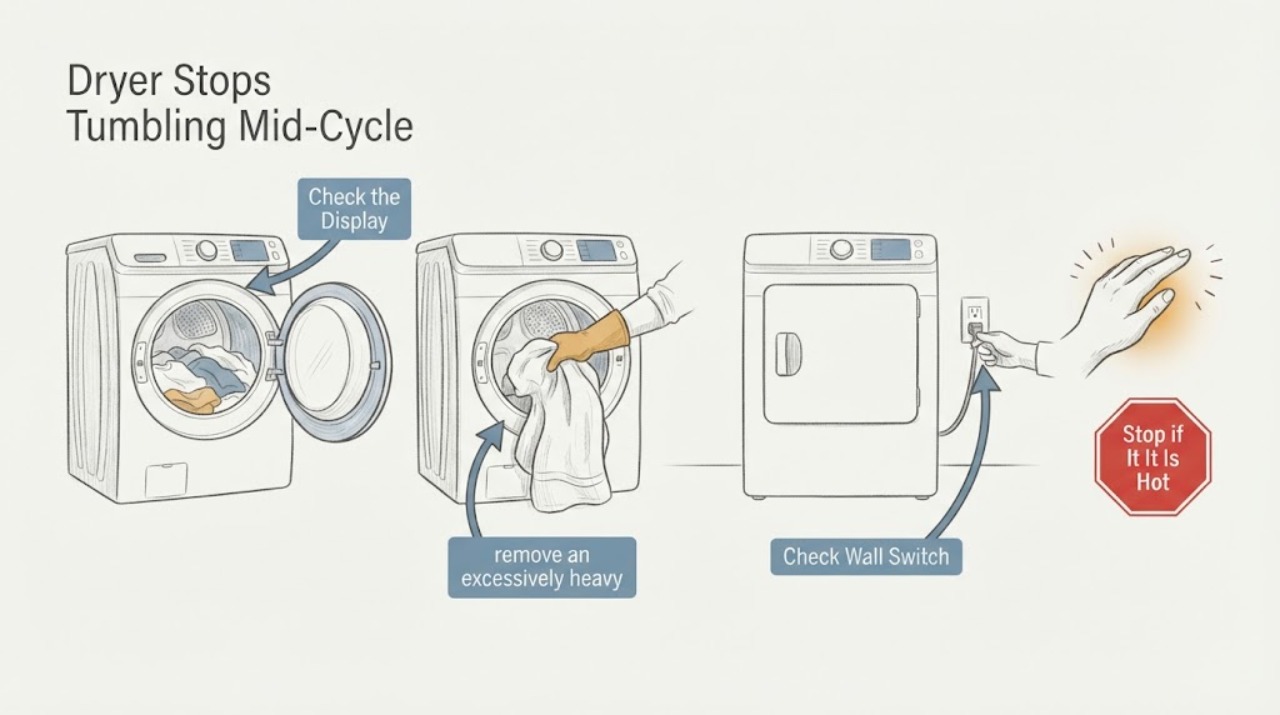
When the drum stops, turn the cycle off and stop using the dryer. Do not strike the top, side, or control panel. Once it is safe to approach, note whether the timer/display remains on, whether heat was present, whether the door opened, whether the load was heavy or wet, and whether the drum resumed only after an impact.
Expected result: The dryer stops with the controls still lit, loses power, stops after the door opens, stops with no heat, or runs only after the cabinet is struck.
Next step: Keep the dryer off and unplug it before cleaning or inspecting. Give service the exact model, cycle, load, heat state, timer state, and the fact that striking the cabinet changed the symptom; do not perform another impact test.
Stop if: Stop immediately for burning odor, smoke, sparking, a hot or damaged cord/outlet, scraping or grinding, or any sign the cabinet or controls are damaged.
Why this matters
Why: These observations separate a cycle/control or supply symptom from a repeatable mechanical stop, but none identifies a failed component. GE recommends service when the drum-not-turning checks do not resolve the concern; impact-dependent operation is already a reason not to continue normal use.
-
Check 2
With the dryer unplugged and cool enough to handle, remove an excessively heavy or wet load and check that the drum is not tightly packed. If the drum is empty, use only gentle hand movement to see whether it turns unusually freely; do not force it, insert tools, or run the dryer to test the result.
Expected result: The load was heavy and wet, or the empty drum turns unusually freely compared with normal resistance.
Next step: If the load was excessive, document that condition but do not resume operation if the dryer had to be struck to tumble. If the empty drum turns unusually freely, leave the dryer unplugged and schedule service.
Why this matters
Why: GE says heavy wet loads can cause the drive belt to slip and says an unusually free-turning drum may indicate a belt problem that requires service. These observations narrow the service report; they do not authorize a belt, motor, or pulley replacement by the user.
-
Check 3
With power disconnected, inspect only the visible door closure, door-switch area, plug, outlet, and breaker/fuse status. Confirm the door closes firmly and the plug is seated without visible heat or damage. Do not remove the rear cover, open the terminal block, bypass the door switch, or touch wiring.
Expected result: The door does not close or the visible switch area is damaged, the plug/outlet is loose or scorched, a breaker/fuse is tripped, or all visible external conditions are normal.
Next step: For a damaged door, switch area, cord, outlet, or repeated breaker trip, leave the dryer disconnected and call qualified service/electrical help. If the external checks are normal but the drum stopped or needed an impact, do not restart it to prove the cause.
Stop if: Stop for scorching, looseness, exposed conductors, moisture near the outlet, or a breaker that trips again.
Why this matters
Why: GE lists a firmly closed door, working household breakers/fuses, and a sound power connection among start/tumble checks. A visible defect can stop operation or create a hazard, while a normal exterior does not rule out an intermittent internal fault.
-
Check 4
With the dryer unplugged and cool, clean the lint filter and inspect the visible exhaust outlet and exterior wall cap for lint blockage, a closed damper, or a crushed/kinked visible duct. Do not operate the dryer with the vent disconnected and do not reach into the cabinet.
Expected result: The lint filter or visible exhaust path is blocked, or the accessible airflow path is clear.
Next step: Correct only visible lint or damper blockage and arrange a proper duct cleaning if the path is restricted. Because this dryer stopped and resumed after a strike, do not use a vent check as permission to resume repeated cycles; service is still required if the stop recurs.
Why this matters
Why: GE says restricted venting can cause heat and humidity to build up and can make the dryer run poorly; it also recommends cleaning the lint filter every use and keeping the exhaust path clear. Venting is a contributing condition to correct, not proof of the reason the drum stops after an impact.
-
Check 5
Do not perform a live test, repeatedly press Start, or strike the cabinet again. Provide the technician the model, the exact point in the cycle, whether the drum was hot or cold, load size, timer/display state, power findings, vent findings, and the fact that an impact temporarily restored tumbling.
Expected result: The dryer runs only after being struck, stops again without an impact, or has any electrical, heat, noise, or mechanical safety symptom.
Next step: Keep the dryer unplugged and arrange GE or qualified appliance service. Do not name or order a motor, belt, idler, relay, control board, or switch solely from this symptom.
Why this matters
Why: An impact-dependent restart is not a supported GE operating behavior and leaves an intermittent fault unresolved. GE directs service when user-level drum checks do not correct a no-tumble concern.
Use your observations
Decision map
Find the observation that best matches what you see, then follow the next safe action.
-
PATH 01Next step
What you see
The dryer stopped with a very heavy or wet load, the drum does not turn unusually freely when empty, and there was no impact-dependent restart or safety symptom.
Do this next
Document the load condition and use a properly sized load only after the dryer has passed service review if it had stopped unexpectedly. Do not use a strike to restart it.
Why this path and its safety boundary
Why it matters: GE identifies a heavy wet load as a condition that can make the drive belt slip, but this does not establish a failed part.
-
PATH 02Next step
What you see
The door does not close firmly, the visible door-switch area is damaged, the outlet/cord is scorched or loose, or the breaker/fuse is abnormal.
Do this next
Leave the dryer disconnected and arrange qualified appliance or electrical service. Do not bypass the door switch or open the terminal area.
Why this path and its safety boundary
Why it matters: A user-visible door or supply problem can prevent tumbling or create an electrical hazard, but the symptom does not identify the internal failure.
-
PATH 03Next step
What you see
The lint filter or visible exhaust outlet is obstructed, the damper does not open, or the duct is visibly crushed or kinked.
Do this next
Correct the visible blockage and arrange duct cleaning. Keep the dryer out of service until the impact-dependent stop has been evaluated if it recurs.
Why this path and its safety boundary
Why it matters: Restricted exhaust can impair dryer operation and increase heat buildup, but clearing the vent does not explain or safely resolve a drum that requires a cabinet strike to resume.
-
PATH 04Next step
What you see
The drum stops again, runs only after the cabinet is struck, the empty drum turns unusually freely, or there is burning odor, smoke, scraping, grinding, sparking, or repeated breaker action.
Do this next
Leave the dryer unplugged and arrange GE or qualified service. Tell the technician exactly what happened and do not restart it for another test.
Why this path and its safety boundary
Why it matters: The dryer has reached the service boundary. The available official guidance does not support a safe user repair or a definitive component diagnosis from these observations.
Helpful context
Understand the symptom
The assigned appliance is the GE Adora DHDVH52EF0WW electric dryer. The report that the drum resumes after the top is struck is a critical observation, but it does not prove a motor, belt, switch, relay, or control failure. A tap can mask an intermittent fault while the dryer remains energized and hot.
Use the symptom to decide when to stop, not as a reason to keep striking or restarting the machine. Checks below are limited to the unplugged dryer, the load, visible airflow and user-accessible controls.
When checks do not resolve it
Need a professional?
Provide GE model DHDVH52EF0WW, cycle and approximate time of the stop, whether heat and controls stayed on, load size and wetness, door and power observations, vent findings, empty-drum observation, and that striking the top temporarily restored tumbling.
Common questions
FAQ
Why should I not hit the top of the GE dryer when it stops tumbling?
An impact can temporarily change an intermittent fault while the dryer remains hot and electrically energized. It does not identify or repair the cause. Stop, unplug the dryer before inspection, record the conditions, and arrange service if it needed an impact to resume.
Can a heavy wet load stop the DHDVH52EF0WW drum?
GE says a heavy load of wet towels or jeans may cause the drive belt to slip. Remove excess clothing only with the dryer stopped and unplugged, but do not resume repeated operation if the dryer previously stopped or needed a strike.
What should I check before calling service for a GE dryer that will not tumble?
GE's user-level checks include unplugging before maintenance, checking for an overloaded load, observing whether the empty drum turns unusually freely, confirming the door closes, checking the visible power supply, and clearing accessible lint/vent restrictions. A recurring or impact-dependent stop still requires service.
Read the exact guide
Official sources
- Dryer - Taking Too Long To Dry Clothes or Not Drying at AllGE Appliances Support · Opened official GE guidance. It supports visible lint-filter, exhaust, load-size and airflow checks and the unplug-before-maintenance boundary; it does not establish venting as the cause of an impact-dependent no-tumble symptom.
- Dryer - Drum Does Not TurnGE Appliances Support · Opened official GE guidance. It supports unplugging before maintenance, reducing a heavy wet load, and observing whether the drum turns unusually freely; it directs service if those checks do not resolve the no-tumble concern and does not authorize user component replacement.
- User Manual & Care for DHDVH52EF0WWGE Appliances · Opened GE's exact model Owner Center page. It identifies the DHDVH52EF0WW as a GE Adora 7.0 cu. ft. Super Capacity Electric Dryer and links the model Owner's Manual and service support; it is used for identity and scope, not for a guessed component diagnosis.
- Dryer - Will Not Run or StartGE Appliances Support · Opened official GE dryer support guidance. It supports accessible door, control, breaker/fuse and power checks; it does not diagnose why this model resumes after being struck or authorize bypassing a door switch.
Community feedback
Share a repair observation
Share a plain-text repair observation. Accepted observations are published automatically; this page may take a moment to update.