
On this page
Start here
Quick answer
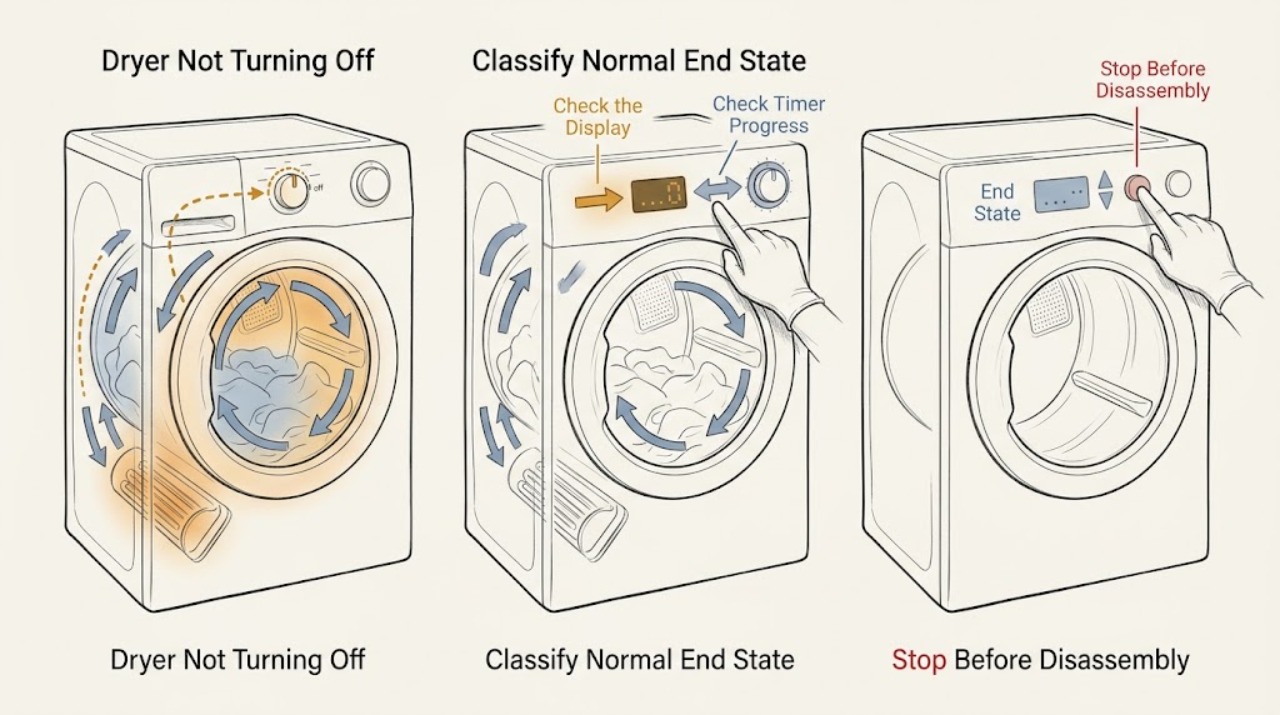
First determine whether the GE dryer is still in a normal cool-down, sensor-dry pause, or reverse-tumble phase, or whether it continues running after a timed cycle has elapsed. On automatic cycles, the timer can advance intermittently while the dryer senses load moisture and temperature; the dryer should eventually cool down and shut off. On a timed cycle, a timer that never advances, or a dryer that keeps running after the control reaches the end, needs service. Check the selected cycle, load and airflow from outside the cabinet, and stop immediately for smoke, burning or melting odor, sparking, abnormal heat, a damaged cord, or a repeat breaker trip. [Source: ge-auto-dry; ge-timer-advance; ge-timer-stop; ge-venting]
Work through in order
Diagnostic checks
Use only checks that match the exact appliance or system and its official guide.
-
Check 1
Watch one safe cycle long enough to identify the end behavior without opening the dryer: note whether it is a timed or automatic cycle, whether the drum tumbles, whether heat has stopped, and whether the display or selector indicates cool-down or end-of-cycle.
Expected result: A short cool-down, intermittent timer movement, or brief pause during reverse tumbling can be normal. Continuous tumbling or heating after the selected cycle has reached its end is not the same behavior.
Next step: If the dryer is only in cool-down or sensor operation, allow the documented cycle to finish. If it remains running after the end state, stop the cycle and continue with the control and airflow checks below.
Why this matters
Why: GE automatic controls can cycle heat and advance intermittently while sensing the load; a true end-state failure points toward a control, timer, sensing, or safety diagnosis.
-
Check 2
Cancel the current cycle using the normal control, then select a simple timed cycle or the model's documented cycle and confirm the time, temperature, fabric, and dryness selections before pressing START.
Expected result: If the dryer stops when cancelled and behaves normally on the correctly selected test cycle, the earlier setting or automatic-cycle behavior may have been misunderstood. If it ignores cancel or continues past the end on more than one valid cycle, the control path needs service.
Next step: Document the exact cycle and display behavior. Do not repeatedly run cycles just to reproduce the fault; request service if the control does not cancel or end normally.
Why this matters
Why: Cycle type changes how the timer and sensor determine the end; repeated failure across valid selections is stronger evidence of an internal control fault than a single sensor-cycle pause.
-
Check 3
For a timed cycle, observe whether the timer or displayed remaining time progresses. For an automatic cycle, observe it over the cycle rather than expecting the knob to move continuously.
Expected result: A timed-cycle timer should move toward shutoff. An automatic-cycle selector may remain still for a period and then advance when the heat cycles off. If a timed timer never moves, or an automatic timer remains at its starting position while the clothes are already dry, service is recommended.
Next step: Stop relying on the dryer for unattended operation and provide the service technician with the cycle type, starting position, elapsed behavior, and whether the load dried.
Why this matters
Why: The timer's behavior is interpreted differently by cycle type; a persistent failure to advance can implicate the timer, sensor input, control, or an associated safety circuit.
-
Check 4
With the dryer off, remove lint from the accessible lint filter, check that the front intake is not blocked, inspect the visible exhaust hose for crushing or kinking, and check the outside wall cap for lint or other obstruction.
Expected result: A clear, unobstructed airflow path and normal exhaust indicate that vent restriction is less likely. Lint at the wall cap, a collapsed hose, or a blocked front intake can cause excess heat and abnormal cycle behavior.
Next step: Correct only accessible lint or obstruction safely. Do not operate a gas dryer without its exhaust vent, and arrange qualified vent service when the duct cannot be safely cleared or remains restricted.
Why this matters
Why: Poor airflow can change drum temperature and extend or interrupt automatic control decisions; it also increases a fire and overheating risk.
-
Check 5
Check whether the selected automatic cycle contains a normal, evenly distributed load and whether the dryer is level. Compare the result with the model's documented timed-cycle behavior rather than assuming a small or absent load should run normally.
Expected result: Some GE sensor systems can detect no load and shut off quickly; a load that shifts away from the sensor area or a dryer tilted toward the rear can also change sensor behavior. A normal load that still never reaches an end state after the accessible checks is not explained by no-load detection.
Next step: Use the model's manual for leveling and cycle-specific guidance. If the same behavior occurs with a normal load and a timed cycle, stop and request service.
Why this matters
Why: Load presence, drum contact, and leveling affect sensor-cycle decisions, but they do not justify bypassing the control or continuing a dryer that stays hot or runs indefinitely.
-
Check 6
After the safe external checks, decide whether the dryer still ignores the end of a valid cycle, cannot be cancelled normally, stays heated, or shows a repeat fault or breaker trip.
Expected result: Persistent running, a non-advancing timed timer, continued heat after the expected end, or electrical or odor symptoms means the fault is not resolved by a setting or visible vent correction.
Next step: Leave the dryer off and arrange GE-authorized appliance service. Use qualified electrical, gas, or emergency service when the symptom involves the home's supply, gas odor, smoke, sparking, fire, or damaged wiring.
Why this matters
Why: The remaining causes can include a timer, electronic control, relay, sensor, thermal safety device, wiring, or model-specific mechanism that requires qualified diagnosis.
Use your observations
Decision map
Find the observation that best matches what you see, then follow the next safe action.
-
PATH 01Safety boundary
What you see
The dryer is in an automatic or sensor cycle and is only pausing, reverse-tumbling, or advancing intermittently.
Do this next
Allow the normal cycle to complete while observing that heat and timer behavior eventually progress to cool-down and shutoff.
Why this path and its safety boundary
Safety stop: Use the timed-cycle and end-state checks to determine whether it truly continues beyond the selected cycle.
-
PATH 02Safety boundary
What you see
The dryer is on a timed cycle and the timer or remaining time never progresses toward shutoff.
Do this next
Stop using the dryer unattended and request service; record the selected cycle and whether the drum was heating or tumbling.
Why this path and its safety boundary
Safety stop: Continue with the airflow, load, and safety checks if the end state is still abnormal.
-
PATH 03Safety boundary
What you see
The dryer stops when cancelled and ends normally on a correctly selected test cycle.
Do this next
Treat the original event as a possible cycle-setting, sensor-cycle, or load interpretation issue and use the model manual for the selected program.
Why this path and its safety boundary
Safety stop: If cancel is ignored or multiple valid cycles run past their end, arrange qualified appliance service.
-
PATH 04Safety boundary
What you see
The lint filter, front intake, exhaust hose, or outside wall cap is obstructed or damaged.
Do this next
Stop and correct only the accessible obstruction safely; use qualified vent service for duct work or persistent restriction. Never run a gas dryer without its vent.
Why this path and its safety boundary
Safety stop: A clear external airflow path makes an internal control or sensing fault more likely when the dryer still will not end.
-
PATH 05Safety boundary
What you see
There is smoke, a burning or melting odor, sparking, unusual heat, a damaged cord or plug, a repeat breaker trip, or gas odor.
Do this next
Stop immediately, keep people away, and use the appropriate safe location and qualified or emergency service channel. Do not open the cabinet or try to reproduce the condition.
Why this path and its safety boundary
Safety stop: Complete at most the external checks and escalate persistent end-of-cycle failure to GE-authorized service.
Helpful context
Understand the symptom
What ‘not turning off’ can mean
A GE dryer may tumble briefly during cool-down or pause while the drum reverses. Automatic or sensor cycles also make decisions from drum temperature or load moisture, so the selector may move in small increments rather than continuously. The useful distinction is whether the machine eventually ends the cycle, whether the timer advances, and whether it remains heated or only tumbles.
Use the control and cycle as evidence
Record the selected cycle, dryness or time setting, whether the drum is turning, whether the display shows a remaining time or end state, and whether the load is dry. A timed cycle should progress toward its end. An automatic cycle can pause or advance sporadically, but it should continue advancing as the heat cycles and then shut off.
Keep airflow and safety checks external
Lint buildup, a blocked wall cap, a crushed exhaust hose, or a blocked front intake can change temperature and cycle behavior. Clean only accessible lint and inspect the outside vent path. Do not open the cabinet, terminal block, burner area, or control housing to diagnose a running dryer.
When repair is the next step
If the cycle selection and accessible vent checks do not explain the behavior, the fault may involve a timer, electronic control, moisture or temperature sensing, a relay, or a safety component. Those components are model-specific and should be diagnosed by qualified GE appliance service rather than replaced from the symptom alone.
Safety boundary
Stop conditions
- Stop immediately for gas odor, smoke, burning or melting odor, sparking, unusual heat, a damaged cord or plug, a repeat breaker trip, or any sign of fire.
- Do not open the cabinet, terminal block, burner area, or control housing; test live wiring; bypass a door, thermal, or motor safety; alter circuit protection; or continue cycles to reproduce the problem.
- Do not operate a gas dryer without its exhaust vent, and do not dry items contaminated with gasoline, solvents, oils, or other flammable substances.
- If the dryer ignores cancel, remains heated, or continues past the end of a valid cycle after safe external checks, leave it off and arrange qualified appliance service.
Only after diagnosis
Potential parts
- mechanical timer or electronic control
Only consider this component if qualified diagnosis confirms that a valid cycle is not advancing or the control ignores cancel; intermittent automatic-cycle movement alone is not proof of failure.
Confirm the exact GE model and the manufacturer's fit information before ordering any component. - moisture or temperature sensor
Only consider a sensor after qualified testing links the abnormal end-of-cycle behavior to sensor input and rules out load, leveling, airflow, and cycle selection.
Use model-specific documentation and qualified service confirmation; do not assume all GE dryer sensors are interchangeable. - thermal safety component or relay
Only consider this class after qualified diagnosis identifies a failed safety or switching component; never bypass it to keep the dryer operating.
Verify the exact model, component specification, and installation requirements with qualified service.
When checks do not resolve it
Need a professional?
Request GE-authorized appliance service when a timed-cycle timer does not advance, the dryer ignores cancel, a normal automatic cycle never reaches cool-down and shutoff, or the same behavior occurs after the accessible airflow and load checks. Use qualified vent service for persistent duct restriction, qualified electrical or gas service for supply concerns, and emergency service for gas odor, smoke, sparking, fire, or damaged wiring.
Have this ready
- Exact GE model and serial details
- Whether the dryer is gas or electric and whether the drum tumbles or remains heated
- Cycle, time, temperature, fabric, and dryness settings
- Whether the timer or displayed remaining time advanced and whether cancel worked
- Load size, whether the clothes were dry, leveling observations, and any no-load or sensor message
- Lint-filter, exhaust-hose, wall-cap, front-intake, smoke, heat, odor, sparking, breaker, or cord observations
Common questions
FAQ
Is it normal for a GE dryer timer to pause during an automatic cycle?
Yes. GE explains that automatic cycles can advance intermittently while the dryer senses temperature and load dryness. It should still advance over the cycle and shut off; a timer that never advances or a dryer that runs past the end needs service.
Why does my GE dryer keep tumbling after the clothes are dry?
First identify whether the dryer is in a documented cool-down, wrinkle-care, reverse-tumble, or automatic-cycle phase. If it continues past the selected end state, ignores cancel, or also stays heated, stop using it and request qualified appliance service.
Can a blocked vent make a GE dryer fail to turn off?
A blocked or damaged exhaust path can change temperature and cause abnormal drying behavior or overheating. Check only accessible lint and the outside wall cap, keep a gas dryer connected to its vent, and arrange qualified vent service for persistent restriction.
Read the exact guide
Official sources
- Dryer - Things To Check For A Venting IssueGE Appliances · GE dryer lint, exhaust, wall-cap, airflow, and gas-dryer vent safety guidance
- Dryer - Benefits of the Automatic Dry CycleGE Appliances · GE dryers with automatic dry control; how temperature sensing, heat cycling, and automatic shutoff work
- Dryer - Heat Management SystemsGE Appliances · GE dryer Sensor Dry and Automatic Temperature Control behavior, heat cycling, timer advancement, and model-specific systems
- Dryer - Timer Stops During the CycleGE Appliances · GE dryer timer-stop checks, power, overheating, no-load detection, leveling, and service boundary
- GE Gas Dryer Use and Care BookGE Appliances · GE gas dryer safety, lint, exhaust, flammable-material, and qualified-repair guidance; model applicability should be confirmed against the appliance manual
- Dryer - Timer is Not AdvancingGE Appliances · GE dryer timer behavior on timed and automatic cycles, including when service is recommended
Community feedback
Share a repair observation
Share a plain-text repair observation. Accepted observations are published automatically; this page may take a moment to update.