
On this page
Start here
Quick answer
A brief squeak when a GE dryer starts can be normal, but GE says a squeak that continues after the first seconds, appears after the dryer warms up, or repeats as a short chirp is not normal. Because the task also says the dryer is not drying, first separate the two symptoms: with the dryer unplugged, check its level, drum and lint-filter opening for accessible foreign objects, then clean the lint filter and inspect the outside vent cap and duct for blockage or a kink. Check the load, cycle and incoming laundry wetness without opening the cabinet. If the squeak continues, the drum stops while the noise continues, the dryer has a burning smell or damaged cord, a breaker trips again, or an internal repair would be needed, discontinue use and arrange qualified service rather than guessing a belt, slide or bearing.
Before you begin
Safety first
- Do not open the cabinet, reach past sharp or inaccessible openings, lubricate or replace a belt, slide, bearing or heater from a generic diagnosis, test live terminals, work on gas connections, or keep operating after smoke, burning odor, damage or repeated protection trips.
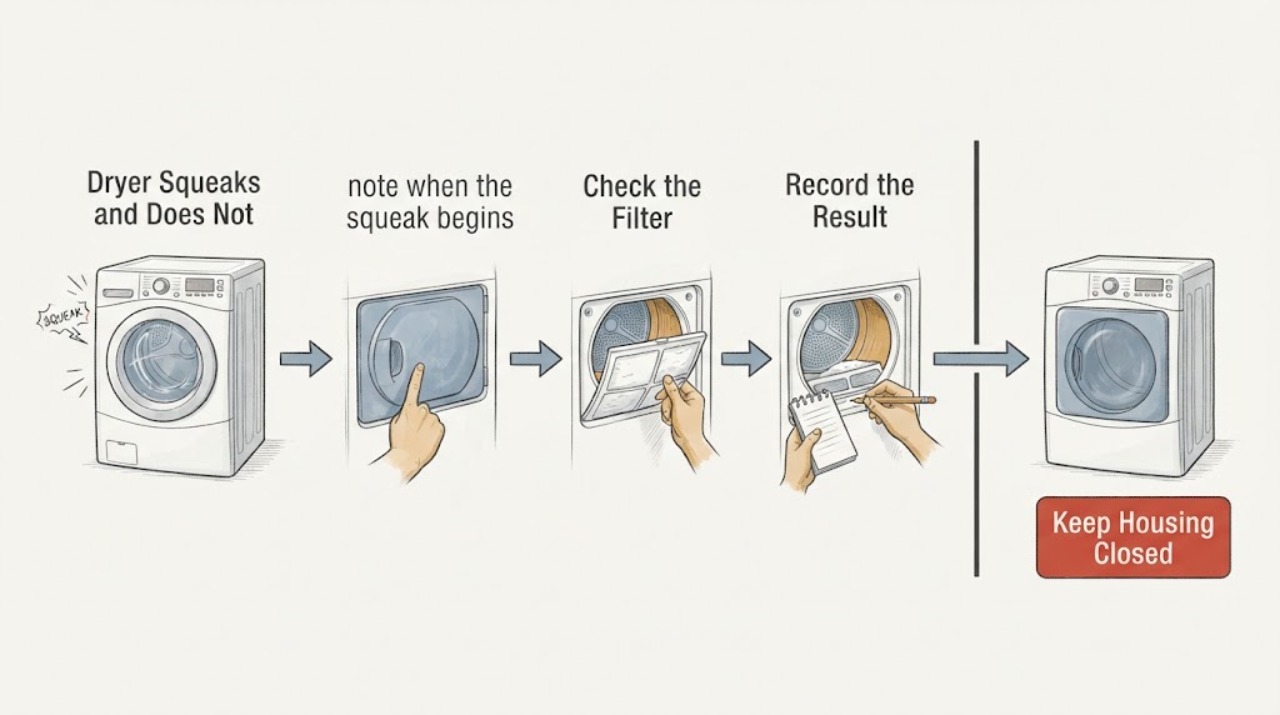
Work through in order
Diagnostic checks
Use only checks that match the exact appliance or system and its official guide.
-
Check 1
From a safe position, note when the squeak begins and ends: listen during the first seconds of start-up, after the dryer has warmed, and after the drum stops. Do not run repeated tests if there is smoke, a burning odor, exposed damage or a protection trip.
Expected result: The squeak stops after the first few seconds, or it continues after start-up, appears only once the dryer is warm, repeats as a short chirp, or continues after drum movement has stopped.
Next step: If the noise continues or returns with heat, discontinue use and arrange qualified dryer service. If it is only a brief start-up sound and drying is otherwise normal, continue with the separate drying checks and monitor for change.
Why this matters
Why: GE describes a brief start-up squeak as a normal sound, while a persistent, heat-related or repeating squeak is not normal. The timing narrows the service description but does not identify a failed component.
-
Check 2
Unplug the dryer before cleaning or inspecting it. Check that it stands level on a solid floor, nothing leans against it, accessible exposed screws are not loose, and the drum is free of coins, clips or other objects. Remove the lint filter and look down the opening; only reach into that opening if the object is plainly accessible, using care because the edges may be sharp.
Expected result: The dryer rocks, an object is visible in the drum or lint-filter opening, a loose exposed screw is found, or there is no accessible external cause for the squeak.
Next step: Correct only the safe external condition, reinstall the lint filter and keep the cabinet closed. If the sound remains, or an object is near a seal or inaccessible mechanism, leave the dryer unused and arrange service.
Why this matters
Why: GE identifies leveling, contact with nearby objects, loose exposed screws and foreign objects as possible noise sources. A scraping noise from the drum front seal or worn or loose drum slides requires service; these observations do not authorize cabinet disassembly.
-
Check 3
With the dryer off, clean the lint filter as the owner's instructions allow and inspect the visible exhaust route and outside wall cap or damper for lint, blockage or a kink. Do not reach into a hidden duct, remove the cabinet, or alter the vent length without the model's installation instructions.
Expected result: The lint filter is coated, the outside damper does not move freely, the duct is visibly kinked or obstructed, or airflow appears normal while clothes remain damp.
Next step: Restore only the accessible lint and vent condition, then use the exact model's installation guidance for duct routing. If the vent cannot be safely cleared or the dryer still does not dry, stop and arrange qualified service.
Why this matters
Why: GE identifies lint and restricted exhaust airflow as causes of long drying and recommends checking the duct and outside damper. Normal visible airflow does not rule out a concealed obstruction or a heat or control fault.
-
Check 4
Review one normal wash load at a time: check whether the load is overpacked or mixes heavy and light fabrics, confirm the selected dryness option, and note whether the clothes leave the washer unusually wet. Do not keep running a dryer that is making an abnormal squeak merely to compare cycles.
Expected result: The load is too large or mixed, a model-specific energy-saving or sensor setting leaves items slightly damp, or clothes are wetter than usual before drying; alternatively, the load and cycle are appropriate but drying is still poor.
Next step: Follow the exact owner's manual for the cycle and load, and address an unusually wet washer load through washer support if needed. If the dryer remains noisy or fails to dry with suitable conditions, arrange service.
Why this matters
Why: GE lists load size, fabric mix, cycle setting, sensor contact and washer spin performance as separate drying variables. These observations do not prove a dryer component failure or explain a persistent abnormal squeak by themselves.
-
Check 5
From outside the appliance, check whether the household fuse or circuit breaker supplying the dryer is tripped or damaged. Reset a tripped device only once when it is safe to do so; do not test live terminals, open the cabinet, work on a gas connection, or repeatedly reset a device that trips again.
Expected result: The breaker or fuse is tripped, the cord or receptacle shows damage, the protection device trips again, or the dryer tumbles but still does not provide expected heat and drying.
Next step: Leave the dryer unplugged for damage or a repeat trip and arrange qualified appliance or electrical service. For a gas dryer, do not adjust or disconnect gas parts; provide the model, fuel type and observed symptoms to the servicer.
Why this matters
Why: GE lists the household fuse or breaker as an external drying check, but a repeat trip, damaged supply or no heat after an external check needs service. A tumbler symptom does not identify whether the cause is electrical, gas, heating or control related.
Use your observations
Decision map
Find the observation that best matches what you see, then follow the next safe action.
-
PATH 01Next step
What you see
The squeak occurs only during the first few seconds and disappears, and the dryer dries normally.
Do this next
Monitor the sound and keep the dryer level and clear. If it lasts longer, changes with heat, or drying declines, stop use and repeat the service-oriented checks.
Why this path and its safety boundary
Why it matters: That timing matches GE's described normal start-up squeak more closely than a persistent noise fault.
-
PATH 02Next step
What you see
The squeak continues after start-up, begins only after warming, repeats as a chirp, or continues after the drum stops.
Do this next
Discontinue use and arrange qualified service. Give the technician the timing, whether the drum was moving, whether the dryer was warm, and the results of the unplugged external checks.
Why this path and its safety boundary
Why it matters: GE classifies continuing or heat-related squeaks as unusual; a noise after drum movement stops also cannot be safely diagnosed by the title alone.
-
PATH 03Next step
What you see
The lint filter or visible exhaust route is restricted, the outside damper does not open freely, or the load is too large or unusually wet from the washer.
Do this next
Correct the accessible condition according to the owner's instructions and use a suitable load. If the squeak remains or drying does not improve, stop and obtain service rather than opening the cabinet.
Why this path and its safety boundary
Why it matters: An airflow, load or incoming-wetness condition can explain poor drying without proving an internal dryer failure.
-
PATH 04Next step
What you see
The lint filter, visible vent, load, cycle and external power checks are normal, but clothes remain damp or the dryer makes the continuing squeak.
Do this next
Keep the dryer out of service and give qualified service the full model number, fuel type, noise timing, drying result and external observations. Do not lubricate, replace or bypass an internal part based only on the symptom.
Why this path and its safety boundary
Why it matters: The issue remains inside the dryer or in a concealed vent or model-specific system, but the available evidence does not support naming a belt, slide, bearing, motor or heater as the cause.
-
PATH 05Next step
What you see
There is smoke, a burning odor, visible cord or cabinet damage, water near electrical parts, or a breaker trips again.
Do this next
Stop using the dryer, isolate power only from a safe position if needed, keep clear of damaged parts, and arrange qualified appliance or electrical service. Do not repeatedly reset or test the dryer.
Why this path and its safety boundary
Why it matters: This is a safety stop condition rather than an ordinary squeak or venting adjustment.
Helpful context
Understand the symptom
Do not diagnose a part from the sound alone
A squeak that disappears shortly after start-up is different from a squeak that remains after the dryer is warm or continues when the drum has stopped. The latter pattern is a stop-and-service symptom in GE's guidance. The noise does not by itself prove a failed belt, drum slide, bearing or motor, and the absence of drying does not identify one of those parts.
Treat the drying complaint as an airflow and operating check
GE lists the lint filter, exhaust duct, outside damper, load size, fabric mix, cycle selection and how wet the load leaves the washer as separate reasons for long drying. Exact vent length, turns and cycle behavior vary by model, so use the owner's instructions for the dryer model once its tag is available.
When checks do not resolve it
Need a professional?
Arrange qualified service when the squeak continues after start-up, appears after warming, continues after the drum stops, remains after safe external checks, or the dryer still does not dry. Stop immediately for smoke, burning odor, damaged wiring or a repeated breaker trip.
Safety scope: Do not open the cabinet, reach past sharp or inaccessible openings, lubricate or replace a belt, slide, bearing or heater from a generic diagnosis, test live terminals, work on gas connections, or keep operating after smoke, burning odor, damage or repeated protection trips.
Have this ready
- Provide the full model and serial number, electric or gas fuel type, whether the squeak occurs at start-up or after warming, whether it continues after the drum stops, load and cycle details, lint-filter and vent observations, breaker behavior, and any odor or visible damage.
Common questions
FAQ
Is a squeak when a GE dryer starts always a failure?
No. GE says a start-up squeak that goes away after the first few seconds can be normal. A squeak that continues, appears after the dryer heats, or repeats as a short chirp is not normal and should be escalated if it remains.
What should I check when the dryer squeaks and clothes stay damp?
Check the timing of the noise separately from the drying conditions. With the dryer unplugged, check level and accessible foreign objects, then clean the lint filter and inspect the visible duct and outside damper. Review load size, fabric mix, cycle selection and how wet the load leaves the washer. Persistent noise or poor drying needs service.
Can I lubricate the dryer or replace a belt because it squeaks?
Do not choose a belt, slide, bearing, lubricant or other part from the noise alone. GE's public guidance identifies some possible noise conditions but sends persistent unusual noises to a qualified servicer; an exact model and inspection are needed before a part decision.
Why can a dryer run but still take too long to dry?
GE lists restricted exhaust airflow, a dirty lint filter, load size or fabric mix, cycle settings, sensor leveling and unusually wet clothes from the washer as separate possibilities. Use the model's instructions and arrange service if those external conditions are normal or the unusual squeak persists.
Read the exact guide
Official sources
- Dryer - Taking Too Long To Dry Clothes or Not Drying at AllGE Appliances · Opened GE Appliances' official dryer support page. It covers exhaust material and obstruction, outside damper, lint-filter cleaning, breaker or fuse, load and fabric conditions, model-dependent cycle settings, washer load wetness and service. No exact model was supplied, so exact vent routing and control behavior remain subject to the owner's manual.
- Dryer - NoisesGE Appliances · Opened GE Appliances' official dryer support page. It distinguishes a brief start-up squeak from persistent, heat-related and repeating squeaks, lists level, exposed screw, drum and lint-filter-opening checks, and directs users to discontinue use and obtain qualified service when unusual noise remains. No exact model was supplied, so the guidance is used only for general GE dryer symptom triage.
Community feedback
Share a repair observation
Share a plain-text repair observation. Accepted observations are published automatically; this page may take a moment to update.