
On this page
Start here
Quick answer
A broken GE dryer timer knob does not automatically mean the timer assembly is bad. First stop the dryer, disconnect power safely, and identify whether only the removable knob or clip is damaged, or whether the shaft behind it is cracked, bent, pushed into the panel, or no longer turns the control. GE's parts catalog contains several different dryer timer knobs and says to check the complete appliance model for fit; one official listing describes a knob that accepts a D-shaped shaft, but that does not make it a universal GE part. Do not force the shaft, run a dryer with a missing or broken control, open the console, or order a timer from a photograph. If the shaft, timer, panel, wiring, or start/heat behavior is abnormal, arrange qualified service.
Before you begin
Safety first
- Owner checks are limited to stopping the dryer, disconnecting power safely, recording the model, inspecting the external knob/shaft interface without force, and describing prior cycle behavior. Do not open the console or cabinet, touch terminals or wiring, bypass the timer or door switch, run without the knob/control, or operate a damaged or partially disassembled dryer.
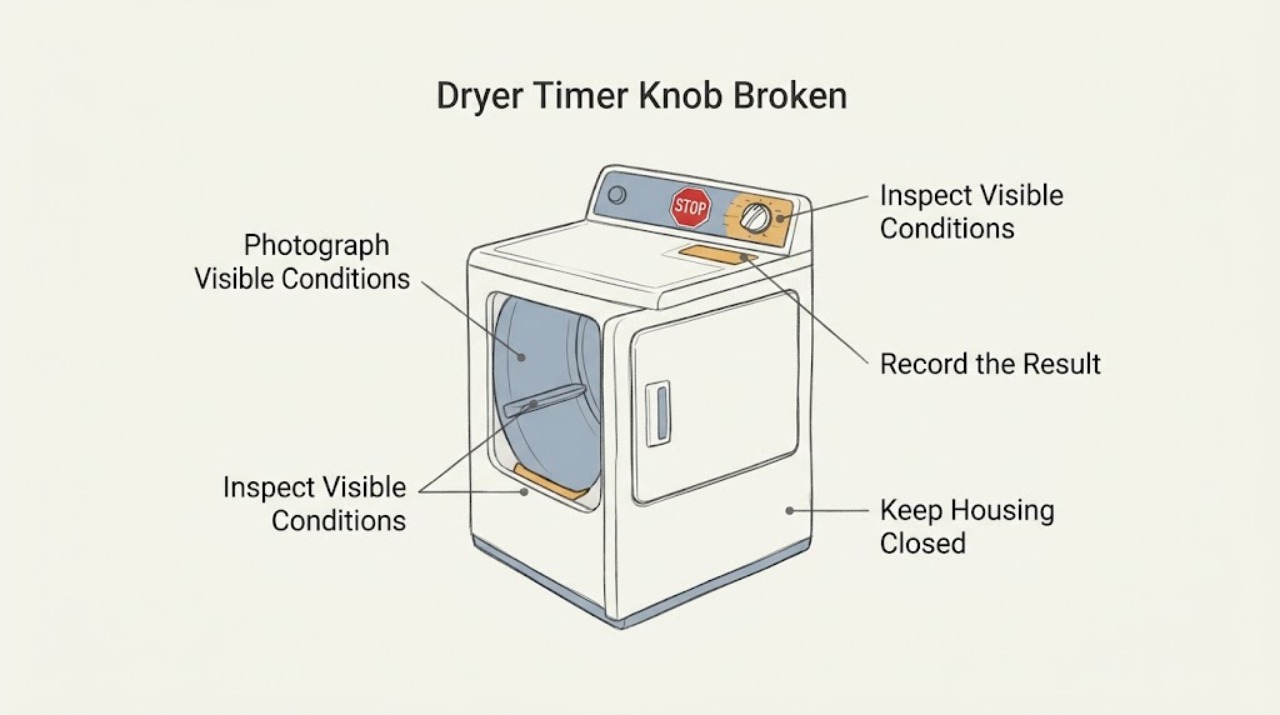
Work through in order
Diagnostic checks
Use only checks that match the exact appliance or system and its official guide.
-
Check 1
Stop the dryer with its normal control, wait for the drum to stop, and disconnect power from a safe dry position. Record the complete GE model and serial information from the ordinary-access label, commonly behind the dryer door, and photograph the control before touching the loose knob.
Expected result: The knob is loose, cracked, missing, or spinning freely; the control panel is cracked or pushed in; the shaft is not visible; or the model label cannot be read.
Next step: Keep the dryer out of use until the model and the external damage are documented. If the panel or shaft is damaged, or the model cannot be confirmed, arrange service rather than testing the control by force.
Stop if: Do not operate a dryer that is partially disassembled or has a broken or missing control, and do not reach behind the console or touch wiring.
Why this matters
Why: GE documentation uses the full model number to identify the control and parts, and its safety guidance warns against operating an appliance with broken or missing parts. The visible knob condition alone does not identify whether the timer shaft or internal control is also damaged.
-
Check 2
With power disconnected, inspect only the visible interface. If the knob has already come off without force, look at the exposed shaft and knob hub for a split, missing clip, rounded or cracked socket, bent shaft, shaft pushed behind the panel, or visible panel damage. Do not pry off a knob that is stuck and do not turn a damaged shaft to see whether the dryer starts.
Expected result: The knob body or clip is damaged but the shaft appears straight and intact, the shaft is damaged or missing, the shaft turns without engaging the control, or the panel/console is damaged.
Next step: For an intact shaft, use the exact GE model to check whether a replacement knob is listed. For any shaft, hub, panel, or control damage, keep power disconnected and arrange qualified appliance service.
Stop if: Do not remove the console, straighten or glue a control shaft, bypass the timer, or use pliers, tape, adhesive, or a generic knob as a repair.
Why this matters
Why: A sound shaft with a detached knob supports a narrow model-specific knob or clip decision. A damaged, slipping, recessed, or non-engaging shaft shifts the problem toward the timer/control interface and cannot be resolved by a knob-only purchase.
-
Check 3
If the dryer was operated before the knob broke, write down what the control actually did: whether a cycle could be selected, whether the dryer started, whether heat and tumbling occurred, and whether the timer advanced. Include whether the cycle was Timed Dry or an automatic named cycle; do not run another cycle solely to observe movement with a broken control.
Expected result: The dryer previously selected and ran a cycle normally, the timer never moved, the timer moved slowly or periodically, the dryer would not start, or heat/tumbling behavior was abnormal.
Next step: Give the technician the cycle type and behavior rather than assuming a timer replacement. Keep the dryer off when the knob cannot reliably select the intended cycle or when starting, heat, or tumbling was abnormal.
Stop if: Do not hold or turn a damaged shaft during operation, run the dryer with the console open, or keep testing a no-start, no-heat, overheating, or electrically abnormal appliance.
Why this matters
Why: GE says slow timer movement is normal in Timed Dry and intermittent movement can be normal in automatic cycles. A timer that does not move throughout a Timed Dry cycle may require service, but a broken knob does not prove the timer itself failed; no-start or abnormal heat adds control, door, motor, heater, or electrical possibilities.
-
Check 4
Use the exact model number in GE's official parts search and compare the listed part name, knob position, shaft interface, color or marking, and model compatibility. Treat a listing such as a D-shaft timer knob as an example of one part's interface, not proof that it fits this dryer.
Expected result: GE returns one model-matched timer knob, several alternatives, no result, or a timer/control assembly rather than a knob; the model number or market is uncertain.
Next step: Use only a model-confirmed GE part and the exact manual, or have qualified service identify it. If no model-matched result is available, do not substitute a generic knob or order the timer assembly from the symptom alone.
Stop if: Do not use a product photo, color, shaft appearance, or another GE/Hotpoint model as compatibility evidence, and do not include substitute hardware in the control.
Why this matters
Why: GE's catalog contains multiple dryer timer knobs and repeatedly instructs the owner to check the appliance model for fit. A different shaft interface, knob position, engineering revision, or control assembly can make an otherwise similar part wrong.
-
Check 5
Before service, record any additional warning: smoke, burning plastic or electrical odor, hot plug or cord, repeated breaker operation, sparks, exposed terminals, a stuck cycle, abnormal heat, or a drum that will not turn. Keep the dryer disconnected and do not move it to reach the rear connection unless that is safe and necessary to isolate an immediate hazard.
Expected result: There is only external knob damage and no other symptom, or there is a hazard, control-panel damage, exposed wiring, abnormal heat, no-start/no-heat behavior, or repeated protective-device operation.
Next step: For knob-only damage, use model-confirmed parts guidance. For any additional symptom, keep the dryer off and arrange qualified appliance service; use a qualified electrician for a hot or damaged supply or repeated breaker trip, and use emergency or gas help for smoke, fire, or a gas odor.
Stop if: Do not reset a recurring trip, open the cabinet, bypass the timer or door switch, operate without the knob/control, or attempt live electrical or gas diagnosis.
Why this matters
Why: A cosmetic or interface-only failure may be narrow, but additional heat, electrical, mechanical, or control symptoms cross the owner-check boundary. GE's safety guidance says not to operate a damaged, malfunctioning, partially disassembled appliance or one with missing or broken parts.
Use your observations
Decision map
Find the observation that best matches what you see, then follow the next safe action.
-
PATH 01Next step
What you see
Only the removable knob body or clip is broken, the exposed shaft is straight and intact, the panel is undamaged, and the dryer had no abnormal start, heat, tumbling, or electrical behavior.
Do this next
Use the complete GE model in the official parts lookup and follow the matching manual or listed installation guidance. Do not run the dryer until the control is securely and correctly restored.
Why this path and its safety boundary
Why it matters: This is the narrow knob-only path. A model-confirmed replacement may restore the interface, but the official GE listing's D-shaped shaft example is not universal compatibility evidence.
-
PATH 02Next step
What you see
The shaft is cracked, bent, recessed, spins without selecting a cycle, the knob will not stay engaged, or the control panel is cracked or pushed inward.
Do this next
Keep the dryer disconnected and arrange qualified GE or appliance service. Provide photos and the model number; do not order a timer or control assembly until the technician confirms the failed interface and exact fit.
Why this path and its safety boundary
Why it matters: The failure is not established as a knob-only repair. The timer shaft, timer/control assembly, mounting, or panel may need model-specific diagnosis.
-
PATH 03Next step
What you see
The knob is intact enough to turn but the dryer was reported to have a non-advancing timer, no start, no heat, abnormal tumbling, or an unexpected cycle result.
Do this next
Stop using the dryer and request qualified diagnosis with the exact cycle and behavior. Do not replace the timer solely because the knob did not move during an automatic cycle.
Why this path and its safety boundary
Why it matters: The knob symptom may be masking a timer, control, door, motor, heater, or electrical problem. GE's timer guidance says movement depends on Timed Dry versus automatic cycles, so movement alone cannot select a part.
-
PATH 04Next step
What you see
The model number cannot be confirmed, the GE parts search returns several incompatible-looking knobs or no match, or the appliance is from another model family or market.
Do this next
Recover the complete model and use the matching GE manual or qualified service for identification. Keep the dryer out of use until the control is restored with a confirmed part.
Why this path and its safety boundary
Why it matters: The part identity and compatibility are unresolved. The catalog's multiple knob listings show why a generic GE dryer knob cannot be selected by appearance alone.
-
PATH 05Next step
What you see
The broken knob is accompanied by smoke, a burning or gas odor, hot or damaged cord/plug, sparks, exposed wiring, repeated breaker trips, abnormal heat, or mechanical damage.
Do this next
Stop using the dryer and isolate power only from a safe position when there is no immediate danger. Obtain qualified appliance or electrical service, and leave the area and contact gas or emergency help for a strong gas odor, smoke, or fire.
Why this path and its safety boundary
Why it matters: This is an appliance, electrical, fire, gas, or mechanical safety path rather than a knob replacement task.
Helpful context
Understand the symptom
What the broken knob tells you—and what it does not
The visible knob is only the user interface for a model-specific control. If the knob or its clip is broken while the shaft and panel remain intact, a matching knob may be all that is needed. If the shaft is damaged, the knob slips, the control will not select a cycle, or the panel is cracked, the control or timer may also be involved. That distinction cannot be made safely by comparing color, shape, or a similar dryer photo.
Timer movement is cycle-dependent
GE says a timer knob turns slowly during a Timed Dry cycle, while an automatic cycle may advance only at intervals as the dryer senses drum temperature. A knob that appears not to move is therefore not proof of a bad timer. Record the cycle and the actual control symptom before requesting a timer or control part.
Only after diagnosis
Potential parts
- model-specific GE dryer timer knob or knob/clip assembly
Consider this only when the visible knob or clip is the sole failure, the shaft and panel are intact, and GE's official parts lookup confirms the exact model. GE lists multiple dryer timer knobs; one opened listing accepts a D-shaped shaft, but that interface is not universal.
Match the complete model, engineering revision and market, shaft interface, knob position, and exact listed part. Do not substitute by color, photograph, or another GE/Hotpoint model.
When checks do not resolve it
Need a professional?
Contact GE or qualified appliance service for a damaged or non-engaging shaft, panel damage, timer/control symptoms, no-start/no-heat behavior, abnormal tumbling, unresolved compatibility, or any broken/missing control. Contact qualified electrical help for a hot/damaged supply or repeated breaker trips, and emergency or gas help for smoke, fire, or a strong gas odor.
Safety scope: Owner checks are limited to stopping the dryer, disconnecting power safely, recording the model, inspecting the external knob/shaft interface without force, and describing prior cycle behavior. Do not open the console or cabinet, touch terminals or wiring, bypass the timer or door switch, run without the knob/control, or operate a damaged or partially disassembled dryer.
Have this ready
- Provide the complete GE model and serial, market, photographs of the knob, hub, shaft and panel, whether the knob came off freely, shaft and clip condition, cycle type, timer movement, start/heat/tumble behavior, and any odor, heat, smoke, spark, or breaker history.
Common questions
FAQ
Can I replace only the broken GE dryer timer knob?
Possibly, but only if the knob or clip is the sole damaged piece and the shaft and panel are intact. Use the complete GE model in the official parts lookup; GE lists multiple timer knobs and says to check model compatibility. Do not run the dryer with a missing or broken control.
Does a D-shaped shaft mean a GE timer knob will fit?
No. One official GE listing describes a knob that accepts a D-shaped shaft, but the same listing requires model-number compatibility checking. Confirm the exact model, control position, shaft interface, and listed part before ordering.
Does a timer knob that does not move mean the timer is bad?
Not necessarily. GE says the knob turns slowly during Timed Dry and may advance only at intervals during automatic cycles. A knob that never advances through a Timed Dry cycle, or a dryer with abnormal start, heat, or tumbling, needs service diagnosis rather than an automatic timer replacement.
Can I glue the broken knob back on or use pliers on the shaft?
No. Do not glue, tape, force, bend, or grip the shaft, and do not bypass the timer. If the shaft or panel is damaged or the knob does not engage securely, keep the dryer disconnected and arrange qualified service.
Read the exact guide
Official sources
- DRYER TIMER KNOB - WHITEGE Appliances Parts · Opened the official GE Appliances Parts listing. It identifies one dryer timer knob as a genuine GE part, states that it accepts a D-shaped shaft, and requires searching by appliance model number to confirm fit; it is not evidence that the part fits an unidentified GE dryer.
- 49-90099GE Appliances · Opened the official GE dryer manual. It identifies the model label behind the door, warns not to operate a dryer that is damaged, malfunctioning, partially disassembled, or missing/broken parts, and says to disconnect power before maintenance; these safety statements are used as a boundary and not as universal repair instructions for every GE dryer.
- Search ResultsGE Appliances · Opened the GE Appliances-hosted parts search. It displays many distinct dryer timer, cycle-selector, control, and knob assemblies and repeatedly instructs the user to check the appliance model for compatibility. The search results are inventory evidence, not a universal part recommendation.
- Dryer - Timer is Not AdvancingGE Appliances · Opened GE's official timer-support article. It distinguishes normal slow movement in Timed Dry from periodic movement in automatic cycles and says a timer that does not move through the cycle may require service.
Community feedback
Share a repair observation
Share a plain-text repair observation. Accepted observations are published automatically; this page may take a moment to update.