
On this page
Start here
Quick answer
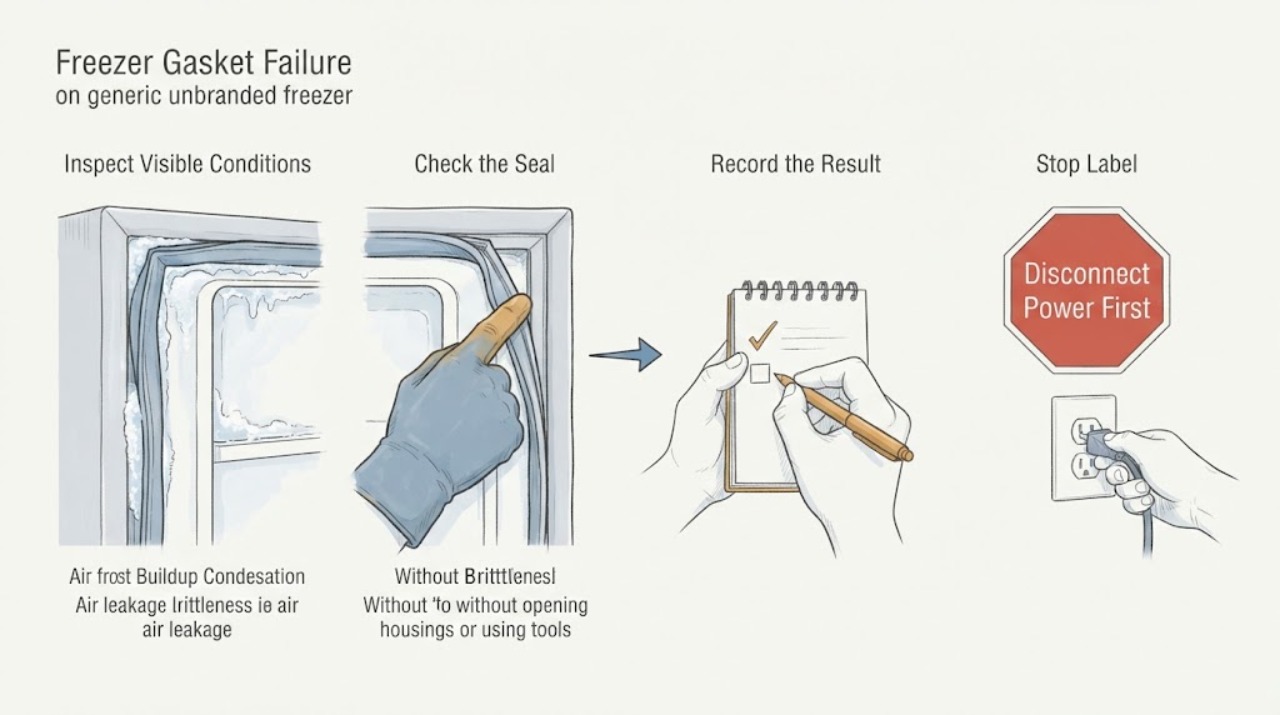
Treat “gasket failure” as a hypothesis until the seal is visibly checked. GE says frost or ice on a freezer wall can also follow humidity, frequent openings, warm food, packages against the wall, or a package holding the door open. Empty the closure path, make sure baskets or slides are seated, and inspect whether the gasket is fully in its groove, smooth, undamaged, and touching the frame evenly around the closed door or drawer. Clean only with GE’s mild baking-soda solution if needed. With no model, do not order a gasket or assume a hinge, drawer, or cabinet fault; arrange GE or qualified refrigeration service if the seal remains uneven, frost persists, or the door does not close.
Before you begin
Safety first
- Disconnect power before cleaning or maintenance. Do not force the door/drawer, stretch or cut the gasket, use unapproved chemicals, open the cabinet/liner, or order a gasket by visual similarity. Arrange service for persistent frost, damaged hardware, leaks, wiring damage, or unsafe temperature.
Work through in order
Diagnostic checks
Use only checks that match the exact appliance or system and its official guide.
-
Check 1
Look at the freezer door or drawer path and remove only visible packages, shelves, bins, or shipping material that prevent a full closure; on a bottom drawer, verify the lower basket is seated in its slides.
Expected result: The door closes only after an obstruction is moved, the basket is not seated, or the closure path was already clear.
Next step: Run the freezer with the closure path clear and observe the seal and frost trend. If the drawer still binds or will not close, stop forcing it and arrange model-specific service.
Why this matters
Why: GE identifies packages, shipping material, and an incorrectly seated lower basket as closure causes. A corrected closure does not prove the gasket was damaged.
-
Check 2
With the door or drawer open, trace the gasket with a clean finger and check whether it is fully seated in its groove, smooth, and free of cuts, tears, splits, or severe wrinkles.
Expected result: The gasket is pulled from the retainer, visibly damaged, wrinkled, or fully seated and intact.
Next step: For a loose section, consult the exact GE design guidance before pressing it back into its retainer. For damage, record the model and use GE service/parts lookup; do not order by appearance alone.
Why this matters
Why: A loose or damaged gasket can prevent an even seal, but an intact gasket does not rule out a hinge, drawer, level, or other closure condition.
-
Check 3
Close the freezer gently and inspect the contact around the entire frame; on a drawer, compare the gap and gasket contact at the top and bottom.
Expected result: The gasket touches the frame evenly, or one side/corner has a visible gap or the gasket does not touch.
Next step: Check only accessible loading and seating conditions. If the gap remains, use the exact model adjustment guidance or arrange qualified service rather than bending hardware or forcing the door.
Why this matters
Why: GE says the gasket should seal to the front of the case around the perimeter and that a freezer door should contact the frame evenly. An uneven gap supports a closure/seal issue, not a specific replacement part.
-
Check 4
If the gasket is dirty or has odor, disconnect power and clean it with warm water plus baking soda, then rinse and dry the seal; avoid bleach, ammonia, detergent, and petroleum-distillate products.
Expected result: The seal is dirty and improves after cleaning, or it remains deformed/damaged/uneven after cleaning.
Next step: If the seal remains uneven or damaged, stop using generic cleaners and record the model for GE or qualified refrigeration service.
Why this matters
Why: GE supports this cleaning method for the gasket, but cleaning cannot repair a cut, split, structural deformation, or closure alignment problem.
-
Check 5
Track frost or ice after the closure path is clear and the gasket is clean, while noting humidity, frequent openings, warm food, and packages touching the rear wall.
Expected result: Frost decreases after the external causes are corrected, or frost persists despite a clear path and apparently even seal.
Next step: If frost persists or the fan is not running, arrange service. Do not remove the inner liner or diagnose the defrost system from frost alone.
Why this matters
Why: GE lists those environmental/loading causes before a gasket diagnosis; persistent frost can also involve a freezer fan or another refrigeration condition.
-
Check 6
Provide the full model number, freezer style, location and pattern of frost, closure observations, gasket damage/cleaning result, and any fan or temperature concern to GE or qualified refrigeration service.
Expected result: The door/drawer will not close, the gasket remains damaged or uneven, frost persists, or the appliance is not maintaining temperature.
Next step: Arrange GE/Bodewell or qualified refrigeration service. Do not order or install a gasket by visual similarity, force drawer hardware, or open the cabinet/liner.
Why this matters
Why: The no-model task does not establish a compatible gasket, hinge, slide, fan, or defrost component.
Use your observations
Decision map
Find the observation that best matches what you see, then follow the next safe action.
-
PATH 01Next step
What you see
A package, shelf, shipping piece, or unseated basket was preventing the freezer door or drawer from closing and the seal is now even.
Do this next
Keep the closure path clear and monitor frost after normal operation; call service if the obstruction returns or the door/drawer still binds.
Why this path and its safety boundary
Why it matters: The initial frost or air-leak symptom was consistent with a closure obstruction, so gasket failure was not established.
-
PATH 02Next step
What you see
The gasket is loose in its groove but not visibly cut or split, and the exact GE design instructions match the appliance.
Do this next
Use the matching model instructions only; if the design is unclear, arrange service instead of pressing, stretching, or heating the seal.
Why this path and its safety boundary
Why it matters: GE describes some gaskets as capable of being pressed back into the retainer, but the task has no model and designs differ.
-
PATH 03Next step
What you see
The gasket has a cut, tear, split, or persistent deformation, or it does not touch the frame evenly when closed.
Do this next
Record the model and use GE support or qualified service. Do not buy a visually similar part or force the door/drawer closed.
Why this path and its safety boundary
Why it matters: The seal may need model-specific adjustment or replacement, but the symptom does not identify a compatible gasket or root cause.
-
PATH 04Next step
What you see
The gasket is clean, seated, intact, and evenly contacting the frame, but frost or ice continues.
Do this next
Correct accessible loading/humidity causes and arrange service if frost persists or the fan is not running; do not diagnose or dismantle the defrost system.
Why this path and its safety boundary
Why it matters: GE lists other possible causes, including humidity, frequent openings, warm food, rear-wall contact, and a freezer fan that is not running.
-
PATH 05Next step
What you see
The appliance has a leak, damaged wiring, abnormal heat, or cannot hold safe freezer temperature.
Do this next
Limit opening and use as appropriate, protect food, disconnect power only when safe, and arrange qualified refrigeration service.
Why this path and its safety boundary
Why it matters: The issue exceeds a gasket-only external check and may affect food safety or electrical safety.
Helpful context
Understand the symptom
A freezer that frosts or seems leaky does not automatically have a failed gasket. GE lists humidity, frequent door openings, warm food, packages against the rear wall, and packages holding the door open as possible frost contributors. Start with the closure path and the visible seal, then use the exact model manual or service path for anything beyond that.
Clear anything preventing a full closure
Check that food packages, shelves, bins, or drawer hardware are not holding the freezer open. On a bottom-freezer drawer, GE specifically says to check that the lower basket is fully seated in its slides; on a newly installed appliance, remove any remaining shipping material. Do not force the door or drawer against an obstruction.
Inspect the gasket without assuming it needs replacement
With the appliance door or drawer open, look for a gasket pulled out of its groove, a cut or tear, a split, a wrinkle, or a section that is not smooth. Close it gently and observe whether the gasket touches the cabinet frame evenly all around. GE describes a gasket that is loose in its retainer, damaged, or unevenly contacting the frame as a condition for model-appropriate adjustment or service, but the no-model task does not support naming a replacement part.
Clean the seal with the approved method
If dirt, mildew, or food odor is present, disconnect power before cleaning and wipe the gasket with warm water and baking soda as GE describes. Rinse and dry it thoroughly. Do not use petroleum distillates, detergent, bleach, or ammonia on the gasket or plastic parts.
Separate frost causes from a seal observation
After correcting an obstruction and cleaning the seal, observe whether frost or ice decreases over the next few days. GE says frost may follow humidity, frequent openings, warm food, rear-wall contact, or a package holding the door open. If frost remains, the gasket is not the only possible cause; GE also lists a freezer fan that is not running and directs unresolved problems to service.
Do not generalize the replacement part
GE has different gasket guidance for top-freezer, bottom-freezer, French-door, and side-by-side designs. A no-model symptom cannot establish which profile, color, door/drawer style, or retaining method applies. Record the full model number and use the matching GE support page or qualified service before ordering or removing a gasket.
When checks do not resolve it
Need a professional?
Arrange GE/Bodewell or qualified refrigeration service when the gasket remains damaged or uneven, the door/drawer will not close, frost persists after accessible closure and loading checks, the freezer fan is not running, or the appliance cannot maintain safe temperature. With no model, do not infer a compatible gasket or hinge/slide part.
Safety scope: Disconnect power before cleaning or maintenance. Do not force the door/drawer, stretch or cut the gasket, use unapproved chemicals, open the cabinet/liner, or order a gasket by visual similarity. Arrange service for persistent frost, damaged hardware, leaks, wiring damage, or unsafe temperature.
Have this ready
- Full model number and serial details, freezer style, frost location, closure/gap observation, gasket damage or cleaning result, basket/slide position, humidity/loading context, and temperature concern.
Common questions
FAQ
Does frost prove a GE freezer gasket has failed?
No. GE also lists humidity, frequent door openings, warm food, packages against the rear wall, and packages holding the door open. Inspect the closure path and gasket contact before treating the gasket as failed.
Can I push a GE freezer gasket back into place?
GE says some top-freezer gaskets that have pulled loose can be pushed back into the retainer, but the exact design is model-specific. Use the matching owner guidance or service path rather than assuming every GE freezer uses the same retainer.
What can I use to clean a GE freezer gasket?
GE’s freezer and gasket care guidance uses warm water with baking soda, followed by rinsing and drying. It warns against petroleum distillates, detergent, bleach, and ammonia on the gasket or plastic parts.
Can I order a universal-looking GE freezer gasket without the model?
Do not. GE publishes different guidance for top-freezer, bottom-freezer, French-door, and side-by-side designs. Record the full model number and confirm the exact fit through GE or qualified service before ordering.
Read the exact guide
Official sources
- Refrigerator & Freezer - Ice on Freezer WallGE Appliances · Opened GE official frost guidance. Used for alternative frost causes, gasket observations, fan/service boundary, and power isolation before maintenance.
- Refrigerator, Freezer and Standalone Ice Maker - Care and Cleaning of Interior and GasketGE Appliances · Opened GE official cleaning guidance for refrigerator/freezer gaskets. Used for warm-water/baking-soda cleaning and prohibited chemicals only.
- Bottom Freezer Refrigerator - Freezer Drawer Not Sealing ProperlyGE Appliances · Opened GE official guidance for bottom-freezer drawer closure, basket/slide seating, gasket groove, even frame contact, and frost/seal observations; exact drawer design remains model-specific.
- Top Freezer Refrigerator - Adjusting or Replacing the Door GasketsGE Appliances · Opened GE official guidance for top-freezer gasket seating, visible damage, wrinkle correction, power isolation, and service. It is not treated as a universal part or procedure for every GE freezer style.
- Refrigerator - Easy to Remove GasketGE Appliances · Opened GE official general gasket guidance. Used for groove seating and smooth all-around contact, plus the warning that style-specific articles govern adjustment/replacement; no model-free part fit is claimed.
Community feedback
Share a repair observation
Share a plain-text repair observation. Accepted observations are published automatically; this page may take a moment to update.