
On this page
Start here
Quick answer
Some GE freezer airflow and compressor sounds are normal, but a sound that resembles a fan blade striking something is not. First note whether the freezer is cooling normally and whether the sound is a smooth airflow/whine or repeated scraping, ticking or impact. Do not reach into the fan or remove covers on an unidentified freezer. If the noise is blade-like, the fan stops, frost is building, temperatures rise, or the cabinet vibrates, keep the freezer closed as much as possible and arrange GE service.
Before you begin
Safety first
- Do not reach into the fan, remove interior or rear covers, run with guards removed, or order an evaporator/condenser fan from the sound description alone.
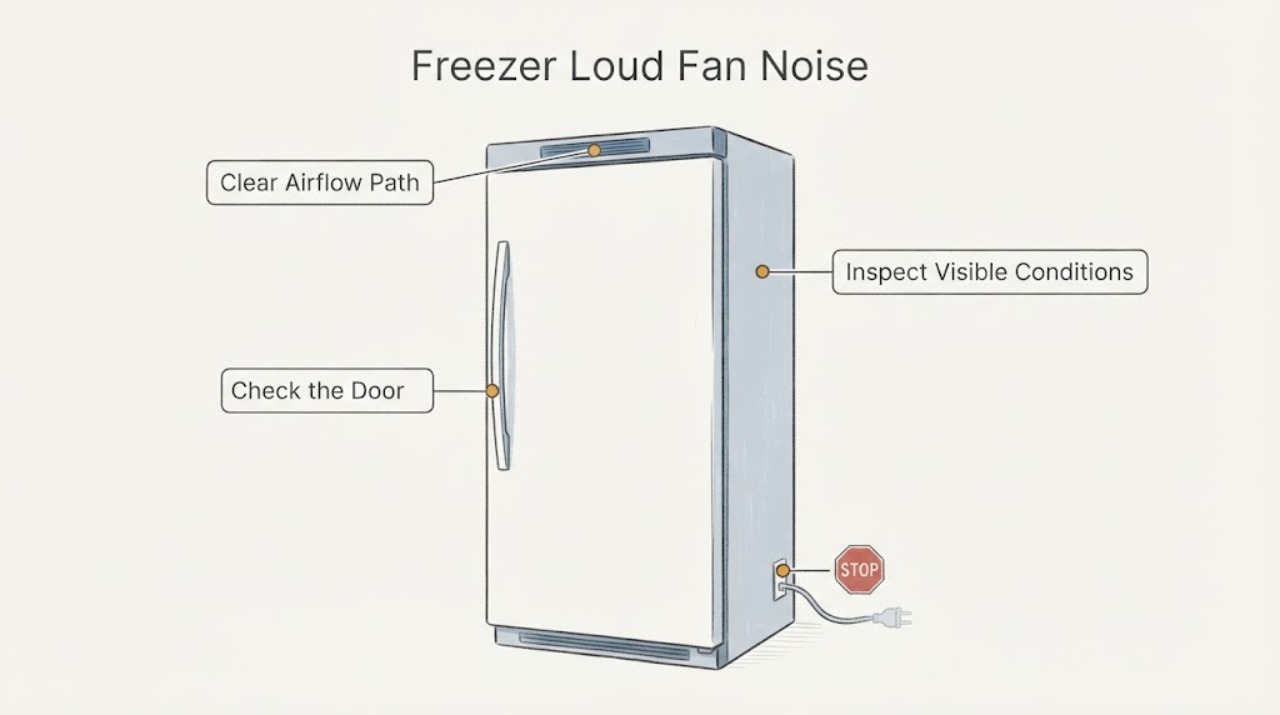
Work through in order
Diagnostic checks
Use only checks that match the exact appliance or system and its official guide.
-
Check 1
Listen from outside the closed freezer and classify the sound as smooth airflow/whine, a brief whoosh after opening, defrost sizzling/popping, or repeated scraping/impact.
Expected result: The sound matches a listed operating sound, or it resembles a fan blade striking an object.
Next step: Monitor a normal sound while checking cooling; stop troubleshooting and arrange service for a blade-like scrape or impact.
Why this matters
Why: GE considers the first group normal in the documented contexts; GE says a blade-strike-like freezer sound is not normal.
-
Check 2
Check the freezer temperature and look for wall ice, packages pressed against the rear wall, or a gasket that is torn or not sealing, without removing interior covers.
Expected result: Temperature is rising, wall ice is present, or the door/lid does not seal; or cooling remains stable with no visible frost issue.
Next step: Keep the door closed, move food only if necessary for safety, and arrange service when cooling or sealing is abnormal; continue only external observation when cooling is stable.
Why this matters
Why: Rising temperature or frost changes the priority from sound identification to preserving frozen food and obtaining service. Stable cooling does not prove that an impact noise is safe.
-
Check 3
Verify that the freezer is stable and not vibrating against a wall or nearby object, and note whether the noise changes when the door or lid is closed, without touching the fan or moving the appliance while powered.
Expected result: The cabinet or nearby surface vibrates, or the sound persists as an internal scrape/impact independent of cabinet contact.
Next step: Correct only an obvious external contact when the appliance is safely accessible; otherwise keep it in service only if cooling and safety are normal and arrange evaluation for persistent impact noise.
Why this matters
Why: External vibration can amplify normal operating noise; a persistent internal impact remains an unresolved fan or obstruction condition.
-
Check 4
Recover the GE model and serial label and use the matching manual before considering any cleaning access, fan cover or replacement part.
Expected result: The model is readable, or identity remains incomplete.
Next step: Use GE model-specific support or qualified service; do not transfer a fan procedure or part number from another freezer.
Why this matters
Why: Model information determines the freezer type, fan arrangement, defrost system and safe service instructions.
Use your observations
Decision map
Find the observation that best matches what you see, then follow the next safe action.
-
PATH 01Next step
What you see
The sound is a brief whoosh after opening, compressor whine, or defrost sizzling/popping, and the freezer is holding temperature.
Do this next
Continue normal external monitoring and keep the model manual available; seek service if the sound changes into repeated impact or cooling degrades.
Why this path and its safety boundary
Why it matters: GE lists these sounds as normal operating or defrost sounds in the appropriate context.
-
PATH 02Next step
What you see
The sound resembles a fan blade hitting something, or the freezer fan is not running.
Do this next
Do not reach into the fan or remove covers; arrange GE service and provide the model, sound description and cooling result.
Why this path and its safety boundary
Why it matters: GE identifies a blade-strike-like freezer sound as abnormal and says a non-running fan requires service.
-
PATH 03Next step
What you see
Wall ice, a poor door seal or packages against the rear wall are visible and the temperature is changing.
Do this next
Keep the freezer closed, correct only safe external loading/sealing issues, and arrange service if frost or temperature problems persist.
Why this path and its safety boundary
Why it matters: GE lists these as possible contributors to freezer wall ice and airflow concerns; the fan noise cannot be diagnosed separately from the cooling condition.
-
PATH 04Next step
What you see
The freezer cools normally, no frost or external vibration is visible, and the sound is simply louder than expected.
Do this next
Record the sound and model information, monitor for change, and use GE service if it becomes scraping, intermittent, or associated with temperature loss.
Why this path and its safety boundary
Why it matters: GE does not publish a universal decibel rating; loudness alone cannot identify a failed fan.
Helpful context
Understand the symptom
Describe the sound before calling it a fan fault
Listen from outside the closed freezer and note when the sound occurs. GE lists compressor running or whining, air-flow whoosh after a door or lid opens, and sizzling or popping during automatic defrost as normal freezer sounds. A steady airflow or motor hum is different from a repeated scrape, click or impact that follows fan speed.
Check cooling and visible frost without opening the cabinet
Check the freezer temperature with an appliance thermometer if available, and look through the compartment for packages touching the rear wall, a door that is not sealing, or unusual frost on the wall. GE says frost-free freezers should not accumulate wall ice and that door openings, warm loads, packages against the rear wall and gasket problems can contribute; if the fan is not running or the frost concern remains, service is recommended.
Keep hands and tools away from the fan
Do not reach behind an interior cover, probe through a grille, or run the freezer with a panel removed to reproduce the sound. GE's unusual-noise guidance identifies a blade-strike sound as a service condition, and its ice-wall guidance says to unplug before maintenance or cleaning. Without the model, the fan location and safe access procedure are not established.
Escalate a new or worsening fan-like noise
Record the model and serial number, the sound description, whether cooling changed, any frost or vibration, and whether the noise began after a door was left open or a defrost event. GE directs unusual noises and a fan that is not running to service. Do not order an evaporator fan, condenser fan or motor from a sound alone.
When checks do not resolve it
Need a professional?
Safety scope: Do not reach into the fan, remove interior or rear covers, run with guards removed, or order an evaporator/condenser fan from the sound description alone.
Have this ready
- Provide the model and serial numbers, sound recording if safe, when the noise occurs, freezer temperature, frost or gasket observations, and whether the sound started after a door-open or defrost event.
Common questions
FAQ
Is a loud fan sound normal in a GE freezer?
Some airflow, compressor and defrost sounds are normal. GE specifically says a sound that resembles a fan blade hitting something is not normal, so the sound character matters more than loudness alone.
Should I remove the freezer cover to see the fan?
No. The model is unknown and the official GE material identifies blade-impact noise as a service condition. Do not reach into the fan or run the appliance with a cover removed.
Can frost cause a freezer fan noise?
GE says frost-free freezers should not have wall ice and lists door openings, warm loads, packages against the rear wall and gasket problems as possible contributors. If frost and noise occur together, preserve the food and use model-specific service rather than assuming a fan part.
How loud is too loud for a GE freezer?
GE says it does not rate freezer sound levels in decibels. Use the sound type, whether it is new or worsening, and whether cooling or frost changed to decide when service is needed.
Read the exact guide
Official sources
- Refrigerator & Freezer - Ice on Freezer WallGE Appliances · Opened the official GE freezer page. It says frost-free units should not accumulate wall ice, lists external contributors, requires unplugging before maintenance and recommends service if the fan is not running or the issue persists.
- Refrigerator and Freezer - Types of Defrost SystemsGE Appliances · Opened the official GE defrost-system page. It explains that automatic-defrost freezers can be silent during defrost and may produce dripping or sizzling as water reaches the heater; model-specific defrost details still require the owner manual.
- Refrigerator & Freezer - Decibel LevelGE Appliances · Opened the official GE support page. It says refrigerators and freezers make sounds while running and that GE does not publish a universal decibel rating; it directs unusual-noise concerns to support.
- Upright & Chest Freezer - Normal SoundsGE Appliances · Opened the official GE freezer support page. It lists compressor whine, defrost sounds and brief whooshing as normal in documented contexts, but does not establish the task freezer’s exact type or model.
- Refrigerator - Unusual NoisesGE Appliances · Opened the official GE unusual-noise page. It says a freezer sound like a fan blade hitting something is not normal and directs service; it does not support a model-independent fan replacement procedure.
Community feedback
Share a repair observation
Share a plain-text repair observation. Accepted observations are published automatically; this page may take a moment to update.