
On this page
Start here
Quick answer
Identify the appliance family and full model before adding water, cleaner or a cleaning cycle. GE's standalone-ice-maker guidance says to use the model Owner's Manual and approved cleaner, and says that guidance does not apply to refrigerator icemakers. GE's Opal procedures also differ between models with a large round front button and models without one. Unplug before the matching cleaning procedure, remove ice and water, clean only the accessible surfaces and parts that the model guidance covers, and rinse completely. Do not pour a standalone or Opal chemical mixture into an unidentified or refrigerator ice maker. Stop for a leak, damaged cord, electrical odor, chemical residue or any step that would require opening the cabinet, then arrange model-specific service.
Before you begin
Safety first
- Do not use an unidentified chemical mixture, pour standalone or Opal cleaner into a refrigerator icemaker, open the cabinet, remove service panels, alter wiring or continue operating with a leak, damaged cord, electrical odor or persistent chemical residue. Unplug and keep the area dry when the matching GE procedure requires it.
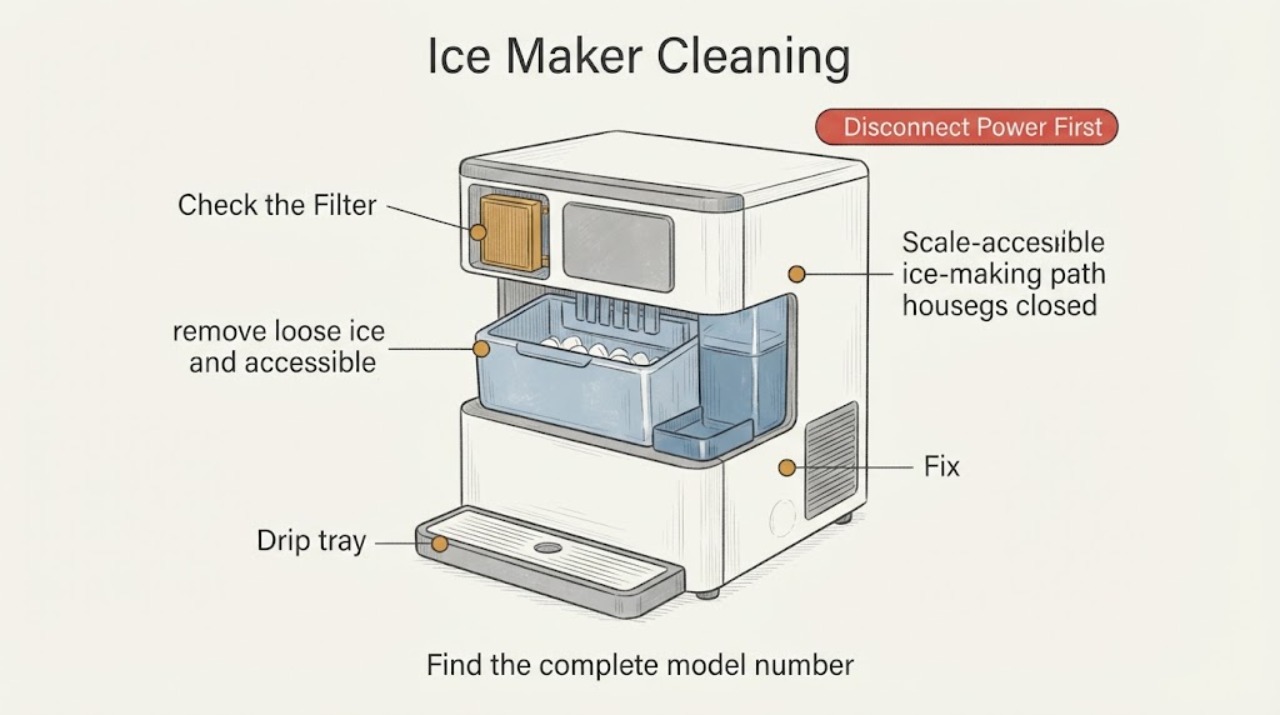
Work through in order
Diagnostic checks
Use only checks that match the exact appliance or system and its official guide.
-
Check 1
Find the complete model number and classify the appliance as a refrigerator icemaker, a freestanding undercounter unit, or a GE Profile Opal countertop unit; for an Opal, note whether the front has a large round button.
Expected result: The label identifies a refrigerator, a ZDIS15/UNC15/UCC15-type standalone unit, an Opal with a round button, or an Opal without a round button; or the label and family cannot be confirmed.
Next step: Use only the matching branch below and the exact Owner's Manual. If the family cannot be confirmed, do not start a chemical cleaning cycle; use only safe external wiping and obtain the model information or service.
Stop if: If the unit cannot be safely identified, stop before adding cleaner, bleach, vinegar or water to an internal path.
Why this matters
Why: GE's cleaning chemistry, controls and drain procedure are family-specific, and its standalone guidance explicitly excludes refrigerator icemakers.
-
Check 2
Before model-approved cleaning, remove loose ice and accessible water, turn the unit off and unplug it when the matching GE procedure calls for that step; keep the plug, cord and floor dry.
Expected result: The unit is disconnected and dry, or there is standing water near the cord, a damaged cord, an electrical smell or another unsafe condition.
Next step: If the area is dry and the appliance is identified, continue only with the exact manual. If water reaches the electrical connection, the cord is damaged or an electrical odor is present, keep it unplugged and arrange service.
Stop if: If power cannot be safely isolated or the area cannot be kept dry, do not proceed with cleaning.
Why this matters
Why: GE's UCC/UNC maintenance page and both opened Opal procedures require power isolation before their cleaning work; wet or damaged electrical areas cannot be safely treated as routine cleaning.
-
Check 3
Clean only the accessible exterior, ice bin, drip tray, filter or gasket that the identified model's GE instructions cover; do not remove a panel, pry a component or enter the ice-making cabinet.
Expected result: The item is explicitly listed by the model guidance and can be removed without force, or it is stuck, cracked, leaking or not identified in the manual.
Next step: Use the matching soft-cloth, water or model-approved cleaning method, rinse where the manual says to rinse, and dry before reinstalling. Stop and request service for a stuck, cracked or leaking part.
Stop if: Do not force the part or substitute a generic cleaner; keep the unit out of service until the model manual or a technician confirms the method.
Why this matters
Why: GE gives surface and removable-part instructions for Opal models and a baking-soda-and-water option for refrigerator, freezer and standalone-icemaker interiors or gaskets, but the exact parts and materials vary by family.
-
Check 4
For a confirmed standalone GE unit, open the exact Owner's Manual and use the model-listed ice-maker cleaner and scale-removal cycle; for ZDIS15, UNC15, UCC15 or a similar family, verify the exact suffix before choosing cleaner.
Expected result: The manual and GE support page agree on the family and cleaner, or the cleaner/model pairing is not confirmed.
Next step: Follow the manual's fill, circulation, drain and rinse directions exactly. If the model or cleaner pairing is uncertain, do not improvise a concentration or use a product chosen from another family.
Stop if: Leave the internal scale path untreated until the model-specific manual or qualified service confirms the method.
Why this matters
Why: GE lists different cleaner products for ZDIS15, UNC15 nugget and UNC15/UCC15 clear-ice families and says to follow the Owner's Manual rather than the cleaner bottle.
-
Check 5
For a confirmed Opal, use only the branch matching the front control: the round-button procedure or the no-round-button procedure; do not use the other branch's button sequence or drain assumptions.
Expected result: The unit has a large round front button, has no large round front button, or the controls do not match either opened GE page.
Next step: Follow the matching GE page and Owner's Manual, including the specified drain-hose handling and at least three fresh-water rinse cycles. If the controls do not match, stop and locate the exact manual before starting a cycle.
Stop if: Do not guess the cleaning mode from a similar-looking appliance.
Why this matters
Why: GE states that Opal cleaning instructions vary by front-button design. The opened procedures use different cleaning controls, while both require complete draining and repeated fresh-water rinsing.
-
Check 6
After cleaning, confirm that all drains, plugs, filters, bins and trays are restored exactly as the model manual shows, then check for chemical odor, leaks and normal water containment before making ice for consumption.
Expected result: The unit is dry, drains are closed, no chemical odor remains and the first ice cycle is normal; or a leak, residue, odor or abnormal operation remains.
Next step: Discard any ice or water that may contain cleaner, repeat only the exact documented rinse if permitted, and arrange service if odor, leak or abnormal operation persists. Do not open the cabinet or diagnose a pump, valve or sealed system from cleaning symptoms.
Stop if: If the unit cannot be made dry and free of cleaner residue without disassembly, keep it unplugged and call service.
Why this matters
Why: GE's Opal procedures require repeated fresh-water rinsing and replacement of drain tubes or plugs. Persistent residue, leaking or abnormal operation means the cleaning did not safely resolve the condition.
Use your observations
Decision map
Find the observation that best matches what you see, then follow the next safe action.
-
PATH 01Next step
What you see
The appliance is a refrigerator icemaker rather than a freestanding or Opal unit.
Do this next
Use the refrigerator model's Owner's Manual for the ice-bin and icemaker cleaning procedure; use only the documented surface-care method and do not pour standalone or Opal cleaning mixtures into it.
Why this path and its safety boundary
Why it matters: GE says the standalone mineral and cleaner guidance does not apply to refrigerator icemakers.
-
PATH 02Next step
What you see
The appliance is a confirmed standalone ZDIS15, UNC15 or UCC15-family unit and the GE manual identifies the cleaner and cycle.
Do this next
Follow the exact manual for the verified model and cleaner, including its drain and rinse steps; do not substitute an Opal procedure.
Why this path and its safety boundary
Why it matters: The standalone cleaner and scale-removal path is model-specific, and GE warns that the bottle directions do not replace the Owner's Manual.
-
PATH 03Next step
What you see
The appliance is a confirmed Opal with a large round front button.
Do this next
Use the round-button GE procedure and its Owner's Manual, drain completely and run the specified fresh-water rinses before returning to ice mode.
Why this path and its safety boundary
Why it matters: GE provides a round-button cleaning branch with its own clean control, rear drain hoses and rinse sequence.
-
PATH 04Next step
What you see
The appliance is a confirmed Opal without a large round front button.
Do this next
Use the no-round-button GE procedure and exact Owner's Manual; do not copy the round-button sequence.
Why this path and its safety boundary
Why it matters: GE provides a separate no-round-button branch with a different cleaning control and filter/model scope.
-
PATH 05Next step
What you see
The model is unknown, the controls do not match the opened family pages, or a leak, damaged cord, electrical odor, persistent chemical residue or abnormal ice production remains.
Do this next
Keep the unit unplugged if there is an electrical or water hazard, do not open the cabinet, and provide the full model and symptom to qualified GE appliance service.
Why this path and its safety boundary
Why it matters: The available official evidence cannot select a safe cleaning recipe or establish an internal component diagnosis for that appliance.
Helpful context
Understand the symptom
Identify the ice-maker family first
The phrase GE ice maker can refer to a refrigerator icemaker, a freestanding undercounter unit, or a GE Profile Opal countertop unit. GE's standalone page explicitly says its mineral and cleaner guidance does not apply to refrigerator icemakers. Record the complete model from the rating label and compare the controls and reservoir with that model's Owner's Manual before choosing a chemical, cleaning mode or drain procedure.
Use the matching cleaning method
Standalone GE families use model-specific cleaner and manual instructions. UCC15NJII and UNC15NJII have a Time To Clean indicator and a model-specific scale-removal procedure. Opal models have separate instructions based on whether the front has a large round button. These are documented branches, not interchangeable recipes; do not copy an Opal bleach, vinegar or drain-hose procedure to a refrigerator or unknown model.
Rinse and stop at the safety boundary
After any model-approved internal cleaning, drain and rinse exactly as the matching GE procedure requires. The opened Opal procedures call for at least three fresh-water rinse cycles. For an interior or gasket on a refrigerator, freezer or standalone icemaker, GE recommends warm water and baking soda and warns against bleach, ammonia, detergent and petroleum distillates on the plastics. A leak, electrical odor, damaged cord, chemical smell after rinsing or a need to open the cabinet is a service condition.
When checks do not resolve it
Need a professional?
Arrange model-specific GE appliance service when the family or model cannot be confirmed, the cleaning controls do not match the manual, a part is stuck or cracked, water reaches electrical connections, a cord is damaged, chemical odor remains after the documented rinses, the unit leaks, or cleaning does not resolve abnormal operation. Do not open the cabinet, bypass a water or ice safety, alter wiring, or diagnose a pump, valve or sealed system from the cleaning symptom alone.
Safety scope: Do not use an unidentified chemical mixture, pour standalone or Opal cleaner into a refrigerator icemaker, open the cabinet, remove service panels, alter wiring or continue operating with a leak, damaged cord, electrical odor or persistent chemical residue. Unplug and keep the area dry when the matching GE procedure requires it.
Common questions
FAQ
Can I use the GE Opal cleaning recipe on any GE ice maker?
No. GE's Opal pages are limited to Opal models and split by the large round front-button design. GE also says the freestanding cleaner guidance does not apply to refrigerator icemakers. Identify the exact model and use its Owner's Manual before adding cleaner or starting a cycle.
Can I follow the instructions printed on the ice-maker cleaner bottle?
GE's standalone cleaner page says to follow the ice maker's Owner's Manual for the specific model and not the instructions on the cleaner bottle.
What if the ice maker still smells like cleaner after rinsing?
Do not serve the ice or keep adding chemicals. Use only the exact model procedure for additional fresh-water rinsing; if odor or residue persists, keep the unit out of service and arrange model-specific service.
Read the exact guide
Official sources
- Refrigerator, Freezer and Standalone Ice Maker - Care and Cleaning of Interior and GasketGE Appliances · Surface and gasket care only; it does not establish a chemical cleaning cycle for an ice-making system.
- Opal Ice Maker - Cleaning and Descaling (Models with a Round Button on the Front)GE Appliances · Only Opal units with a large round button on the front; the page states that other Opal models use different instructions.
- Ice Maker - Standalone Ice Maker NoiseGE Appliances · Freestanding/standalone GE-family ice makers; not refrigerator icemakers.
- GE Profile Opal Nugget Ice Maker - Cleaning and Descaling (Models with no Round Button on the Front)GE Appliances · Only Opal models without a large round front button; includes a separate control sequence, removable-part scope and rinse sequence.
- Ice Maker - Cleaning Models UCC15NJII & UNC15NJIIGE Appliances · Only UCC15NJII and UNC15NJII as titled; used for the model-specific boundary, power isolation and manual-directed scale cleaning, not as a generic panel-removal instruction.
- Ice Maker - How to Use the CleanerGE Appliances · GE standalone ice makers; the page names ZDIS15, UNC15 and UNC15 clear-ice variants and does not apply its method to refrigerator icemakers.
Community feedback
Share a repair observation
Share a plain-text repair observation. Accepted observations are published automatically; this page may take a moment to update.