
On this page
Start here
Quick answer
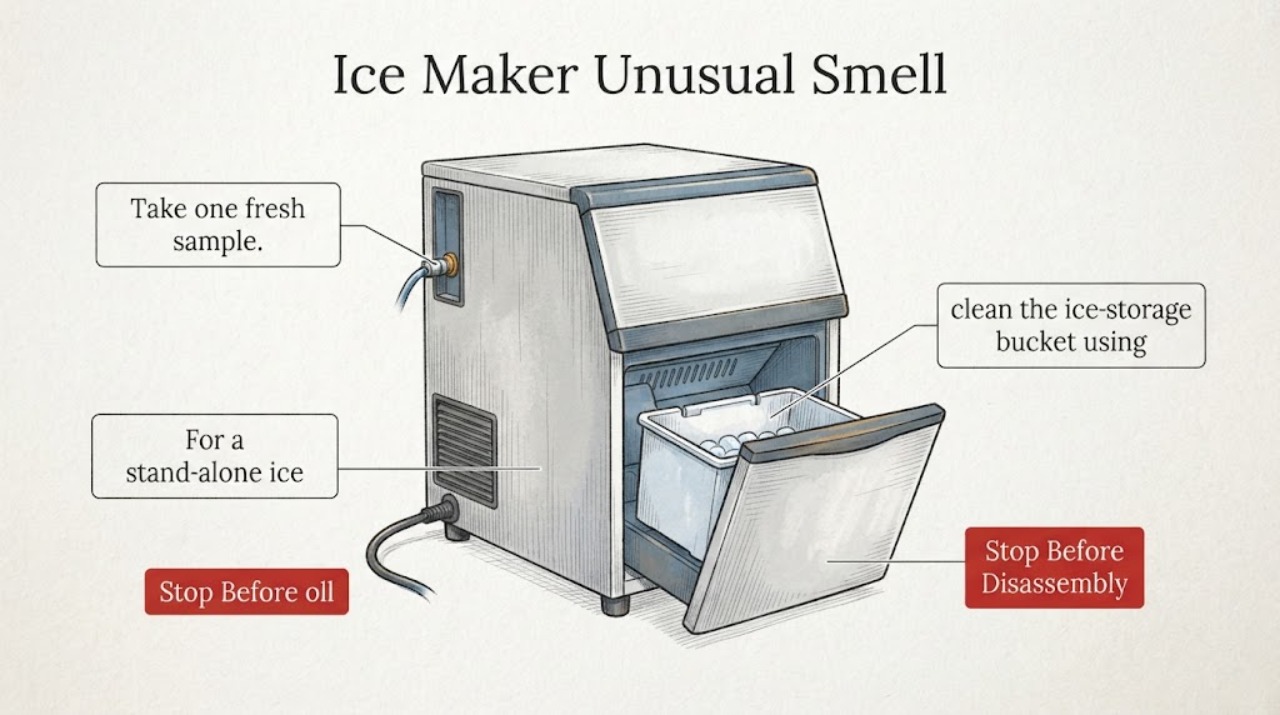
First determine whether the odor is in the ice, the storage bin, or the ice-maker appliance itself. GE's odor guidance is specifically for a stand-alone ice maker: discard the ice, remove any food or beverage stored in the bin, wash the storage bucket with mild dish soap and water, rinse it well, and consider incoming-water quality or minerals. Do not apply that stand-alone procedure to a refrigerator icemaker without the refrigerator's exact manual. If the smell is burning, electrical, chemical, sewage-like, or returns after the model-approved cleaning, stop using the ice maker and arrange qualified GE appliance service; do not taste questionable ice or open the cabinet.
Work through in order
Diagnostic checks
Use only checks that match the exact appliance or system and its official guide.
-
Check 1
Take one fresh sample of ice only if it is safe to handle, and compare the smell of the ice, the empty storage bin, nearby food packaging and the exterior of the appliance without tasting it.
Expected result: The odor is present in the cubes or bin, or it is strongest from the appliance body, wiring area or surrounding cabinet.
Next step: Discard questionable ice. If the appliance itself smells hot, electrical or chemical, stop using it and arrange service; do not open the cabinet or run another harvest cycle to test it.
Why this matters
Why: An odor transferred into cubes can come from water, stored items or the bin. A burning, electrical or chemical smell from the appliance is outside GE's simple cube-odor guidance and needs a safety response.
-
Check 2
For a stand-alone GE ice maker when the smell is in the ice or storage bin, remove and discard the stored ice and remove any food or beverage that was placed in the bin.
Expected result: The smell decreases after old ice and stored items are removed, or it remains with an empty bin.
Next step: Continue with the bucket-cleaning and water-quality checks only for a stand-alone unit. If the odor remains or the unit is a refrigerator icemaker, identify the exact manual before taking further steps.
Why this matters
Why: GE says stored food or beverages can transfer odors or tastes to ice. A persistent smell after the bin is empty is not proof of a failed component; water quality or a model-specific cleaning issue remains possible.
-
Check 3
With the stand-alone ice maker stopped, clean the ice-storage bucket using mild dish soap and water, rinse it well, dry it, and discard the first questionable ice rather than returning it to drinks. Do not substitute bleach, vinegar, descaler or a cleaner bottle's instructions unless the exact owner manual authorizes it.
Expected result: The bin is visibly dirty or the smell improves after cleaning, or the smell returns with a clean bin.
Next step: Follow the exact owner manual for any machine-clean or descaling cycle. Do not pour chemicals into an unidentified ice maker or use a refrigerator procedure on a stand-alone model.
Why this matters
Why: GE specifically recommends mild dish soap and water for the storage bucket. Improvement points to the bin or stored ice as a contributor; recurrence means the water source, model-specific cleaning procedure or another appliance condition still needs review.
-
Check 4
Check the incoming water context and identify the appliance: note whether the home has hard or mineral-heavy water, whether the ice maker is stand-alone or built into a refrigerator, and record the complete model number before changing a filter or water treatment.
Expected result: The water is known to be hard or the appliance type/model is still unknown, or the odor is unchanged despite clean ice and bin.
Next step: Use only the exact model's manual for filter replacement, water treatment and machine-clean instructions. If the model cannot be identified or the smell persists, request GE-qualified service and provide the model, odor description and cleaning history.
Why this matters
Why: GE says naturally occurring minerals and water quality can affect ice taste and smell, but its stand-alone article does not establish a universal filter, softener, cleaner, or part for every GE ice maker.
Use your observations
Decision map
Find the observation that best matches what you see, then follow the next safe action.
-
PATH 01Next step
What you see
The smell is limited to old ice or the storage bucket and improves after the ice and stored items are removed and the bucket is washed.
Do this next
Follow the exact owner manual for the next clean cycle and discard questionable ice until the smell is gone; keep food and beverages out of the ice bin.
Why this path and its safety boundary
Why it matters: The evidence is consistent with transferred odor or a dirty bin, not a confirmed internal failure.
-
PATH 02Next step
What you see
The appliance is a stand-alone ice maker, the bin is clean, and the smell returns in newly made ice.
Do this next
Check hard-water context and use only the exact owner manual's approved filter, cleaning or water-treatment guidance. Escalate if the smell persists.
Why this path and its safety boundary
Why it matters: Water quality or a model-specific cleaning/water-path issue remains possible; GE's general page does not identify a particular failed component.
-
PATH 03Next step
What you see
The smell is burning, electrical, chemical or otherwise comes from the appliance rather than the ice, or it is accompanied by smoke, heat, leaking or abnormal noise.
Do this next
Stop using the ice maker, keep people from consuming the ice, disconnect power only if it can be done safely without touching damaged wiring, and arrange qualified GE appliance service. Do not open the cabinet or repeat the cycle.
Why this path and its safety boundary
Why it matters: This is outside the simple ice-cube odor branch and may present an appliance or food-safety risk.
Helpful context
Understand the symptom
Separate an ice odor from an appliance odor
A stale smell in stored ice is a different question from a burning, chemical, sewage-like or mold-like odor coming from the appliance. GE's opened guidance addresses odor or bad taste in cubes from a stand-alone ice maker and does not diagnose every smell from an ice-maker cabinet. Identify the affected material before choosing a cleaning step, and keep questionable ice out of drinks or food.
The stand-alone and refrigerator branches are different
GE's odor article expressly says it applies to a stand-alone ice maker, not an icemaker inside a refrigerator. A refrigerator model may have a filter, bin, water path and cleaning instructions that differ from a stand-alone unit. Confirm the product type and full model number before using a cleaner, changing a filter or following an internal access procedure.
When checks do not resolve it
Need a professional?
Arrange qualified GE appliance service when the smell comes from the appliance body, electrical area or wiring; when there is smoke, abnormal heat, leaking or unusual noise; when the odor persists after the exact manual's cleaning procedure; or when the product type and model cannot be identified well enough to select a safe procedure. Do not taste suspect ice, open the cabinet, or use an unapproved chemical cleaner.
Common questions
FAQ
Why does my GE ice taste or smell bad?
For a stand-alone GE ice maker, GE lists water quality and minerals, food or beverages stored in the bin, and a dirty storage bucket as checks. Discard the ice, remove stored items, wash the bucket with mild dish soap and water, and rinse it well. A refrigerator icemaker needs its exact model guidance because GE's stand-alone article does not apply to refrigerator icemakers.
Can I use the ice-maker cleaner bottle instructions for any GE model?
No. GE says to follow the owner manual for the specific ice-maker model when cleaning and not the cleaner bottle's instructions. Do not infer a cleaner or dosage from another GE model.
What if the smell comes from the ice-maker appliance itself?
Stop using it if the odor is burning, electrical, chemical or accompanied by smoke, heat, leaking or unusual noise. Keep questionable ice out of food and contact qualified GE appliance service rather than opening the cabinet or repeating cycles.
Read the exact guide
Official sources
- Appliance Repair Service and SupportGE Appliances · GE's official service page for major appliances and ice-maker support; it supports escalation when safe user-level cleaning does not resolve an appliance odor or safety concern.
- Ice Maker - How to Use the CleanerGE Appliances · GE guidance for specified stand-alone ice-maker families; it requires following the exact owner manual and does not establish a universal cleaner or dosage for an unspecified GE ice maker.
- Ice Maker - Cubes Odor or Bad TasteGE Appliances · GE explicitly scopes this guidance to a stand-alone ice maker, covering water quality, stored food or beverages and cleaning the storage bucket; it does not apply to a refrigerator icemaker.
- FAQs | IcemakersGE Appliances · GE's official icemaker FAQ index confirms a dedicated bad-odor/bad-taste support path and distinguishes icemaker support from other product lines; it does not diagnose an unspecified model.
Community feedback
Share a repair observation
Share a plain-text repair observation. Accepted observations are published automatically; this page may take a moment to update.