
On this page
Start here
Quick answer
Do not try to fix a burnt thermal protector in an unidentified GE microwave by replacing the disc, connector or wire and testing it. Stop using the oven, isolate power from a dry safe position, and keep the enclosure closed. Photograph only the model label and any external plug, cord, outlet or cavity evidence without opening the case. GE explicitly gives no DIY microwave repair advice because the high-voltage capacitor can remain charged after unplugging; arrange qualified GE or appliance service and report the burnt protector, odor, smoke, sparks, breaker behavior and whether the microwave still heated before it was isolated.
Before you begin
Safety first
- Keep the microwave disconnected. Do not open the enclosure, discharge a capacitor, bypass a thermal protector, replace internal connectors, perform live measurements or run a test load. Use qualified GE/appliance service and a qualified electrician for damaged supply wiring.
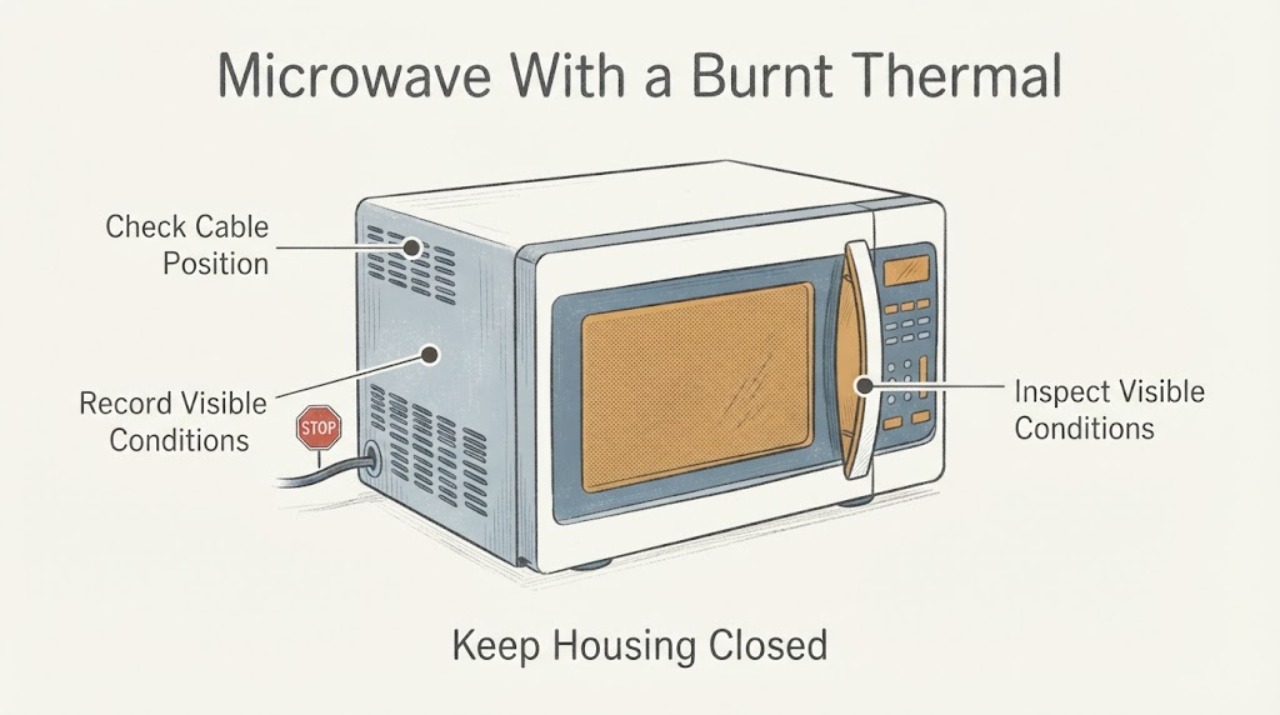
Work through in order
Diagnostic checks
Use only checks that match the exact appliance or system and its official guide.
-
Check 1
Stop the microwave immediately and isolate its power from a dry, safe position: unplug a reachable countertop unit without touching a damaged plug/cord, or switch off the appropriate breaker for a hardwired or inaccessible unit. Do not open the enclosure or try another cook cycle.
Expected result: There is active smoke/flame, a strong electrical or chemical odor, visible arcing, a hot or scorched plug/outlet, or no immediate external danger after power is isolated.
Next step: For active fire or smoke, leave the area and use local emergency procedures. Otherwise keep the microwave disconnected and arrange qualified appliance/electrical service; do not restore power for a test.
Why this matters
Why: Smoke, burning odor, arcing and scorching are safety events. GE directs stopping the microwave for a non-food electrical odor and for arcing or burns; a quiet unit after isolation is not proof that the internal damage is safe.
-
Check 2
Without removing any cover, record the model and serial label, installation type, where the smell or smoke appeared, whether the outlet/cord/cabinet shows external damage, and whether the appliance previously ran, lost heat, tripped a breaker or made sparks.
Expected result: The label is readable and the evidence is external, or the label/evidence is inaccessible without opening the enclosure.
Next step: Photograph the label and external damage for service. If obtaining the label would require opening the cabinet or touching damaged wiring, stop and let the technician identify the appliance.
Why this matters
Why: The model and prior symptom help a technician locate the correct service documentation; an inaccessible label or an internal-only observation cannot safely establish a protector rating or replacement part.
-
Check 3
Inspect the cooking cavity only with the door open and power isolated. Look for arcing marks, peeling/burned paint, a damaged waveguide cover or food/metal residue; do not scrub through damaged coating and do not energize the oven to reproduce a spark.
Expected result: There are cavity burns/arcing marks or the cavity is visibly intact and the reported burn was internal.
Next step: Keep the unit out of service and provide the observation to qualified service. Do not substitute a cover, paint, protector or connector based on a generic online part listing.
Why this matters
Why: GE says arcing or burns in the cavity are not normal and require stopping use. An intact cavity does not clear an internal burnt protector or high-voltage fault.
-
Check 4
Check the external receptacle and power cord only from a dry position for looseness, heat damage, discoloration or a breaker that has tripped. Do not probe the outlet, wiggle the cord under power, or touch exposed conductors.
Expected result: The outlet/cord is scorched or loose, the breaker trips, or external power appears normal while the internal protector was reported burnt.
Next step: Leave power isolated; use a qualified electrician for receptacle/cord damage and authorized appliance service for the microwave. Do not reconnect it to another outlet.
Why this matters
Why: External supply damage needs electrical attention, while a normal-looking outlet does not rule out the internal high-voltage hazard that GE warns about.
-
Check 5
Give the service provider the model/serial label, photographs taken without opening the case, the original odor/smoke/spark description, breaker behavior and any cavity marks. Ask for diagnosis of the complete safety and high-voltage system rather than a thermal-protector-only replacement.
Expected result: The service provider can verify the model documentation and inspect the complete appliance, or the only proposed repair is to substitute a protector/connector without finding the cause.
Next step: Approve only qualified service that follows the exact model documentation; otherwise keep the microwave disconnected and replace it through an appropriate safe channel.
Why this matters
Why: GE says special equipment is generally needed for microwave diagnosis and routes unresolved no-heat problems to service. A protector replacement without model-specific verification and cause assessment is not supported.
Use your observations
Decision map
Find the observation that best matches what you see, then follow the next safe action.
-
PATH 01Next step
What you see
There is active smoke/flame, an electrical or chemical burning odor, arcing, or a scorched plug/outlet/cavity.
Do this next
Leave the area for active fire/smoke, isolate power only from a safe position and keep the microwave out of service. Arrange emergency or qualified electrical/appliance help as appropriate.
Why this path and its safety boundary
Why it matters: GE treats these as stop-use conditions, and the reported burnt protector adds evidence of an internal safety event rather than a routine maintenance task.
-
PATH 02Next step
What you see
External power and cavity look undamaged, but the internal thermal protector or wire is visibly burnt from a prior opening.
Do this next
Do not reassemble and test, bypass the protector or replace a connector by guesswork. Keep power isolated and have qualified service identify the exact model-specific failure path.
Why this path and its safety boundary
Why it matters: The internal finding remains outside safe user diagnosis; GE warns that the capacitor can retain high voltage after unplugging and does not provide DIY repair advice.
-
PATH 03Next step
What you see
The microwave had stopped heating, lost power, tripped a breaker or made abnormal sounds before the burn was found.
Do this next
Give the complete symptom history to qualified service and do not perform a powered test load. GE recommends service when basic external checks do not resolve a microwave problem.
Why this path and its safety boundary
Why it matters: Those outcomes can involve multiple microwave components; the reported protector is not enough to identify the cause or prove that a replacement alone will be safe.
-
PATH 04Next step
What you see
There is no model label available without opening the cabinet, or the proposed fix relies on a generic protector rating, connector size or online part listing.
Do this next
Classify the part identity as unresolved for the user, keep the unit disconnected and let a qualified technician identify the model and correct service procedure.
Why this path and its safety boundary
Why it matters: The repair scope and component compatibility are unresolved; the GE support boundary does not support a model-agnostic internal repair.
Helpful context
Understand the symptom
A burnt protector is a stop condition, not a part number
The topic names a thermal protector, but GE microwave designs vary and the report does not establish the exact model, protector rating, wiring or root cause. A protector or its terminal may be damaged by an overheating event, a connection problem or another fault, but the public GE sources do not authorize choosing a substitute or inferring the failed component from a photograph. Treat the visible burn as evidence for a service technician rather than as permission to continue testing.
Isolate power without entering the microwave
GE says a microwave can retain high voltage in its internal capacitor after unplugging and that it provides no do-it-yourself repair advice. If the microwave is countertop-mounted, disconnect the plug only from a dry safe position; if it is hardwired or the outlet/cord is damaged, use the breaker or qualified electrical help rather than touching the wet, scorched or exposed area. Do not remove the cover, touch internal terminals or attempt capacitor discharge.
Keep external observations separate from an internal diagnosis
After power is isolated, inspect only from outside for a burnt plug, cord, outlet, cabinet or cavity damage, and record what happened before shutdown. GE says a non-food electrical or chemical burning smell requires stopping the microwave; arcing or burns in the cavity also require stopping use. These observations help service triage, but they do not identify whether the protector, connector, magnetron, fan, control or another high-voltage part caused the event.
When checks do not resolve it
Need a professional?
Safety scope: Keep the microwave disconnected. Do not open the enclosure, discharge a capacitor, bypass a thermal protector, replace internal connectors, perform live measurements or run a test load. Use qualified GE/appliance service and a qualified electrician for damaged supply wiring.
Have this ready
- Provide the model/serial label if visible externally, installation type, photographs taken without opening the enclosure, odor/smoke/spark history, cavity marks, breaker behavior and whether the oven previously ran or heated.
Common questions
FAQ
Can I replace the burnt thermal protector and connector myself?
Do not do that on the basis of this report. GE says it offers no DIY microwave repair advice because the internal high-voltage capacitor can retain a dangerous charge after unplugging and special equipment is generally needed. The correct protector, connector and cause require model-specific qualified service.
Is it safe to plug the microwave in briefly after replacing the protector?
No. A burnt protector is not cleared by a brief test, and GE says to stop for a non-food electrical or chemical burning smell or for arcing/burns. Keep the unit disconnected and arrange qualified inspection instead of running a test load.
What if the microwave still powers on?
Powering on does not prove the internal safety system is sound. Record the prior odor, heat, sparks, breaker behavior and any external cavity marks without opening the case, then keep it out of service until qualified service checks the exact model and complete system.
Could the burn be only a food or cavity stain?
GE distinguishes ordinary food staining from arcing or burns in the cavity. If you see arcing or burned paint, stop using the microwave. A burnt internal protector or wire is a separate internal safety concern and cannot be treated as ordinary cavity discoloration.
Read the exact guide
Official sources
- Microwave - Runs But Does Not HeatGE Appliances · Opened GE’s official no-heat article. It states that many components can cause the symptom, gives no DIY microwave repair advice because the internal capacitor can retain high voltage after unplugging, and recommends service.
- Microwave - Staining or Browning Inside the CavityGE Appliances · Opened GE’s official cavity-staining article. It distinguishes food-related discoloration from arcing or burned cavity paint and directs stopping use for the latter; it does not support internal component repair.
- Microwave - OdorsGE Appliances · Opened GE’s official microwave odor article. It distinguishes food/new-appliance smells from electrical or chemical burning odors and directs stopping the microwave and unplugging only when safe for visible plug/cord/outlet burning.
- GE Appliances Support Articles by Product CategoryGE Appliances · Opened GE’s official support directory and verified it routes microwave owners to GE microwave support articles and manuals/service resources. It is used for support routing, not for a thermal-protector diagnosis.
Community feedback
Share a repair observation
Share a plain-text repair observation. Accepted observations are published automatically; this page may take a moment to update.