
On this page
Start here
Quick answer
A GE JVM7195SK3SS that hums with its door closed before anyone starts a cycle should not be tested by running it. From a safe, dry position, stop using it and disconnect power if the sound could be accompanied by heating, a running turntable, smoke, sparks, odor, abnormal heat, or a breaker trip. GE documents that an over-the-range fan can start automatically from heat and that a slight transformer hum may be heard even when the microwave is not in use, but those explanations do not clear an unexplained buzz that begins on its own. Do not open the cabinet, defeat a door interlock, run a water or ice test, or repeatedly restore power. Confirm the complete rating-label model because the opened GE Owner Center page exposes the JVM7195SKSS family rather than the task's JVM7195SK3SS suffix, then give a qualified microwave technician the sound timing and safe external observations.
Before you begin
Safety first
- Owner checks stop at safe power isolation, exact model-label identification, external observation from a distance, and a cool visual inspection of accessible surfaces. Do not run the microwave to test unsolicited operation, place water or food inside for a heat test, open the cabinet, remove the door or interlock, test leakage, touch high-voltage parts, or bypass any safety switch.
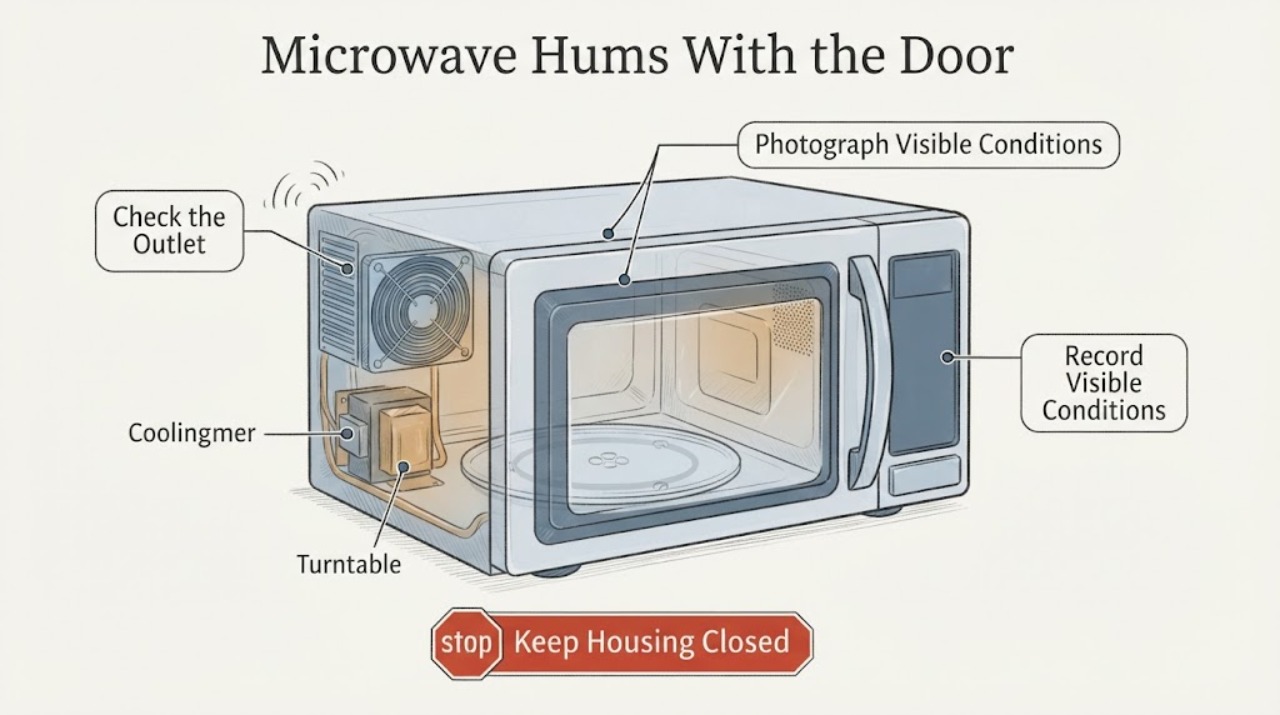
Work through in order
Diagnostic checks
Use only checks that match the exact appliance or system and its official guide.
-
Check 1
If the microwave is humming now, do not press Start, open the cabinet, or put a cup of water inside. From a safe, dry position, stop using it and disconnect the plug only if the plug and surrounding floor are dry and reachable without touching hot, damaged, wet, or arcing equipment. If the outlet is unsafe to reach, leave the area clear and have an electrician isolate the circuit.
Expected result: The sound is accompanied by a moving turntable, a cavity light, visible steam or heat, sparks, smoke, a burning/electrical odor, a hot cord or outlet, water near the appliance, or a breaker trip; or it is only an unexplained buzz with no visible operating sign.
Next step: Keep the unit out of service for any operating or safety sign and arrange qualified microwave/electrical service. If the unit is safely isolated and there is no hazard, continue only with stopped, external identification and observation.
Stop if: Leave the microwave off for any possible heating, turntable motion with no command, smoke, sparks, active arcing, burning odor, abnormal heat, water near electrical parts, damaged cord/outlet, or repeated breaker operation.
Why this matters
Why: A turntable, heat, odor, sparks, or electrical symptom makes unintended operation or an internal fault possible. A quiet external buzz alone cannot prove that microwave energy is absent, so it should not be cleared by a user-run test.
-
Check 2
Without removing panels or touching the wiring, read and photograph the complete rating-label identity, including JVM7195SK3SS if that is what is printed, serial/market information, and whether the unit is installed over a range. Compare it with the opened GE Owner Center entry, which is labeled JVM7195SKSS, and use the exact suffix when requesting the manual or service.
Expected result: The label confirms JVM7195SK3SS, shows a different suffix, or is unreadable; the microwave is countertop, over-the-range, or another installation type.
Next step: Give the complete label information and installation type to GE or a qualified microwave technician. If the suffix cannot be confirmed, keep the article's guidance at safe symptom level and do not use another model's diagnostic sequence.
Stop if: Do not remove the outer cover, trim, door interlock, vent housing, or control panel to find the model or investigate the buzz.
Why this matters
Why: The opened official support page confirms a closely named JVM7195SKSS family but not the task suffix. Installation type also changes whether automatic vent-fan behavior is plausible. A near-match is not permission to copy controls, code meanings, or parts.
-
Check 3
With the unit isolated, record what was visible immediately before disconnection and where the sound seemed to come from: external vent area, control-panel area, underside, cavity, or turntable. Note whether the display, cavity light, fan, vent airflow, or tray was active without a user command; do not reconnect it merely to make the observation clearer.
Expected result: Only an external fan-like sound was noticed, a low steady transformer-like hum was heard with no other sign, or any light, airflow, tray motion, display change, heating, or unexplained cycling was present.
Next step: If the sound was clearly limited to a documented fan/transformer context and disappears after safe isolation/cooling, give the observation to service and verify the exact manual before use. For any active or uncertain operation, leave it disconnected and request service.
Stop if: Do not re-energize the microwave to distinguish fan from magnetron, and do not use the GE one-minute heating test when the complaint is unsolicited operation.
Why this matters
Why: GE documents automatic over-the-range fan behavior and a slight transformer hum as possible non-cooking sounds. Any active tray, light, heating, or unexplained cycling is a different branch and cannot be classified as a normal fan or transformer sound from listening alone.
-
Check 4
After the appliance is off and cool, inspect only visible, user-accessible surfaces: door screen and frame, latch area, cavity floor and walls, glass tray, cord, plug, and outlet. Look for scorch marks, a hole or damaged shielding, cracked or misaligned door parts, moisture, melted plastic, or a hot/discolored connection. Do not press the door, remove trim, scrape the cavity, or test the interlocks or microwave leakage.
Expected result: The visible surfaces are intact and dry, or there is scorch damage, cavity/door damage, moisture, exposed metal, melted plastic, a damaged cord/outlet, or evidence of arcing.
Next step: Keep the microwave off and provide photographs and the exact model to qualified appliance service; use a qualified electrician for a damaged household outlet, cord, or repeated breaker. Do not attempt a shielding, latch, or interlock repair.
Stop if: Stop immediately for a damaged door or cavity, active arc marks, smoke, odor, moisture near electrical parts, or a hot/damaged plug or outlet.
Why this matters
Why: An intact exterior does not prove the high-voltage or interlock system is safe, but visible damage or moisture rules out a listening-only diagnosis. GE identifies door interlocks and shielding as safety components and directs service for abnormal electrical or mechanical sounds.
-
Check 5
Prepare a service handoff instead of a live test: write down when the buzz starts, whether the door was opened or closed, whether the cooktop was recently hot, how long the sound persists after safe power isolation, whether the display or tray moved, and any prior installation or repair work. Include the complete model label and photographs of visible damage or the outlet.
Expected result: The sound stops after isolation and does not return while disconnected, or the event recurs after power is restored, is tied to door closure, or is accompanied by operation, heat, odor, sparks, or breaker action.
Next step: Request model-specific qualified microwave service and supply the timeline without asking for an interlock bypass or high-voltage test. If a household power issue is suspected, have a qualified electrician assess the circuit separately.
Stop if: Do not repeatedly reset, reconnect, or run the microwave to reproduce the buzz, and do not order a fan, transformer, switch, or control board solely from this symptom.
Why this matters
Why: A symptom that disappears only when power is removed remains unresolved; recurrence or any operating sign raises the need for an appliance technician to assess the fan, controls, transformer, motor, and interlock system. The observation does not identify a replaceable part by itself.
Use your observations
Decision map
Find the observation that best matches what you see, then follow the next safe action.
-
PATH 01Next step
What you see
The microwave was not commanded to cook, the door was closed, and there was no observed tray motion or heating; the sound seemed like a fan near an over-the-range vent and followed a hot cooktop or recent use.
Do this next
Keep the unit off until it has cooled, record the installation and exact suffix, and use the exact manual or qualified service to confirm the fan behavior. Arrange service if the sound is harsh, scraping, persistent after cooling, or accompanied by a light, tray movement, heat, or odor.
Why this path and its safety boundary
Why it matters: GE's automatic-fan guidance makes heat-triggered vent operation plausible, and its normal-characteristics guidance also recognizes fan and transformer sounds. This is a possible operating explanation, not a model-specific clearance for JVM7195SK3SS.
-
PATH 02Next step
What you see
The turntable, cavity light, display, or heating appeared active with the door closed and no user command, or the source cannot be separated from a possible operating sound.
Do this next
Leave it disconnected from a safe, dry position and request qualified microwave service. Do not open the cabinet, bypass the door interlock, run a cup-of-water test, or repeatedly reconnect power.
Why this path and its safety boundary
Why it matters: This pattern cannot be safely treated as a normal hum. GE's own starting-on-its-own guidance separates fan-only behavior from possible heating, but a user should not start an unsolicited-operation microwave to make that distinction.
-
PATH 03Next step
What you see
The display or cavity is dark, no tray or light was observed, and the isolated unit has no visible damage, but the buzz was new, harsh, intermittent, or present before a user started a cycle.
Do this next
Do not use the sound alone to select a transformer, fan, switch, or control board. Provide the timeline and exact model to qualified service, and use an electrician if the cord, outlet, or breaker also shows a problem.
Why this path and its safety boundary
Why it matters: A transformer-like standby hum is documented by GE, but an unexplained or changing buzz is not proven normal by that general description. The absence of visible operation does not test the internal high-voltage or control system.
-
PATH 04Safety boundary
What you see
There are sparks, scorch marks, smoke, burning or electrical odor, abnormal heat, a damaged door/cavity, moisture near electrical parts, a hot connection, or a repeated breaker trip.
Do this next
Keep the microwave out of service and obtain qualified microwave or electrical help from a dry, safe position. Do not clean away evidence by scraping, continue cooking, or reset the breaker repeatedly.
Why this path and its safety boundary
Why it matters: This is a safety stop involving possible arcing, shielding/door damage, internal electrical fault, or household power fault. It is not a fan-noise troubleshooting case.
Safety stop: Leave the appliance isolated until the responsible qualified provider says it is safe to use.
Helpful context
Understand the symptom
The key fact here is not simply that the sound is a hum. It begins without a user selecting a cook cycle and with the door closed, so first decide whether the microwave is only making a fan or transformer sound or is actually entering an operating state. GE's public guidance says an over-the-range fan may start automatically when heat reaches the underside, and it notes that a slight transformer hum can sometimes be heard while the unit is not in use. Neither explanation authorizes a user to prove heating by starting the oven.
The public GE support page opened for this research identifies the JVM7195SKSS family and links its manual and service route, but it does not expose the task's full JVM7195SK3SS suffix. Treat that suffix difference as a real identity boundary: record the complete rating-label model and market before using any button sequence or installation-specific instruction.
When checks do not resolve it
Need a professional?
Request GE or qualified microwave service for an unexplained pre-start buzz, any possible heating or turntable motion without a command, a fan that remains abnormal after cooling, recurring noise, visible cavity/door damage, or any electrical symptom. Request electrical service for the household outlet, cord, plug, circuit, or breaker when those are implicated.
Safety scope: Owner checks stop at safe power isolation, exact model-label identification, external observation from a distance, and a cool visual inspection of accessible surfaces. Do not run the microwave to test unsolicited operation, place water or food inside for a heat test, open the cabinet, remove the door or interlock, test leakage, touch high-voltage parts, or bypass any safety switch.
Have this ready
- Provide the complete rating-label model and market, installation type, sound description and location, door state, whether the cooktop was hot, display/light/tray observations, duration, visible damage or moisture, and the exact time of any breaker or odor event.
Common questions
FAQ
Can a GE over-the-range microwave fan turn on by itself?
GE says an over-the-range automatic vent fan can start when heat from the cooktop reaches the underside, and it may continue until the area cools. That explanation is plausible only when the sound is fan-like and there is no evidence of heating, tray motion, odor, sparks, or other abnormal operation. Record the exact installation and model, and arrange service for a harsh or persistent sound.
Should I put a cup of water in the microwave to see whether it is heating?
Not for this complaint. GE publishes a heating check for some reports of starting on its own, but a JVM7195SK3SS that is already humming without a user command should not be intentionally run. Leave it isolated and have qualified service distinguish fan-only operation from unintended microwave operation.
Is a low hum with the microwave off always a bad transformer?
No. GE notes that a slight transformer hum can sometimes be heard while a microwave is not in use. A new, harsh, changing, or unexplained buzz still needs service because listening from outside cannot clear the high-voltage, control, fan, or interlock system, and the model suffix must be confirmed first.
Can I remove the door switch or outer cover to find the buzz?
No. GE describes the door's safety interlocks and shielding as part of containing microwave energy. Do not remove the cover or defeat an interlock; provide the exact model and safe observations to a qualified microwave technician.
Read the exact guide
Official sources
- Over-the Range Microwaves - Vent Fan Coming On When Plugged InGE Appliances · Supports a limited installation/plug-in fan explanation for applicable over-the-range models; it does not clear a unit that may be heating or operating a turntable without a command.
- Microwave - Normal Operational CharacteristicsGE Appliances · Supports separating a slight standby transformer hum and documented fan or cooking-cycle sounds from a new unsolicited buzz; it is general GE guidance rather than an exact JVM7195SK3SS service manual.
- User Manual & Care for JVM7195SKSS | GE AppliancesGE Appliances · The opened GE Owner Center identifies the JVM7195SKSS family and links its manual/service route. It does not expose the task's JVM7195SK3SS suffix, so the full rating-label suffix must be confirmed before applying model-specific controls or fitment.
- Microwave - Arcing or Making SoundsGE Appliances · Supports stopping for electrical/mechanical sounds, arcing, sparks, odor, or visible cavity damage; it is not used to diagnose a component in JVM7195SK3SS.
- Microwave - Automatic Fan FeatureGE Appliances · Supports a conditional fan-only explanation for an over-the-range installation; it does not prove that an unexplained buzz from JVM7195SK3SS is normal.
- Microwave - Door Loud, Hard To Close, Starts as Soon as the Door ClosesGE Appliances · Supports the possibility that an apparent start can be fan-only, but the article's repeated door-closing suggestion is not used as a test here because the assigned complaint involves unsolicited operation and a high-risk stop boundary.
- Microwave - Starting On Its OwnGE Appliances · Supports the fan-only versus possible-heating distinction and the service boundary. Its published heating test is not recommended for this unsolicited-operation task because the unit should not be intentionally run.
- Microwave - Door DesignGE Appliances · Supports the no-user-repair boundary for the door, shielding, and interlock system; it does not identify the cause of the task's buzz.
Community feedback
Share a repair observation
Share a plain-text repair observation. Accepted observations are published automatically; this page may take a moment to update.