
On this page
Start here
Quick answer
Stop using the GE microwave and disconnect power before cleaning. Wipe grease from the cavity, door surfaces, and controls with a mild, non-abrasive cleaner on a cloth; never use commercial oven cleaner, abrasives, bleach, ammonia, or sharp tools. If it is an over-the-range model, clean its accessible metal grease filter and replace a grease-filled charcoal filter only according to the exact model manual. Never operate the vent without its required filters. Smoke, arcing, a burning electrical or chemical odor, peeling or scorched cavity coating, or a grease fire is a stop-and-service condition; do not open the microwave cabinet or touch high-voltage parts. [GE microwave cleaning, GE grease-filter, GE microwave safety]
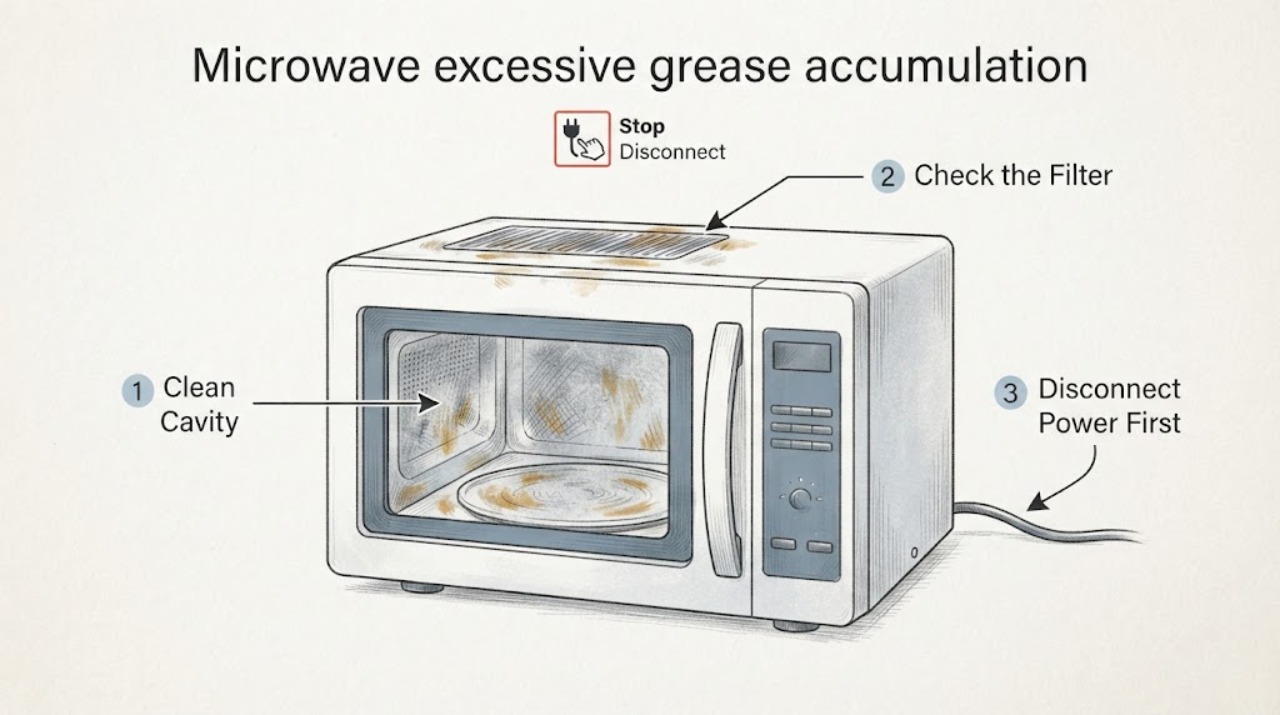
Work through in order
Diagnostic checks
Use only checks that match the exact appliance or system and its official guide.
-
Check 1
Stop cooking, let hot surfaces cool, and disconnect the microwave from power before wiping grease or removing an accessible filter; do not begin cleaning while smoke, flame, or active sparking is present.
Expected result: The appliance is cool and unpowered with grease visible, or there is still smoke, flame, sparking, or a strong electrical/chemical odor.
Next step: If any active hazard remains, keep the door closed when appropriate to the situation, keep clear, and use qualified/emergency help; do not open the cabinet or restore power for a test.
Why this matters
Why: GE requires unplugging before maintenance, while smoke, arcing, and non-food burning odors indicate a condition beyond ordinary cleaning.
-
Check 2
Wipe the cavity walls, floor, door surfaces, and grease splatters with a damp soft cloth or sponge and mild dishwashing liquid; remove residue without sharp tools or abrasive pads.
Expected result: Grease and food soil lift without exposing damaged coating, holes, peeling paint, or persistent scorch marks; or the cavity coating is damaged or cannot be safely cleaned.
Next step: Rinse the cloth and wipe away cleaner residue, then dry the cavity. If there is peeling, a hole, active sparking, or a burn mark that causes arcing, stop using the microwave and arrange service or replacement guidance.
Why this matters
Why: GE identifies mild non-abrasive cleaning as the normal cavity method. Sharp tools and commercial oven cleaners can damage surfaces, while arcing or cavity damage can make continued use unsafe.
-
Check 3
If this is an over-the-range model with a removable metal grease filter, remove it only by the visible tab or model-manual method and soak it in hot water with detergent; avoid ammonia products and let it dry fully before refitting.
Expected result: The reusable metal filter is greasy but intact and can be cleaned, or it is damaged, missing, or its removal does not match the GE instructions.
Next step: Refit the dry filter so it locks in place. If removal or filter type is uncertain, stop and consult the exact model manual; do not operate the hood without required filters.
Why this matters
Why: GE says metal grease filters collect cooking grease and provides a soak-and-dry method, but filter designs vary and the filter must be secured before the vent is used.
-
Check 4
For a recirculating over-the-range model, inspect the charcoal filter for heavy grease or discoloration and check vent draw only with the microwave's documented external method; do not wash a charcoal filter unless the exact manual says it is washable.
Expected result: The charcoal filter is visibly grease-filled or odors remain, or the vent does not draw as documented; alternatively the model vents outside and the duct installation needs model-specific review.
Next step: Use the exact model number to select a replacement or check duct installation. If the vent remains weak after the documented external checks, arrange service instead of opening the fan or microwave cabinet.
Why this matters
Why: GE says charcoal filters are model-specific and should be replaced when filled with grease, while a weak vent draw can indicate installation or service needs.
-
Check 5
Keep the microwave out of service if grease reappears with smoke, the vent filter is saturated, the cavity sparks, the coating peels or burns, or a non-food burning odor persists after cleaning.
Expected result: The symptom ends after safe cleaning and the cavity/filter remain intact, or it returns during ordinary use.
Next step: Leave the microwave disconnected and obtain qualified appliance service. Do not remove the outer cover, defeat the door interlock, discharge a capacitor, or touch the magnetron/high-voltage wiring.
Why this matters
Why: A recurring symptom can involve the vent system, cavity, door, control, or high-voltage section; grease appearance alone cannot identify a repairable internal part.
Use your observations
Decision map
Find the observation that best matches what you see, then follow the next safe action.
-
PATH 01Next step
What you see
Grease is limited to removable metal hood filters and the filter is intact.
Do this next
Clean and fully dry the metal filter using the exact GE filter method, then lock it back in place before using the vent.
Why this path and its safety boundary
Why it matters: This is a documented over-the-range maintenance condition rather than evidence of an internal microwave fault.
-
PATH 02Next step
What you see
A recirculating model has a charcoal filter that is shiny, grease-filled, or holding cooking odors.
Do this next
Confirm the model and replace it according to the owner manual; do not substitute an unverified filter or operate without required filters.
Why this path and its safety boundary
Why it matters: GE treats that charcoal filter as a model-specific replacement item, not as a washable metal grease filter.
-
PATH 03Next step
What you see
Grease is on the cavity or door but there is no arcing, peeling coating, smoke, or non-food burning odor.
Do this next
Wipe the cavity and door with a damp soft cloth and mild non-abrasive detergent, then dry and inspect before returning to service.
Why this path and its safety boundary
Why it matters: Normal user cleaning may be appropriate, provided the microwave is unplugged and the correct mild cleaner is used.
-
PATH 04Next step
What you see
There is flame, smoke, arcing, a hole or peeling/scorched cavity coating, or an electrical/chemical burning odor.
Do this next
Do not reopen the cabinet or retry the appliance. Keep it off, follow the appropriate emergency response for an active fire, and obtain qualified appliance service or replacement guidance.
Why this path and its safety boundary
Why it matters: The condition exceeds safe grease cleaning and may involve fire, shock, microwave-energy, or high-voltage hazards.
Helpful context
Understand the symptom
Separate cavity grease from hood-filter grease
Grease on the cooking cavity and grease in an over-the-range vent filter are different cleaning surfaces. GE's interior guidance uses a damp cloth or sponge with mild, non-abrasive cleaner. GE's over-the-range guidance covers reusable metal grease filters and, on recirculating models, a model-specific charcoal filter. A countertop microwave may not have either hood filter, so use the exact owner manual for the appliance's layout.
Do not turn a cleaning problem into a microwave repair
Grease, smoke, sparking, damaged paint, or an electrical odor can indicate a condition that should not be tested by running another cycle. Cleaning never includes removing the outer cover, reaching the waveguide or magnetron area, or replacing high-voltage parts. Leave those conditions to qualified service.
When checks do not resolve it
Need a professional?
Arrange qualified service if grease accumulation is accompanied by arcing, smoke, persistent non-food burning odor, cavity damage, a vent that does not draw after model-specific external checks, or a filter that cannot be identified or secured. A microwave that has been exposed to flame or has damaged cavity coating should not be tested by the user.
Common questions
FAQ
Can I use oven cleaner to remove heavy grease from a GE microwave?
No. GE says to use mild, non-abrasive cleaners and specifically says not to use commercial oven cleaners, abrasives, ammonia, or bleach-containing cleaners on the microwave.
Can I wash the grease filter?
A removable metal grease filter can be soaked in hot water and detergent and dried fully according to GE's filter guidance. A charcoal filter is model-specific and should be replaced when grease-filled rather than washed unless the exact manual says otherwise.
What should I do if the microwave sparks after cleaning?
Stop using it. GE treats arcing, a hole, peeling or scorched cavity coating, and non-food electrical odors as reasons to stop and obtain qualified service; do not open the cabinet or continue testing.
Read the exact guide
Official sources
- Over-the-Range Microwave - Charcoal Filter ReplacementGE Appliances · Model-specific charcoal-filter replacement triggers and access variants; not a universal part or procedure.
- GE Microwave Use and Care Guide — Exhaust FeatureGE Appliances · Scoped manual evidence for reusable grease-filter cleaning, required filter placement, and avoiding grease-fire conditions; not a universal model match.
- Microwave - Arcing or Making SoundsGE Appliances · GE external symptom guidance for sparking/arcing, food spills, metal, empty operation, and service when electrical/mechanical sounds persist.
- Microwave - Cleaning RecommendationsGE Appliances · General GE microwave cavity, door, and control cleaning; model manual controls variations.
- Microwave - OdorsGE Appliances · GE guidance distinguishing food odors from electrical/chemical burning odors and stopping the appliance when the latter occurs.
- Vent Hood - Cleaning Metal Grease FiltersGE Appliances · Common GE metal grease-filter removal, cleaning, drying, and refitting; consult the exact model manual if the filter differs.
- Over-the-Range Microwave - Oven Vent System DrawGE Appliances · External vent-draw observation and model-specific duct/charcoal-filter distinction; service boundary when installation is correct but draw remains weak.
- Microwave - Cavity Repair Needed Due to Arcing, Chipping, Peeling or ScorchingGE Appliances · GE guidance for cavity holes, peeling or flaking coating, and discontinuing use when damage affects safe operation.
- GE Over-the-Range Microwave Use and Care Guide — Exhaust FeatureGE Appliances · Scoped manual evidence for reusable metal grease filters and model-dependent charcoal recirculation; not a universal replacement-part claim.
Community feedback
Share a repair observation
Share a plain-text repair observation. Accepted observations are published automatically; this page may take a moment to update.