
On this page
Start here
Quick answer
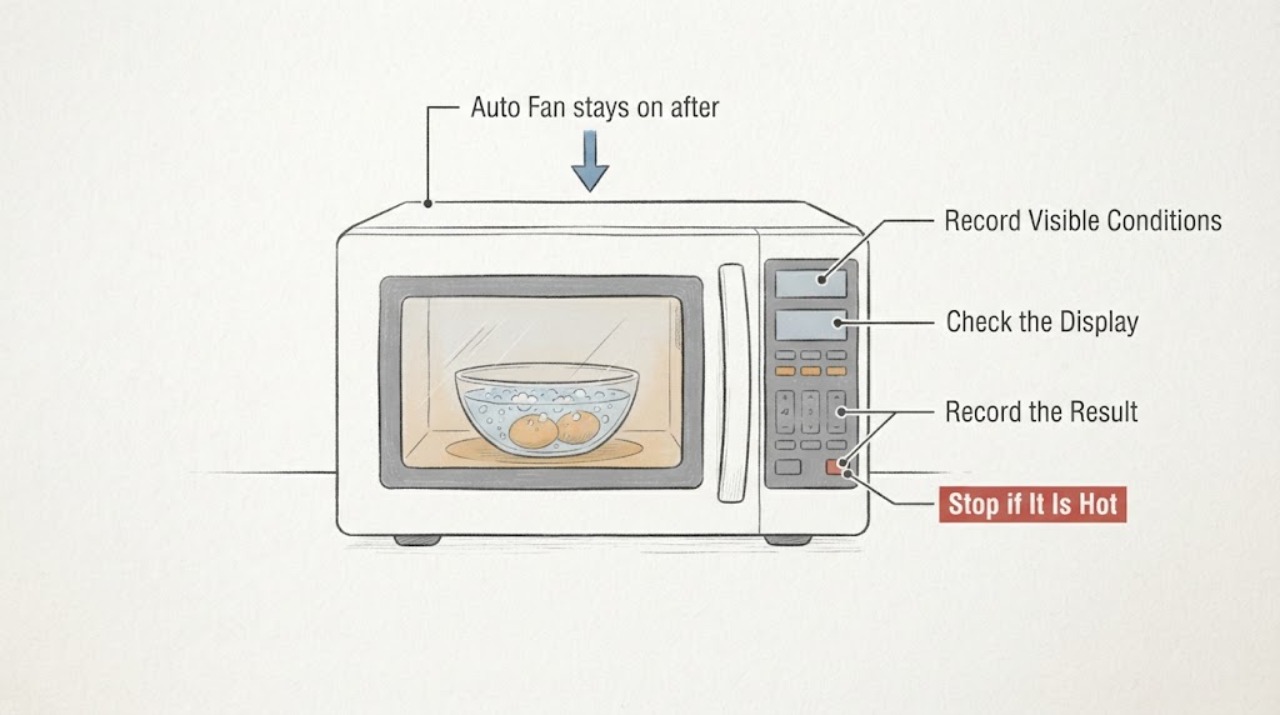
On the GE JVM7195SKSS over-the-range microwave, a low-speed fan that starts while eggs or other food are boiling on the cooktop is usually the model's Automatic Fan responding to rising cooktop heat. The Owner's Manual says the automatic fan may not turn off immediately and can remain on for 30 minutes or more after the cooktop and microwave controls are turned off. First distinguish that protective fan from the manually selected Vent Fan: the manual cycles the Vent Fan through its speeds and turns it off on the fifth press, while the automatic fan turns off only after the internal parts cool. Keep the vents clear and do not open the case or disable the fan. If it runs at an unexplained high speed long after all cooking has stopped, returns without cooktop heat, or there is smoke, a grease fire, arcing, or electrical damage, stop using the appliance and arrange qualified service.
Work through in order
Diagnostic checks
Use only checks that match the exact appliance or system and its official guide.
-
Check 1
Confirm the label reads JVM7195SKSS and record when the fan started, whether the cooktop was on, the fan speed you hear, whether the microwave had just been used, and whether the display shows any warning. Do this from a safe position without opening the case or repeatedly pressing controls.
Expected result: A low, steady fan that began while boiling eggs on the cooktop is different from a high fan that starts with no recent heat, changes erratically, or continues through a cold, unused period.
Next step: Continue to the manual-versus-automatic check. If the label does not match, use the correct manual instead of applying this model's timing.
Stop if: Stop for smoke, burning odor, sparks, arcing, a hot or damaged cord or outlet, a grease fire, or a damaged door or cabinet.
Why this matters
Why: The exact model is documented as an over-the-range microwave with an Automatic Fan that responds to heat rising from the cooktop; the timing and speed are more useful than the word continuous by itself.
-
Check 2
From the normal control panel, determine whether the Vent Fan was selected manually. When there is no active cooktop heat and the appliance is otherwise safe, press the documented Vent Fan control only as needed to identify its cycle: the JVM7195SKSS manual lists boost, high, medium, low, and a fifth press to turn the manual fan off. Do not open the case or try to interrupt an automatic fan by force.
Expected result: If the fan follows the documented speed cycle and turns off on the fifth press, it was a manual Vent Fan setting. If a low fan remains despite the manual off step after recent boiling, it is consistent with the Automatic Fan cooling function.
Next step: For a manual setting, leave the control off. For a low automatic fan after boiling, allow the cooling period in the next check rather than repeatedly pressing the button.
Stop if: Do not bypass, disconnect, obstruct, or reach through any opening toward the fan or internal wiring.
Why this matters
Why: Manual Vent Fan selection and heat-triggered Automatic Fan are different states; the latter may ignore the off control until the internal parts cool.
-
Check 3
Turn off the cooktop and microwave controls normally, keep all external openings clear, and allow the unit to cool without using the microwave or cooktop to reproduce the symptom. The exact manual says the Automatic Fan can remain on for 30 minutes or more after both sets of controls are off.
Expected result: The fan stops after the surrounding and internal parts cool, or it remains on well beyond the documented cooling behavior with no new heat source.
Next step: If it stops, return to normal use while keeping the vents clear. If it does not stop or recurs without cooktop heat, keep the microwave off and arrange qualified appliance service.
Stop if: Do not disconnect the internal fan, remove panels, or continue cooking solely to test how long it runs.
Why this matters
Why: Stopping after cooling supports normal heat protection; persistence in a cold, unused appliance is not explained by the documented boiling-heat trigger and does not identify a particular sensor, motor, or control part.
-
Check 4
With the appliance off and cool, look from outside for items, cookware, grease, or installation materials obstructing the visible ventilation openings or for heavy grease buildup beneath the microwave. Use appropriately sized cookware on the cooktop and avoid unnecessary high heat; do not move a mounted microwave or dismantle a filter or fan assembly to reach hidden parts.
Expected result: Clear openings and reasonable cookware use fit the manual's advice to minimize Automatic Fan operation; blocked openings, excessive heat, or heavy grease can increase the need for ventilation and fire precautions.
Next step: Correct only a safe, visible obstruction and let the appliance cool. Arrange service if the fan remains abnormal after clear airflow and no cooking heat.
Stop if: Do not cover vents, spray cleaner into openings, scrape wiring, or operate beneath a grease fire.
Why this matters
Why: External heat and airflow conditions can explain a fan that starts during boiling, but they do not prove an internal fan or temperature-control failure.
-
Check 5
Record whether the fan is low and steady or high and noisy, whether it starts with no cooktop use, whether it stops after the documented cooling period, and whether the microwave display and cooking functions otherwise behave normally. Do not run a no-load microwave test or repeatedly restart the appliance just to observe the fan.
Expected result: A low fan tied to recent cooktop heat and followed by normal shutoff is different from a fan that remains active while the appliance is cold, starts unpredictably, or accompanies a control, odor, smoke, or electrical symptom.
Next step: Give the service technician the model, timing, speed, cooktop activity, cooling result, and any display or hazard observations; keep the unit off for persistent abnormal behavior.
Stop if: Do not open the high-voltage or control area, test live wiring, or order an internal part from the fan symptom alone.
Why this matters
Why: The manual supports a heat-protection explanation but does not authorize a user to diagnose or replace an internal fan motor, sensor, thermal protector, or control.
Use your observations
Decision map
Find the observation that best matches what you see, then follow the next safe action.
-
PATH 01Next step
What you see
The JVM7195SKSS fan is low and steady, began while boiling eggs or otherwise heating the cooktop, and stops after the cooktop and microwave remain off long enough for the unit to cool.
Do this next
Keep the vents clear, use appropriately sized cookware and only necessary high heat, and allow the fan to finish cooling normally.
Why this path and its safety boundary
Why it matters: This matches the exact manual's Automatic Fan protection for heat rising from the cooktop and is not, by itself, evidence of a failed fan part.
-
PATH 02Next step
What you see
The fan follows the documented Vent Fan speed sequence and turns off when the manual off position is selected, with no recent cooktop heat.
Do this next
Leave the manual Vent Fan off when ventilation is no longer needed; do not alter internal wiring or controls.
Why this path and its safety boundary
Why it matters: The observed state is consistent with a manually selected ventilation setting rather than a continuously running automatic protection fan.
-
PATH 03Next step
What you see
The fan remains on after the unit is cold and unused, starts without cooktop heat, runs at an unexplained high or erratic speed, or repeatedly returns after a normal cool-down.
Do this next
Stop using the microwave for testing and arrange qualified GE or appliance service with the timing and speed record.
Why this path and its safety boundary
Why it matters: The documented heat-triggered explanation is insufficient for this pattern, but the observation does not identify a specific sensor, fan motor, thermal protector, or control.
-
PATH 04Next step
What you see
There is smoke, an active grease fire, burning odor, arcing, a hot or damaged cord or outlet, water near electrical parts, or a damaged cabinet or door.
Do this next
Stop cooking, keep clear, disconnect power only from a safe accessible position, use emergency help for an active fire, and arrange qualified electrical or appliance service. Never open the case or bypass safety controls.
Why this path and its safety boundary
Why it matters: This is an immediate fire, electrical, or microwave-safety event, not a normal fan-cooling question.
When checks do not resolve it
Need a professional?
Provide the exact model JVM7195SKSS, whether the cooktop was boiling eggs or otherwise on, fan speed, start and stop times, result after at least the manual's 30-minute-or-more cooling behavior, external airflow observations, and any display or safety symptom. Ask the technician to determine the correct repair path rather than ordering a fan, sensor, thermal protector, or control by symptom alone.
Common questions
FAQ
Why does the JVM7195SKSS fan keep running after I boiled eggs?
Boiling on the cooktop can heat the air rising into this over-the-range microwave. The exact manual says Automatic Fan starts at low speed when it senses too much cooktop heat and may stay on for 30 minutes or more while internal parts cool.
Can I turn the fan off with the Vent Fan button?
The manual documents a fifth Vent Fan press to turn the manually selected Vent Fan off. An Automatic Fan triggered by heat may not turn off until the internal parts cool, so do not force it or disable it internally.
When is continuous fan operation no longer a normal cooling behavior?
Treat it as a service case if it continues while the microwave and cooktop are cold and unused, starts without a heat source, runs erratically or at an unexplained high speed, or returns repeatedly after cooling. Smoke, fire, arcing, burning odor, or electrical damage requires immediate stop-use action.
Read the exact guide
Official sources
- JVM7195 / JNM7196 Owner's Manual (49-7000093 Rev. 2)GE Appliances · Opened through the exact JVM7195SKSS GE Owner Center. The manual identifies JVM7195/JNM7196 microwave models and documents the exact Automatic Fan and Vent Fan behavior used here.
- User Manual & Care for JVM7195SKSS | GE AppliancesGE Appliances · The opened GE Owner Center identifies JVM7195SKSS as a GE 1.9 Cu. Ft. Over-the-Range Sensor Microwave Oven, manufactured June 2016–Present, and links its Owner's Manual.
Community feedback
Share a repair observation
Share a plain-text repair observation. Accepted observations are published automatically; this page may take a moment to update.