
On this page
Start here
Quick answer
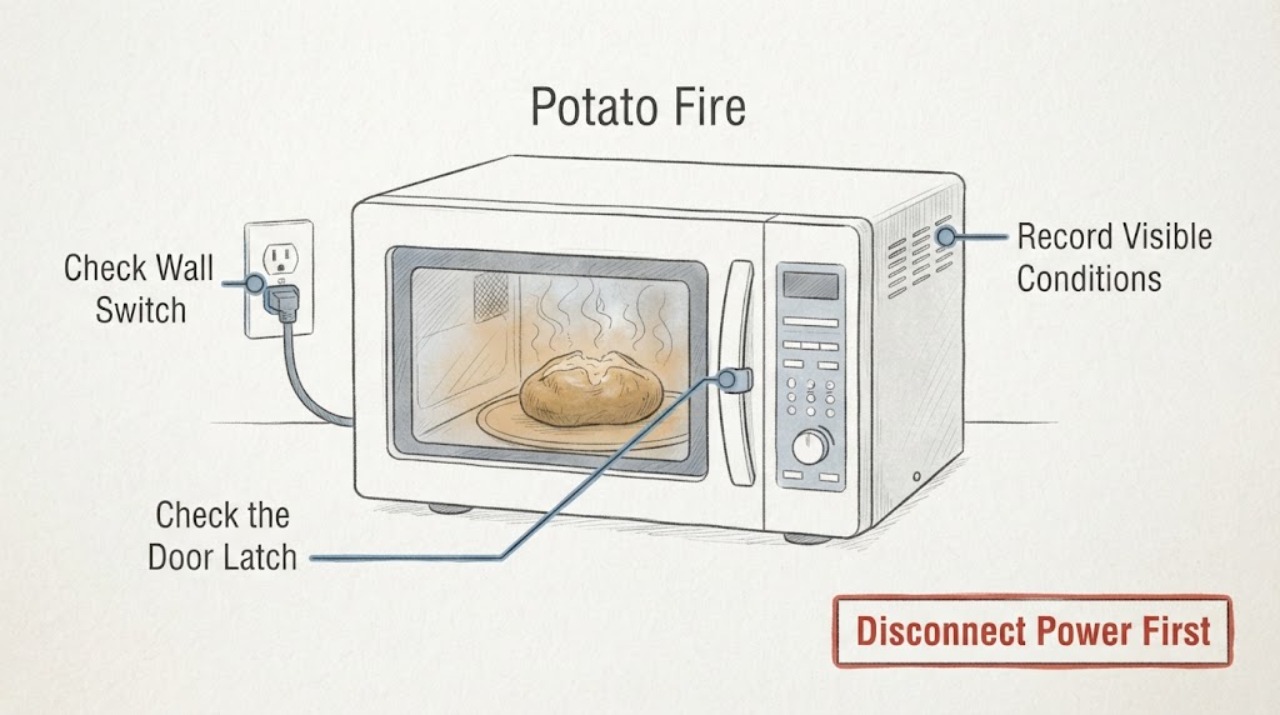
Treat a potato fire in the GE JVM6175SF1SS as a stop-use event, not a reason to run a cup-of-water test. If anything is still burning, keep the door closed, turn the microwave off, and disconnect power from a safe position or at the breaker; opening the door can spread the fire. Once it is completely cool, do only a visual check from outside the cavity for a warped or loose door, damaged hinges or latch, damaged seal or sealing surface, scorched or peeling cavity coating, melted parts, smoke damage, or a damaged cord or outlet. GE's JVM6175 owner manual warns that potatoes can dehydrate and catch fire when overcooked, and says not to operate a damaged microwave or attempt self-service. Leave the JVM6175SF1SS unplugged and arrange qualified service; do not test it again, remove the cover, or bypass a door interlock.
Work through in order
Diagnostic checks
Use only checks that match the exact appliance or system and its official guide.
-
Check 1
If the potato or any material is still burning, keep the microwave door closed, press Cancel/Off only if it is safe to approach, and disconnect the power cord or switch off the breaker from a safe, dry position. Move away and call emergency services if the fire, smoke, or heat does not stop promptly; do not open the door to look inside.
Expected result: The fire is contained and stops after power is removed; smoke, flame, heat, or an electrical odor continues; or the plug, cord, outlet, cabinetry, or surrounding area is scorched or hot.
Next step: Leave the area and use emergency services for an uncontrolled fire. If the event is contained, keep the microwave isolated and do not restore power for any reason until qualified service inspects it.
Stop if: Do not open the door while hot, pour water into the microwave, reach through smoke, unplug a damaged cord by hand, or reset the breaker to see if the oven still works.
Why this matters
Why: Keeping the door closed limits oxygen and helps prevent the fire from spreading, while continuing smoke or heat indicates an active fire or electrical hazard rather than an appliance troubleshooting problem.
-
Check 2
When the oven is fully cool and power is isolated, inspect only from the outside and with the door opened normally if it is safe: look at the door, hinges, latches, seal, sealing surfaces, cavity walls and ceiling, turntable, turntable support, and the visible power cord and outlet. Photograph any damage before cleaning or moving the over-the-range unit.
Expected result: The door is bent or loose, a hinge or latch is cracked, the seal or mating surface is damaged, the cavity coating is scorched or peeling, a part is melted, or the cord/outlet shows heat damage; or no external damage is visible.
Next step: Keep the JVM6175SF1SS disconnected and arrange qualified appliance service for inspection. Give the technician the photographs, the food and time used, whether there was smoke, flame, popping, odor, or breaker operation, and whether another item was heated afterward.
Stop if: Do not straighten the door, sand or repaint cavity damage, remove the turntable motor cover, or close and operate the unit to see whether the latch still works.
Why this matters
Why: Any damage to the door, latch, hinges, seal, sealing surface, cavity, or power path means microwave leakage, arcing, fire, or shock protection cannot be assumed. No visible damage does not prove the internal generator, wiring, controls, or interlock are safe after a fire.
-
Check 3
Record the exact model JVM6175SF1SS and serial information, potato size and whether its skin was pierced, the selected feature and time, visible metal or foil, whether the turntable and rack were present, where the flame or smoke began, and any immediate sound or odor. Do not use the microwave again to reproduce the event.
Expected result: The potato was unpierced or badly dehydrated, the cavity contained metal/foil or a metallic trim item, the rack or shelf was mispositioned, the fire started at the food, the fire involved the wall or ceiling, or the cause cannot be located.
Next step: Provide the record and photographs to qualified service. Treat an unknown origin, wall/ceiling scorching, popping, electrical odor, or a repeated heating symptom as an internal inspection requirement.
Stop if: Do not infer that a food-origin fire is harmless, order a magnetron, fuse, control, or interlock from the story alone, or repeat the same potato or a water-cup test.
Why this matters
Why: Food dehydration and overcooking can explain a potato fire, while metal, foil, rack placement, residue, or cavity damage can cause arcing. These observations narrow what the technician should inspect but do not clear the appliance or identify a failed part.
-
Check 4
Check the surrounding installation without moving the over-the-range unit: look for grease or smoke damage around the underside, vent openings, cabinet, and outlet, and confirm that no other appliance or combustible material was affected. Do not remove mounting hardware or the cabinet cover.
Expected result: The vent or cabinet is scorched, grease is built up, the outlet or cord is heat-damaged, the microwave shifted, or the surrounding installation looks normal.
Next step: If the outlet, cord, cabinet, vent, or mounting is damaged, arrange qualified electrical and appliance inspection before touching or moving the unit. If the area is normal, keep the unit isolated and still arrange appliance service.
Stop if: Do not pull down the built-in microwave, disconnect the vent or wiring, clean soot from energized parts, or restore power to inspect the fan or light.
Why this matters
Why: Heat or smoke outside the cavity adds a fire and installation hazard. A normal-looking exterior still does not rule out internal fire or high-voltage damage, especially after the exact-model report described immediate abnormal heating afterward.
-
Check 5
Give the technician the model and serial, the fire timeline, photographs, food and cookware details, selected programme or Potato feature, approximate runtime, whether the door was opened, and any later popping, overheating, arcing, breaker trip, or unusual odor. Ask for a post-fire safety inspection rather than a power-on demonstration.
Expected result: The technician finds cavity, door, interlock, cord, control, or high-voltage damage; finds only removable food residue; or cannot confirm the fire source without internal testing.
Next step: Follow the qualified technician's repair-or-replace recommendation and any electrical inspection. Keep the microwave disconnected until the inspection is complete and the technician explicitly returns it to service.
Stop if: Do not open the cabinet, discharge capacitors, probe live circuits, replace protective devices, or bypass door interlocks.
Why this matters
Why: A fire event requires qualified examination even when the visible residue is removable. A technician's finding of no visible external damage is not a license for an unqualified person to test high-voltage components or bypass protection.
Use your observations
Decision map
Find the observation that best matches what you see, then follow the next safe action.
-
PATH 01Next step
What you see
Flame, smoke, heat, or electrical odor is still present, or the cord, outlet, cabinet, or microwave exterior is scorched.
Do this next
Keep the door closed, disconnect power only from a safe position if possible, leave the area, and call emergency services if the event is not immediately controlled. Do not restore power.
Why this path and its safety boundary
Why it matters: This is an active fire or electrical emergency, not a safe appliance check.
-
PATH 02Next step
What you see
The fire is out, but the door, hinges, latch, seal, sealing surface, cavity coating, turntable support, or other visible part is damaged.
Do this next
Keep the JVM6175SF1SS unplugged and arrange qualified service. Do not straighten, repaint, glue, or test the damaged part.
Why this path and its safety boundary
Why it matters: The microwave's containment and microwave-energy safety cannot be assumed, even if the display or fan still works.
-
PATH 03Next step
What you see
No visible damage is found, but the fire was followed by popping, immediate overheating, arcing, an electrical odor, a breaker trip, or abnormal heating of another food.
Do this next
Do not perform a cup-of-water or empty-cavity test. Keep power isolated and obtain a post-fire inspection from qualified GE or microwave service.
Why this path and its safety boundary
Why it matters: A hidden cavity, control, interlock, wiring, or high-voltage fault remains possible; a clean-looking cavity does not clear the appliance.
-
PATH 04Next step
What you see
The fire appears limited to an overcooked or unpierced potato and there are no visible marks or later symptoms.
Do this next
Leave the microwave off and have qualified service assess it before any return to operation. Preserve the incident details and do not reproduce the cooking condition.
Why this path and its safety boundary
Why it matters: Food dehydration or overcooking is a plausible trigger because GE warns that potatoes can catch fire, but the fire event still does not establish that the microwave is safe to reuse.
Helpful context
Understand the symptom
This article is for the GE JVM6175SF1SS, identified on GE's parts portal as a 1.7 cu. ft. over-the-range sensor microwave. The owner manual linked from that exact-model page covers the JVM6175 family and says potatoes with an unbroken skin should be pierced; it also warns not to overcook potatoes because they can dehydrate and catch fire. The exact Reddit report describes a JVM6175SF1SS potato fire followed by immediate overheating and popping when another food was tried, so do not treat a repeat test as harmless evidence.
If the fire is active or there is still smoke, keep the door closed. Turn the oven off and disconnect power only if you can do so without reaching through smoke, heat, water, or damaged wiring; otherwise use the circuit breaker from a safe location and leave the area. Do not open the door to inspect while hot, and use emergency services for a fire that is not controlled by removing power and keeping the door closed.
After the appliance is cold and isolated, the only appropriate owner check is visual: inspect the door, hinges, latches, seal and mating surface, cavity walls and ceiling, turntable and support, and accessible cord or outlet for warping, cracks, scorching, melted plastic, peeling coating, smoke residue, or arcing marks. GE's safety guidance says not to operate a damaged oven and not to tamper with the safety interlocks. A clean-looking cavity does not clear an appliance that has experienced a fire.
Do not remove the cabinet, probe the high-voltage section, replace a fuse, bend a latch, bridge an interlock, or run an empty or water-filled test. The fire can be food-related, caused by arcing from metal or residue, or involve damage that cannot be separated safely without qualified inspection.
When checks do not resolve it
Need a professional?
Arrange qualified GE or microwave-appliance service after any cavity fire, even if the microwave appears to work. Escalate immediately for continuing smoke or flame, scorched wiring or cabinetry, electrical odor, a breaker trip, door or latch damage, damaged sealing surfaces, arcing, or abnormal heating after the event. Do not restore power for a test, remove the cabinet, work on high-voltage parts, or bypass an interlock.
Common questions
FAQ
Can I test the GE JVM6175SF1SS with a cup of water after the potato fire?
No. A post-fire power-on test can expose you to a hidden cavity, control, interlock, wiring, or high-voltage fault and cannot prove that the microwave is safe. Keep it disconnected and arrange qualified inspection.
Could an overcooked potato itself cause the fire?
Yes, it is plausible: the JVM6175 manual warns that potatoes can dehydrate and catch fire when overcooked and instructs users to pierce an unbroken skin. That possibility does not clear the microwave after a fire, especially if there was popping, arcing, abnormal heating, or any cavity or door damage.
What damage means the GE microwave must stay out of service?
Any bent or loose door, damaged hinges or latches, damaged seal or sealing surface, scorched or peeling cavity, melted part, heat-damaged cord or outlet, smoke damage, arcing mark, or unexplained abnormal heating is a stop-use condition. GE says not to operate a damaged oven and not to tamper with the safety interlocks.
Read the exact guide
Official sources
- Microwave Arcing In CavityGE Appliances · The opened GE support article lists metal, twist ties, rack placement, uncovered foods, and some vegetables or seasonings as possible arcing contexts. It supports recording visible arcing or cavity evidence but does not authorize testing a microwave after a fire.
- GE Microwave caught potato on fireReddit r/appliancerepair · The opened Reddit post identifies the microwave as GE JVM6175SF1SS and reports a potato fire followed by immediate overheating and popping with another food. It is an incident report only, not proof of cause, repair, or safe reuse.
- Model Search | JVM6175SF1SSGE Appliances · The opened GE parts portal identifies JVM6175SF1SS as a GE 1.7 cu. ft. over-the-range sensor microwave and links the owner manual used for safety and cooking guidance.
- JVM6175/JVM6177/LVM6177 Microwave Oven Owner's ManualGE Appliances · This is the owner manual linked from the exact JVM6175SF1SS GE parts page. It identifies the JVM6175 family, instructs users to keep the door closed and disconnect power if materials ignite, warns that potatoes can catch fire when overcooked, says not to operate a damaged oven, and prohibits self-service or interlock tampering.
Community feedback
Share a repair observation
Share a plain-text repair observation. Accepted observations are published automatically; this page may take a moment to update.