
On this page
Start here
Quick answer
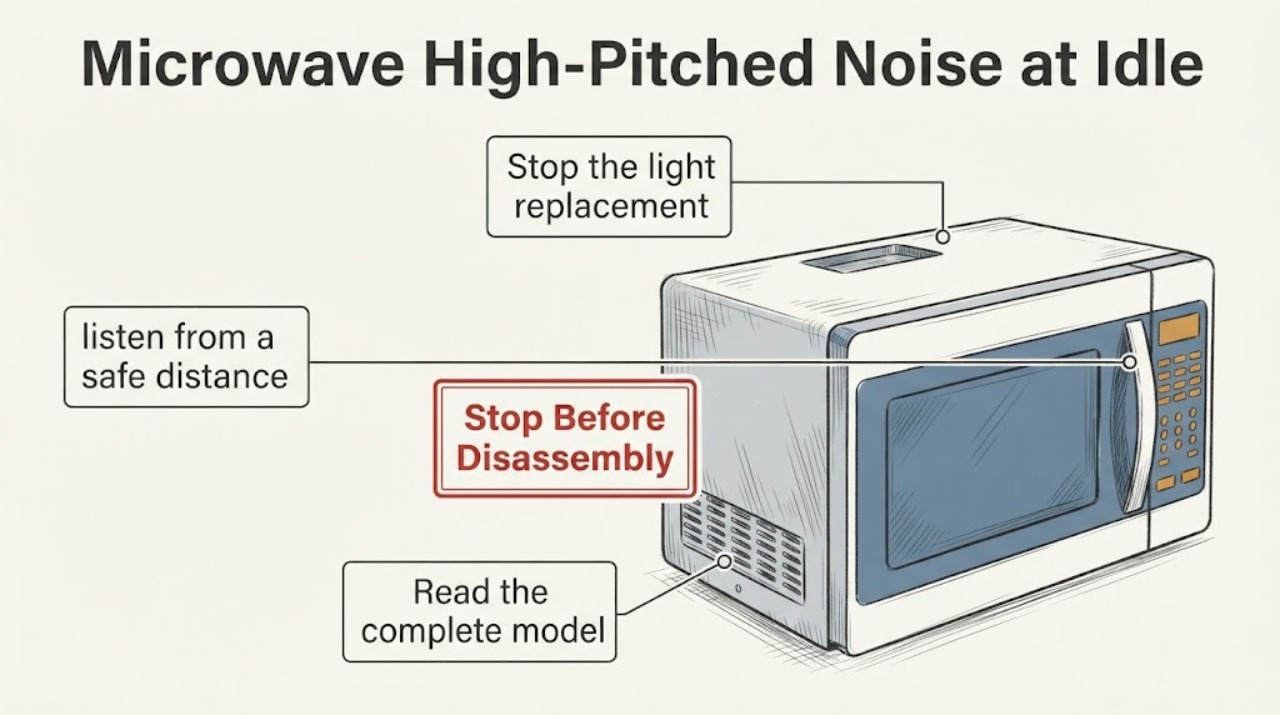
Do not open a GE microwave cabinet to chase a high-pitched sound. GE says microwaves are not a do-it-yourself repair because the high-voltage capacitor can retain a charge after unplugging. First confirm whether the sound is actually coming from the microwave and whether it stops when the correct circuit is off; if it continues with that circuit off, look for another source without touching the appliance. If the sound returns only when the microwave is powered, note whether it is a slight standby hum, a short fan run, or a persistent electrical or mechanical noise. Replace a light only through the exact model's instructions and with power disconnected; if the noise is persistent, new, or accompanied by arcing, smell, heat, smoke, or a tripped breaker, leave the microwave disconnected and arrange GE service.
Work through in order
Diagnostic checks
Use only checks that match the exact appliance or system and its official guide.
-
Check 1
Stop the light replacement and leave the microwave disconnected at the correct breaker or plug while any lamp cover, grille, or access part is open or not fully secured. Do not remove the outer cabinet or touch internal wiring.
Expected result: The appliance is fully disconnected and closed up, or a cover is difficult to restore and power cannot be safely isolated.
Next step: If the cover cannot be restored or power isolation is uncertain, stop and arrange GE service instead of investigating the noise internally.
Why this matters
Why: GE requires model-specific light instructions and disconnected power for lamp work, while its microwave repair guidance warns about retained high voltage after unplugging.
-
Check 2
With the microwave untouched and the correct circuit off, listen from a safe distance and compare the sound with nearby appliances, fans, alarms, or plumbing. Do not toggle the breaker repeatedly just to reproduce it.
Expected result: The high-pitched sound stops with the microwave circuit off, or it continues unchanged while that circuit is off.
Next step: Record the location, timing, and whether the sound follows the microwave circuit. Keep the microwave disconnected if the source is uncertain or the sound is clearly appliance-related.
Why this matters
Why: A sound that continues with the circuit off may be coming from another source; a sound that returns only when the microwave is powered is evidence to give service, not permission to open the microwave.
-
Check 3
Read the complete GE model number from the rating label or owner's paperwork and identify whether the unit is countertop, built-in, or over-the-range without removing the cabinet or opening a panel.
Expected result: The model and installation type are known, or the identity remains incomplete.
Next step: Use the exact model manual for any consumer-replaceable lamp instruction. If the model cannot be identified, provide the label information to GE service.
Why this matters
Why: GE says microwave sounds and light-replacement access vary by model and installation; a generic bulb or noise procedure cannot establish the correct scope.
-
Check 4
Only after all model-authorized lamp covers and grilles are secured and no internal parts are exposed, make one brief external observation in standby; do not run the microwave empty or place hands near vents or openings.
Expected result: The sound is a slight steady standby hum, a fan that stops after a short period, or a persistent high-pitched/electrical or mechanical sound.
Next step: If the sound is persistent, changed after the light work, or cannot be distinguished from an electrical/mechanical noise, disconnect the unit and arrange GE service. Do not repeat tests with an empty cavity.
Why this matters
Why: GE lists a slight transformer hum and short post-cycle fan operation as possible normal characteristics, but says abnormal electrical or mechanical sounds should be serviced.
-
Check 5
Record any arcing, popping, burning smell, smoke, unusual heat, display failure, or tripped breaker without opening the microwave or attempting another cooking cycle.
Expected result: Any of these warning signs is present, or the only symptom is a quiet sound with no other abnormal behavior.
Next step: For any warning sign, keep the microwave disconnected and arrange service. For an isolated standby sound, provide the model and timing to GE support before deciding whether it is normal for that model.
Why this matters
Why: GE treats electrical or mechanical sounds as a service concern and separately warns that empty operation can damage the interior; a quiet sound alone still cannot identify the internal source.
Use your observations
Decision map
Find the observation that best matches what you see, then follow the next safe action.
-
PATH 01Next step
What you see
The sound continues unchanged while the correct microwave circuit is off.
Do this next
Leave the microwave disconnected and identify the external source from a safe distance. If the source cannot be established, have service inspect the closed appliance.
Why this path and its safety boundary
Why it matters: The sound may be from a nearby appliance, fan, alarm, or building system rather than an electrically powered microwave; the observation does not justify opening the microwave.
-
PATH 02Next step
What you see
The sound returns only when the microwave is powered and is a slight steady standby hum that matches the normal idle condition for the model.
Do this next
Confirm the exact model manual or GE support description before continuing normal use, and stop if the sound changes or any warning sign appears.
Why this path and its safety boundary
Why it matters: GE says a slight transformer hum while not in use can be normal, but the generic guidance does not certify a particular GE model from sound alone.
-
PATH 03Next step
What you see
The sound persists, is sharply high-pitched, began after the light work, or resembles an electrical or mechanical noise rather than a brief fan run.
Do this next
Disconnect the microwave and arrange GE service. Do not remove the cabinet, test a capacitor, or repeatedly restore power to reproduce the sound.
Why this path and its safety boundary
Why it matters: GE's public guidance does not identify the internal component from this symptom and recommends service for electrical or mechanical sounds.
-
PATH 04Next step
What you see
Arcing, smoke, burning odor, unusual heat, a tripped breaker, or another visible electrical warning accompanies the sound.
Do this next
Stop using the appliance, keep power isolated if safely accessible, and request professional service. Do not run it empty or open the cabinet.
Why this path and its safety boundary
Why it matters: The symptom is no longer a simple standby-noise question and may involve an unsafe electrical or microwave condition.
Helpful context
Understand the symptom
A circuit-off sound changes the first question
If the correct microwave circuit is genuinely off, an electrically powered microwave should not be the source of a continuing powered sound. Do not use that observation to justify opening the cabinet: GE warns that a microwave capacitor can retain a high-voltage charge even after unplugging. Establish the sound source from outside the appliance and keep the unit disconnected while a light cover, grille, or other access part is not fully restored.
Separate a slight standby hum from a new high-pitched fault
GE says a slight transformer hum may be heard while a microwave is not in use, and that sound varies by model and installation. GE also describes a fan that can run briefly after a cycle and an over-the-range vent fan that can run when the underside becomes too warm. A persistent or unusually sharp sound cannot be identified as one of these normal conditions without the model and a safe external observation.
Keep light replacement separate from microwave repair
GE's over-the-range light guidance says to consult the exact owner's manual, disconnect power, and stop for a technician when the lamp cover is too difficult to access. It does not authorize removing the microwave's outer cabinet or testing exposed circuitry. If the noise appeared after light work, record what was changed and let service inspect the closed appliance rather than repeatedly restoring power to listen for it.
When checks do not resolve it
Need a professional?
Stop and arrange GE or qualified microwave service if the noise is persistent or electrical/mechanical, returns after the light-circuit work, cannot be localized safely, or is accompanied by arcing, smoke, burning odor, unusual heat, display failure, or a tripped breaker. Service is also required if the lamp cover is difficult to access or the exact model manual does not provide a consumer-replaceable light procedure. Do not open the microwave cabinet, test the high-voltage capacitor, or operate the unit empty.
Common questions
FAQ
Can a GE microwave make a slight sound while it is idle?
GE says a slight transformer hum while the microwave is not in use may be normal, and that sounds vary by model and installation. A new, persistent, or sharply high-pitched noise should be described to GE support rather than diagnosed by opening the cabinet.
Is it safe to remove the GE microwave cover after turning off the breaker?
No. GE says it offers no DIY microwave repair advice because a high-voltage capacitor can retain a charge even after unplugging. Use only the exact model's external light procedure; cabinet or internal work belongs to service.
Should I run the microwave to reproduce a high-pitched noise?
Do not run it empty or keep repeating a test when the sound is persistent or electrical/mechanical. GE recommends service for electrical or mechanical sounds and warns that empty operation can damage the interior.
Read the exact guide
Official sources
- Microwave - Normal Operational CharacteristicsGE Appliances · Official GE guidance for microwave and Advantium operating characteristics; used for slight standby transformer hum, short post-cycle internal fan operation, model/install sound differences, and support escalation when the symptom is not covered.
- Microwave Do-It-Yourself Repair RecommendationsGE Appliances · Official GE Appliances safety guidance for microwave ovens; it states that GE offers no DIY microwave repair advice because high-voltage capacitors can retain charge after unplugging and special diagnostic equipment is required.
- Microwave - Arcing or Making SoundsGE Appliances · Official GE guidance for microwave sounds during use; used for the distinction between normal food-related noises and electrical or mechanical sounds requiring service, and the warning against empty operation.
- Over-The-Range Microwave - Interior Lamp ReplacementGE Appliances · Official GE guidance for over-the-range microwave interior lamps; it requires the exact model owner's manual, disconnected power, and service when the lamp cover is too difficult to access. It is not used as permission for cabinet repair.
Community feedback
Share a repair observation
Share a plain-text repair observation. Accepted observations are published automatically; this page may take a moment to update.