
On this page
Start here
Quick answer
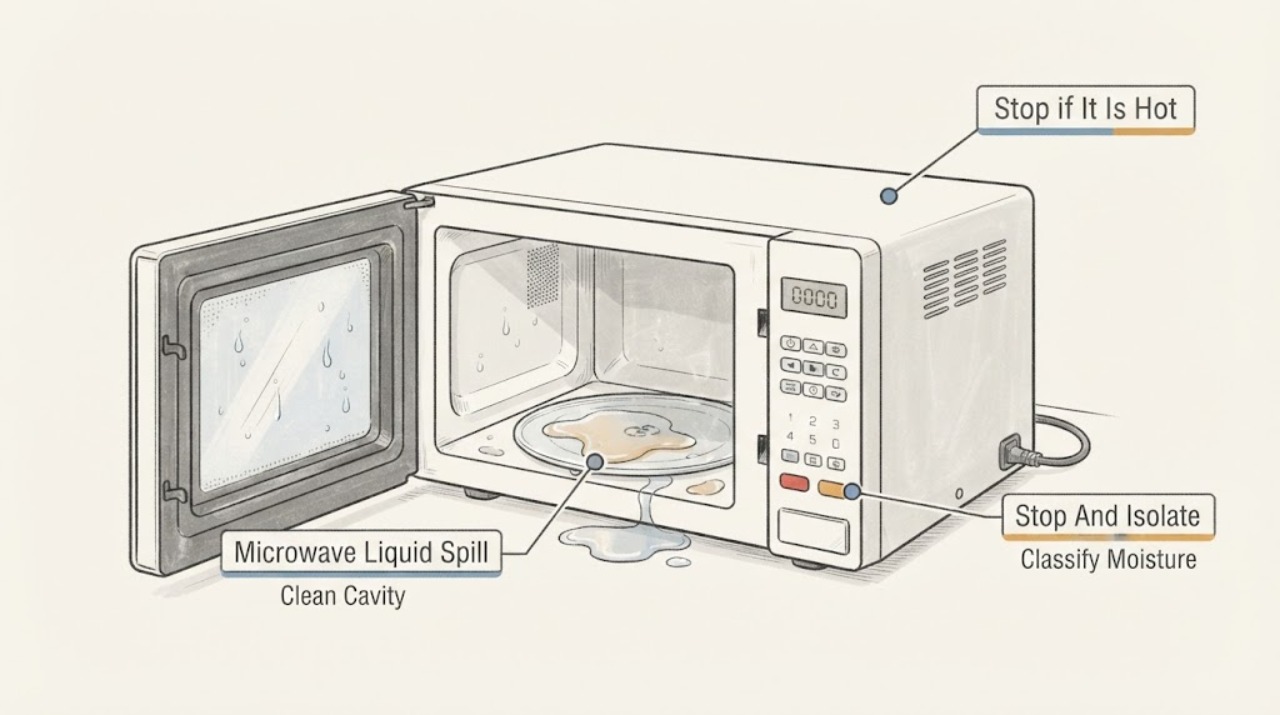
Stop the microwave, unplug it if safe, and identify where the liquid went before touching controls or trying another cycle. GE says most cavity spills can be cleaned with a mild dishwashing liquid and a damp cloth, while the control panel should only be wiped with a soft damp cloth and dried immediately; do not spray solution directly onto the controls. Steam or condensation inside the cavity or around the door can be normal after heating moist food, but liquid that reached the control panel, vents, underside, cord, outlet or cabinet interior is outside a safe user-cleaning check. Do not open the case, bypass the door interlock or run the microwave to see whether it still works. Arrange model-specific service for liquid inside the cabinet, persistent moisture between door glass, arcing, smoke, a burning smell, peeling cavity coating or any abnormal operation.
Work through in order
Diagnostic checks
Use only checks that match the exact appliance or system and its official guide.
-
Check 1
Press Cancel/Off if it responds, keep hands away from wet controls, and unplug the microwave from the outlet if the plug, cord and outlet are dry and safely reachable. If the outlet, plug or cord is wet, hot or visibly damaged, do not touch it; isolate the area and arrange qualified electrical/appliance help.
Expected result: The liquid is limited to the cooking cavity or dry exterior, or it reached the control panel, vent openings, underside, cord, outlet or an area that cannot be seen.
Next step: Keep the microwave unplugged and continue only with the matching location branch. Do not open the cabinet, insert tools or run another cycle to check whether it works.
Why this matters
Why: A cavity-only spill can be approached as external cleaning after power is removed. Liquid in or near electrical areas cannot be scoped by the general cleaning page and should not be tested by restoring power.
-
Check 2
Record whether the liquid appeared during or after heating high-moisture food, whether it is a thin film of steam on the cavity/door, or whether a container actually tipped, overflowed or splashed onto the appliance exterior.
Expected result: The moisture is ordinary condensation that clears, a visible food/liquid spill in the cavity, or unexplained liquid between door glass/around controls.
Next step: For clearing condensation, leave the door open after the appliance is not in use and monitor without operating it while wet. For an actual spill or moisture between glass, use the cleaning or service branch below; do not assume the model has the same construction as another GE microwave.
Why this matters
Why: GE says condensation from moist food and steam around the door can be normal and usually dissipates within 10–15 minutes. An actual spill or persistent moisture is not established as normal condensation.
-
Check 3
If the spill is confined to the unplugged cavity, turntable area or accessible door surface, remove the loose liquid with a soft damp cloth and mild dishwashing liquid, then wipe with clean water and dry. GE also permits baking soda and water for the interior. Do not use commercial oven cleaner, abrasive cleaner, ammonia or bleach.
Expected result: The cavity and door are clean and dry with no visible arcing mark, hole, active peeling, cracked door area or liquid remaining in a gap.
Next step: Keep the unit unplugged until the model manual permits normal use and the cavity is fully dry. If any cavity damage, arcing or trapped liquid remains, stop and arrange service or replacement assessment instead of testing it.
Why this matters
Why: A clean, dry, intact cavity supports an external-cleaning outcome, but it does not prove that liquid did not enter a control or vent. A burn, hole, peeling coating or arcing mark is a stop condition.
-
Check 4
For a small amount on the dry exterior only, wipe the control panel and surrounding surface with a soft damp cloth, then dry immediately. Do not spray cleaner, pour water, push liquid into button gaps or remove trim to reach behind the panel.
Expected result: The liquid was only on the surface and no fluid entered button gaps, vents, seams, the underside, cord or outlet; or the path of the liquid cannot be confirmed.
Next step: If entry into a gap, vent, underside or control area is possible, leave the microwave unplugged and request model-specific service. Do not power it to see whether the buttons respond.
Why this matters
Why: GE supports damp-cloth surface cleaning but does not provide a universal user procedure for liquid that has entered controls or the cabinet. Uncertain entry is treated as possible internal contamination.
-
Check 5
After power is isolated, inspect only the visible cavity, door edge and cord/outlet area for arcing marks, smoke residue, a hole, actively peeling cavity coating, melted plastic, burning odor or visible damage. Do not remove the outer cover or probe inside vents.
Expected result: There is no visible damage and no abnormal smell, or there is arcing, smoke, burning/chemical odor, cavity damage, damaged cord/outlet or abnormal behavior.
Next step: For any abnormal sign, keep the microwave unplugged and arrange qualified service or replacement assessment. Do not scrape, paint, tape or seal the cavity and do not perform a high-voltage test.
Why this matters
Why: GE says electrical/mechanical popping requires service, a hole in the cavity requires discontinuing use, and active peeling of the interior coating is not a user repair. These signs cannot be safely attributed to a simple spill.
-
Check 6
Arrange GE or qualified appliance service if liquid entered the controls, vents, underside or cabinet; if the microwave was energized while wet; if moisture remains between door glass; or if there is arcing, smoke, burning/chemical odor, abnormal operation or visible cavity/cord damage.
Expected result: The spill cannot be proven cavity-only and surface-dry, or any electrical, door, cavity or operation symptom is present.
Next step: Keep the appliance unplugged, preserve the model and serial information, describe where the liquid went and whether it was powered, and give those facts to service. If there is active smoke or fire, leave the area and use local emergency procedures.
Why this matters
Why: The official cleaning pages support accessible surface cleaning only. They do not authorize opening the cabinet or diagnosing high-voltage parts after an internal liquid event.
Use your observations
Decision map
Find the observation that best matches what you see, then follow the next safe action.
-
PATH 01Next step
What you see
Only a light film of moisture appears inside the cavity or around the door after heating high-moisture food and it clears within the normal period.
Do this next
Leave the door open after use so moisture can dissipate, keep food covered when appropriate and keep airflow around the case clear. Escalate if moisture persists between door glass or appears unrelated to cooking.
Why this path and its safety boundary
Why it matters: GE describes this as normal condensation/steam rather than proof of a liquid-spill failure.
-
PATH 02Next step
What you see
A tipped container or splash is confined to the cavity or accessible door surface, with power removed and no arcing, hole, peeling, odor or trapped liquid.
Do this next
Clean with a mild damp cloth, rinse/wipe as appropriate and dry fully. Do not use commercial oven cleaner, abrasives, bleach or ammonia, and follow the exact owner's manual before normal operation.
Why this path and its safety boundary
Why it matters: The event fits GE's ordinary accessible cleaning guidance.
-
PATH 03Next step
What you see
Liquid reached the control panel, button gaps, vents, underside, cord, outlet or cabinet interior, or the route cannot be determined.
Do this next
Keep the microwave unplugged and arrange qualified service. Do not open the case, bypass the interlock, use a hair dryer or restore power to test it.
Why this path and its safety boundary
Why it matters: The spill may involve electrical components; GE's surface-cleaning instructions do not establish a safe DIY internal-drying or reset procedure.
-
PATH 04Next step
What you see
The microwave shows arcing, smoke, burning/electrical or chemical odor, a damaged cord/outlet, a cavity hole, active peeling coating or abnormal operation after the spill.
Do this next
Stop use, unplug only if safe and accessible, leave the area for active smoke/fire, and contact qualified service or local emergency support. Do not run another test cycle or attempt high-voltage repair.
Why this path and its safety boundary
Why it matters: This is a safety/service condition and is not a simple cleaning result.
Helpful context
Understand the symptom
First separate a spill from normal condensation
Steam and condensation from heating moist food can appear inside the cavity, on the door or around an over-the-range control panel. A cup overturned onto the panel, vents, underside or outlet is a different event because the liquid may have reached electrical areas. GE says normal condensation generally dissipates in about 10–15 minutes, while persistent moisture between the door glass needs service. Do not use the normal-condensation explanation to justify running a microwave after an actual external spill.
Clean only accessible surfaces after power is removed
For a spill limited to the cavity or exterior surface, unplug first and use a mild cleaner on a damp cloth. GE allows baking soda and water for the cavity, but prohibits commercial oven cleaners, abrasives, ammonia and bleach. The control panel should be wiped with a soft damp cloth and dried immediately; never spray a cleaner or pour water onto it.
Treat electrical symptoms as a service boundary
A spill that entered the case, vents or controls is not a DIY drying or reset problem. Do not remove the outer cover or attempt high-voltage inspection. Stop completely for arcing, smoke, burning/electrical or chemical odor, a damaged cord/outlet, abnormal operation, a hole in the cavity or active peeling of the cavity coating. Give service the model, spill location, whether the unit was energized and every observed symptom.
When checks do not resolve it
Need a professional?
Request qualified GE service when liquid entered controls, vents, the underside or cabinet; the microwave was powered while wet; moisture remains between door glass; or there is arcing, smoke, burning/chemical odor, abnormal operation or visible cavity/cord damage. Do not choose a fuse, switch, board, magnetron, capacitor or other part from a spill alone.
Common questions
FAQ
Can I wipe a GE microwave after a small spill?
Only after unplugging and only when the spill is confined to an accessible cavity or exterior surface. GE recommends a mild cleaner and damp cloth for the cavity, and a soft damp cloth dried immediately for the control panel. Do not spray liquid directly onto controls.
Is moisture inside a GE microwave always a problem?
No. GE says condensation after heating high-moisture food and steam around the door can be normal and usually dissipates in about 10–15 minutes. Persistent moisture between the door glass or liquid unrelated to cooking needs service assessment.
What if liquid spilled on the microwave buttons?
Keep it unplugged. GE supports only wiping the control panel with a soft damp cloth and drying immediately; it does not provide a universal user procedure for liquid that entered button gaps or the cabinet. Do not spray, pry the panel open or power the unit to test it; arrange model-specific service if entry is possible.
Can I run the microwave with a little water still inside?
Do not operate it while a spill remains or when liquid may have entered controls or vents. Clean and dry only an accessible cavity spill according to the model manual. Arcing, smoke, burning odor or cavity damage requires stopping use and service.
What should I do if the microwave sparks after the spill?
Stop the microwave, unplug it if the cord and outlet are safe to touch, and do not run another test. GE recommends service for electrical or mechanical popping and says a hole or actively peeling cavity coating requires discontinuing use.
Read the exact guide
Official sources
- Microwave - Cavity Repair Needed Due to Arcing, Chipping, Peeling or ScorchingGE Appliances Support · Official GE cavity-damage guidance; no DIY cavity coating repair is inferred.
- Microwave - Moisture or CondensationGE Appliances Support · Official GE general microwave moisture guidance; it distinguishes cooking condensation from persistent moisture requiring service.
- Microwave - Cleaning RecommendationsGE Appliances Support · Official GE general microwave cleaning guidance; the exact owner's manual controls model-specific construction and cleaning details.
- Microwave - OdorsGE Appliances Support · Official GE microwave odor and safety guidance; it is used for abnormal odor escalation, not for diagnosing a spill's internal part.
- Microwave - Arcing or Making SoundsGE Appliances Support · Official GE general microwave arcing guidance; exact model cookware/rack instructions remain manual-specific.
Community feedback
Share a repair observation
Share a plain-text repair observation. Accepted observations are published automatically; this page may take a moment to update.