
On this page
Start here
Quick answer
First verify the identity and ventilation mode before calling this a failed fan. The assigned topic spells the model JMV3160DF2BB, while GE's opened owner and installation documents identify the published family as JVM3160DFBB/JVM3160; read the rating plate before applying a model-specific instruction. GE describes this OTR family as convertible: recirculating mode returns air to the room through a charcoal filter, while outside-top or outside-back mode requires a correctly oriented blower, duct, and free-moving exterior damper. The two reusable metal filters trap cooktop grease; they are not proof that air must leave through a wall or roof. With power disconnected from a safe, dry position, inspect only the visible grease filters, any visible charcoal-filter presence, the external wall or roof cap, and obvious duct or grille obstruction. If the inherited installation mode, blower direction, duct route, or exterior damper is uncertain, leave the unit off and have a qualified installer check it. Do not perform a tissue test while energized, remove the cabinet or blower, enter the high-voltage area, or modify the duct yourself.
Before you begin
Safety first
- Do not open the microwave cabinet, enter the high-voltage cavity, remove or rotate the blower, test live wiring or capacitors, perform a paper/tissue airflow test while energized, climb to a roof cap, disconnect hidden ducting, or modify the house duct yourself. Disconnect power only from a safe, dry position before visible filter inspection.
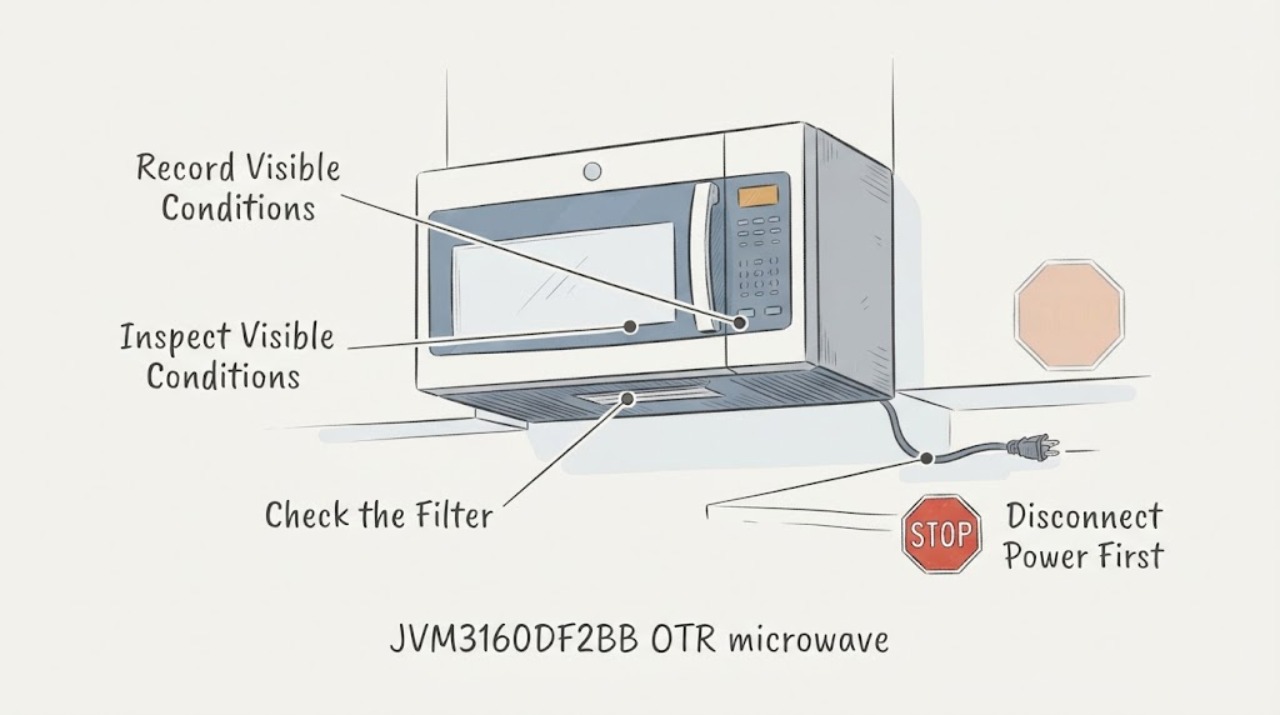
Work through in order
Diagnostic checks
Use only checks that match the exact appliance or system and its official guide.
-
Check 1
Treat the model mismatch as the first check. From the accessible rating plate or existing paperwork, compare every character with the assigned JMV3160DF2BB label; GE's opened pages use JVM3160DFBB for the published OTR family. Record the full model, serial information, market, and whether the unit is an over-the-range installation without moving it.
Expected result: The rating plate clearly says JVM3160DF2BB or another JVM3160 variant, it actually says JMV3160DF2BB, or the label cannot be read without removing the unit or opening a panel.
Next step: Use the exact rating-plate identity to retrieve the matching GE manual. If the label cannot be safely read, give a photo and the current installation details to an installer or GE service rather than copying a blower or filter procedure.
Stop if: Do not pull down a built-in microwave, remove the case or grille to find the label, or assume the previous homeowner's model description is correct.
Why this matters
Why: The JMV/JVM character order and the missing or extra suffix change which manual and installation configuration apply. The opened GE documents are evidence for the JVM3160DFBB family, not proof for an unverified model string.
-
Check 2
With the microwave disconnected from power at a safe, dry point and fully cool, identify the intended airflow mode from visible evidence only. Look for a charcoal filter arrangement and a room-facing return path, or for a visible duct connection leading toward the wall or cabinet above; do not remove the top grille or open the blower area to expose hidden parts.
Expected result: A charcoal filter and room return are visible, a wall/roof duct and exterior cap are visible, both appear possible, or no configuration can be established.
Next step: For an uncertain or inherited installation, keep the unit off and ask a qualified installer to trace the duct and verify the configuration. Do not convert modes or move the blower yourself.
Stop if: Do not energize the microwave for a tissue, paper, smoke, or hand test, and do not insert anything through a grille or vent opening.
Why this matters
Why: GE's documents treat recirculating and outside exhaust as different installations. Little or no air at an exterior cap is expected if the unit is recirculating; an outside-vented setup with no identifiable route or cap has an installation question before a fan question.
-
Check 3
Still with power disconnected, inspect the two accessible reusable metal grease filters. Check for a heavy grease film, a filter that is upside down or not seated in its slots, missing filter tabs, crushed mesh, or a grille and underside coated with grease. Clean and reseat only as the exact owner manual directs; do not use corrosive cleaner or operate with a damaged filter.
Expected result: The metal filters are visibly blocked or mis-seated, they are clean and seated, or cleaning would require grille/cabinet removal.
Next step: Restore only a plainly accessible filter position or cleaning condition, then ask the installer to assess airflow mode and ducting. If filter access is not safe or requires removing the grille, stop and arrange service.
Stop if: Do not run the fan with a loose filter, reach into the blower, spray cleaner into the unit, or remove internal panels.
Why this matters
Why: GE says the reusable filters trap cooktop grease and should remain in place; a blocked filter can restrict airflow, but a clean filter does not prove the blower, duct, or damper is working. A filter defect also does not select a motor or internal component.
-
Check 4
If a charcoal filter is visibly present, compare its presence and condition with the exact manual and the intended mode. Do not infer that a charcoal filter is a substitute for an outside duct, and do not remove the grille merely to reach a filter. Record whether the filter is missing, visibly saturated/discolored, or not applicable because the unit is configured for outside exhaust.
Expected result: The installation is recirculating and the charcoal filter is present, the filter is missing or visibly dirty, the unit is outside-vented, or the mode is still unknown.
Next step: Use the exact manual or installer to confirm the correct filter arrangement. For a missing/dirty filter or uncertain mode, leave the microwave off until the configuration is verified; do not buy a filter or alter the duct based on the symptom alone.
Stop if: Do not remove the top grille, touch the blower, bypass a filter, or operate the microwave with a loose filter or exposed opening.
Why this matters
Why: GE says recirculating models use a disposable charcoal filter to help remove smoke and odors, while the reusable metal filters serve grease capture. A charcoal-filter condition affects odor filtration in recirculation mode; it does not establish a blocked duct or failed fan.
-
Check 5
From an accessible, dry exterior and with the appliance still off, look for an outside wall cap or roof cap associated with the microwave and check only for obvious blockage, paint, nesting material, or a flap that is visibly stuck. Do not climb onto a roof, insert tools into the duct, remove a cap, or ask someone to run the fan while you perform a paper test.
Expected result: No exterior cap exists, a cap is visible but blocked or stuck, a cap and duct route look unobstructed, or the exterior cannot be safely inspected.
Next step: Document the visible condition and have a qualified installer trace, clear, and verify the duct and damper. If there is no outside route, confirm whether the unit is intentionally recirculating before any mode change.
Stop if: Do not climb, dismantle house ducting, force a damper, drill through a wall or roof, or modify the exhaust route yourself.
Why this matters
Why: GE's outside-exhaust instructions require a hood exhaust duct and say dampers must swing freely and ducts must not be blocked. No cap or an inaccessible/stuck cap makes inherited installation or building ducting more likely than a proven internal fan failure.
-
Check 6
Give the installer or GE service the model photo, intended mode, filter observations, visible cap/duct condition, and the history that the unit came with the new home. Ask them to verify the blower orientation for the selected mode, the damper, duct connection, route, and required clearances before diagnosing an internal fan or control problem. Do not test the microwave's high-voltage or blower wiring.
Expected result: The installer confirms recirculation is normal, corrects an installation mismatch, finds an obstruction or failed damper, or confirms the duct and configuration are correct but airflow remains abnormal.
Next step: Use the unit only after the installer confirms a safe configuration. For persistent weak airflow after configuration and visible filter checks, arrange appliance service and provide the full model and installation record.
Stop if: Do not remove the microwave from its mount, rotate the blower, open the cabinet, test capacitors or live wiring, or enter the high-voltage cavity.
Why this matters
Why: A configuration correction can explain weak or absent exterior airflow without proving an appliance failure. If the installation is confirmed and the symptom remains, the next decision belongs to qualified service; filters, fan speed, sound, and outside draft alone cannot identify a motor or control fault.
Use your observations
Decision map
Find the observation that best matches what you see, then follow the next safe action.
-
PATH 01Next step
What you see
The unit is confirmed to be in recirculating/non-vented mode and a charcoal filter and room return path are present.
Do this next
Check the visible grease filters and have an installer confirm the charcoal-filter arrangement against the exact manual. Do not convert the unit to outside exhaust without qualified installation work.
Why this path and its safety boundary
Why it matters: No exterior wall or roof airflow is expected in this configuration. A dirty or missing charcoal filter can reduce smoke/odor filtering, but it does not mean the outside fan path is blocked.
-
PATH 02Next step
What you see
The unit is intended to exhaust outside, but no matching wall/roof cap or continuous duct route can be identified after the move.
Do this next
Keep the microwave off until a qualified installer traces and verifies the duct, cap, damper, and blower orientation. Do not make a new opening or reconnect hidden ducting yourself.
Why this path and its safety boundary
Why it matters: An inherited or incomplete installation is more likely than a proven failed blower. The GE installation document requires a hood exhaust duct for outside ventilation.
-
PATH 03Next step
What you see
An outside cap is visible but stuck/blocked, the duct is visibly obstructed, or the installer finds the damper or duct connection wrong.
Do this next
Have the installer clear or correct the duct and damper and verify the selected exhaust mode. Do not force the flap, insert tools, or operate the microwave while the route is unsafe.
Why this path and its safety boundary
Why it matters: The external installation path can explain weak airflow and may impose back pressure; this observation does not identify a fan motor or internal control failure.
-
PATH 04Next step
What you see
The configuration, duct route, damper, blower orientation, and visible filters are confirmed correct, yet the airflow remains weak or absent in normal use.
Do this next
Arrange qualified GE appliance service with the complete rating-plate identity and installation findings. Keep the cabinet closed and do not perform live or high-voltage diagnosis.
Why this path and its safety boundary
Why it matters: The external installation explanation is insufficient, but airflow and sound still do not prove a failed motor, capacitor, control, or other part.
-
PATH 05Next step
What you see
The model label cannot be read or the assigned JMV3160DF2BB identity does not match the GE JVM3160 documentation.
Do this next
Stop model-specific troubleshooting and obtain the exact rating-plate identity and manual from GE or a qualified installer. Do not transfer this family's configuration or accessory assumptions to another model.
Why this path and its safety boundary
Why it matters: The opened GE instructions cannot establish the correct filter, mode, blower, or duct procedure for an unmatched model or suffix.
-
PATH 06Next step
What you see
There is smoke, burning odor, arcing, a hot or damaged cord/outlet, grease fire, exposed wiring, water near electrical parts, or a breaker trip.
Do this next
Stop immediately, disconnect power only from a safe dry position if possible, keep clear, and arrange qualified appliance/electrical service. Use emergency help for an active fire or immediate danger.
Why this path and its safety boundary
Why it matters: The issue has crossed the ordinary ventilation and filter boundary into a fire or electrical hazard.
Helpful context
Understand the symptom
No outside airflow can be normal in recirculating mode
GE's installation instructions list three configurations for this OTR family: recirculating (non-vented ductless), outside top exhaust, and outside back exhaust. The GE comparison page describes the JVM3160DFBB as convertible to external venting and factory-set to recirculate with a filter included. In recirculating mode, air is returned to the room through a charcoal filter; looking for air at a wall or roof cap will give the wrong conclusion. In either mode, the two reusable metal filters under the unit trap grease from the cooktop. They do not by themselves prove that the house duct is connected or that smoke and odor will be removed outside.
A move can expose an installation mismatch rather than a failed fan
GE's installation document says that outside ventilation needs a hood exhaust duct, a direct route with as few elbows as possible, a free-moving damper, and an correctly oriented blower. Its recirculating section instead requires the charcoal-filter arrangement. The document also warns that proper installation is the installer's responsibility. A microwave inherited with a new home may therefore have a duct that never reaches the wall or roof, an exterior cap that is blocked, a damper that cannot open, or a blower left in the recirculating orientation. These possibilities cannot be distinguished by a sound or a weak draft alone, and the user should not remove the blower to find out.
When checks do not resolve it
Need a professional?
Ask a qualified installer to verify recirculating versus outside-top/back exhaust, blower orientation, duct continuity, damper movement, filter arrangement, and clearances. Ask GE appliance service to diagnose the unit only after installation conditions are confirmed.
Safety scope: Do not open the microwave cabinet, enter the high-voltage cavity, remove or rotate the blower, test live wiring or capacitors, perform a paper/tissue airflow test while energized, climb to a roof cap, disconnect hidden ducting, or modify the house duct yourself. Disconnect power only from a safe, dry position before visible filter inspection.
Have this ready
- Provide the rating-plate photo and exact model/suffix, market, whether the unit was inherited with the home, intended exhaust mode, visible grease/charcoal-filter condition, exterior cap and duct observations, and any smoke, odor, heat, breaker, or prior installation work.
Common questions
FAQ
If I cannot feel air outside, is the GE OTR fan broken?
Not necessarily. GE documents a recirculating configuration that returns air to the room through a charcoal filter, as well as outside-top and outside-back configurations. Confirm the mode and duct route before judging the fan; no exterior draft can be normal in recirculation mode.
What is the difference between the metal grease filters and charcoal filter?
GE's owner manual says the two reusable metal filters trap grease from the cooktop. A model configured to recirculate also uses a disposable charcoal filter to help remove smoke and odors. Neither filter alone proves that a hidden duct or outside damper is correctly installed.
Could the blower have been left in the wrong direction after the microwave was installed?
It is a legitimate installation question: GE's installation instructions specify different blower orientations for recirculating, outside-top, and outside-back exhaust. The blower is not an owner-level adjustment on a mounted microwave; have a qualified installer verify it without opening the cabinet yourself.
Can I test the vent with a tissue or paper towel?
Do not perform a powered tissue, paper, smoke, or hand test for this inherited installation. Disconnect power for visible filter and exterior-cap observations only, then have an installer verify the duct, damper, and configuration. Never open the microwave cabinet to test the blower or high-voltage section.
Why does the model spelling matter here?
The assigned identity is written JMV3160DF2BB, while the GE documents opened for this OTR family identify JVM3160DFBB. Verify every character on the rating plate and use the matching manual before assuming that the filter, charcoal kit, blower orientation, or duct procedure is the same.
Read the exact guide
Official sources
- Over The Range Microwave Ovens ComparisonGE Appliances · Official GE product-comparison page opened directly. It supplies the published family ventilation mode and general vent specifications, not a diagnosis for a different or unverified suffix.
- GE JVM3160 Owner's ManualGE Appliances · Official GE-hosted owner manual opened directly for the JVM3160 family. It is used for the two-speed fan and filter roles, while exact model/suffix documentation controls.
- 31-7000341_HiRes.pdf: Installation Instructions Over the Range Microwave OvenGE Appliances · Official GE-hosted installation PDF opened directly. It documents recirculating, outside-top, and outside-back configurations and is used for installation logic; it is not permission for the owner to remove or rotate the blower.
- GE Appliance - Model and Serial Number LocationGE Appliances · Official GE support page opened directly for the identity gate; it does not define vent configuration or any replacement part.
- Installation for JVM3160DFBBGE Appliances · Official GE owner-center installation page opened directly. It identifies the published JVM3160DFBB family and links its owner and installation documents; the assigned JMV3160DF2BB spelling must still be checked against the rating plate.
Community feedback
Share a repair observation
Share a plain-text repair observation. Accepted observations are published automatically; this page may take a moment to update.