
On this page
Start here
Quick answer
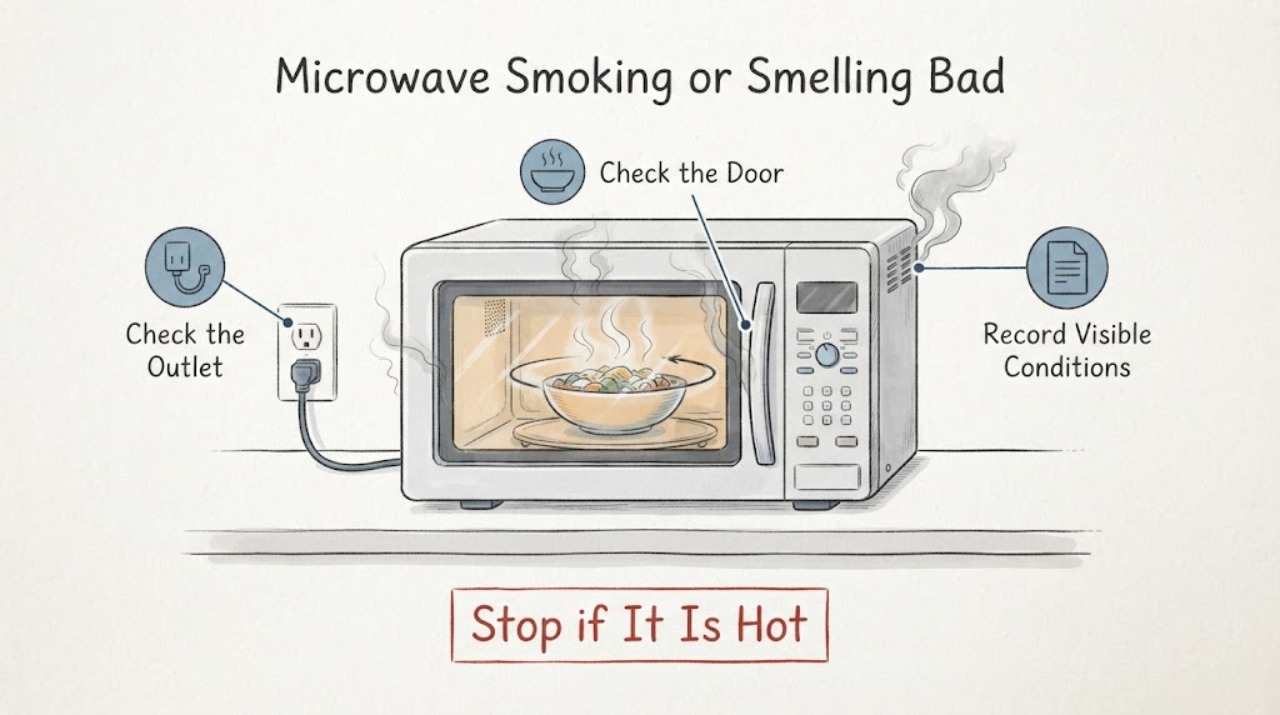
Stop the GE microwave immediately if smoke is active, the food or container is burning, you see sparks, or the odor is electrical or chemical. Keep the door closed if anything inside has ignited, turn the microwave off, and disconnect power only when that can be done safely. After it is cool and isolated, identify whether the event came from overcooked food or a metal/foil item, inspect the cavity for arcing, scorch marks, a hole or peeling coating, and confirm whether the unit was in a convection or combination mode. GE allows a small burning smell or a little smoke during the first few uses of convection bake, convection roast or combination fast cook, but persistent non-food burning odor, visible electrical damage, cavity damage or repeat smoke requires qualified service and no internal microwave repair.
Work through in order
Diagnostic checks
Use only checks that match the exact appliance or system and its official guide.
-
Check 1
Stop the microwave as soon as smoke, flames, sparks, or a strong non-food burning odor appears. Keep the door closed if anything inside has ignited; turn the microwave off and disconnect the plug or the controlling breaker only if it is safe to reach and the cord or outlet is not hot, wet or visibly damaged.
Expected result: The smoke or flame stops with the door closed and power off, or smoke, arcing, heat or an electrical/chemical odor continues or is visible around the plug, cord or outlet.
Next step: Leave the microwave isolated and arrange qualified microwave service. If there is an active fire or danger that cannot be controlled with the door closed, leave the area and use the appropriate emergency response; do not reopen the door to inspect it.
Why this matters
Why: GE treats an ignited load, arcing and non-food electrical or chemical burning odor as a reason to stop operation. These observations do not identify a replaceable internal part.
-
Check 2
After the microwave is fully cool and disconnected, remove only the food and cookware and inspect the cavity, turntable area and visible rack for metal or foil touching a wall, a twist-tie or metallic trim, heavy food residue, scorch marks, a hole, or coating that is peeling or flaking. Do not remove the cavity cover, door, or cabinet panels.
Expected result: A metal/foil item or burned food is visible with no cavity damage, or there is arcing evidence, a cavity hole, active peeling/flaking, or a burn-through mark.
Next step: If the cavity is damaged or arcing occurred, do not power the microwave again; arrange replacement or qualified service as applicable. If only food residue or an unsuitable item is found and there is no electrical odor or damage, clean the cool cavity with a non-abrasive method before considering any future use.
Why this matters
Why: GE identifies metal or foil, twist-ties and overcooked materials as causes of arcing or fire. GE says a cavity hole or actively peeling interior coating is non-repairable and requires discontinuing use; a normal-looking cavity does not prove the microwave is safe after electrical smoke.
-
Check 3
Write down the cooking mode and timing: ordinary microwave heating, convection bake, convection roast, combination fast cook, or an empty run. Note whether the smoke came from the food/container or from the appliance and whether this was one of the first uses of a convection or combination mode.
Expected result: A small amount of smoke occurred during the first few convection or combination uses, or smoke occurred during microwave-only heating, after several uses, or without a clear food source.
Next step: For the narrow first-use convection/combination case, follow the exact owner manual and stop if smoke is heavy or the smell persists. For microwave-only, repeated or unexplained smoke, keep the unit out of service and request qualified diagnosis.
Why this matters
Why: GE limits the potentially normal first-use smoke explanation to specified convection/combination modes and says service is recommended when that odor persists. Smoke during ordinary microwave heating or without a food source is not established as normal by that guidance.
-
Check 4
Check whether the event followed an empty run, a very small load, excessive cooking time, or a container that was sealed or had a metal handle or tie. Do not deliberately repeat an empty or questionable-load test; do not heat a sealed container to reproduce the symptom.
Expected result: The microwave was operated empty, food was visibly overcooked, or the container/packaging had a sealed opening or metal component; alternatively, none of those conditions is known.
Next step: If an empty run caused overheating or the microwave does not work properly after cooling, follow GE's service boundary rather than repeating the test. If the load was the only abnormal factor and the cavity is intact, discard damaged food and use only microwave-safe, vented containers in future; stop if smoke returns.
Why this matters
Why: GE warns that empty operation can damage the oven or create a fire possibility, and that overcooking, sealed containers and metal components can cause fire, pressure or arcing. These conditions explain a possible event but do not rule out appliance damage.
-
Check 5
With the appliance still off, check only the exterior door, visible hinges/latches, power cord and plug for bending, looseness, scorching or other damage. Confirm that the door closes normally without forcing it, but do not operate the microwave with the door open or bypass an interlock.
Expected result: The door, cord, plug or outlet is visibly damaged, the door does not close correctly, or the exterior appears normal.
Next step: Keep the microwave disconnected and arrange qualified service for any visible damage or any unexplained smoke. Do not remove the cover, test high-voltage parts, or attempt an interlock or leakage repair yourself.
Why this matters
Why: GE says not to operate a damaged microwave and not to defeat door safety interlocks. A normal exterior cannot exclude an internal high-voltage, control or leakage fault after smoking.
Use your observations
Decision map
Find the observation that best matches what you see, then follow the next safe action.
-
PATH 01Next step
What you see
There was a flame, continuing smoke, visible arcing, an electrical or chemical odor, or burning near the cord or outlet.
Do this next
Keep the door closed if a load ignited, isolate power only when safe, leave the unit off and arrange qualified microwave service or emergency help as appropriate.
Why this path and its safety boundary
Why it matters: This is a stop-use and service condition rather than a routine odor-cleaning problem; the official guidance does not identify a safe homeowner component diagnosis.
-
PATH 02Next step
What you see
The smoke was a small amount during the first few uses of convection bake, convection roast or combination fast cook, and there is no cavity, cord, plug or outlet damage.
Do this next
Stop and request service if the smell persists after multiple uses, becomes heavy, appears during microwave-only heating or is accompanied by arcing or visible damage.
Why this path and its safety boundary
Why it matters: GE describes a strong burning/oily smell or little smoke as potentially normal while a new convection heater is used for the first few times, but says the odor should dissipate with use.
-
PATH 03Next step
What you see
A metal/foil item, twist-tie, overcooked food or other clear load problem is found, and the cavity coating is intact with no continuing electrical odor.
Do this next
Clean the cool cavity with a non-abrasive method, discard damaged food, and use only appropriate microwave-safe containers. Stop permanently and seek service if smoke, arcing or odor returns.
Why this path and its safety boundary
Why it matters: The load can explain the smoke or arcing event, but the microwave has not been cleared for operation solely because the offending item was removed.
-
PATH 04Next step
What you see
The cavity has a hole, active peeling/flaking or burn-through, or arcing remains unexplained after the load is removed.
Do this next
Do not run another heating test. Arrange qualified service or replacement according to the condition and the model's support route.
Why this path and its safety boundary
Why it matters: GE says a hole or actively peeling cavity coating is non-repairable and requires discontinuing use; unexplained arcing can severely damage the interior.
-
PATH 05Next step
What you see
The microwave was run empty or now overheats, shuts down, or does not work properly after cooling.
Do this next
Do not repeat the empty test. Leave the microwave off and arrange service if it does not operate properly or if smoke/odor returns.
Why this path and its safety boundary
Why it matters: GE warns that empty operation can damage the oven or create a fire possibility; a cool-down/reset observation does not identify or repair internal damage.
Helpful context
Understand the symptom
Treat active smoke or a non-food burning smell as a safety event
A food spill or overcooked food can create an odor, but smoke from the cavity, sparking, an electrical or chemical smell, or visible burning near the plug needs a stop-use decision first. GE's safety instructions say to keep the door closed if material ignites and to turn the oven off and disconnect power or the breaker; GE's odor guidance says to stop the microwave and unplug it when visible burning is near the plug, cord or outlet. Do not open the cabinet or try to locate the high-voltage cause.
Separate a cooking mistake from cavity or appliance damage
Once the microwave is cool and power is isolated, record what was being heated and which mode was selected. GE lists metal or foil touching the cavity, twist-ties, metal utensils, overcooked food and empty operation as fire or arcing risks. A cavity hole, active peeling or paint flaking, or continuing arcing is not a cleaning problem: GE says to discontinue use and replace the microwave when those conditions are present.
A first-use convection smell has a narrow boundary
GE says a strong burning or oily smell, or a little smoke, can occur during the first few uses of convection bake, convection roast or combination fast cook because of the new convection heater. That does not explain smoke during ordinary microwave-only heating, visible arcing, cavity damage or a persistent electrical/chemical odor. If the smell does not dissipate after multiple uses, GE recommends service.
When checks do not resolve it
Need a professional?
Arrange qualified microwave service when smoke is unexplained or repeated, the odor is electrical or chemical, arcing occurred, the cavity coating is peeling or burned through, the cord/plug/outlet or door is damaged, the microwave was run empty and does not work properly afterward, or the smell does not dissipate after the narrow first-use convection/combination case.
Have this ready
- Give the technician the GE model number, selected cooking mode, food/container used, whether the microwave was empty, when the smoke or odor began, whether sparks or flames appeared, and any visible cavity, cord, plug or outlet damage. Do not open the cabinet or attempt high-voltage, interlock or leakage work.
Common questions
FAQ
Is a little smoke ever normal in a GE microwave?
GE says a strong burning or oily smell or a little smoke can occur during the first few uses of convection bake, convection roast or combination fast cook because of the new convection heater. That narrow explanation does not cover persistent smoke, microwave-only heating, visible arcing, cavity damage, or an electrical or chemical odor.
What should I do if the food catches fire?
Keep the microwave door closed, turn it off, and disconnect power or shut off the breaker only if it is safe. Opening the door can let the fire spread. If the fire cannot be controlled safely, leave the area and use emergency assistance.
Can I keep using the microwave after finding a scorch mark or peeling paint?
Do not keep using it if the cavity has a hole or the coating is actively peeling or flaking. GE says those conditions require discontinuing use, and it does not provide an approved repair method for cavity chips, burns or scratches.
Should I open the microwave and check the high-voltage parts?
No. GE's safety manual says the oven should be adjusted or repaired only by properly qualified service personnel. Keep the appliance isolated and provide the technician with the model and the smoke/odor timeline.
Read the exact guide
Official sources
- Microwave - OdorsGE Appliances · GE family-level guidance for new-microwave odors, first-use convection/combination smoke, food odors, electrical or chemical burning smell and service escalation.
- Microwave - Cavity Repair Needed Due to Arcing, Chipping, Peeling or ScorchingGE Appliances · GE family-level external cavity inspection and stop-use guidance for arcing, cavity holes and actively peeling or flaking interior coating.
- Microwave - Precaution (Operating Empty)GE Appliances · GE family-level guidance on avoiding empty operation, cooling after an accidental short empty run and seeking service when the microwave does not work properly.
- IMPORTANT SAFETY INFORMATIONGE Appliances · Opened GE microwave owner-safety manual for fire response, arcing causes, overcooking/metal precautions, door/interlock limits and qualified-service boundary; exact model is not assigned.
Community feedback
Share a repair observation
Share a plain-text repair observation. Accepted observations are published automatically; this page may take a moment to update.