
On this page
Start here
Quick answer
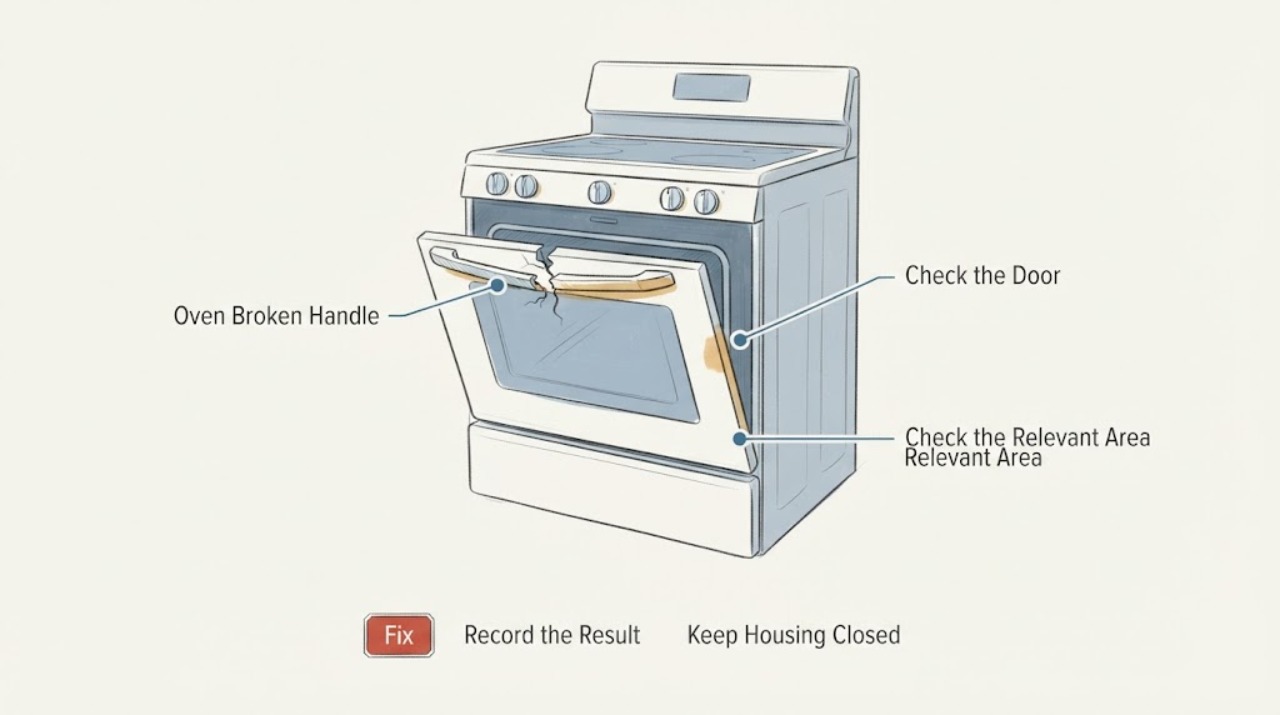
Stop using the GE oven door handle as a lifting or pulling point until the door is stable. GE says a loose or broken oven door handle requires door disassembly and recommends a service technician because door components may be sharp. Do not lift the door by its handle, let the door hang on a damaged handle, or assume a replacement handle fits without the complete model number. From a safe, cool position, check whether the door still sits squarely, closes and seals without forcing, and whether glass, hinges, latch or trim are damaged. Keep the oven off and arrange service if the door is unstable, will not close, exposes hot surfaces, or has damaged glass or hinges.
Work through in order
Diagnostic checks
Use only checks that match the exact appliance or system and its official guide.
-
Check 1
Turn the oven off and allow the door and handle to cool completely. Do not pull, lift, carry or hang the door from the broken handle; keep children away from the door and do not use the oven while the handle is loose enough to shift.
Expected result: The handle is loose, cracked, detached, sharp, hot to touch, or unable to support the door; the door may also be sagging or moving unexpectedly.
Next step: Keep the oven out of service and arrange GE or qualified appliance service. Do not test the handle by opening a hot oven or by tightening hidden fasteners without the model instructions.
Why this matters
Why: A damaged handle can no longer be treated as a reliable door control. GE says the handle repair requires door disassembly and warns that door components may be sharp; the door and nearby surfaces can also create burn and pinch hazards.
-
Check 2
After the oven is fully cool, inspect only the visible door condition from the outside: look for cracked or displaced glass, a crooked door, separated trim, exposed sharp edges, hinge movement, latch damage or a gasket that is out of position. Do not remove the door or use the handle as leverage.
Expected result: The handle is the only visible problem and the cool door remains square and supported, or the door/glass/hinge/latch/gasket is also damaged or unstable.
Next step: If the door is unstable, will not close, has damaged glass or exposes sharp parts, keep the oven off and arrange service without another use test. If the door appears stable, do not assume it is safe for cooking; continue only with model identification and service planning.
Why this matters
Why: A handle-only symptom still requires model-matched repair, while additional door damage changes the issue from a cosmetic handle problem to a door-safety and sealing concern. GE says damaged door windows should not be used and that major sealing problems need service.
-
Check 3
Find the complete GE model number from the rating label or owner documentation and use the matching owner manual/installation instructions to identify the door style and approved handle/door procedure. Do not order by appearance or assume a handle from another GE family fits.
Expected result: The model manual identifies a model-specific handle/door component, or the model cannot be confirmed and only a visually similar part is available.
Next step: Provide the model number to GE service or a qualified technician. Do not substitute a part or begin door disassembly on an unverified model.
Why this matters
Why: GE states that door removal and reseating can vary by model and recommends the owner manual. Without the model number, compatibility and safe fastener/door construction are unresolved.
-
Check 4
If a technician or model manual confirms that the door itself must be moved, follow the model-specific handling instructions and grasp the door at both sides rather than the handle. Do not remove a door with a damaged or unsupported hinge, and do not place a removed door on its handle.
Expected result: The exact instructions support a safe door-handling step, or the door is heavy, unstable, hinge-damaged or cannot be supported at both sides.
Next step: If the door cannot be safely supported or the manual does not clearly cover the model, stop and leave removal to service. Do not improvise with the handle, a pry tool or a second unverified procedure.
Why this matters
Why: GE's general removal guidance says door designs differ, the door can be very heavy, and newer models must not be lifted by the handle. An unsupported or hinge-damaged door can fall or pinch.
-
Check 5
Arrange service rather than continuing operation if the door does not close and seal normally, the handle pulls away from the door, glass or hinge parts are damaged, heat escapes abnormally, or the repair would require door disassembly or panel access. Give the technician the complete model number and visible damage description.
Expected result: The door remains stable and intact but the handle is broken, or any additional instability, glass damage, sharp edge, poor seal or hot-air/scorching symptom is present.
Next step: Keep the oven off until repaired and verified by qualified service. Do not use the door for support, cook with the door ajar, bypass a latch, or replace hidden door parts without model-matched instructions.
Why this matters
Why: GE explicitly recommends a technician for a loose or broken handle because the door must be disassembled and components may be sharp. A damaged or poorly sealing door adds burn and heat-containment risk.
Use your observations
Decision map
Find the observation that best matches what you see, then follow the next safe action.
-
PATH 01Next step
What you see
The oven is cool, the handle is loose or broken, but the door remains square, supported and visibly intact.
Do this next
Keep the oven off and arrange GE or qualified service, providing the complete model number. Do not lift or force the door by the handle.
Why this path and its safety boundary
Why it matters: The handle still requires a model-matched door repair; the apparently intact door does not make a universal DIY replacement procedure safe.
-
PATH 02Next step
What you see
The door sags, shifts, will not close or seal, has hinge/latch damage, or cannot be supported without the broken handle.
Do this next
Do not operate the oven. Keep clear of the door and arrange qualified service; do not attempt to align hinges or force the latch.
Why this path and its safety boundary
Why it matters: This is a door-safety and heat-containment problem, not merely a cosmetic handle issue.
-
PATH 03Next step
What you see
The door glass is cracked or broken, exposed sharp parts are present, or trim/hinge components are visibly damaged.
Do this next
Stop using the oven and arrange service. Do not clean by reaching into the damaged door or attempt to tape, glue or clamp the handle/glass.
Why this path and its safety boundary
Why it matters: GE says a broken or cracked oven-door window creates a safety issue and should not be used; sharp door components also make handle repair hazardous.
-
PATH 04Next step
What you see
The model number cannot be confirmed, or a proposed handle/door procedure comes from a different GE family.
Do this next
Pause parts ordering and door disassembly. Obtain the complete model number and use GE's matching manual or service technician.
Why this path and its safety boundary
Why it matters: Compatibility and door construction are unresolved; visual similarity is not evidence of a safe fit.
Helpful context
Understand the symptom
Treat the handle as a safety issue
A door handle carries pulling force and may be close to hot surfaces. Do not use a loose, cracked or detached handle to lift, carry or force the oven door. GE says the repair requires door disassembly and that door parts may be sharp, so a broken handle is not a simple universal screw-tightening job.
Check the whole door before service
With the oven off and fully cool, look without removing trim or panels at the handle mounts, door alignment, glass, hinges, latch and gasket. A handle can be the only visible damage, or the door may also be crooked, unable to close, or unable to maintain a safe seal. Do not force the door or continue operating it to see whether the handle holds.
Use the exact model for parts and door work
GE publishes different door-removal and reseating methods, and its support material says the owner manual or installation instructions are the best source for the specific model. Record the complete model number before ordering any handle, screw, bracket, glass or door component. Do not substitute a visually similar handle or use a generic repair procedure.
When checks do not resolve it
Need a professional?
Arrange GE or qualified appliance service for any loose, cracked or detached oven handle because GE says repair requires door disassembly and door components may be sharp., Stop using the oven for an unstable door, cracked/broken glass, damaged hinges or latch, exposed sharp edges, a door that will not close/seal, or abnormal scorching/heat escape., Do not lift the door by its handle, force the latch, glue or clamp the handle, order a visually similar part, or remove the door without model-matched instructions and safe support.
Have this ready
- complete GE range or wall-oven model number
- whether the handle is loose, cracked, detached or sharp
- whether the door remains square, supported and able to close/seal
- visible glass, hinge, latch, trim or gasket damage
- whether the oven was recently moved, installed or exposed to heat damage
Common questions
FAQ
Can I keep using a GE oven with a broken handle?
Do not use the broken handle to operate or support the door. GE says a loose or broken handle requires door disassembly and recommends a service technician; stop completely if the door is unstable, glass is damaged or it cannot close and seal normally.
Can I lift a GE oven door by the handle?
No. GE's door guidance says not to lift the door by the handle. If a model-specific door procedure is required, the door is handled from both sides and may be heavy; leave it to service when the handle or hinges are damaged.
Can I order a replacement GE oven handle by appearance?
No. Record the complete model number and use the matching manual or GE service route. GE says door-removal details vary by model, and visual similarity does not establish safe compatibility.
What if the oven door glass is also cracked?
Do not use the oven. GE says a cracked or broken oven-door window creates a safety issue and recommends repair service; do not tape, clamp or disassemble the damaged door yourself.
Read the exact guide
Official sources
- Range & Wall Oven - Oven Gasket Not Sealing ProperlyGE Appliances · Official GE Appliances support page used for visible door alignment, gasket, heat-escape and service boundaries; it does not identify a handle repair part.
- Range & Wall Oven - Lift Off Oven DoorGE Appliances · Official GE Appliances overview used only to establish that door removal and parts vary by model and that the manual is authoritative.
- Range & Wall Oven - Operation of Oven If Door Window Is Broken or CrackedGE Appliances · Official GE Appliances safety page; used only for the stop-use boundary when door glass is broken or cracked.
- Range & Wall Oven - Removing or Reseating Oven DoorGE Appliances · Official GE Appliances support page; door designs and procedures vary by model, and damaged handles/hinges should not be used as lifting points.
- Range & Wall Oven - Oven Handle Loose or BrokenGE Appliances · Official GE Appliances support page for range and wall-oven handles; it supports the door-disassembly and sharp-component service boundary, not a model-independent replacement procedure.
Community feedback
Share a repair observation
Share a plain-text repair observation. Accepted observations are published automatically; this page may take a moment to update.